
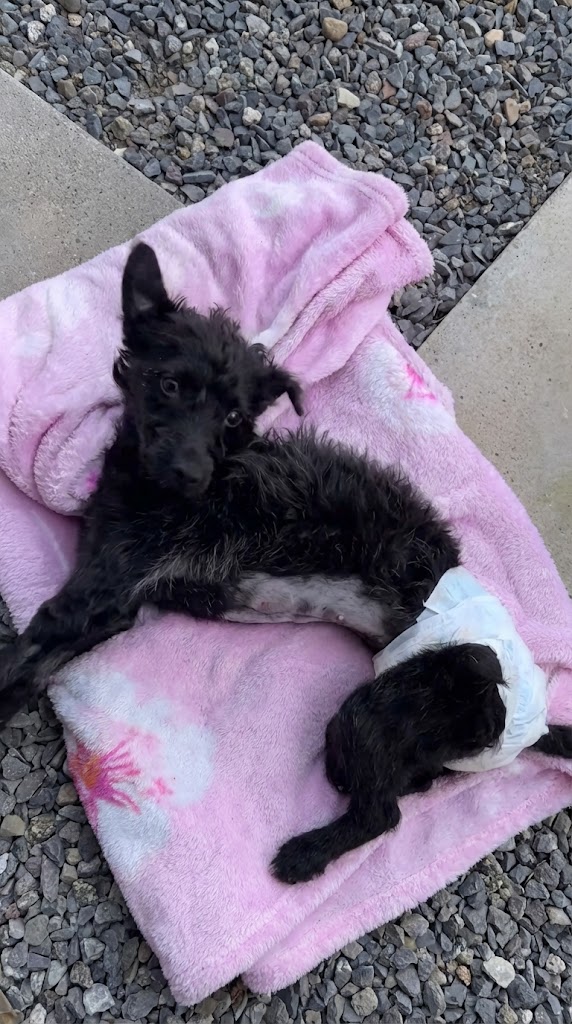
Aurora could move her eyes. She could gently lick. But the rest of her little body would not respond.
For a puppy so young, the world should have been full of movement and discovery. Instead, Aurora was found alone on the streets, crying out while lying completely unable to move.
There were no obvious injuries to explain what had happened.
No visible signs of trauma.
Only a helpless puppy whose body seemed to have stopped cooperating with her.
Yet even in that frightening condition, Aurora showed small signs of awareness that would become important throughout her journey.
She could still see the people around her. She could respond in limited ways. And, remarkably, she could still feel when someone touched her.
Those details gave her rescuers something to hold on to, even as the medical questions surrounding her condition became increasingly complicated.
Aurora's story would not become one of sudden, extraordinary transformation.
Her progress would come slowly.
And for the people caring for her, learning to recognize those tiny changes would become part of what made her journey so meaningful.
A Little Puppy Whose Body Would Not Respond
When Aurora was discovered, her condition was deeply concerning.
She was lying on the street, unable to lift herself or move away from her surroundings. Her cries made it clear that something was terribly wrong, but the cause was not immediately apparent.
Paralysis can be frightening to witness in any animal. In a young puppy, the contrast between what should be possible and what the body can actually do feels especially difficult.
Aurora could not stand.
She could not walk.
She could not reposition herself normally.
Everything that depended on voluntary movement was beyond her ability at that moment.
But her eyes remained active, and she could still make small movements with her mouth.
There was another detail that complicated the situation: despite her inability to move, she appeared to retain sensation when touched.
That distinction mattered.
Her condition did not fit an obvious explanation based on the visible evidence. Without external injuries to guide them, the people trying to help her faced an uncertain medical picture.
They could see how seriously Aurora was affected.
What they could not yet understand was why.
The first responsibility was to make sure she received the care she could not provide for herself.
For a puppy unable to control her own body, even the simplest daily needs required assistance.
Food, cleanliness, physical comfort, and human attention all became essential parts of her survival.
Aurora had been found in a situation where she could do almost nothing for herself.
Now, she had people willing to do those things for her.
Searching for Answers When None Came Easily
Aurora's early medical journey was filled with uncertainty.
Specialists examined her, hoping to identify the reason for her paralysis. But the answers the rescue team needed remained elusive.
Her unusual combination of symptoms made understanding the problem especially challenging.
She could feel touch.
She could move her eyes.
She could lick.
Yet her body remained otherwise unresponsive.
As the examinations continued, the question was no longer simply how to help Aurora move again.
It was whether meaningful recovery would ever be possible.
Some specialists believed her condition was too severe and recommended ending her suffering.
For those caring for Aurora, that possibility was painful to consider.
They understood that keeping an animal alive was not the same as ensuring a good quality of life. Comfort, freedom from suffering, and the ability to experience positive moments all mattered.
But they also saw signs that Aurora could still enjoy parts of her life.
She responded to attention.
She enjoyed treats.
And she continued to show awareness of the people helping her.
Those observations did not guarantee that treatment would succeed. They did, however, give her caregivers reasons to continue seeking an explanation before making an irreversible decision.
Day after day, they attended to her needs.
They cleaned her carefully, helped her eat, and provided the comfort she could not seek out independently.
Their work was repetitive and demanding.
There was no easy shortcut.
Aurora's condition required patience long before anyone knew whether recovery was possible.
And eventually, another medical opinion offered a new direction.
A neurologist located some distance away considered an explanation that shifted attention away from Aurora's spine.
He suspected that the underlying problem might involve a rare neurological condition affecting the brain.
This was not yet a simple answer.
But it introduced a possible path toward treatment.
For the first time, the rescue team had a reason to consider an operation that might address the source of Aurora's paralysis.
The possibility came with serious risks.
Still, it represented something they had been searching for from the beginning.
A chance.
VIDEO: Found Unable to Move, Aurora's Fight for a Second Chance Began With Hope
A Difficult Choice for a Puppy Who Still Enjoyed Life
Deciding whether Aurora should undergo surgery was far from straightforward.
Her caregivers had already heard discouraging medical opinions. They knew the proposed procedure would be delicate, and they had no guarantee that her body would regain movement afterward.
A successful operation would not necessarily mean an immediate recovery.
There were many uncertainties still ahead.
Yet Aurora continued to offer small reminders that her life contained more than her medical condition.
One of the most touching was her enjoyment of food.
Even while unable to move normally, she could accept treats and take pleasure in them.
It was an ordinary puppy experience occurring under extraordinary circumstances.
To her rescuers, that mattered.
Aurora was not simply a medical case defined by paralysis. She was a living animal who could still respond to kindness and experience moments of comfort.
The rescue team chose to pursue the surgical opportunity.
It was a decision based on the hope that the suspected underlying problem could be treated and that Aurora might eventually recover some of the movement she had lost.
Nothing about the choice was certain.
But doing nothing would have left the underlying problem unresolved.
The Operation That Opened a New Possibility
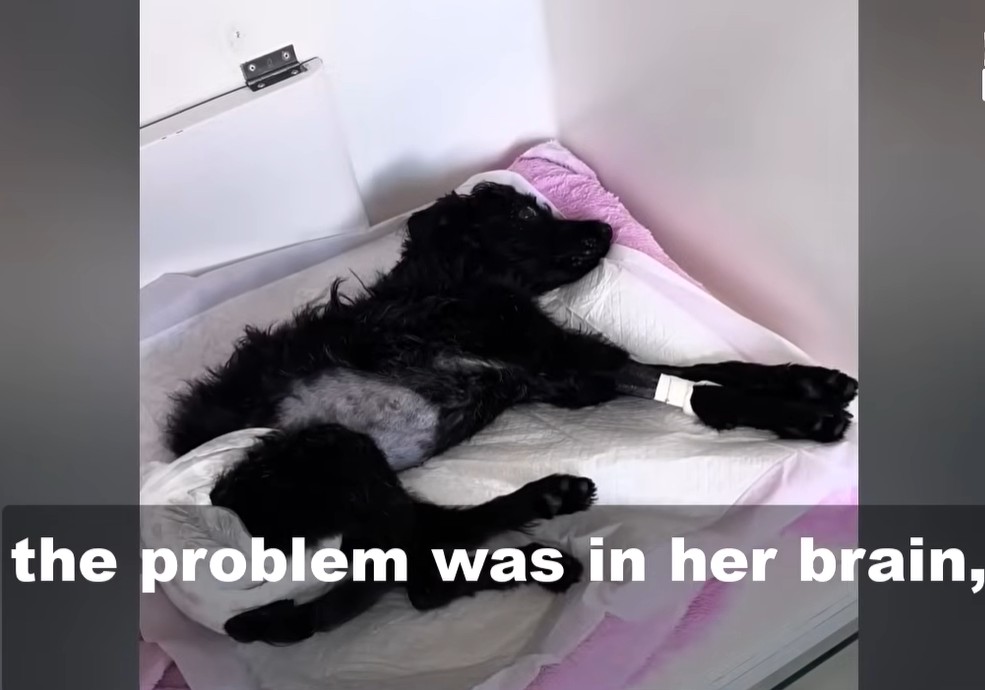
Aurora underwent the delicate neurological surgery.
For the people who had spent so much time looking after her, the procedure represented a turning point in an already difficult journey.
They had watched her struggle with a body that would not respond.
They had searched for explanations.
They had continued caring for her when the outlook seemed discouraging.
Now, the possibility of improvement depended on a medical intervention whose outcome remained uncertain.
The waiting was difficult.
Eventually, the surgeon emerged with encouraging news.
The operation had been successful.
The problem identified as the source of Aurora's suffering had been addressed.
It was an important achievement, but it did not settle every question.
Aurora had spent a significant part of her young life unable to move. Even after surgery, her body would need time and careful support.
No one could simply assume that she would stand up and begin walking.
The medical team and her caregivers still needed to observe how she responded.
Would she move her neck?
Would her legs begin to show activity?
Would she become more comfortable?
Would she eventually be able to do things that had seemed impossible when she was first rescued?
Those answers would emerge gradually, if they emerged at all.
For now, the operation had given Aurora an opportunity she might otherwise never have had.
And her caregivers were determined to support her through the next stage.
Learning to Recognize the Smallest Signs of Healing
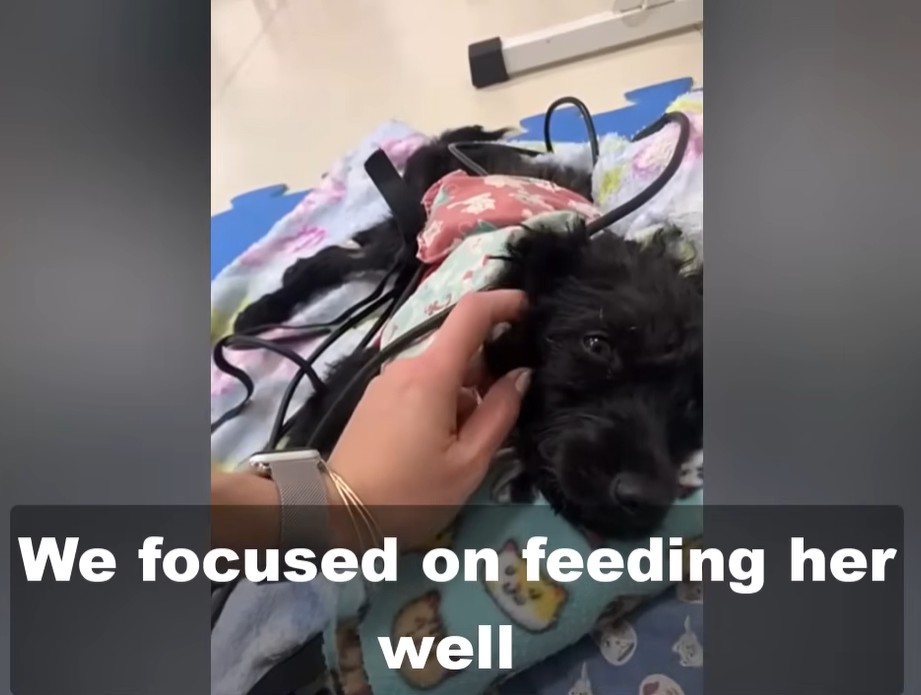
After surgery, Aurora's recovery became a careful daily process.
She needed gentle rehabilitation, assistance with movement, appropriate nutrition, and constant attention to her comfort.
Her body could not be expected to recover simply because the medical procedure had gone well.
The work of rehabilitation was different from the urgency of rescue or surgery.
It required repetition.
It required observation.
And above all, it required patience.
Aurora's caregivers continued to help her with the basic needs that had been part of her routine since she was rescued.
But now, they were also watching for changes that might indicate her nervous system and muscles were beginning to respond.
At first, those changes were extremely subtle.
They were not the dramatic movements that people sometimes imagine when hearing about an animal recovering from paralysis.
They were small enough that someone unfamiliar with Aurora's condition might have overlooked them entirely.
Then came one especially meaningful development.
Aurora began moving her neck.
Slowly, she could turn her head toward familiar voices.
For a healthy puppy, turning toward a sound would be an ordinary action. For Aurora, it represented a level of physical control she had previously lacked.
There was something deeply moving about seeing her respond to the people who had stayed beside her throughout her treatment.
Her world was beginning to include movement again.
Not much.
Not quickly.
But enough to recognize that something had changed.
Her caregivers also noticed faint movements in her legs.
These were tiny responses, far removed from the coordinated movements necessary for walking.
Still, they were signs worth paying attention to.
Aurora's recovery was unfolding in increments rather than dramatic leaps.
Each small improvement had to be understood for what it was, without assuming that the next milestone would necessarily follow.
A little more movement did not guarantee full mobility.
But it showed that the work of treatment and rehabilitation had not been without encouraging results.
The Most Important Change Was Not Her Ability to Walk
As the team continued supporting Aurora, another development brought reassurance.
She was no longer experiencing the pain that had been part of her earlier condition.
This improvement was meaningful in its own right.
Before anyone could know whether Aurora would eventually walk, there was the more immediate question of whether she could live comfortably.
Pain relief changed that picture.
Aurora could rest without the same suffering.
She could enjoy her food.
She could experience gentle care and familiar human attention while her physical recovery continued.
For an animal whose early circumstances had been so uncertain, these were significant improvements in quality of life.
It would have been easy to measure Aurora's progress only by asking whether she could stand.
But that would have overlooked much of what had changed.
She had gone from lying helplessly on the street to receiving sustained medical attention and rehabilitation.
She had undergone an operation that successfully addressed the identified problem.
She had regained some control over her neck and shown slight activity in her legs.
And she had become more comfortable.
None of those achievements required her to run or jump to have value.
A Recovery That Cannot Be Rushed
Aurora's condition remained serious.
Although her progress was encouraging, the available account did not establish that she had regained the ability to stand or walk independently.
Her recovery was still a work in progress.
That uncertainty is an important part of her story.
It would be easier to describe a complete transformation, with Aurora suddenly racing around like any other puppy.
But that was not the journey her rescuers had witnessed.
Instead, they were seeing a slower kind of improvement.
A head turning toward a familiar voice.
A slight movement in a leg.
A puppy becoming more comfortable after a period of profound physical helplessness.
Those moments did not erase the challenges still ahead.
Aurora continued to need care, rehabilitation, and close attention.
Her caregivers could celebrate improvement while remaining realistic about the future.
That balance mattered.
Hope did not require them to ignore her limitations.
And acknowledging those limitations did not mean dismissing the progress she had already made.
The smallest changes were worth recognizing precisely because they had once seemed so difficult to achieve.
For Aurora, healing was not a single event.
It was an ongoing process made possible by medical care, daily assistance, and the willingness of people to remain involved even when results came slowly.
The Quiet Strength Behind Aurora's Second Chance
Aurora's story began with a frightening image: a young puppy alone on the street, crying because she could not move.
There was no obvious injury to explain what had happened.
No immediate answer.
And no certainty that treatment could restore her mobility.
The people who helped her faced difficult medical decisions. They heard discouraging opinions, considered the limits of treatment, and eventually chose a risky operation after receiving a new neurological assessment.
The procedure succeeded.
Then came the slower work.
Exercises.
Careful feeding.
Physical support.
And the patient observation of movements that were easy to miss.
Today, within the recovery described, Aurora's story is not one of complete physical restoration.
It is one of meaningful progress.
She has begun turning her neck. Her legs have shown small signs of movement. She can enjoy food and familiar attention, and she is no longer experiencing the pain that once troubled her.
These improvements do not tell us exactly what her future mobility will look like.
But they tell us something important about the value of the care she received.
Aurora was given the opportunity to be more than a puppy whose condition seemed hopeless.
She was treated as an individual whose comfort, experiences, and potential for improvement mattered.
And in return, her gradual progress gave her caregivers reasons to continue.
There is no need to make her recovery sound bigger than it is.
The truth is meaningful enough.
A puppy who once could not move can now turn her head toward the people caring for her.
A body that appeared completely unresponsive has begun showing limited movement.
And an animal whose future was once deeply uncertain has been given time, treatment, and ongoing support.
Aurora still has challenges ahead.
She may need considerable rehabilitation, and the full extent of her recovery remains unknown.
But she is no longer facing those challenges alone.
Her journey reminds us that compassion is not measured only by dramatic rescues or perfect endings.
Sometimes it is found in the willingness to provide care day after day, even when improvement is slow and the future remains uncertain.
Aurora has not yet reached every milestone her caregivers might hope for.
But she has already reached several that once seemed beyond her grasp.
And for this little puppy, each new movement is another reason to keep believing that her life holds possibilities worth protecting.


