
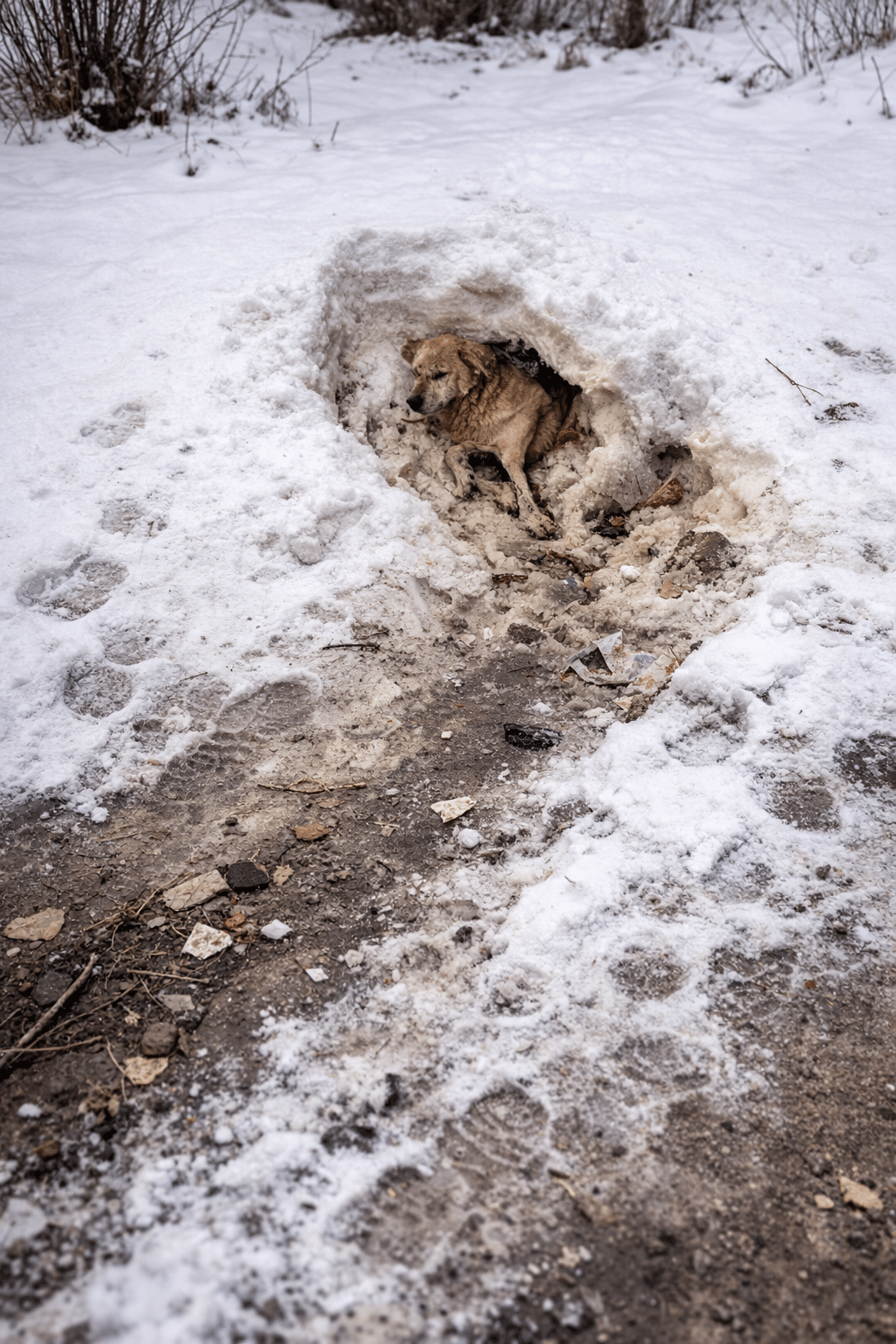
For several days, Mishka had been trapped inside a frozen snow pit.
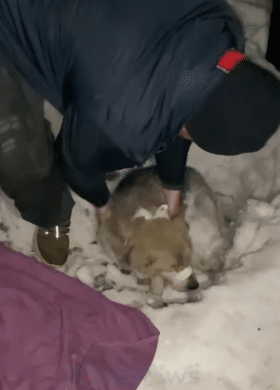
By the time help reached him, his body was stiff from the cold and he could no longer stand on his own. At first, the danger seemed obvious: after so much time exposed to freezing conditions, rescuers feared the cold had taken a severe toll.
But once Mishka was lifted from the snow and examined, the situation became far more complicated.
The problem was not only what the cold had done to him.
His body had already been badly injured.
What the X-Rays Revealed
Veterinary examinations showed that Mishka's pelvic bones were shattered.
There was another discovery as well.
Multiple lead bullets were still lodged inside his body, including one dangerously close to his spine.
Suddenly, his inability to stand made painful sense.
Mishka was dealing with serious injuries while also recovering from days spent immobilized in freezing conditions. His veterinary team had to decide how aggressively they could treat him without creating additional risk.
Pelvic surgery was considered too dangerous.
Instead, the team chose a more cautious approach: control his pain, monitor him closely, and begin carefully supervised physical rehabilitation before prolonged immobility weakened his muscles even further.
There were no guarantees.
For the first days, Mishka remained under constant observation while receiving the care he needed simply to become stable enough for the next step.
Then, around Day 10, rehabilitation began to take a more active form.
With the help of a wheelchair and supportive harness, Mishka started assisted mobility training.
His legs could not yet carry him normally.
But he was moving.
And for a dog who had been unable to rise from the snow, movement itself was a beginning.
Small Signs That His Body Was Fighting Back
Recovery did not follow a smooth path.
There were difficult days and moments when progress seemed almost impossible to measure. Mishka still needed significant support, and no one could know how much function he would ultimately regain.
Yet between Days 16 and 38, subtle changes began to appear.
His behavior became more engaged.
He responded more to the people caring for him. He became increasingly affectionate and seemed more present in his surroundings.
Then came an especially important physical milestone.
Mishka was able to relieve himself without assistance.
It may have seemed like a small event compared with walking or running, but in his condition it offered an encouraging sign that nerve function was returning.
For his caregivers, recovery could now be measured in moments like these.
Not dramatic leaps.
Just one small function returning, followed by another.
Mishka was eventually transferred to the Yuna Veterinary Center, where specialists could continue his rehabilitation with a structured program designed around his limited mobility.
He practiced outside in the snow.
He worked indoors with mobility equipment.
He learned how to move using wheels while his muscles slowly rebuilt the strength they had lost.
VIDEO: Trapped in Frozen Snow and Unable to Stand — Watch Mishka Begin His Long Road Back
Water Gave Him a Safer Way to Move
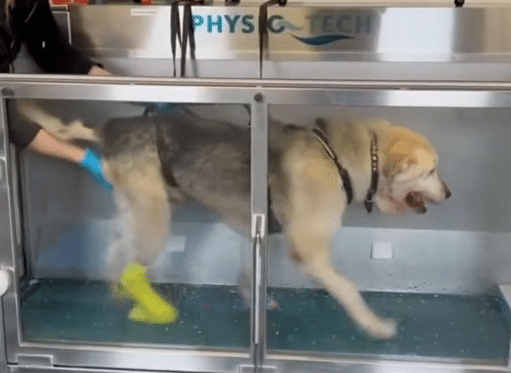
As Mishka's rehabilitation continued, hydrotherapy became one of the most important parts of his routine.
An underwater treadmill allowed him to practice the motion of walking while the water supported part of his weight.
That support mattered.
His damaged pelvis still needed protection, yet his muscles also needed movement if he was ever going to become stronger.
In the water, those two needs could be balanced more carefully.
Each session was closely supervised.
The progress was gradual.
A few controlled movements became repeated steps. Repeated steps helped rebuild strength. With time, Mishka's body began responding to the work.
By Day 72, his movement had become noticeably steadier.
Still, the wheelchair and other forms of support had been such a large part of his recovery that one question remained:
Would Mishka ever be able to walk independently again?
The answer did not come quickly.
It arrived on Day 110.
That day, Mishka walked across grass using his own legs.
Slowly.
Carefully.
Without the wheels that had helped carry him through the earlier stages of recovery.
There was nothing effortless about those first independent steps.
They represented months of repeated therapy, cautious movement, pain management, and patience.
For Mishka, the distance itself mattered far less than what those steps proved.
His body was learning how to support him again.
Recovery Continued Long After the First Steps
Walking on grass was a major turning point, but it was not the end of Mishka's rehabilitation.
His progress continued over the months that followed.
Between Days 130 and 360, the changes became easier to see.
The dog who had once been unable to move in a frozen pit gradually became more energetic and curious about the world around him.
He entered foster care, where recovery was supported by something simpler but equally important: consistency.
Daily routine.
Steady attention.
A safe environment in which his body could continue growing stronger.
As time passed, his coat became fuller.
His muscles developed.
His confidence returned alongside his physical strength.
The transformation was gradual enough that no single day could explain it.
There was no instant recovery.
Instead, one improvement built on another until the difference between the dog found in the snow and the dog months later became remarkable.
Nearly One Year Later, Mishka Ran
By Day 360, almost an entire year had passed since Mishka's rescue.
The journey that began with a dog unable to stand reached a moment that would once have seemed impossible.
Mishka ran.
He moved across open snowfields alongside other dogs, using the legs that had once been too injured to support him.
The winter landscape was still there.
But Mishka was no longer trapped inside it.
One important reminder of his past remained.
The bullet located near his spine was still inside his body.
His recovery had not erased everything that happened to him.
It had simply changed what those injuries were able to take from his future.
Mishka could move again.
He could explore.
He could run.
A Recovery Built One Day at a Time
It would be easy to describe Mishka's story as a miracle.
But his journey shows something more grounded and perhaps even more meaningful.
He recovered through repetition.
Through carefully managed pain relief.
Through mobility support.
Through physical therapy.
Through water-based rehabilitation.
And through hundreds of days in which progress sometimes meant nothing more dramatic than trying again.
His veterinary and rehabilitation teams could not promise what the final outcome would be when they first began.
They could only give him the safest opportunity possible to improve.
Mishka did the rest one step at a time.
From a frozen pit where he could not rise, to a wheelchair, to supported rehabilitation, to his first careful steps on grass, and finally to running across the snow, his 360-day journey was built from countless small victories.
Some recoveries are measured in hours.
Others take weeks.
Mishka's took almost a year.
What mattered was that the people caring for him continued giving his body the time and support it needed.
And eventually, the dog who once could not stand was moving forward on his own.


