
Some rescue stories begin with a bark, a movement, or a desperate attempt to be noticed.
Galileo's began almost in silence.
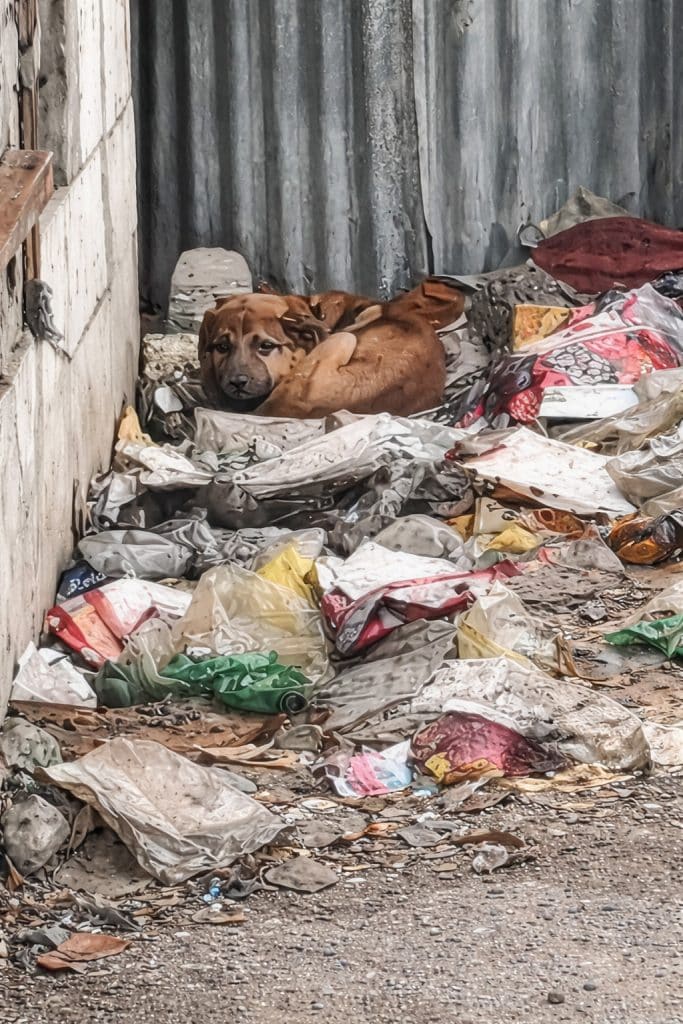
He was lying among piles of discarded debris in a landfill, curled tightly into himself and so still that he could easily have been mistaken for something abandoned with everything around him.
But he was alive.
His breathing was difficult, his body was exhausted, and he appeared to have almost nothing left to give.
What saved him was that someone looked closely enough to realize he was still holding on.
The Dog Hidden Among the Debris
There was little about the landfill that suggested a living animal might be waiting there for help.
Yet among the waste was Galileo.
As rescuers approached him, the seriousness of his condition became clearer. His head was badly swollen, and something around his neck was creating dangerous pressure.
A thick rubber band had tightened around him.
Over time, it had become embedded into the injured skin around his neck and was restricting the area badly enough that every breath appeared difficult.
Galileo did not have the energy to resist the people moving toward him.
He barely reacted.
His body remained quiet while rescuers carefully examined what had happened.
The full story of how the rubber band ended up around his neck was unknown, but one thing was obvious: it could not remain there any longer.
Getting Galileo away from the landfill was only the first step.
He needed medical attention.
From the Landfill to Immediate Care
Rescuers lifted Galileo carefully and transported him to a clinic.
There was no dramatic struggle.
No burst of energy.
He was simply too weak.
His eyes still moved, but the rest of him seemed exhausted by the effort of surviving.
At the clinic, attention turned immediately to the object around his neck.
Removing it required care because it had already caused significant injury to the surrounding tissue. The team worked slowly, avoiding unnecessary pressure while freeing Galileo from what had been restricting him.
For the first time, the source of that constant pressure was finally gone.
It did not erase the damage that had already happened.
But it stopped the situation from becoming worse.
That moment marked an important change in Galileo's story.
Until then, nearly all of his strength had been spent simply enduring.
Now, treatment could begin.
VIDEO: Found Struggling to Breathe in a Landfill — The Moment Galileo Was Finally Freed
The First Days of Healing
Once the rubber band had been removed, the extent of Galileo's injuries could be addressed.
According to the source, surgery followed as the medical team repaired the damaged area and closed the wounds. He also received medication, fluids, and continued care while his body began the slow process of recovery.
There was no instant transformation.
Healing came quietly.
The swelling gradually started to decrease.
His breathing became easier.
For a dog who had been struggling for air, that change alone represented something enormous.
He no longer had the same constant pressure around his neck.
He could rest without fighting through every breath.

During those early days, Galileo spent much of his time resting.
He ate small amounts.
He allowed the people caring for him to handle him gently.
There was no need to rush him into becoming energetic or playful.
His body had already been through enough.
The goal was simply to give him the conditions he needed to recover.
Food.
Rest.
Medical attention.
Safety.
And time.
Recovery often looks ordinary from the outside.
A dog sleeps.
A bowl is placed nearby.
Medication is given.
Another quiet day passes.
But for Galileo, those ordinary moments represented something he had not had in the landfill: stability.
Nothing was tightening around his neck anymore.
Nobody was asking him to survive alone.
The Small Moment That Meant Everything
Physical healing could be measured in swelling, stitches, breathing, and appetite.
Another kind of recovery was harder to measure.
It appeared in small changes.
Galileo's expression began to soften.
He became more responsive to the people around him.
Then came one of those moments that might seem insignificant in another dog's life.
He lifted his head.
Just a little higher than before.
Later, he managed to stand.
He was not suddenly strong.
He was not completely healed.
But he was trying.
That mattered.
Every attempt showed that the dog found almost motionless among landfill debris was beginning to reconnect with the world around him.
The distance between surviving and living can sometimes be measured in very small movements.
A raised head.
A steadier breath.
An interest in food.
A willingness to stand.
For Galileo, each one was progress.
When Curiosity Returned
As the weeks passed, the changes became easier to see.
His appetite improved.
His strength returned gradually.
His tail, once still, began to move again.
He also started paying attention to other dogs.
At first, he watched them carefully.
Then curiosity began replacing hesitation.
Eventually, that curiosity became playfulness.
It was a different version of Galileo from the one rescuers had found.
The landfill had revealed him at his weakest.
Recovery began revealing who he could become when pain was no longer controlling every moment of his day.
He could move without the same struggle.
He could breathe comfortably.
He could respond to other animals.
He could begin enjoying ordinary experiences rather than using every bit of energy simply to stay alive.
There was nothing dramatic about those steps.
That was part of what made them so meaningful.
A normal life was becoming possible.
A Permanent Home After Recovery
Galileo's journey did not end when his medical condition improved.
Recovery had given him another chance.
He still needed a place where that chance could continue.
That was when Adelka entered the next part of his story.
She chose Galileo and gave him a permanent home.
The change was more than a new location.
For a dog whose story had once centered on survival in a landfill, home meant consistency.
Care would not disappear when treatment ended.
Safety would not be temporary.
He could simply live.
There was no longer a need for every day to revolve around wounds, medication, or whether he had enough strength to stand.
Those difficult chapters had become part of his past.
Now there was room for something much simpler.
Movement.
Companionship.
Routine.
Play.
The ordinary experiences that healthy dogs are meant to have.
From a Landfill to Open Space
The contrast between Galileo's beginning and the life described later in the source is striking.
He was once found hidden among waste, struggling for air with severe swelling around his head and neck.
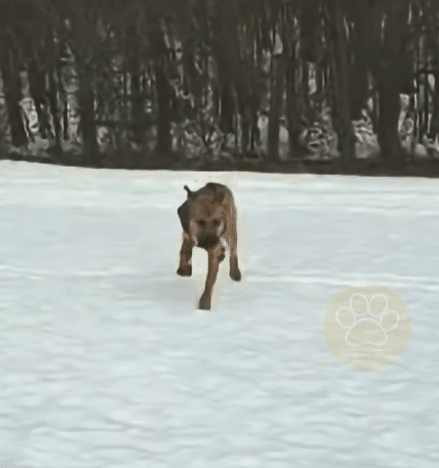
Today, he can run.
He moves through open snow with an energy that would have been almost impossible to imagine during those first moments of rescue.
His head is no longer swollen.
His breathing is easy.
His body can move freely.
The difference did not happen in one dramatic instant.
It came through a chain of decisions.
Someone noticed him.
Someone stopped.
Someone carried him away from the landfill.
A medical team removed what was hurting him and treated the damage.
Care continued long enough for his strength to return.
And finally, someone chose to give him a home.
None of those steps could replace the one before it.
Together, they changed what Galileo's future could look like.
The Quiet Power of Being Noticed
It is easy to remember the final image of a rescued dog running freely.
It is harder to forget where that freedom started.
For Galileo, it began in a place where he could easily have remained unseen.
He was quiet.
Weak.
Almost hidden by the surroundings.
Yet someone noticed that the shape among the debris was breathing.
That moment was enough to begin everything that followed.
Rescue did not instantly remove his injuries.
Surgery did not instantly restore his strength.
Recovery did not happen in a single day.
But once Galileo was no longer alone, every small improvement had the chance to build on the one before it.
A little less swelling.
An easier breath.
A small meal.
A lifted head.
A first attempt to stand.
A moving tail.
Curiosity.
Play.
And eventually, a home.
His story is not powerful because suffering disappeared overnight.
It is powerful because care continued long enough for something better to replace it.
Galileo once had to struggle for something as basic as breathing.
Now he can run without that burden.
For a dog found almost invisible in a landfill, that simple freedom may be the clearest sign of how much one rescue can change.


