
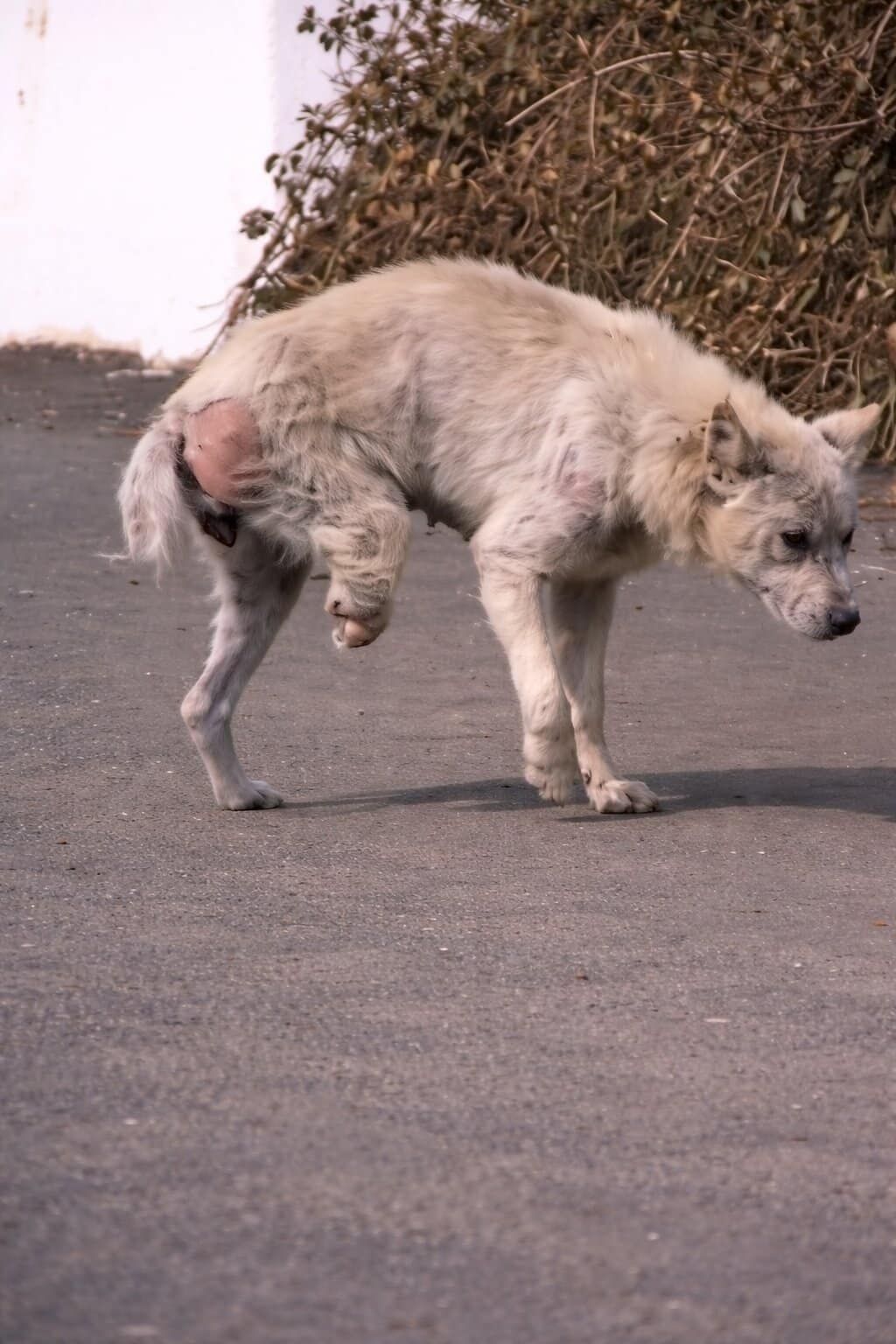
For years, Jang-soon moved through a construction area scattered with scrap metal and debris, relying on instinct to make it through each day.
Even from a distance, it was clear that life had not been gentle with him.
His coat had become patchy. His skin showed signs of irritation, and small injuries were visible across parts of his body. But one problem stood out more than anything else: one of his hind legs was badly deformed.
The leg was swollen and bent at an unnatural angle.
Still, Jang-soon kept walking.
Slowly.
Carefully.
Day after day.
Years of Surviving With an Injury No One Had Treated
No one knew exactly what had happened to Jang-soon before he began living around the construction site.
What people could see was the result.
His damaged hind leg made every movement difficult, yet he continued wandering through the rough surroundings in search of food and somewhere to rest.
There was little comfort in a place filled with discarded materials and construction debris. For a dog already dealing with skin problems and a serious leg injury, even ordinary movement appeared exhausting.
Yet Jang-soon adapted because he had no other choice.
He learned the area.
He learned where food might appear.
And most of all, he learned to keep his distance from people.
Human contact frightened him so much that even those who wanted to help could not simply walk up and touch him.
But one person refused to stop caring.
The Grandmother Who Kept Showing Up
An elderly woman living nearby had watched Jang-soon from a distance for nearly four years.
She gave him the name Jang-soon because he reminded her of a beloved dog she had once had and lost.
That connection stayed with her.
Although Jang-soon remained cautious and would not allow her to handle him, she continued bringing food.
Not once.
Not occasionally.
She kept coming back.
Sometimes her efforts went beyond simply filling his stomach.
She prepared food especially for him, including grilled samgyeopsal, or Korean pork belly. When medicine was needed for his skin condition, she carefully hid it inside the meat so he could receive some treatment without having to overcome his fear of being touched.
Her care was simple and quiet.
She could not repair his damaged leg herself.
She could not persuade him to suddenly trust people.
But she could make sure he had something to eat.
And for years, that was how she stayed beside him.
When Rescuers Realized They Could Not Simply Walk Up to Him
Eventually, Jang-soon’s condition came to the attention of the rescue team from Kritter Klub.
When rescuers arrived, they did not rush toward him.
They watched.
Jang-soon’s fear of people was immediately obvious. A direct approach could have caused him to panic and run, putting even more strain on the hind leg that was already badly damaged.
The team needed another way.
They decided that using a large net would allow them to secure him as safely as possible and prevent a desperate escape attempt.
For a dog who had spent years avoiding human contact, the moment was frightening.
For the grandmother watching nearby, it carried another emotion entirely.
She had spent nearly four years making sure Jang-soon was not completely alone. Now she was watching strangers take him away—not because they wanted him gone, but because they could finally give him the medical help she had never been able to provide.
The source describes her standing nearby with tears in her eyes.
There was sadness in seeing him leave.
But there was relief, too.
At last, someone might be able to understand what had happened to his leg.
VIDEO: After Years of Limping Through a Scrap Yard, Jang-soon Was Finally Taken to Safety
The X-Rays Revealed How Long He Had Been Hurting
At the veterinary clinic, Jang-soon received a full examination.
Doctors focused closely on the hind leg that had affected the way he walked for so long.
X-rays provided the clearest answer yet.
The bones had suffered severe fractures sometime in the past, most likely following an accident or another significant trauma. Because the injury had gone untreated for a long period, it had not healed normally.
The damage had become much more serious over time.
According to the veterinary findings described in the source, infection had developed and some surrounding tissue had started to deteriorate.
At that point, simply leaving the leg as it was was no longer a reasonable option.
Veterinarians determined that surgery was necessary.
For Jang-soon, this meant facing something unfamiliar again: people handling him, medical care, and an environment far removed from the construction site where he had learned to survive.
But this time, every unfamiliar step was moving him toward relief.
Surgery Meant Losing Part of the Leg — And Leaving Years of Pain Behind
During surgery, the veterinary team removed the badly damaged bone and cleaned the affected areas to prevent the infection from continuing to spread.
It was a major intervention.
Jang-soon would not leave the clinic exactly as he had arrived.
He had lost part of the injured leg.
But the leg that had caused him so much difficulty for years was no longer being left untreated.
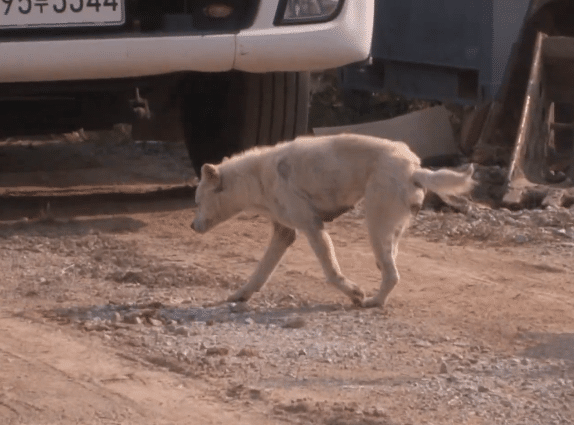
There is something especially difficult about imagining how long he had adapted to that condition.
Before his rescue, the injury had simply become part of his daily life.
He still searched for food.
He still moved through the construction site.
He still avoided people.
From the outside, survival continued.
But survival and comfort are not the same thing.
For years, Jang-soon had carried an injury that needed professional treatment.
Now, for the first time, that treatment had finally happened.
Recovery Brought Something He Had Not Known for Years
After surgery, Jang-soon entered the next stage of his journey.
Healing would take time.
His body had been through years of strain, and adjusting after losing part of a hind leg would not happen instantly.
But one major burden had changed.
He was no longer living with the same untreated injury and constant discomfort that had shaped his life at the construction site.
He could rest in a place where his condition was being monitored.
He could receive proper care.
And slowly, another change began to appear.
Jang-soon had always been deeply cautious around people.
That fear did not disappear the moment he was rescued.
Trust rarely works that way.
Instead, the changes came gradually.
The dog who once refused human contact began showing small signs that he was becoming more comfortable around the people caring for him.
For an animal who had spent years keeping everyone at a distance, those small changes mattered.
Physical healing was only one part of his recovery.
Learning that human hands could bring care rather than something to fear was another.
Four Years of Kindness Had Already Started the Rescue
It would be easy to think that Jang-soon’s story began when the rescue team arrived.
In reality, someone had already been helping him for years.
The grandmother could not perform surgery.
She could not diagnose his injury.
She could not force a frightened stray into accepting help.
So she worked within the limits Jang-soon gave her.
She brought food.
She found ways to give him medicine.
She kept watching.
And she kept returning.
That kind of care does not always look dramatic.
Sometimes rescue begins long before an animal ever reaches a clinic.
Sometimes it begins with one person deciding that a frightened stray is still worth noticing, even when progress is slow.
Her patience helped Jang-soon survive until more specialized help could finally reach him.
A Different Kind of Life Was Finally Possible
Jang-soon still had a recovery journey ahead after surgery.
His experience did not erase the years he had spent struggling through the construction site, nor did it immediately remove his fear of people.
But the hardest part of his old life had changed.
He was no longer roaming through scrap and debris with a severely damaged leg that had never received the treatment it needed.
He had been examined.
He had undergone surgery.
He had people watching over his recovery.
And the distance he once kept between himself and humans was slowly beginning to shrink.
Jang-soon’s story is not about one dramatic moment changing everything at once.
It is about persistence.
A grandmother who continued feeding a dog that would not let her come close.
Rescuers who understood that fear required patience.
Veterinarians who finally addressed an injury that had been left untreated for years.
And a stray dog who kept moving forward until help finally caught up with him.
For nearly four years, compassion had been waiting quietly beside him.
Eventually, it opened the door to something more than survival.
It gave Jang-soon the chance to heal.


