
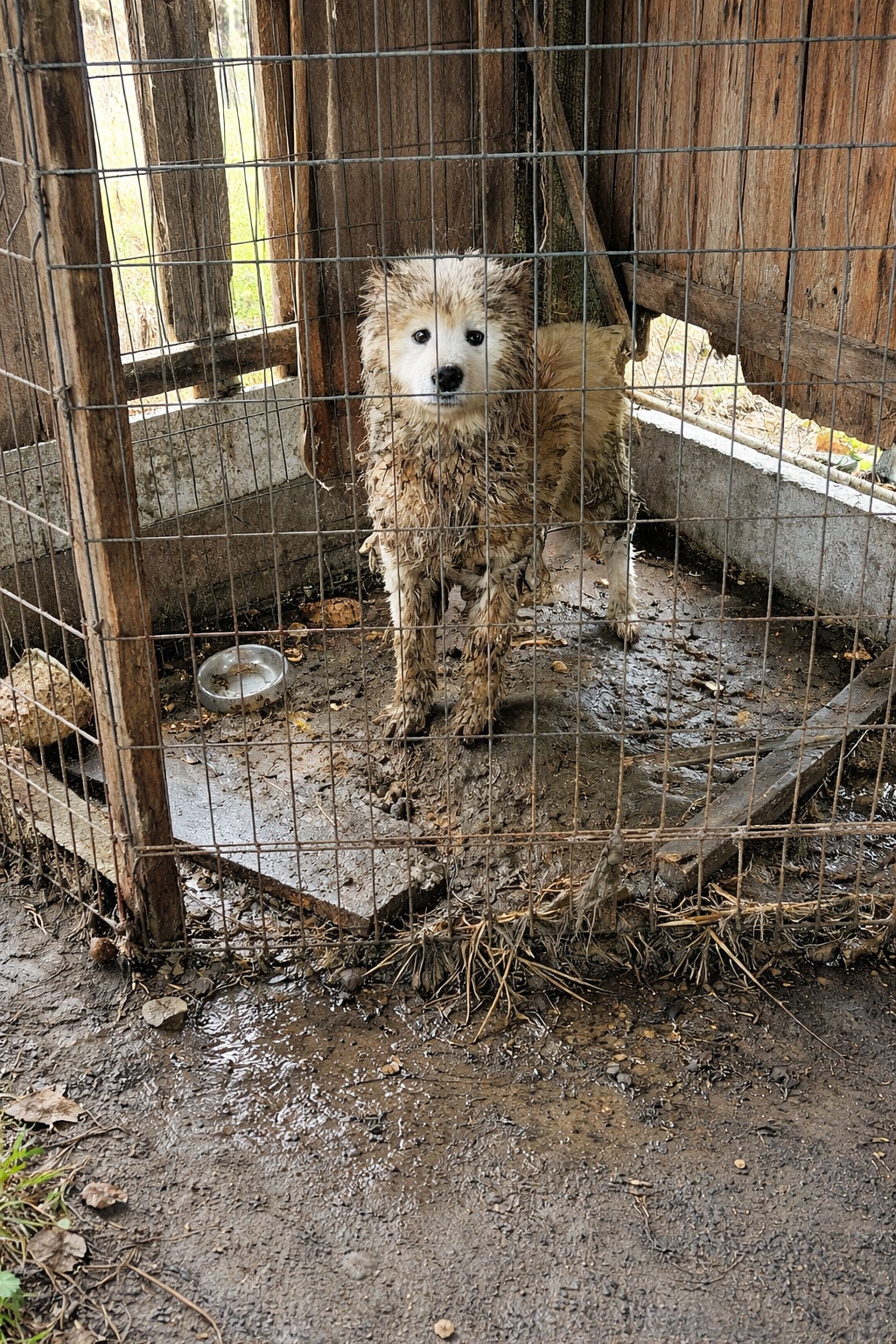
For nearly three years, Shinju's world ended at a set of metal bars.
She had been bought as a puppy, but instead of growing up with space to explore and a safe place to rest, she spent most of her early life confined inside a cage measuring only about two square meters.
There was no room to run.
No soft bed waited for her.
The floor had become dirty with waste, and even something as basic as clean water was not always available.
Day after day, Shinju remained in that same small space, eating when food appeared, sleeping when exhaustion came, and watching life continue beyond the bars.
A Life Reduced to a Few Square Meters
By the time rescuers discovered Shinju, the cage was not simply where she stayed.
It was almost everything she knew.
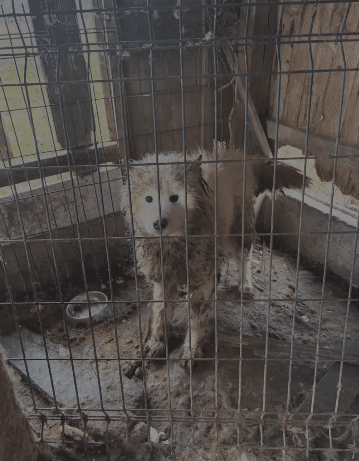
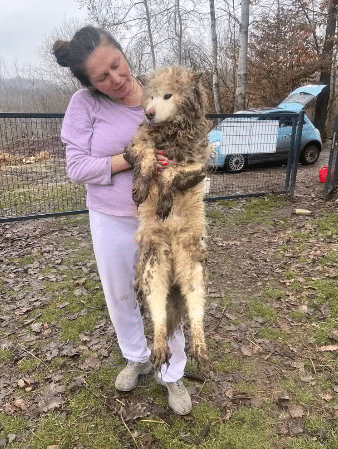
Her coat had become heavily soiled and tangled after years of poor conditions. Beneath all that fur, her body had grown thin and fragile.
For experienced rescuers, difficult cases were not unfamiliar. Yet seeing Shinju living in such a confined space was still deeply upsetting.
The natural response might have been to open the cage immediately and carry her away.
But the situation was more complicated.
When the rescuers first came to the property, Shinju's owner was not there. Removing her without permission could have created legal problems and made it harder to secure her safety permanently.
So they had to leave.
But leaving that day did not mean abandoning her.
They Kept Coming Back
The rescuers returned again.
Then they returned the next day.
And they continued coming back.
Through the bars, they brought Shinju food and spoke to her gently. Those visits could not instantly change the place where she lived, but they gave her something she had been missing for a long time: consistent attention.
At the same time, the rescuers tried to persuade the owner to surrender Shinju voluntarily.
There was no dramatic shortcut.
There was patience.
There were repeated visits.
And there was a refusal to simply forget the dog behind the cage door.
Eventually, that persistence made a difference.
The owner agreed to let Shinju go.
After nearly three years, the door that had defined her life was finally opened.
The First Thing She Needed Was Water
Shinju stepped out slowly.
For the first time in years, there were no bars immediately surrounding her body.
The rescuers knew she needed veterinary attention and cleaning, but before they could move on to anything else, one need became impossible to ignore.
Shinju was desperately thirsty.
They placed fresh water in front of her.
She lowered her head and began drinking.
She did not stop after a few quick laps.
She kept going, swallowing water rapidly without lifting her head, as though she had been waiting far too long for the chance to drink freely.
It was a simple scene.
But it revealed just how much something ordinary could mean to a dog coming out of long-term neglect.
VIDEO: After Three Years Behind Bars, Shinju Finally Stepped Into Freedom
Her coat still carried the evidence of where she had lived. Dirt and waste had become trapped in fur that was badly tangled and matted.
Her body looked weighed down by it.
But now, for the first time, there were people beside her who could begin doing something about it.
Beneath the Matted Fur Was a Fragile Dog
Once Shinju was safely in care, attention turned to cleaning her.
A normal bath was not enough.
The mats in her coat had become so severe that washing alone could not remove them. The tangled fur clung tightly to her body, making shaving the safest practical option.
So the rescuers carefully removed it.
As the heavy coat disappeared, Shinju's condition became easier to see.
She was extremely thin.
Her body looked delicate after years spent in poor surroundings, without the kind of care that should have been part of her life from the beginning.
Yet removing the filthy, matted fur also marked a quiet transition.
The cage was behind her.
The weight of that neglected coat was gone.
Now the work was about helping her become stronger.
There was no instant transformation.
Recovery would come through ordinary things repeated consistently: proper meals, veterinary attention, cleanliness, space, and patient care.
For a dog whose world had been so limited, even those basics represented something completely new.
Discovering What an Open World Felt Like
As time passed, Shinju began experiencing things that had once been unavailable to her.
She could walk across grass.
She could move without reaching the edge of a cage after only a few steps.
She could spend time around other dogs.
She could explore.
One of the most striking moments came when she began playing with a bright red ball.
It was such a normal sight that, without knowing her past, someone might have seen only a dog enjoying a toy.
But Shinju had spent almost three years unable to live like that.
Every open stretch of ground was new.
Every opportunity to move freely was different from the confined routine she had known.
Her world was no longer measured by metal bars.
There were warm meals and people who approached her gently.
There was veterinary care when she needed it.
And perhaps most importantly, there was time to adjust.
Nothing required her to understand freedom all at once.
She could learn it gradually.
Small Changes Began to Add Up
Shinju's physical strength slowly improved.
So did the way she interacted with the world around her.
The dog who had once stayed in the same cramped corner could now move through open spaces with growing confidence.
Her eyes became brighter.
Her movements became more energetic.
She began enjoying sunshine, companionship, play, and the simple freedom to choose where she wanted to stand or rest.
For dogs recovering from long periods of neglect, change is often most meaningful in small moments.
A willingness to explore.
A relaxed body.
An interest in a toy.
The ability to rest without being surrounded by dirt and confinement.
In Shinju's case, those moments gradually formed a very different picture from the one rescuers had first encountered.
She was no longer simply enduring each day inside a cage.
She was participating in life around her.
A Life No Longer Defined by Bars
Toward the end of the rescue footage, Shinju appears beside one of the people who helped her.
The rescuer gently kisses the top of her head.
Shinju looks relaxed and content.
There is nothing dramatic about the moment, and perhaps that is what makes it so meaningful.
For years, her life had been defined by confinement, isolation, and limited care.
Now she could experience affection without a cage between herself and the person offering it.
Her story did not change because of one grand gesture.
It changed because people returned when it would have been easier to walk away.
They kept bringing food.
They kept trying to reach an agreement with the owner.
They kept showing up until the day Shinju could finally leave.
And after that door opened, they stayed long enough to help her discover what came next.
Grass beneath her paws.
Fresh water.
A clean body.
A ball to chase.
Other dogs nearby.
A gentle hand resting on her head.
For Shinju, freedom was not one single moment.
It was a collection of ordinary experiences that had once been missing from her life.
After almost three years in a tiny cage, she finally had the space to learn what those ordinary things felt like.
And with patience, care, and people who refused to forget her, that small world behind the bars was replaced by something much larger: a life with room to move, to heal, and simply to be a dog.


