
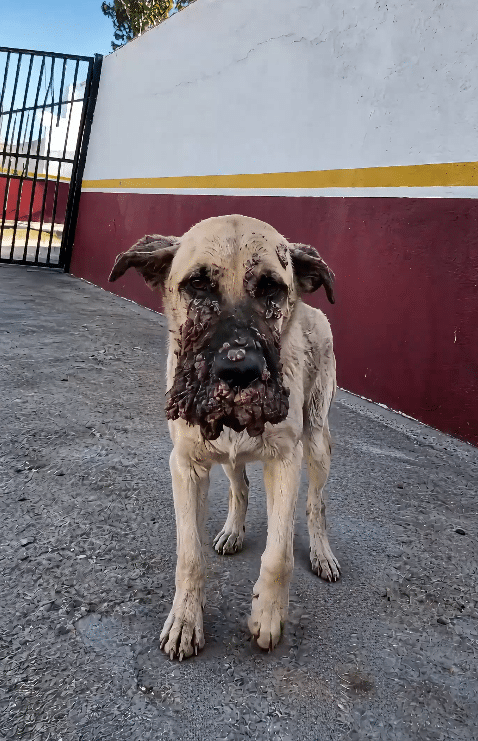
Outside a kindergarten, a lonely dog lay quietly as people continued with their daily routines.
Parents arrived with their children. Teachers came and went. Footsteps passed nearby, but almost nobody wanted to approach the animal resting there.
His face looked different from that of any ordinary stray.
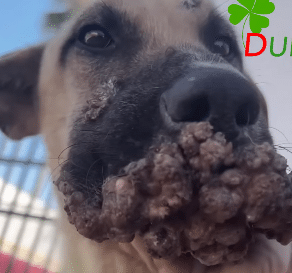
Large, unusual growths covered much of his muzzle and lips. An unpleasant smell came from his infected mouth, and his thin body suggested that finding enough food had become a serious struggle.
Some people avoided him because of the smell. Others were frightened by his appearance. According to the account of his rescue, some even laughed.
Yet beneath that frightening appearance was a dog who would soon surprise the people trying to save him.
They would give him a name.
Hercules.
And although his condition was serious, the next 45 days would reveal just how much could change when a struggling animal finally received the attention he needed.
The Dog Nobody Wanted to Approach
Hercules had been living outside the kindergarten when animal rescuers discovered him.
By then, his physical condition had deteriorated considerably.
The growths around his mouth were not simply unusual to look at. They interfered with one of the most basic things a dog needs to survive: eating.
Chewing had become difficult and painful.
For a stray already struggling to find food, that problem carried serious consequences. Hercules was dangerously thin, with little strength left to spare.
Even the appearance of his mouth made it difficult to understand exactly what he was suffering from.
To the people passing him, his condition may have seemed too overwhelming to confront.
But looking away did nothing to lessen his discomfort.
And Hercules remained there, facing the same daily struggle.
There was no way to know exactly how long he had been living with those growths or what his earlier life had been like. His history before the rescue was largely unknown.
What rescuers could see, however, was enough to understand that he urgently needed help.
His body was weak.
His mouth was severely affected.
And without proper care, even something as ordinary as a meal had become a challenge.
One Gentle Tail Wag Changed Everything
When the rescuers approached Hercules, they had reason to be cautious.
A dog experiencing significant pain may react unpredictably, particularly when unfamiliar people come close.
The rescue team moved toward him slowly.
They did not know whether he would retreat, become frightened, or resist their attempts to help.
Instead, Hercules offered a small, unexpected response.
He wagged his tail.
There was no dramatic struggle. No aggressive reaction. Just a gentle movement from a dog whose appearance had caused so many others to keep their distance.
That moment revealed something important.
His illness had changed the way people looked at him, but it had not taken away his ability to respond warmly to human attention.
The rescuers could finally see the gentle animal behind the swollen muzzle.
For Hercules, this encounter marked the end of being overlooked and the beginning of something very different.
He was taken to a veterinary clinic, where his medical needs could finally be assessed.
But reaching the clinic was only the first step.
His condition would require far more than a single examination or a few days of rest.
The people caring for him were about to discover how complicated his recovery could be.
The Diagnosis Behind His Unusual Appearance
At the veterinary clinic, the examination revealed several serious concerns.
Hercules was dehydrated and severely underweight. Parasites were also affecting his already weakened body.
Most concerning was the condition of his mouth.
The growths had become extensive, and the surrounding infection made eating especially uncomfortable.
Then the veterinary team discovered another problem.
A piece of plastic bag was lodged inside his mouth.
The source account suggests that Hercules may have picked up discarded material while searching desperately for food, although the exact circumstances were unknown.
The discovery highlighted just how difficult his life as a stray had become.
After examining him, veterinarians identified an advanced case of canine oral papillomavirus.
The condition had caused numerous wart-like growths around and inside his mouth, severely interfering with his ability to chew.
This was not a cosmetic problem.
It affected his nutrition, comfort, and overall health.
The veterinary team expected that more than one surgical procedure might eventually be necessary, alongside other medical care.
Recovery would take time.
And there was no guarantee that progress would happen quickly.
VIDEO: Hercules Was Left Alone Because of His Face — Watch How His Rescue and Recovery Began
The First Days Were About Keeping Him Alive
During the first week, the priority was not transforming Hercules' appearance.
It was stabilizing his health.
Veterinarians administered intravenous fluids to address his dehydration and provided medication to help control the infection.
His mouth was carefully cleaned, while pain relief and nutritional support became essential parts of his treatment.
These interventions were important because Hercules needed nourishment to regain strength, yet eating remained one of the hardest things for him to do.
A meal that would have been simple for a healthy dog required patience and effort.
Each attempt to chew could cause discomfort.
Still, Hercules continued trying.
He worked through his meals slowly, accepting the food and care offered to him even when the process was difficult.
There was another complication.
Because canine oral papillomavirus can spread between dogs, Hercules needed to be kept apart from other animals while undergoing treatment.
Isolation helped protect other dogs, but it also meant that his recovery environment was necessarily limited.
He could not simply join other animals for companionship or play.
For the time being, his world centered on medical attention, carefully managed meals, and the people looking after him.
His condition was serious enough that even small signs of stability mattered.
A little more nourishment.
A little less discomfort.
Another day of treatment completed.
None of these moments looked like a dramatic transformation.
Yet together, they formed the foundation of his recovery.
Trust Returned Through Ordinary Acts of Care
Physical healing was only one part of Hercules' journey.
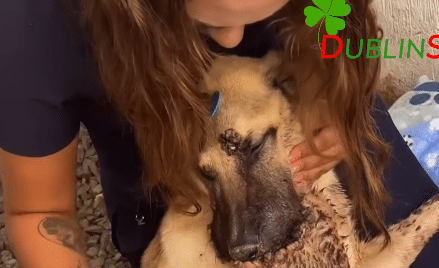
He also began responding differently to the people around him.
As the days passed, the veterinary team noticed encouraging changes.
His eyes appeared brighter.
His tail moved more frequently.
And he began recognizing the people who returned to care for him each day.
These were quiet developments, but they mattered.
Before his rescue, Hercules had spent his days in a place where many people seemed unable or unwilling to come close.
Now, he was receiving consistent attention.
There were meals prepared with his condition in mind. Gentle handling during treatment. Familiar human faces appearing again and again.
The difference was not simply that people were nearby.
They were actively trying to make him more comfortable.
Hercules' growing responsiveness suggested that he was becoming more at ease with his new surroundings.
He did not need to understand the medical procedures to benefit from the patience behind them.
He only needed the chance to experience care without being rejected because of his appearance.
That change became increasingly visible as his strength slowly returned.
His recovery was still uncertain, and his mouth remained affected by the disease.
But the dog who had once been lying alone outside the kindergarten was beginning to show more of his gentle personality.
The Second Week Brought the First Real Hope
By days 11 through 14, Hercules was making encouraging progress.
His weight began increasing.
His discomfort became easier for the veterinary team to manage.
And his treatment plan expanded to include immune-support therapy and a specially prepared autogenous vaccine intended to assist his body's response to the virus.
The improvement did not mean the condition had disappeared.
Hercules still needed monitoring and continued separation from other dogs.
However, he had recovered enough strength to begin taking short walks outside.
For a dog who had been so severely weakened when he was found, that was a meaningful development.
Walking required energy that his body had previously struggled to maintain.
Each outing gave him an opportunity to move beyond the confined space of his treatment area, even though precautions remained necessary.
Gradually, his muscles grew stronger.
He appeared more confident.
And the people caring for him could see that their efforts were beginning to produce results.
The difference was not yet measured by a completely healthy face.
It was reflected in the small things Hercules could do again.
Standing with greater strength.
Moving more comfortably.
Showing interest in the world around him.
His condition remained serious, but the direction of his recovery was becoming more hopeful.
Progress Came With Setbacks
The weeks that followed were not easy.
Hercules had arrived at the clinic with multiple health problems, and his weakened condition complicated the process of recovery.
Although treatment was helping, progress was not always consistent.
Some days brought visible improvement.
Other days raised new concerns.
The veterinary team remained cautious about the possibility that the viral growths could continue causing problems.
This uncertainty was an important part of his story.
Recovery from a difficult medical condition does not necessarily happen in a smooth sequence of daily improvements.
An animal may regain strength while still requiring treatment for the original illness.
That was the situation Hercules faced.
His appetite and energy were improving, but his medical needs had not disappeared.
The people caring for him continued their work, adjusting their attention to his changing condition and monitoring the response to treatment.
For Hercules, the challenge was simply to keep recovering, one day at a time.
The same patience that had helped him survive the first week remained essential.
And eventually, another encouraging milestone arrived.
Day 25: A Reason to Believe He Was Getting Better
Approximately 25 days after his rescue, Hercules underwent follow-up testing.
The results brought welcome news.
Tests for several serious infectious diseases that had initially concerned the veterinary team came back negative.
Combined with his improving condition, the findings gave his caregivers greater confidence about the progress he was making.
His body appeared to be responding to treatment.
The medications and ongoing care were helping him move toward better health.
This was a significant development for a dog whose condition had been so worrying at the beginning.
But there was still an important distinction between improvement and complete recovery.
Hercules had made it through a dangerous early period.
He was stronger and more stable than when he arrived.
Yet the papillomavirus continued to require attention.
His progress was something to celebrate without overlooking the care he would still need.
And one of the most meaningful changes was yet to come.
By Day 45, Even Eating Had Become Different
For most dogs, finishing a meal is an ordinary part of the day.
For Hercules, it had once been a painful challenge.
The growths around his mouth had made chewing difficult, leaving him struggling to obtain the nourishment his body desperately needed.
During the later weeks of treatment, however, that began to change.
Hercules became able to eat much more comfortably.
He no longer showed the same obvious difficulty with every bite.
His appetite improved, and his growing strength reflected the benefits of consistent food and medical care.
By approximately day 45, he had gained nearly two kilograms.
For a dog who had been dangerously underweight when he was rescued, that increase represented meaningful progress.
His appearance had also changed as his overall condition improved.
The animal who once seemed overwhelmed by illness was now visibly healthier and more energetic.
Yet his journey had not reached its final chapter.
A small number of papillomas began appearing again around the outside of his mouth.
Their return meant that continued treatment and specialist monitoring were still necessary.
His caregivers could not simply assume the illness was gone.
The most responsible next step was to keep observing his condition and supporting his recovery.
Even with that uncertainty, the difference between the beginning and day 45 was remarkable.
Hercules had gone from struggling to chew and suffering from severe weakness to eating comfortably and regaining much-needed weight.
He had made progress that once seemed difficult to imagine.
And it had happened because the people treating him continued providing care even when recovery became complicated.
What Hercules' Transformation Really Means
It would be easy to look at Hercules' story and focus only on the physical difference.
The extensive growths around his mouth were the first thing many people noticed when he was lying outside the kindergarten.
They shaped the way strangers reacted to him.
Some stayed away because they were uncomfortable. Others were afraid to approach.
But his appearance never told the whole story.
The gentle tail wag he offered when rescuers first approached revealed a different side of Hercules.
He was capable of trust and affection even while experiencing serious physical discomfort.
That simple response helped make his rescue especially memorable.
The following weeks showed why sustained care matters as much as the initial decision to help.
Rescue brought Hercules to safety.
Veterinary treatment addressed his immediate medical problems.
Patient feeding helped rebuild his strength.
And continued human attention gave him the opportunity to become more comfortable with the people around him.
No single moment accomplished everything.
It took many days of small, consistent efforts.
It also required accepting that improvement would sometimes be followed by uncertainty.
Even at day 45, the return of some growths showed that Hercules needed further care.
His story should not be mistaken for an account of a dog whose every medical problem had already been resolved.
Instead, it is the story of a dog whose life became significantly better because people recognized that his condition deserved treatment, not avoidance.
A Gentle Dog Who Deserved to Be Seen
The most lasting image of Hercules may not be the way his face looked before treatment or how much healthier he appeared weeks later.
It may be that first small movement of his tail.
A dog who had been passed by so many people still responded gently when someone finally approached.
That moment did not erase his illness.
It did not make recovery easy.
But it allowed the rescuers to see the individual behind the frightening medical condition.
Over the next 45 days, Hercules received treatment, gained weight, regained strength, and began eating without the severe difficulty that had once shaped his days.
His condition still required medical attention, but he was no longer facing it alone.
There is something deeply meaningful about that distinction.
Not every rescue story ends with a complete recovery or a confirmed adoption into a permanent home.
Sometimes the most important outcome is that an animal who was suffering has finally been given a genuine opportunity to heal.
For Hercules, that opportunity began outside a kindergarten, when someone chose to approach instead of turning away.
His story leaves a simple reminder.
A dog's appearance may reveal that something is wrong, but it cannot tell us how much gentleness, trust, or life remains within.
Hercules did not need everyone to understand his condition.
He needed people willing to help him through it.
And because those people stayed, the dog who had once struggled through every meal was given a chance to live with greater comfort, strength, and hope.


