
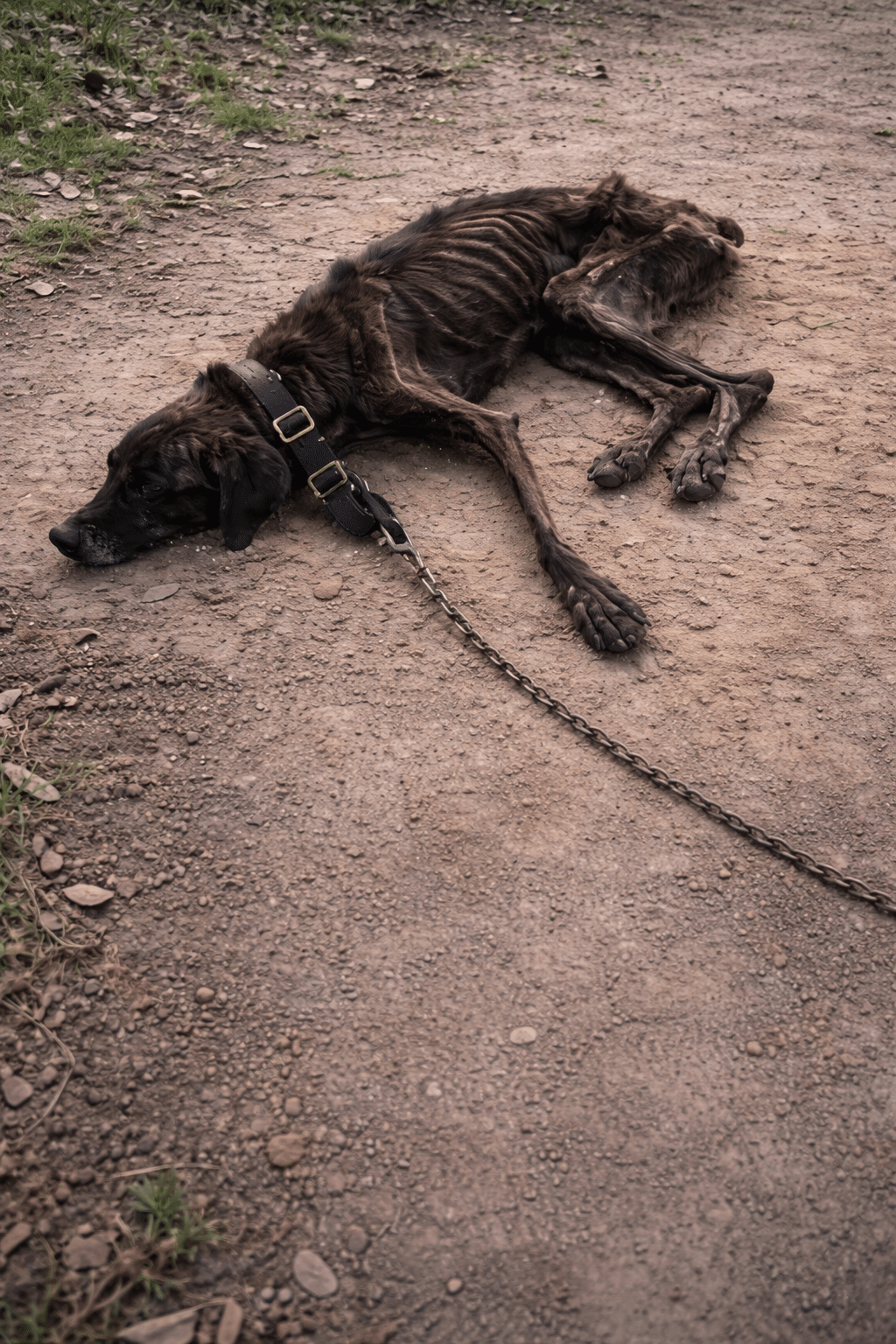
When rescuers first reached Champ, his body showed just how long he had been without the care he needed.
He weighed only 22 kilograms.
For a dog of his size, the number was dangerously low. His body had become so weak that even the most basic movements required more strength than he seemed to have left.
Champ had been left behind in a yard, still attached to a chain, after his owner walked away following the end of a relationship. Without dependable food or regular care, his condition had steadily deteriorated.
By the time help arrived, this was no longer simply a case of a dog needing a meal.
Champ needed immediate medical attention.
The First Days Were About Survival
At the clinic, veterinarians discovered that Champ's condition was even more serious than his appearance suggested.
His injuries required urgent treatment, infection had spread through his system, and his red blood cell count had fallen to a dangerous level.
The veterinary team began working to stabilize him.
He received blood transfusions.
He was given IV fluids.
His condition was monitored constantly.
There was no guarantee that any of it would be enough.
During those first five days, Champ remained extremely fragile. His blood levels dropped again, and he showed little interest in food.
Every small change mattered.
Every hour that passed without another crisis mattered.
The people caring for him could provide treatment, warmth, nutrition, and supervision. What they could not know was whether Champ's exhausted body still had enough strength to respond.
Somehow, he kept going.
Not dramatically.
Not all at once.
He simply made it through one difficult day, and then another.
Learning to Stand Again
Surviving the first week was only the beginning.
Months of severe undernourishment had taken away much of Champ's muscle strength. Even when his medical condition began to stabilize, his body had to relearn movements that most dogs perform without thinking.
Standing was difficult.
Walking was harder.
A lifting harness was used to support part of his weight while he tried to move.
At first, his steps were uncertain and brief.
One step.
Then another.
There was nothing graceful about those early attempts, but progress did not need to be graceful.
It only needed to continue.
His blood levels gradually improved, and his appetite began returning in small increments. A little boiled chicken became important. So did a few bites of scrambled egg.
Finishing food was more than eating.
It was another sign that his body was beginning to participate in its own recovery.
By the end of the second week, Champ reached a milestone that once seemed far away.
He stood without assistance.
Only briefly.
Not perfectly.
But he stood.
VIDEO: From 22 Kilograms and Fighting to Stand to Running Free Again — Champ's Long Road Back
Soon, those moments of standing became short walks.
His legs were still rebuilding strength, but each attempt gave him another chance to practice.
The dog who had once seemed almost disconnected from everything around him was beginning to move through the world again.
Day 18 Brought More Than a Change of Address
On day 18, Champ was well enough to leave the clinic and enter foster care.
For a dog recovering from such profound weakness, leaving intensive medical care did not mean the work was finished.
It meant the next stage could begin.
His feeding remained structured. His medical needs continued to be monitored. Most importantly, he now had a stable environment in which recovery could happen slowly.
The numbers began changing.
Twenty-two kilograms became 26.
Within roughly two months, his weight climbed to nearly 39 kilograms.
But the changes could be seen beyond a scale.
His coat began filling in.
His eyes looked brighter.
His body no longer seemed to be conserving every last bit of energy simply to make it through the day.
There was now room for curiosity.
Movement.
Interaction.
A future.
Then, on day 61, Champ reached another turning point.
He was adopted.
The foster stage was over.
This home would no longer be temporary.
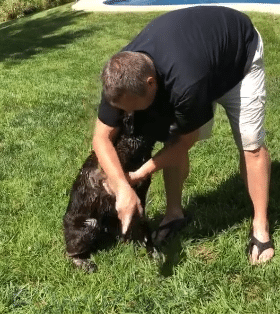
The Dog Who Could Barely Stand Began to Run
By day 110, less than four months after his rescue, Champ weighed more than 45 kilograms.
He had more than doubled the weight he carried when rescuers first found him.
The number was remarkable, but it still did not tell the whole story.
The clearest evidence of his recovery was movement.
Champ could swim.
He could run along the beach.
He could chase balls through the snow.
These were ordinary joys for a healthy dog, yet for Champ they represented an extraordinary distance traveled.
Months earlier, standing had required a support harness.
Now his legs carried him freely.
Months earlier, caregivers celebrated a few bites of food.
Now he had the energy to play.
The contrast was difficult to miss.
His transformation also appeared in the way he interacted with people. According to his story, Champ enjoyed being around children and was comfortable meeting strangers.
There was no way to erase what had happened before his rescue.
But his daily life no longer seemed defined by it.
He was doing something much more important.
He was living.
Recovery Was Built From Hundreds of Small Decisions
Stories like Champ's can look almost impossible when the beginning and ending are placed side by side.
One image shows a severely weakened dog unable to support himself.
Another shows a powerful, healthy animal running outdoors.
The distance between those two versions of Champ might appear to be a single dramatic transformation.
It was not.
It was hundreds of smaller moments.
A transfusion when his body needed support.
Fluids when he needed stabilization.
Monitoring when his condition remained uncertain.
Carefully planned meals.
A harness supporting him while his muscles slowly strengthened.
Another attempt to stand.
Another short walk.
Another meal finished.
A foster home willing to continue the process after the clinic.
And eventually, a family willing to make that home permanent.
No individual step explains Champ's recovery by itself.
Together, they changed everything.
Day 900 Looked Nothing Like Day One
Nine hundred days after Champ was rescued, he was healthy.
Veterinarians described the scale of his recovery as extraordinary.
The reason becomes clear when his condition on day one is remembered.
He had arrived at only 22 kilograms, physically depleted and facing multiple serious medical challenges.
He had needed immediate intervention simply to have a chance.
Nine hundred days later, the dog at the center of the story was almost unrecognizable from the one rescuers first encountered.
Not because his past had disappeared.
Because his present had become so different.
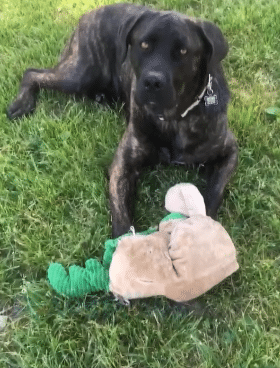
His strength had returned.
His body had rebuilt itself.
He could move freely and confidently.
And instead of being left alone in a yard, he had a permanent home.
That outcome was not created by one dramatic moment.
It came through consistency.
Medical treatment when it mattered most.
Nutrition delivered carefully rather than rushed.
Physical support while his muscles recovered.
Patience when progress was measured in single steps.
And people who continued showing up after the immediate emergency had passed.
What Champ's 900 Days Leave Behind
Champ's story began with a body that had almost nothing left to give.
At 22 kilograms, he needed help with nearly every part of recovery.
He could not simply be fed once and expected to become well.
His medical condition had to be stabilized.
His nutrition had to be rebuilt.
His strength had to return gradually.
He had to learn to stand, then walk, then move without support.
And after the clinic, he still needed somewhere safe enough for that progress to continue.
That may be the most important part of Champ's journey.
Rescue was not one event.
It was a process.
The first people who intervened gave him a chance to survive.
The veterinary team helped his body stabilize.
His foster home gave recovery time to continue.
His eventual adoption gave that recovery permanence.
By day 110, Champ had already become stronger than anyone seeing him at the beginning might have imagined.
By day 900, he was fully healthy.
The dog once too weak to stand was now running, swimming, playing, and sharing his life with people who had chosen to keep him.
Champ's transformation is powerful because the ending does not erase the beginning.
Instead, it shows what can happen when a severely neglected animal receives something he had been missing for far too long:
Care that continues.
Food that keeps arriving.
Medical attention that does not stop after the first emergency.
And a home that finally becomes permanent.
Twenty-two kilograms marked the point where Champ's rescue began.
More than 45 kilograms later, the scale told only part of the story.
The rest could be seen in every confident step, every run across open ground, and every ordinary moment of a dog finally free to live.


