
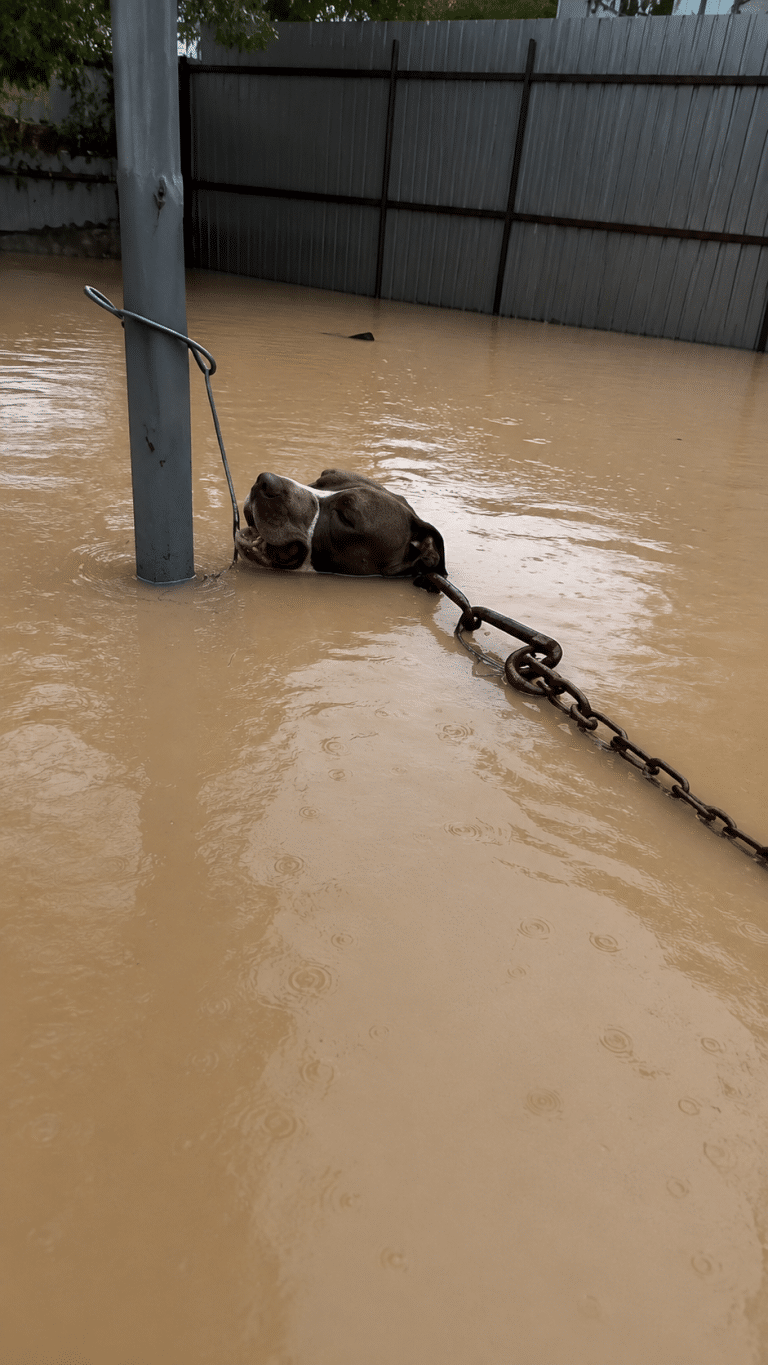
The brown-and-white Pitbull could barely keep his nose above the floodwater.
Around him, the yard had almost disappeared beneath the rising water. Heavy rain continued to fall, and the only thing still standing clearly above the surface was a metal pole.
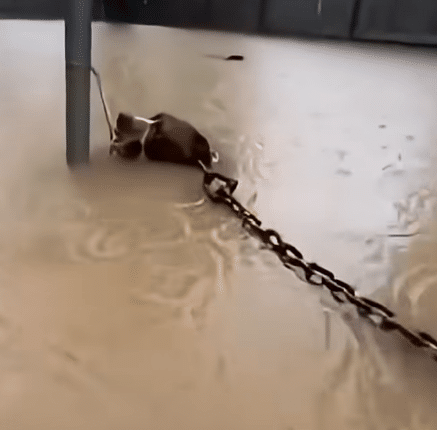
A thick, rusted chain connected the frightened dog to that pole.
It was supposed to keep him in one place.
Now, it was preventing him from reaching safety.
With every movement of the water, the Pitbull struggled to hold his head a little higher. His legs trembled beneath him, and there was nowhere dry to stand.
He could not move far enough to escape.
He could not simply swim away.
And as the water climbed toward his mouth, even breathing became a struggle.
The dog had no way to free himself. His survival depended on someone reaching him before the flood rose any higher.
A Yard Disappearing Beneath the Water
The danger was not difficult to see.
What had once been an ordinary outdoor space was now almost completely submerged. The rain had transformed the yard into a flooded area, leaving the Pitbull surrounded by water in every direction.
The chain around his neck restricted his movement to a small space near the metal pole.
For an animal caught in a flood, movement can mean the difference between reaching higher ground and remaining trapped as conditions worsen.
But this dog had no such choice.
His body was still supported by his legs, yet the water had already reached his throat. He stretched his neck upward, trying to protect the small space between his nose and the surface.
Every ripple made that effort harder.
Water pushed against his muzzle. His mouth opened as he struggled for air. His frightened eyes followed the movement around him, but there was no visible escape from the chain.
The most painful part of the scene was how little control he had over what was happening.
He was not refusing to leave.
He was physically unable to.
As the flood continued rising, the distance between his nose and the water grew dangerously small.
He needed help.
And he needed it soon.
When the Rescuer Entered the Floodwater
A rescuer eventually made his way through the flooded yard toward the trapped Pitbull.
Getting close enough to help was only the beginning.
The dog was still attached to the metal pole, and the chain had to be released before he could be moved away from danger.
The rescuer faced an immediate problem.
The lock securing the chain was badly rusted and difficult to open.
Under ordinary circumstances, a stubborn metal lock might simply be frustrating. In this situation, every failed attempt meant the dog remained in water deep enough to threaten his breathing.
The rescuer worked against the soaked metal while the Pitbull continued struggling beside him.
His hands slipped as he tried to find a way to release the fastening.
The chain remained tight.
Meanwhile, the dog was becoming increasingly exhausted.
He had already spent precious energy keeping his head above the surface. There was no opportunity to lie down or rest. Even small movements required effort because the chain prevented him from finding a safer position.
The man continued working.
His hands became scraped during the difficult attempt to force the rusted lock open, but he did not abandon the effort.
There was one immediate goal.
Free the chain.
Get the dog out of the water.
Everything else could wait.
The Struggle That Could Not Continue Much Longer
The scene brought together two different kinds of determination.
The Pitbull was doing everything his tired body could manage to keep breathing.
The rescuer was doing everything possible to remove the restraint that held him there.
Neither had much room for error.
For the dog, the metal chain meant that the danger could not be escaped through instinct alone. No matter how urgently he tried to move, the pole kept him in the same flooded space.
For the man, the difficulty lay in the lock.
He had reached the animal, but reaching him was not enough.
The rescue would only succeed when that final physical barrier was removed.
The rain and surrounding floodwater made the task especially difficult. The dog remained frightened, and his position near the water's surface left little time for repeated attempts.
Yet the rescuer stayed beside him.
He kept working with the metal fastening even as the situation grew more urgent.
Then, after the struggle with the rusted lock, something finally changed.
The restraint gave way.
VIDEO: Pitbull Trapped by a Rusted Chain in Rising Floodwater Is Finally Freed by a Determined Rescuer
The Moment the Chain Finally Released
The lock finally broke open.
After everything that had kept the Pitbull trapped beside the pole, the chain was no longer holding him in place.
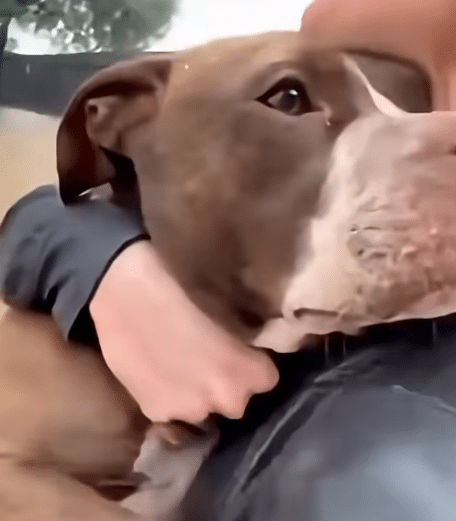
The rescuer immediately took hold of the exhausted dog and lifted him away from the dangerous water.
It was the turning point the animal had needed.
Only moments earlier, he had been stretching his neck upward for enough air to survive. Now, he was being supported by someone who had reached him despite the flood.
The change in his behavior was especially moving.
The Pitbull stopped struggling.
He did not continue fighting against the man's hold. He did not bark or try to pull away.
Instead, he became quiet.
His wet body rested against the rescuer, and his head settled onto the man's shoulder.
That simple movement carried more emotion than a dramatic reaction could have.
The dog had spent the previous moments using all his strength to remain above the water. Once he was lifted, he no longer had to bear that effort alone.
It is impossible to know exactly what an animal is thinking.
But his relaxed posture suggested that the immediate terror was beginning to ease.
The person who had approached him through the flood was now holding him safely away from it.
And for the first time in the rescue, the Pitbull could rest.
A Quiet Response After So Much Fear
There was no sudden burst of excitement.
No energetic movement.
No playful response.
The Pitbull appeared simply exhausted.
His fur was soaked by the rain and floodwater. The rescuer's hands showed the effects of his difficult work with the chain.
Yet the most memorable detail was the dog's head resting against the man's shoulder.
Before the lock opened, every movement had been about staying alive.
His legs had to keep supporting him. His neck had to remain extended. His nose had to stay clear of the water.
There had been no opportunity for comfort.
Now, supported in the rescuer's arms, the dog seemed able to release some of that tension.
The contrast was striking.
The same animal who had been struggling desperately moments before was suddenly still.
Not because the danger had been unimportant.
But because the immediate threat had finally been removed.
The scene also showed why an animal's response to help is not always dramatic.
Sometimes relief appears in the smallest gestures.
A body becoming less tense.
A frightened animal no longer pulling away.
A tired head resting against the shoulder of the person carrying him.
For this Pitbull, that quiet moment became the emotional center of the rescue.
He had been unable to save himself from the chain.
But someone had reached him before the water rose any farther.
Why Being Chained Made the Flood So Dangerous
Flooding creates serious risks for animals, especially when they cannot move to a safer place.
In this case, the chain transformed an already dangerous situation into a direct threat to the Pitbull's survival.
The surrounding water was rising, but the dog could not follow the natural instinct to seek higher ground.
The metal pole remained fixed.
The chain remained attached.
And the animal had to struggle within the small area those restraints allowed.
That is what makes this rescue so difficult to forget.
The Pitbull's survival did not depend only on his ability to endure the water. It depended on whether someone could remove the obstacle preventing him from escaping.
The source does not explain why he had been left chained outside or how long he had been trapped in the flood.
Those details remain unknown.
What is clear is the condition in which he was found: frightened, exhausted, and barely able to keep his head above the water.
The rescue also demonstrates the added danger of leaving animals restrained outdoors when severe weather threatens.
An animal needs a safe way to move away from rising water. When that freedom is taken away, the opportunity to escape can disappear very quickly.
This Pitbull had reached a point where he could no longer solve the problem through his own efforts.
The rusted lock had to be opened by someone else.
And the rescuer's persistence made that possible.
The Simple Act of Refusing to Leave Him Behind
There are rescue moments that stay in people's minds because of extraordinary action.
Others are remembered for something much quieter.
In this case, it was a man remaining beside a frightened dog until the chain finally released.
The rescuer encountered a lock that would not open easily, slippery metal, and a flood that left little room for delay.
He could have been defeated by the difficulty of the task.
Instead, he continued trying.
His persistence mattered because the dog had no alternative.
The Pitbull could not remove the chain with his paws. He could not move the pole. He could not make the flood stop rising.
He needed another living being to recognize his danger and act.
That help eventually came.
And the moment the chain was released, the entire direction of the story changed.
A dog who had been trapped with water at his throat was lifted into someone's arms.
An animal who had been fighting to keep breathing was finally able to rest his head.
The rescue does not provide a detailed account of what happened afterward. There is no confirmed information about veterinary treatment, a permanent home, or the dog's longer-term recovery.
The supported ending is simpler, but still deeply meaningful.
He was freed from the chain.
He was lifted away from the rising floodwater.
And he was no longer facing that immediate danger alone.
What Remains After the Water
The most lasting image of this rescue is not the metal pole standing in the flooded yard.
It is not the stubborn lock or the water that had nearly covered the Pitbull's face.
It is the moment after the struggle ended.
A soaked, exhausted dog resting quietly against the person who had come to help him.
That image holds the contrast between fear and relief in a way that needs very few words.
The Pitbull's circumstances had left him helpless against the rising water. His chain prevented the escape he urgently needed, and the rescuer had to work through difficult conditions to free him.
Nothing about that effort was effortless.
But it was enough.
The story is also a reminder of a responsibility that extends beyond a single rescue: animals must have access to safety when dangerous weather approaches. Restraints that seem ordinary in calm conditions can become life-threatening when water begins to rise.
For this dog, the chance to survive came through one person's determination.
There is no need to imagine a dramatic future to understand the value of what happened.
The flood was real.
The danger was immediate.
The chain was finally opened.
And in the arms of the man who freed him, the Pitbull showed a quiet response that made the rescue unforgettable.
Sometimes compassion is not expressed through grand words or promises.
Sometimes it is simply someone refusing to stop until a frightened animal is safe.
And sometimes, the clearest sign that the effort mattered is a tired dog finally able to rest.


