
Some cries for help are so faint they could easily disappear into the silence.
Bono's was one of them.
When rescuers heard a weak sound coming from an empty building, they followed it without knowing what they would find. Somewhere inside, a dog was still alive.
And he needed someone to notice.
Behind the Silence, a Dog Was Still Waiting
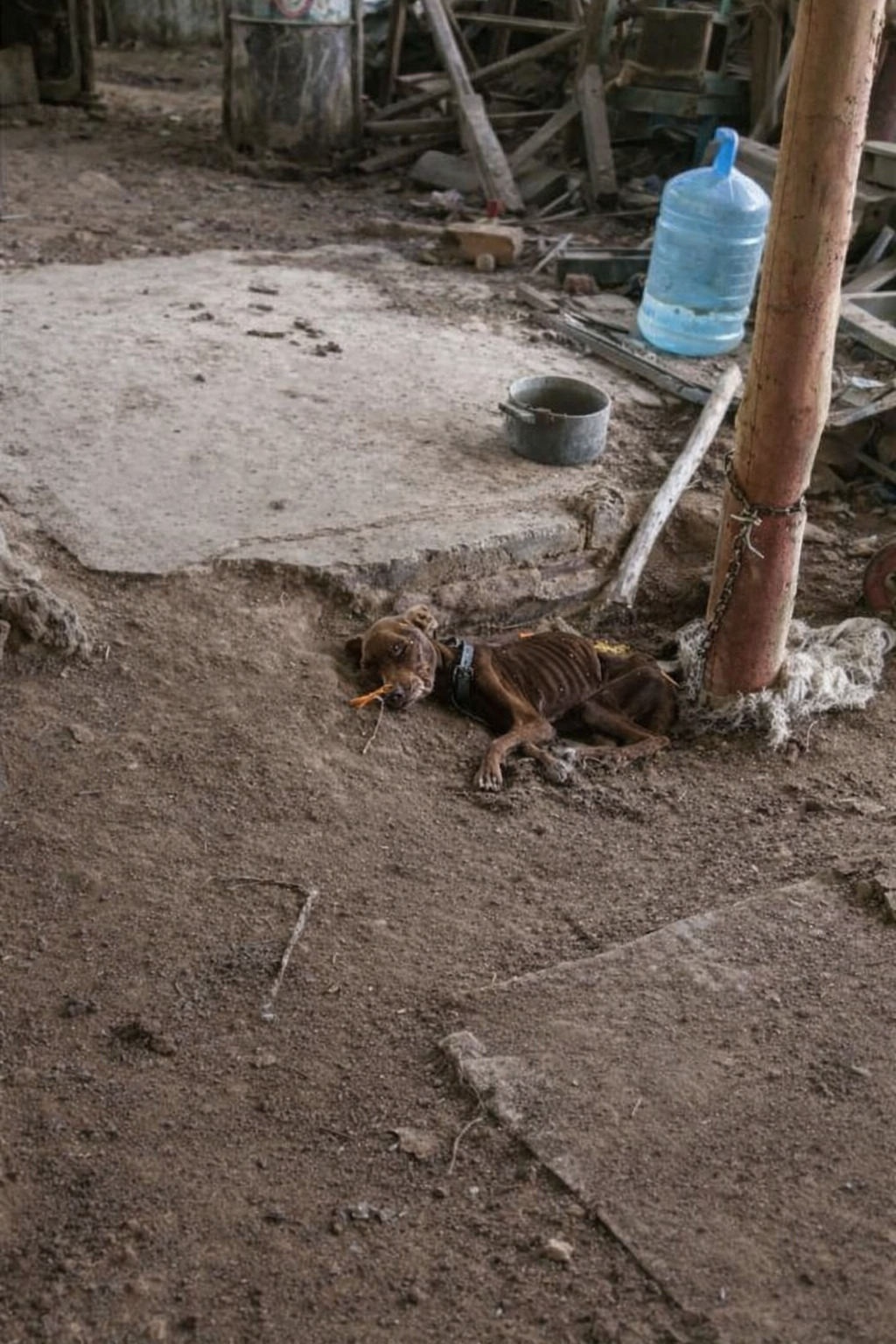
The sound led rescuers into an abandoned pet shop on the edge of town.
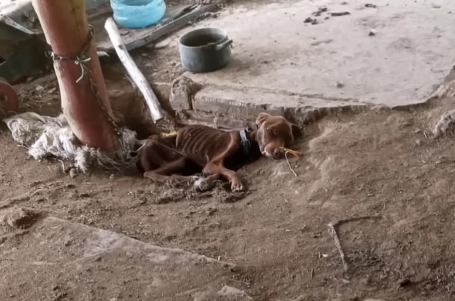
Inside, they found a Doberman chained to a post.
His condition made it clear that he had gone far too long without proper care. Bono was dangerously thin, with little strength left in his body. He could barely lift his head, and even the arrival of strangers brought almost no reaction.
There was no barking.
No attempt to pull away.
He simply remained where he was, exhausted and weak.
The rescuers later gave him the name Bono.
What first appeared to be the discovery of one neglected dog soon became something larger. Because Bono was not alone.
Six other dogs had also been left inside the property.
Authorities were contacted, and police became involved. According to the source, the former owner later admitted abandoning the animals, and legal action followed.
For Bono, however, those consequences belonged to another chapter.
At that moment, the most urgent question was much simpler:
Could his body recover from what it had endured?
Leaving the Chain Behind Was Only the Beginning
Bono was taken directly to a veterinary hospital, where the medical team began assessing just how fragile his condition had become.
He was severely dehydrated and dangerously underweight. He also had a serious infected injury that required immediate attention.
At only 19 kilograms, his body had very little reserve left.
Treatment began carefully.
Fluids were provided. His injury was cleaned and treated. Because he was not strong enough to eat normally on his own, every step had to be approached with patience.
During those first days, Bono spent much of his time lying quietly on his bedding.
His eyes remained open and aware as people moved around him.
The change in his surroundings must have been enormous.
He had gone from an abandoned building and a chain to a place filled with people trying to keep him safe.
Yet recovery could not be rushed.
His condition remained serious, complicated by infection and anemia. There were no instant transformations and no guarantee that strength would return quickly.
There was only careful treatment, close monitoring, and another day to get through.
VIDEO: Chained and Too Weak to Stand, Bono's Long Road Back Began With One Rescue
Healing Meant Celebrating the Smallest Victories
The medical team supported Bono through the basics that a healthy dog might never have to think about.
Eating.
Sitting.
Balancing.
Holding his own weight.
Food was offered in small, manageable portions while his weakened body adjusted. Caregivers remained nearby as he slowly began doing more for himself.
At first, progress could be measured in tiny changes.
Bono became more alert.
Then he started eating without as much assistance.
And eventually, there came a moment that would have seemed ordinary anywhere else.
He sat up by himself.
For a dog who had once been found unable to lift his head, that simple movement carried enormous meaning.
It showed that his body was responding.
It showed that the work of recovery was beginning to take hold.
Most importantly, it meant there could be another milestone after this one.
And then another.
The Day Bono Stood on His Own Again
Weeks of consistent care gradually changed the dog rescuers had carried away from the abandoned shop.
Bono's body began rebuilding itself.
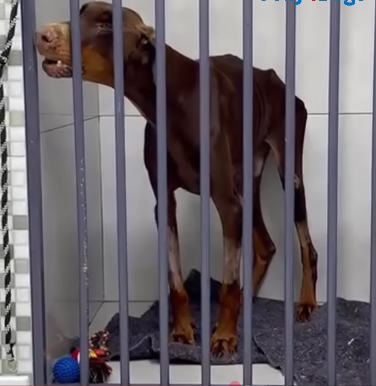
Eventually, he was able to stand without being supported.
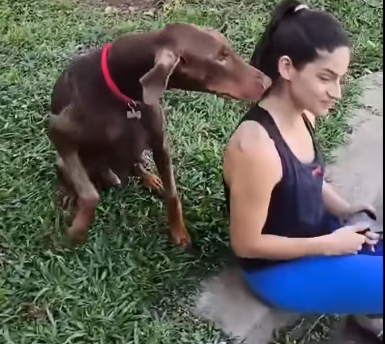
Then came another unfamiliar experience: stepping onto grass again.
He moved carefully at first, testing his balance and strength one step at a time. The dog who had once remained almost motionless on the floor was now beginning to move through the world on his own legs.
His physical transformation became increasingly visible.
When Bono first entered care, he weighed only 19 kilograms.
As he ate regularly and regained muscle, that number rose steadily. In time, his weight climbed to more than 37 kilograms.
Nearly every part of him seemed different.
His coat looked healthier.
His posture became stronger.
His movements grew steadier.
But perhaps the most noticeable change could not be measured on a scale.
It was in the way he looked at the world.
The distant expression seen during his earliest days began to fade. Bono appeared more curious and engaged with the people and surroundings around him.
Recovery was no longer simply about keeping a critically weak dog alive.
It was becoming a return to ordinary life.
Strength Was Only Part of What He Regained
Physical healing can be seen in numbers and movement.
Trust is quieter.
For Bono, those two forms of recovery unfolded side by side.
In the hospital, gentle voices and careful hands had become part of his everyday experience. He had learned that people could approach without bringing fear.
Day after day, that consistency gave him something he had been missing.
Safety.
There was food when he needed it.
There was a comfortable place to rest.
There were people paying attention when his body struggled.
Nothing about the process erased what had happened before he was found. But it gave Bono a chance to experience something different.
And slowly, his behavior reflected that change.
The Doberman who once had almost no energy to respond became a dog who could stand, explore, eat, and engage again.
The transformation was not built around one dramatic moment.
It was built from dozens of small ones.
A meal finished.
A stronger posture.
A few careful steps.
Another day of healing.
Together, those moments carried Bono far from the place where his story had nearly ended.
Recovery Opened the Door to Something Bigger
Getting stronger meant Bono could finally move beyond survival.
Once his recovery was complete, a family who loved animals welcomed him into their home.
For the first time, his future was no longer defined by a chain or an abandoned building.
His days began to look remarkably ordinary.
And that was exactly what made them special.
Bono could go for peaceful walks.
He had access to a spacious yard.
He could spend time playing gently with a young child who became one of his favorite companions.
There were other dogs around him as well, giving him canine company as he settled into family life.
He even had opportunities to run freely on the beach.
After everything his body had been through, freedom was no longer an abstract idea.
It was something he could feel beneath his paws.
Space to move.
A safe place to sleep.
People nearby who expected him to be there tomorrow.
From a Forgotten Room to a Place of His Own
There is no single moment that explains Bono's transformation.
It began when someone heard a quiet cry and decided not to ignore it.
It continued when rescuers entered an abandoned building and found a dog who could no longer help himself.
Then came the veterinary team, working patiently through dehydration, severe weight loss, infection, anemia, and profound weakness.
Finally came a family willing to offer something that medical treatment alone could never provide.
Belonging.
Bono's recovery was not immediate.
It happened gradually, through care that was repeated long after the first rescue was over.
That distinction matters.
Saving an animal from danger can happen in a moment.
Helping that animal feel safe again can take much longer.
Bono went from 19 kilograms and barely able to move to more than 37 kilograms and strong enough to walk, play, explore, and live as part of a family.
But the numbers tell only part of the story.
The greater change was the life surrounding him.
Where there had once been isolation, there was companionship.
Where movement had once been limited by a chain and weakness, there was a yard, walks, and open space.
Where there had once been uncertainty, there was now a home.
Bono's journey shows what can happen when compassion continues beyond the rescue itself.
Someone had to hear him.
Someone had to enter that building.
Someone had to carry him toward care.
Others had to remain beside him through the slow days when progress was measured in the smallest movements.
And eventually, someone had to open a door and say, in the simplest possible way:
You can stay here.
For Bono, that was the difference between merely surviving and finally having a life of his own.


