
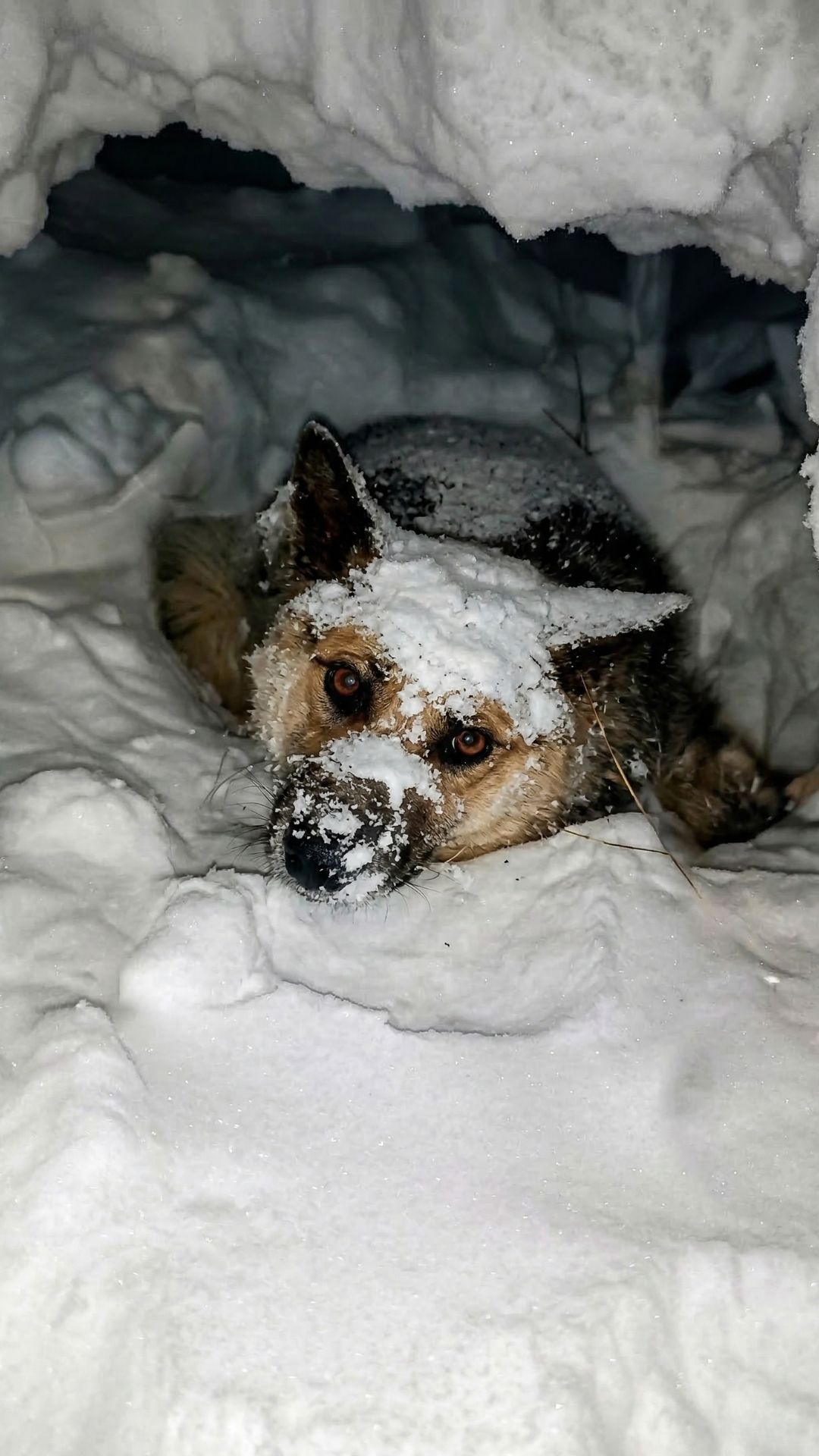
For three days, a dog lay almost completely still beneath the heavy snow outside a crowded apartment building.
Around him, the city had slowed beneath a powerful winter storm. People stayed indoors, protected from the freezing air while snow continued to gather outside.
Just beyond those warm walls, however, one frightened animal remained unnoticed.
He did not wander in search of shelter.
He did not call attention to himself.
He simply stayed where he was, his body growing colder while the snow gathered around him.
The sight might have remained unseen even longer if a photograph had not finally reached people willing to act.
That image changed everything.
The Night Someone Finally Came for Him
Rescuers headed into the cold as soon as they learned about the dog.
By the time they reached him, he had reportedly been lying there for three days.
They lifted his rigid body from the snow, and suddenly the silence was broken by a sharp cry.
Until that moment, he had barely moved.
Now, in the rescuers' arms, the sound revealed just how frightened and exhausted he was.
They knew they could not waste time.
The dog needed warmth, safety, and medical attention as quickly as possible.
With much of the city quiet because of the storm, the rescuers drove through the night searching for an emergency clinic that was still open.
The immediate concern was obvious: after so much time exposed to the cold, his body could be in serious danger.
But there was another question they could not answer.
Why was he unable to move?
Was the cold responsible?
Had something happened to his spine?
Was there an injury they could not see?
All they could do was keep going.
VIDEO: Buried in Snow for Three Days, Thor's Rescue Revealed a Wound No Scan Could Show
At the Clinic, the Mystery Deepened
Once the dog reached the clinic, the veterinary team began warming him carefully and monitoring his condition.
Everyone prepared for the possibility that prolonged exposure to the snow had caused serious internal problems.
Yet the first findings brought unexpected relief.
His organs appeared to be functioning normally.
That was encouraging, but it did not explain why he still would not move.
A neurologist was consulted.
The team examined him for signs of spinal trauma, damaged nerves, broken bones, or another physical problem that could explain what looked like paralysis.
Test after test brought the same result.
There was no clear physical injury causing his immobility.
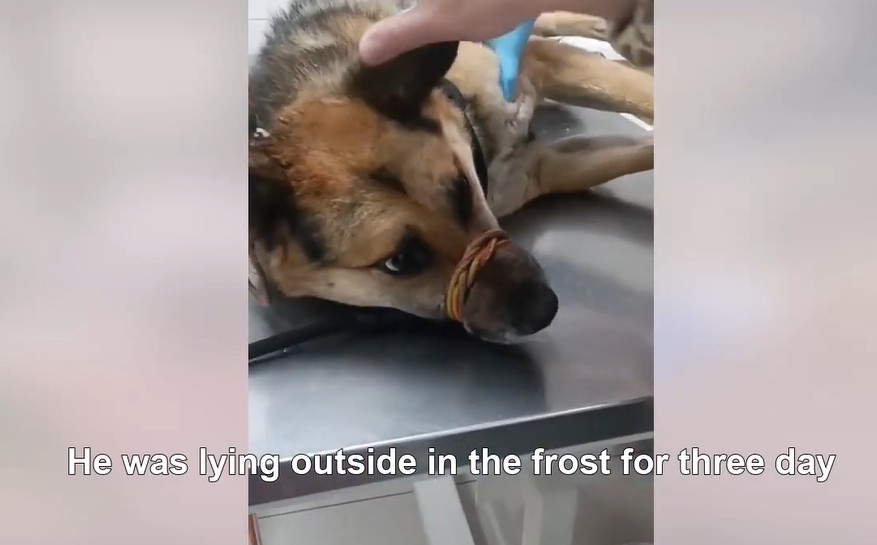
The dog was eventually given a name: Thor.
The more the team observed him, the clearer the situation became.
Thor's body was capable of movement.
Fear seemed to be stopping him.
There were old marks around his face and ears that suggested he had experienced hardship before rescuers found him in the snow. Exactly what had happened in his past was unknown, but his behavior showed how deeply frightened he had become.
The storm had placed his body in danger.
Yet even after he was warm, his mind still seemed trapped in a place where movement did not feel safe.
When Safety Became Part of the Treatment
Thor did not need an operation to repair a broken spine.
What he needed was far less dramatic and, in some ways, far more difficult to provide.
He needed time.
He needed calm surroundings.
He needed repeated experiences that showed him he was no longer in danger.
His caregivers gave him a quiet place to rest and followed the treatment recommended for his emotional condition, including medication intended to help him cope with his severe fear.
There was no attempt to rush him.
No expectation that one warm night would undo everything that had come before.
Thor remained close to the floor.
Sudden sounds startled him.
Movement around him could make him tense.
Even gentle activity seemed to remind him that the world had not always been kind or predictable.
But one part of Thor's behavior stood out immediately.
He loved food.
He ate eagerly whenever meals were offered, as though his appetite had survived even when much of his confidence had disappeared.
For his caregivers, those meals became more than simple nourishment.
They were small, ordinary moments in which Thor could experience something dependable.
Food arrived.
No one frightened him.
The room stayed calm.
Then it happened again.
And again.
That kind of repetition mattered.
Trust is rarely rebuilt through one dramatic gesture. More often, it grows through quiet routines that prove safety one day at a time.
Thor still did not rise.
But he stayed.
He ate.
He watched.
And despite everything that seemed to frighten him, he never became aggressive toward the people helping him.
That gentleness offered a glimpse of the dog hidden beneath all the fear.
Ten Days Later, Thor Stood Up
Progress came slowly enough that no one could force it.
Then, around ten days after his rescue, Thor did something that had once seemed impossible.
He stood.
There was no surgery behind the moment.
No sudden physical repair.
The same dog who had remained pressed against the ground finally lifted himself onto his feet.
For the people caring for him, it was a powerful sign that something inside Thor was beginning to change.
And then came another small transformation.
His expression softened.
For the first time, there was something that looked unmistakably like a smile.
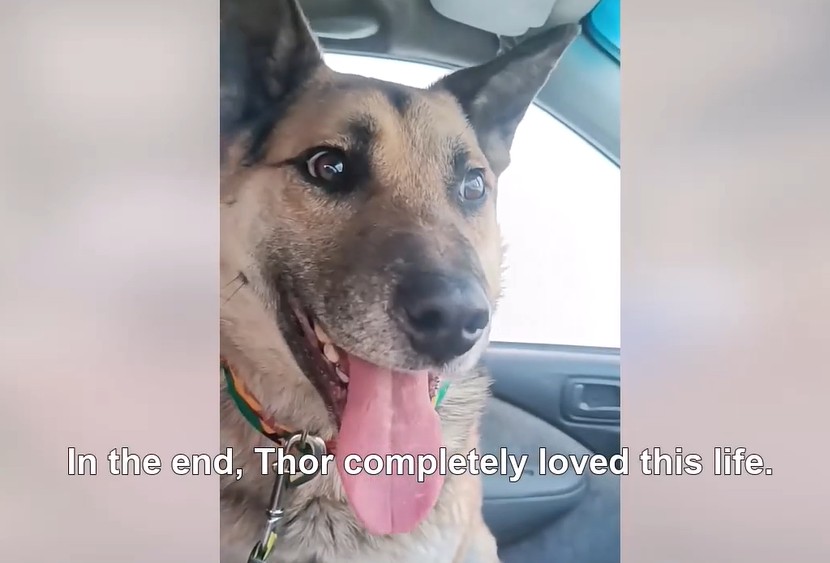
Soon afterward, Thor was taken outside for a short walk.
He did not rush forward.
He did not pull on the leash or race toward everything around him.
Instead, he explored cautiously, walking in small circles and taking in the unfamiliar surroundings at his own pace.
The steps themselves were simple.
But compared with the dog who had been unable to move only days earlier, every one of them mattered.
Thor was beginning to discover that walking no longer meant entering danger.
The world could contain open space without threatening him.
A human beside him could mean protection instead of fear.
That was a lesson his caregivers were willing to let him learn slowly.
A Home Where He Could Keep Learning to Trust
As Thor's personality began to emerge, his rescuer made an important decision.
He would not be hurried into another uncertain situation.
Thor would remain where he was safe until the right long-term home could be found—one prepared to understand that his recovery was emotional as well as physical.
For a dog like Thor, patience was not an optional kindness.
It was part of his healing.
The other dogs around him also became part of his new routine.
Over time, Thor began interacting and playing with them.
The animal who had once seemed completely disconnected from the world was now beginning to participate in it again.
He explored more.
He relaxed more easily.
He allowed ordinary moments to become ordinary again.
That may be one of the quietest forms of recovery.
Not a dramatic transformation overnight, but the gradual disappearance of fear from places where fear once controlled everything.
A meal becomes just a meal.
A walk becomes something to enjoy.
Another dog becomes a companion.
A room becomes a place to rest instead of somewhere to hide.
The Cold Passed, and Something Warmer Remained
Thor's story began with an image that was difficult to forget: a dog lying beneath the snow while an entire apartment building stood nearby.
Three days passed before help reached him.
Yet once someone finally noticed, his life began moving in another direction.
The clinic ruled out the serious physical causes that rescuers had feared.
The people around him then faced a different challenge—helping a deeply frightened dog feel safe enough to use the healthy body he already had.
That process required warmth, medication, food, quiet companionship, and patience.
Most importantly, it required consistency.
Thor was not expected to become fearless immediately.
He was simply given the chance to discover, one day at a time, that the danger was over.
Ten days after being rescued, he stood.
Then he walked.
Then he played.
Those moments did not erase whatever had happened before the snowstorm.
They did something more meaningful.
They gave Thor a future that was no longer controlled entirely by his past.
The storm that nearly took his chance at life eventually disappeared.
The snow melted.
And Thor was left with something he had desperately needed all along:
A warm place.
Gentle care.
Other dogs beside him.
And people willing to give him enough time to believe that he was finally safe.


