
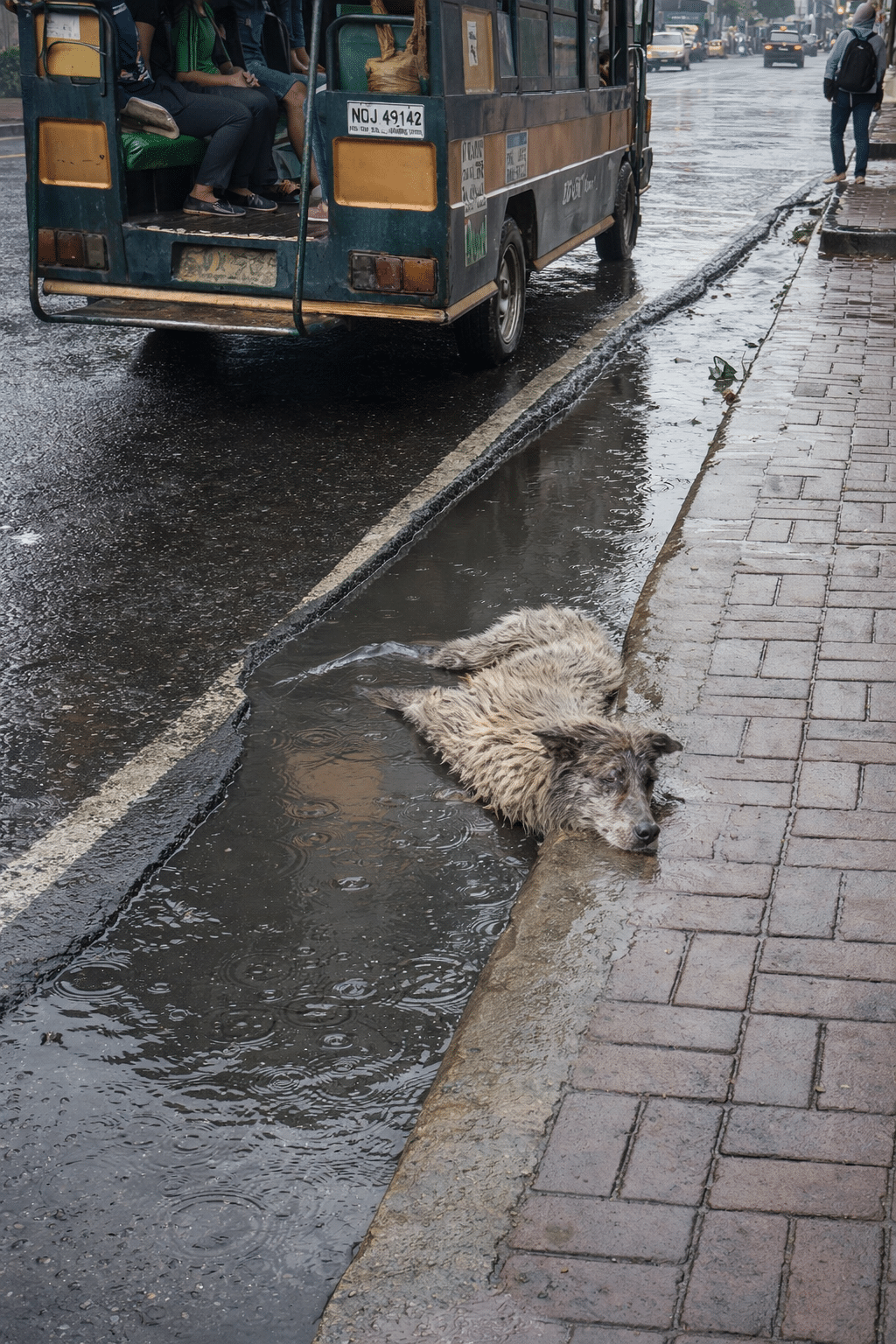
Rain kept falling around the small dog curled beside the road.
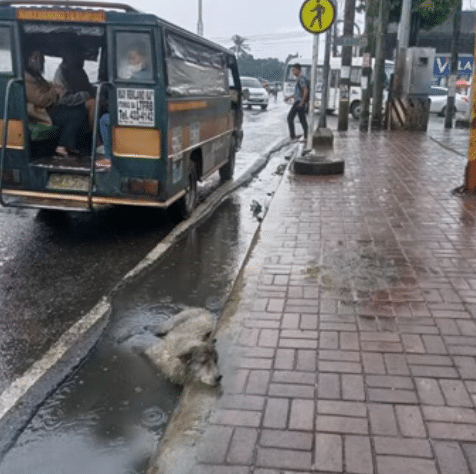
Borgie had been struck by a passing car near a bus stop, and afterward he could barely move. His body rested partly in a shallow puddle as the cold water soaked through his fur.
There was nowhere for him to go.
So he stayed there through the night.
By morning, the streets had come alive again. People moved past the bus stop on their usual routines, some noticing the little dog beside the curb before continuing on.
Borgie remained where the accident had left him.
Weak.
Cold.
And waiting.
The Morning Someone Finally Came Closer
The rain had not stopped when help eventually reached Borgie.
Rescuers found him trembling and exhausted, his body drenched after spending hours exposed to the weather. He could not properly stand, and his hind legs appeared especially weak.
Yet when the rescuers approached, Borgie did not react aggressively.
He simply watched them.
There was something deeply quiet about that moment. After the accident, the cold, and the long wait beside the road, the frightened dog finally had people standing beside him who were not going to keep walking.
They carefully lifted Borgie and placed him inside their vehicle.
For the first time since the collision, he was leaving the roadside behind.
But getting him out of the rain was only the beginning.
His inability to move his back legs raised serious questions, and the rescuers knew he needed veterinary attention as quickly as possible.
The X-Rays Revealed More Than the Accident
At the veterinary hospital, Borgie was examined and X-rays were taken to understand the extent of his injuries.
The first piece of news offered some relief.
Despite being struck by a vehicle, Borgie had no broken bones.
But the images also revealed something unexpected.
Several small metal pellets could be seen in his back.
According to the source, they were believed to have come from an air gun at some point before the traffic accident. No one knew exactly when it happened or the full circumstances surrounding it.
It meant the road accident was not the only hardship Borgie's body had experienced.
The more immediate concern, however, was his hind legs.
Borgie could not move them.
Veterinarians feared that damage affecting his spine could leave him unable to walk normally again.
There were no guarantees about what would happen next.
VIDEO: Found Shivering and Unable to Walk, Borgie Begins His Fight to Stand Again
Recovery Began With Small, Repeated Efforts
The veterinary team chose to keep working with Borgie rather than assume the worst.
His recovery plan focused on giving his body support while watching closely for any signs that movement might return.
He received nutritious food along with calcium and vitamins as caregivers worked to rebuild his strength.
Physical therapy became one of the most important parts of that process.
Each day, Borgie's hind legs were gently moved and exercised. The goal was to encourage muscle activity and look for responses that might suggest his body was beginning to recover.
At first, there was very little change.
That made patience essential.
Recovery from a serious injury does not always announce itself with one dramatic moment. Sometimes it begins almost invisibly, with a little more appetite, a little more alertness, or the smallest movement that was not there the day before.
For Borgie, those early signs began appearing after several days.
Around five days into his care, he started eating on his own again.
His expression also began to change.
The withdrawn dog who had arrived soaked and exhausted became more interested in what was happening around him. When caregivers approached, his tail began to move.
It was a modest gesture.
But after everything Borgie had just been through, even a gentle wag felt meaningful.
Then Borgie Tried to Stand
The moment everyone had been hoping for came during his continued rehabilitation.
Supported by the veterinary team, Borgie tried to raise himself.
His movements were slow and uncertain.
The hind legs that had refused to cooperate after the accident were being asked to carry his weight again.
Little by little, he pushed upward.
Then Borgie was standing.
Only briefly at first.
But he was standing.
The next challenge was movement.
With careful support, Borgie attempted his first small steps since the collision. They were hesitant and far from steady, but they showed that something had changed.
He could move forward.
For the people who had spent days exercising his legs and watching for the slightest improvement, those first steps represented far more than simple movement.
They were proof that recovery was possible.
Seven Months Changed Almost Everything
Borgie's progress continued long after those first uncertain steps.
Physical therapy, regular exercise, food, and consistent care remained part of his life as his strength gradually returned.
There was no need to rush him.
What mattered was continuing.
Week after week, the weak dog rescued from beside the bus stop became more capable of using his body again.
His appearance changed as well.
The coat that had looked dull during the difficult beginning of his recovery became healthier and softer. His body filled out as he regained strength.
Seven months after he had been found unable to move properly in the rain, Borgie barely resembled the exhausted dog from that morning.
He had energy.
He wanted to play.
Most importantly, he could move with a freedom that once seemed uncertain.
The transformation was not the result of one single intervention.
It came from many ordinary acts repeated over time.
Food placed in front of him.
Exercises performed again and again.
Careful observation.
Encouragement.
And people willing to continue even when the outcome was unclear.
The Life Waiting Beyond Recovery
Healing Borgie's body gave him another chance.
Finding him a safe home completed the next chapter.
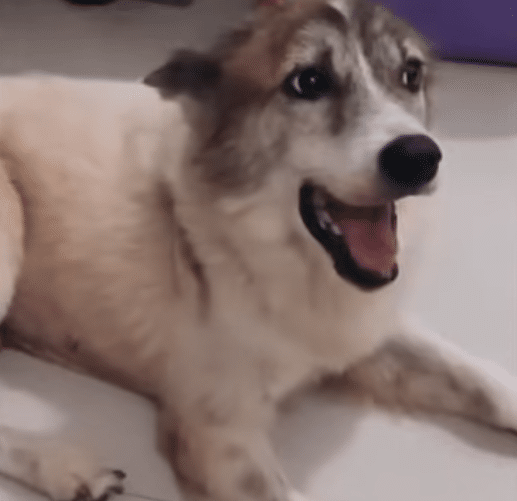
Eventually, Borgie joined a family where he could live surrounded by care and affection.
The roadside puddle was no longer his world.
Neither was the veterinary room where he had struggled to stand.
His life now included something much simpler and more valuable: a home where he was wanted.
Later footage of Borgie shows just how far he came.
The dog who once lay unable to use his hind legs could be seen running across grass, tail moving happily as he played near the people who had welcomed him into their lives.
It is difficult to connect that energetic dog with the small figure rescuers first found shaking beside the road.
Yet they are the same dog.
That is what makes Borgie's recovery so memorable.
What Borgie's Journey Leaves Behind
There was no way to know, during that rainy morning, how Borgie's story would end.
The accident had left him helpless.
His hind legs were not moving.
X-rays had revealed evidence that he had already endured hardship before the crash.
Even after reaching veterinary care, the possibility of lasting paralysis remained.
But Borgie's caregivers continued working with what they had in front of them rather than focusing only on what might be lost.
The first victory was not running.
It was eating again.
Then came a wagging tail.
Then standing.
Then a few uncertain steps.
Months later, those small milestones had become a dog racing freely across the grass.
Borgie's story is a reminder that rescue is rarely one dramatic moment.
Sometimes rescue begins when someone finally stops beside an animal everyone else has passed.
Healing begins with the next meal.
The next exercise.
The next attempt to stand.
And sometimes, when enough patience and compassion are given, a dog once lying helpless in the rain gets the chance to discover an entirely different life.
Borgie received that chance.
And in the end, he did much more than survive.
He found safety, movement, play, and a family of his own.


