
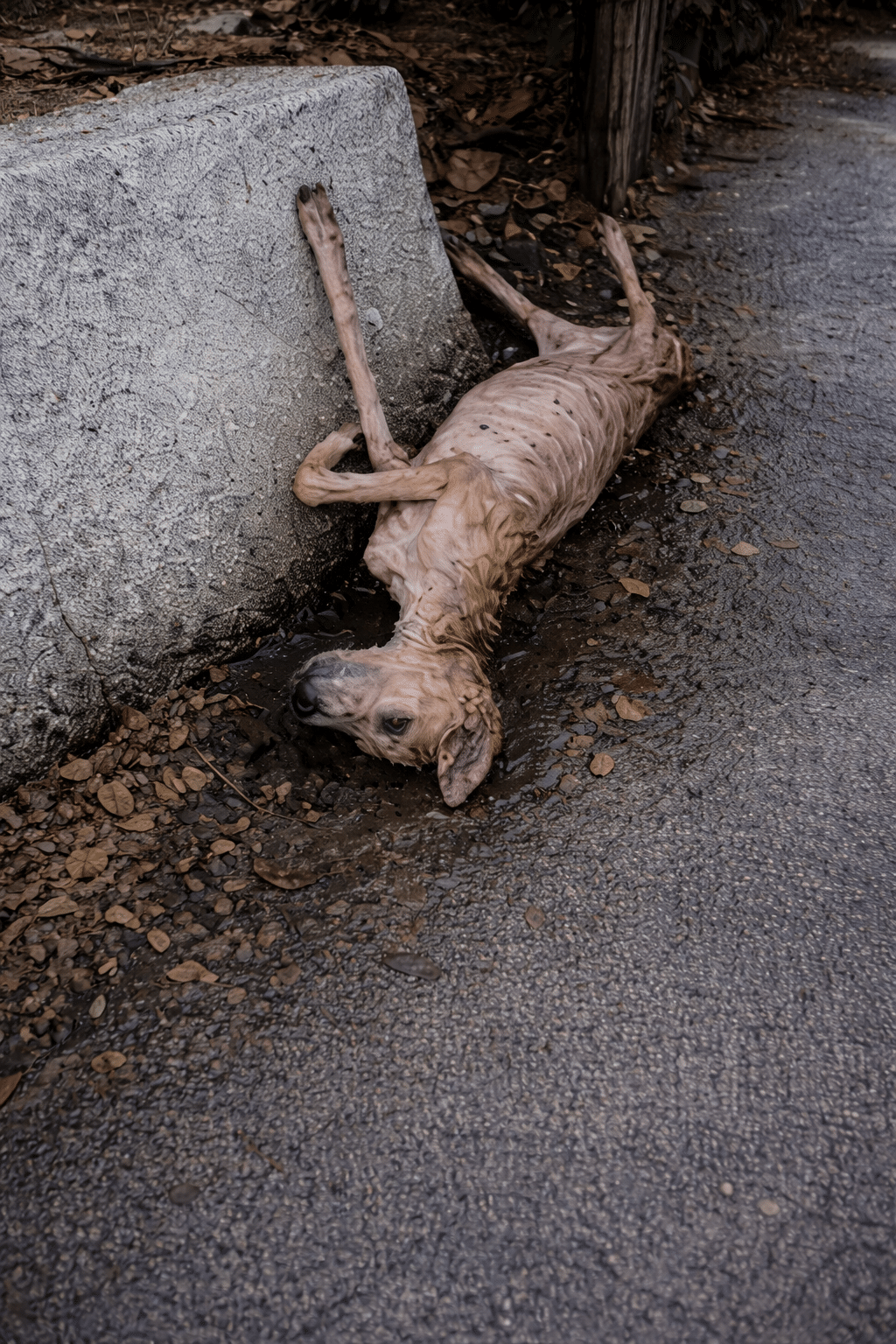
Blue was lying flat beside a cold wall when he was found.
He could barely move. His body had become extremely thin, and several injuries on his skin needed urgent attention. One of his eyes was badly affected by infection, leaving it swollen and uncomfortable.
Most troubling of all, Blue could not stand.
He could not even turn himself over without help.
Yet despite how weak he had become, he was still breathing, still responding, and still holding on.
A Body That Could No Longer Support Him
The extent of Blue’s condition became clearer after veterinary examination.
An X-ray revealed a severe fracture in his spine. The injury explained why his legs could no longer support him and why even the smallest movement had become so difficult.
His physical condition made everything more complicated.
He had lost significant weight. His muscles were weak, and his body did not yet have the strength required for aggressive treatment or surgery.
Before anything else could happen, he needed to survive the immediate crisis.
Blue was taken to an emergency veterinary clinic, where the first priority was stabilization.
His injuries were cleaned and cared for, and treatment for infection began. Because his condition was so fragile, he remained under close observation for the next 72 hours.
At that stage, even eating was difficult.
Solid food was too much for him, so caregivers began with small amounts of nutritional syrup. It was not much, but it gave his body something to work with while the veterinary team watched his condition closely.
For several days, progress was measured in very small changes.
Stable breathing.
A little more responsiveness.
The ability to tolerate nourishment.
Nothing about Blue’s recovery could be rushed.
Five Days That Changed What Came Next
After five days of continuous monitoring, Blue’s vital signs had become stable enough for him to leave the emergency clinic.
It was only one step.
His spinal injury was still serious, his strength was still limited, and he remained dependent on the people caring for him.
But stability meant there was now a path forward.
Blue was transferred to a rescue shelter where his recovery could continue in a quieter environment.
The first night was difficult.
As the effect of his pain medication diminished, Blue cried softly. A caregiver remained beside him, offering comfort rather than leaving him alone with the pain.
There was no promise that the road ahead would be easy.
There was only the promise of presence.
For a dog who had been found unable even to roll over, that mattered.
Surgery was not yet possible because Blue’s body was too weak to tolerate it. Instead, the team focused on rebuilding his strength gradually.
Nutrition became an important part of that plan.
Soft, high-protein foods were introduced carefully, including boiled eggs, warm milk, and other nourishing meals that he could manage without placing too much stress on his weakened body.
VIDEO: Blue Couldn’t Rise When He Was Found — Watch His First Month of Healing
By Day Ten, Small Changes Began to Matter
Recovery did not arrive in one dramatic moment.
It appeared through details that might have seemed ordinary in another dog.
By around the tenth day, Blue was able to eat soft food more comfortably.
His eyes looked clearer.
He became more aware when someone entered the room.
Instead of remaining completely withdrawn, he began responding to the people around him. When a caregiver gently stroked his head, Blue leaned toward the touch.
It was a small gesture.
But after everything his body had endured, allowing that closeness was meaningful.
Physical strength was returning slowly, but so was something less visible: trust.
Blue was still dealing with pain and limited mobility. No one could pretend otherwise.
Yet his world was beginning to change.
Hands were no longer only associated with examination or treatment. They also brought food, cleaned his face, adjusted his bedding, and stayed beside him when he was uncomfortable.
Those repeated moments of care began forming a new routine.
One Month Later, He Looked Like a Different Dog
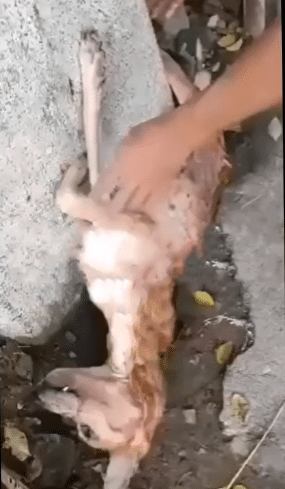
After a month of steady care and improved nutrition, the transformation was becoming easier to see.
Blue had begun gaining weight.
Areas of damaged skin were healing, and healthy fur was returning in places where his coat had been thin or missing.
His surroundings also looked very different from the place where he had first been found.
Instead of lying beside a hard wall, Blue now rested on soft blankets.
Toys were placed nearby.
His eyes and face were cleaned regularly, and his daily care became less about simply keeping him alive and more about helping him become comfortable.
The changes were gradual, but they accumulated.
A little more strength.
A little more awareness.
A little more interest in what was happening around him.
Blue also began meeting other dogs at the shelter.
The introductions were slow and carefully managed. There was no need to overwhelm him. He could simply observe, sniff, and become familiar with companionship at his own pace.
For an animal whose early recovery had required almost constant assistance, those quiet interactions represented another step toward a fuller life.
His Spinal Injury Still Defines the Road Ahead
Blue’s improvement does not mean every problem has disappeared.
The fracture in his spine remains serious.
Whether he will eventually be able to stand independently depends on further medical evaluation and the support available to him as his body grows stronger.
His future may involve continued treatment and long-term assistance.
That uncertainty is part of his story.
There is no need to turn Blue’s recovery into an instant miracle when the truth is meaningful enough.
He was found unable to rise.
He survived the most critical stage.
He began eating again.
His injuries started healing.
He gained weight.
He responded to affection.
And he reached a point where he could begin interacting with the world around him instead of simply enduring each hour.
Healing can look like that.
Not a sudden transformation, but a series of small victories that become visible only when someone has the patience to notice them.
From a Cold Wall to a Place of Safety
Today, Blue is no longer lying helpless where he was first discovered.
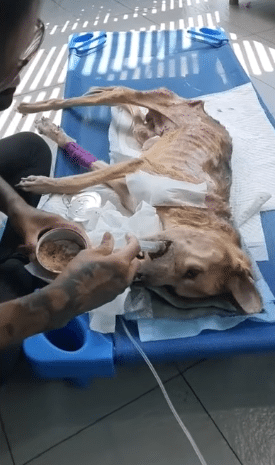
He has warmth beneath him.
He has regular meals.
He has people who clean his eyes, monitor his condition, and remain close when he needs reassurance.
Most importantly, he is no longer facing his condition alone.
There is still a long medical road ahead, and his spinal injury cannot be ignored. But the circumstances surrounding him have already changed completely.
When Blue was first found, his world had narrowed to survival.
Now there are soft blankets, familiar voices, food arriving every day, gentle touch, and other dogs nearby.
These things cannot repair a spine by themselves.
But they can give a fragile body the time and security it needs to keep trying.
Healing Does Not Have to Be Dramatic to Be Powerful
Blue’s story is not about a sudden cure.
It is about what happens when care continues even after the emergency has passed.
His recovery has depended on ordinary things repeated consistently: cleaning wounds, treating infection, providing nourishment, managing pain, keeping him comfortable, and staying close.
There is something deeply moving about that kind of patience.
Blue did not need to perform a dramatic transformation to prove that the effort was worthwhile.
Sometimes progress was simply eating a little more.
Sometimes it was looking toward the person entering the room.
Sometimes it was leaning into a hand instead of pulling away.
A month earlier, Blue could not even roll himself over.
Now he is stronger, more alert, and surrounded by people committed to helping him through whatever comes next.
His future remains uncertain.
But uncertainty is very different from abandonment.
Blue has already learned that when the difficult moments return, someone will still be there.
And for a dog who began this journey lying motionless beside a wall, that may be one of the most important changes of all.


