
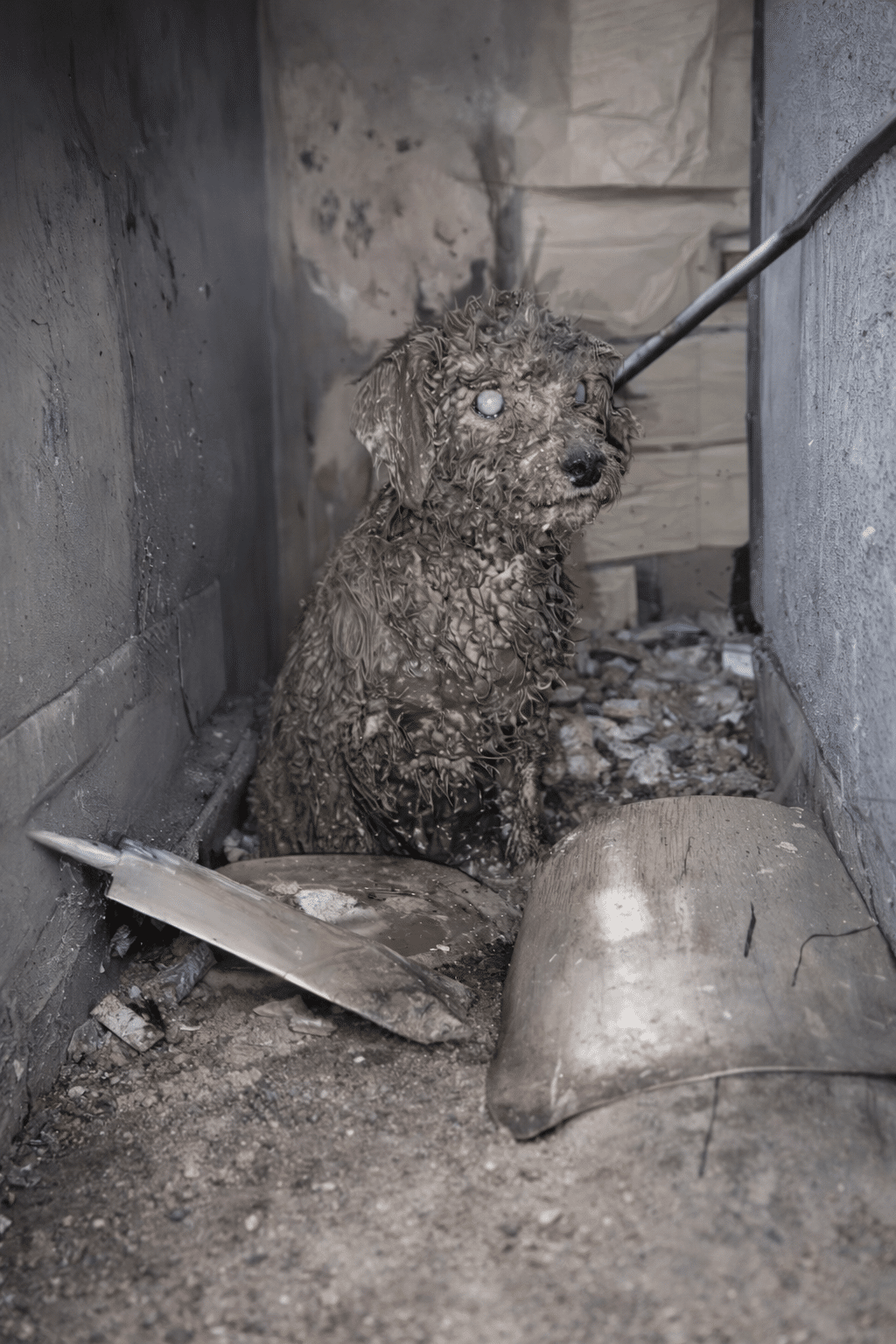
At the bottom of a garbage pit more than five meters deep, a frightened dog stood motionless, surrounded by darkness and debris.
Above him was a narrow opening.
Around him were walls too smooth to climb.
And somewhere beyond those walls was a world he could no longer reach.
He had no way of knowing whether anyone would come.
The dog was blind, exhausted, and trapped in a place where even a healthy animal would have struggled to escape.
By the time rescuers found him, he was no longer making any visible attempt to climb out.
He simply stood there.
Waiting.
What happened next would depend on a man's willingness to descend into a space so narrow that even reaching the trapped animal presented a serious challenge.
A Small Life Hidden Far Below the Surface
The search began when rescuers received a report from a neighborhood about a missing dog.
There was little indication at first of where the animal might have gone.
Eventually, the search led to a vertical garbage pit.
It was an especially difficult place for an animal to become trapped.
The shaft extended more than five meters underground, while its opening measured barely half a meter across. Its walls were smooth and slippery, offering almost nothing a dog could use to gain a foothold.
At the bottom, the rescuers spotted the missing animal.
He was standing among discarded materials, unable to find a way back to the surface.
The situation was troubling enough before anyone understood the full extent of his condition.
From above, the rescuers could see that he was frightened and barely moving.
They could not yet know that the dog had another disadvantage that made his circumstances even more difficult.
He could not see.
For a blind animal, unfamiliar surroundings can be particularly challenging. Familiar sounds, scents, and textures often become important ways of understanding the world.
Here, those familiar signals offered little help.
There was no gentle path upward.
No open space through which he could walk to safety.
Only the confined bottom of a deep shaft and the distant presence of people trying to reach him.
The team needed to act.
But getting down to the dog was only the beginning of the problem.
They also had to find a way to bring him back.
When the First Rescue Plan Failed
The rescuers initially attempted to use a wooden ladder.
It seemed like a reasonable approach to an otherwise inaccessible space.
But once they lowered it into the shaft, the problem became clear.
The ladder was too short.
It was also too unstable to provide a safe route to the bottom.
Trying to force the attempt could have placed both the rescuer and the trapped dog at greater risk.
The team abandoned that plan and prepared a longer aluminum extension ladder instead.
This second ladder offered a more practical way into the narrow pit.
Still, the descent would require considerable care.
There was very little room to maneuver, and the animal waiting below was already frightened.
John, one of the rescuers, volunteered to climb down.
He began lowering himself carefully, one step at a time.
As he descended, the shaft became darker and more confined.
Every movement had to be deliberate.
Reaching the bottom was important, but John also needed to avoid alarming the dog so much that handling him would become impossible.
When John finally approached, the animal's fear became unmistakable.
The dog trembled intensely.
He pressed his body against the wall, trying to put what little distance he could between himself and the unfamiliar person beside him.
It was not an easy moment.
John had reached the animal, but that did not mean the dog understood he was being rescued.
To him, another presence had suddenly entered an already frightening space.
John chose patience over speed.
Rather than immediately trying to grab the dog, he stayed still and allowed the animal time to settle.
There was no need to turn those first moments into a struggle.
For a dog who could not see the person reaching toward him, a calm approach mattered.
A Few Pieces of Food Changed the Moment
The turning point came through something simple.
John offered the dog several slices of ham.
Until then, the animal had been shaking and keeping close to the wall.
But hunger gave him a reason to approach the unfamiliar kindness.
He began eating.
With each piece, his trembling gradually eased.
The difference was small at first, but it was enough.
The dog was beginning to accept help from someone he had every reason to find unfamiliar.
For John, that growing calm created the opportunity he needed.
He could now prepare to lift the animal without forcing a frightened confrontation in the confined shaft.
A difficult rescue was finally moving toward its most important moment.
VIDEO: Blind Dog Trapped Five Meters Underground Trembled in Fear — Until a Rescuer Climbed Down to Save Him
The Difficult Journey Back Into Daylight
Once the dog had become calmer, John gently gathered him into his arms.
The next task was to return to the surface.
The rescuers above were ready to assist.
Working together, they carefully helped bring John and the dog upward through the narrow shaft.
It was a slow process, but the animal remained in John's care as they made their way out.
Then, at last, the dog emerged from the pit.
After being trapped far below the surface, he was finally somewhere the rescuers could examine him properly.
What they saw revealed how difficult his circumstances had been.
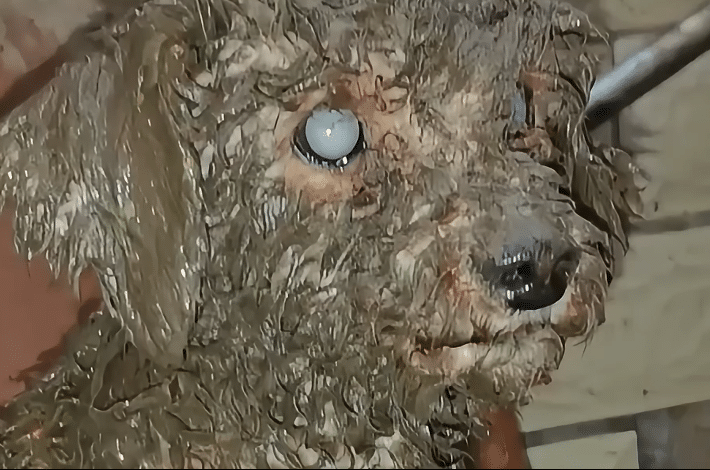
His coat was heavily covered with mud and grime.
A strong odor clung to his fur, reflecting the filthy environment in which he had been trapped.
And his eyes told another part of the story.
They appeared cloudy and white.
The dog was completely blind.
That discovery made the rescue even more significant.
A sighted animal would already have faced an almost impossible climb in such a deep, slippery shaft.
For a dog unable to see his surroundings, finding a safe route out would have been even more difficult.
Yet despite his fear during the initial approach, the dog remained calm in John's arms after being brought to the surface.
The animal who had trembled against the wall was now allowing someone to hold him.
It was an important change.
Not proof that every fear had disappeared, but a first sign that human contact did not always have to mean uncertainty.
John and the rescue team had accomplished the most urgent task.
They had brought him out alive.
But the next part of his journey would require a different kind of patience.
Four Baths to Wash Away the Dirt
After the rescue, the dog was taken to a shelter where his caregivers could begin addressing his immediate needs.
The first challenge was the condition of his coat.
Mud, accumulated grime, and parasites had to be removed.
One bath was not enough.
Neither was a second.
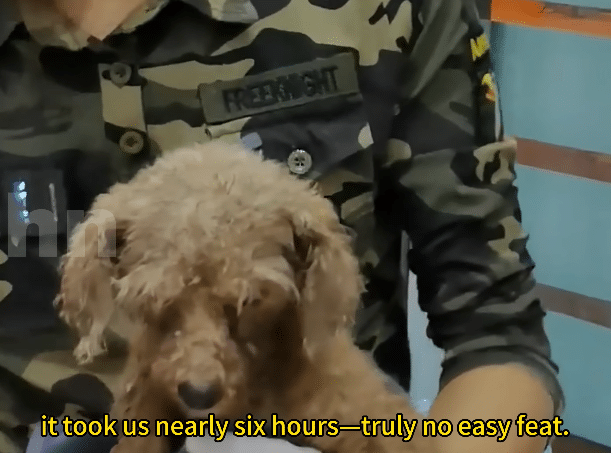
The rescuers washed him four separate times before the layers of dirt were finally cleared away.
With each washing, more of the filth disappeared.
Eventually, the water ran clear.
It was a practical part of his care, but it also marked a meaningful contrast with the place from which he had been rescued.
Only a short time earlier, he had been standing in a pit surrounded by garbage.
Now he was receiving careful attention from people who wanted him to be clean, comfortable, and safe.
The baths could not restore his eyesight.
They could not tell his caregivers what his life had been like before he disappeared into the shaft.
But they addressed a need that had gone unmet.
And for an animal beginning to recover from a frightening ordeal, those basic acts of care mattered.
During this period, the rescuers also made another decision.
They gave him a name.
Happiness.
It was a hopeful choice for a dog whose recent experience had offered very little reason for happiness.
The name did not deny what he had endured.
Instead, it reflected what his rescuers wanted his future to contain.
Comfort.
Gentleness.
And the possibility of a life no longer defined by being trapped and afraid.
The Diagnosis That Could Not Change His Future
Happiness underwent a veterinary examination.
The findings confirmed the rescuers' concerns about his eyes.
His vision was unlikely to return.
There was no indication that he would someday be able to see the people caring for him or visually explore his new surroundings.
His blindness was expected to remain part of his life.
That reality could not be changed simply because he had survived the pit.
But it also did not mean Happiness was incapable of adjusting to safety.
Blind dogs can still respond to familiar voices, scents, touch, and daily routines.
For Happiness, learning to feel secure would depend on those experiences rather than sight.
The shelter staff continued caring for him.
His daily routine included eye medication, which he gradually learned to accept with patience.
This was not the dramatic part of his rescue.
There was no deep shaft to climb.
No ladder to prepare.
No urgent moment when someone had to reach him before he could be carried to safety.
Instead, there were ordinary acts of care repeated consistently.
And those quieter moments began revealing changes in his behavior.
The First Week Revealed a Different Dog
During his first week at the shelter, Happiness slowly became more comfortable.
At the beginning, his fear had been obvious.
In the pit, he had trembled when John came near.
Now, with continued care, the same animal began responding differently to his surroundings.
Unfamiliar sounds no longer startled him as easily.
His appetite returned.
He grew more patient with the daily medication needed for his eyes.
These were not sudden changes that erased everything he had experienced.
They were gradual signs of adjustment.
Perhaps the most touching change appeared in the way he responded to people.
Happiness began leaning gently into caring hands.
A dog who had once pressed himself against a wall in fear was now moving toward human touch.
He still could not see the people around him.
But he could experience their presence through the way they handled him.
The significance of that behavior was easy to understand.
For Happiness, affection did not depend on recognizing a face.
It arrived through contact.
Through the familiarity of gentle handling.
Through repeated experiences in which people approached him without causing harm.
The shelter had become a place where he could begin building that familiarity.
And the change was visible in the simplest interactions.
He no longer needed to recoil from every new sound.
He could eat.
He could accept care.
He could lean toward a person offering comfort.
None of these moments could give back his sight.
But they showed that his ability to respond to kindness remained very much intact.
Learning That Safety Does Not Require Sight
Happiness's story carries a particular kind of tenderness because his rescue did not end with every problem solved.
The team successfully removed him from the dangerous pit.
They cleaned the filth from his coat.
They provided shelter and veterinary attention.
They helped him grow more comfortable with everyday care.
Yet one part of his condition remained unchanged.
He was still blind.
That distinction matters.
Rescue does not always mean restoring an animal to perfect health.
Sometimes it means recognizing the limitations that cannot be removed and providing the support an animal needs to live with them.
For Happiness, progress appeared in his willingness to trust.
He began accepting the people around him instead of responding only with fear.
His improved appetite and calmer behavior suggested that his circumstances were becoming easier for him to manage.
And the way he leaned into gentle touch showed how meaningful positive human contact could become.
His rescuers did not need him to see their faces for their care to make a difference.
They needed him to feel safe in their presence.
The dog who had been found completely still at the bottom of a garbage pit was beginning to experience a different environment.
One where people noticed his needs.
One where food and medication were provided.
One where human hands could offer reassurance.
It was a quieter kind of transformation than the moment he was lifted from the shaft.
But it was no less important.
The Life That Was Worth Climbing Down For
There is one image from Happiness's journey that is difficult to forget.
A blind dog, standing in darkness more than five meters below the surface, unable to escape by himself.
And a rescuer named John, carefully descending a ladder because leaving the animal there was not an acceptable option.
No one could know exactly what Happiness understood during those first moments.
He trembled when John approached.
He gradually calmed when food was offered.
And eventually, he allowed himself to be lifted into safety.
Those simple, documented actions tell the story more clearly than any imagined thoughts could.
He had been afraid.
Someone reached him.
And help became possible.
His later progress at the shelter added another chapter.
Four baths removed the grime from his coat.
A veterinary examination clarified the limitations he would continue to face.
Daily care gave him opportunities to become familiar with kindness.
During his first week, his appetite improved, his fear of unfamiliar sounds diminished, and he began welcoming gentle touch.
The available account does not describe an adoption or a complete medical recovery.
What it does confirm is meaningful enough.
Happiness was rescued from a place he could not escape.
He received care.
And he began showing signs of greater comfort and trust.
His name speaks to the hope his rescuers held for him, even though his future beyond the shelter is not fully documented.
He may never see the light above the pit that once trapped him.
He may never visually recognize John or the people who helped him afterward.
But sight is not the only way an animal experiences safety.
For Happiness, a steady hand and familiar kindness became part of a world he could begin trusting again.
The most important moment of his rescue was not simply reaching the bottom of the shaft.
It was the decision to go down in the first place.
Because sometimes, giving an animal another chance begins with one person refusing to leave him where he has fallen.
And for a blind dog named Happiness, that decision changed everything the rescuers could change.


