
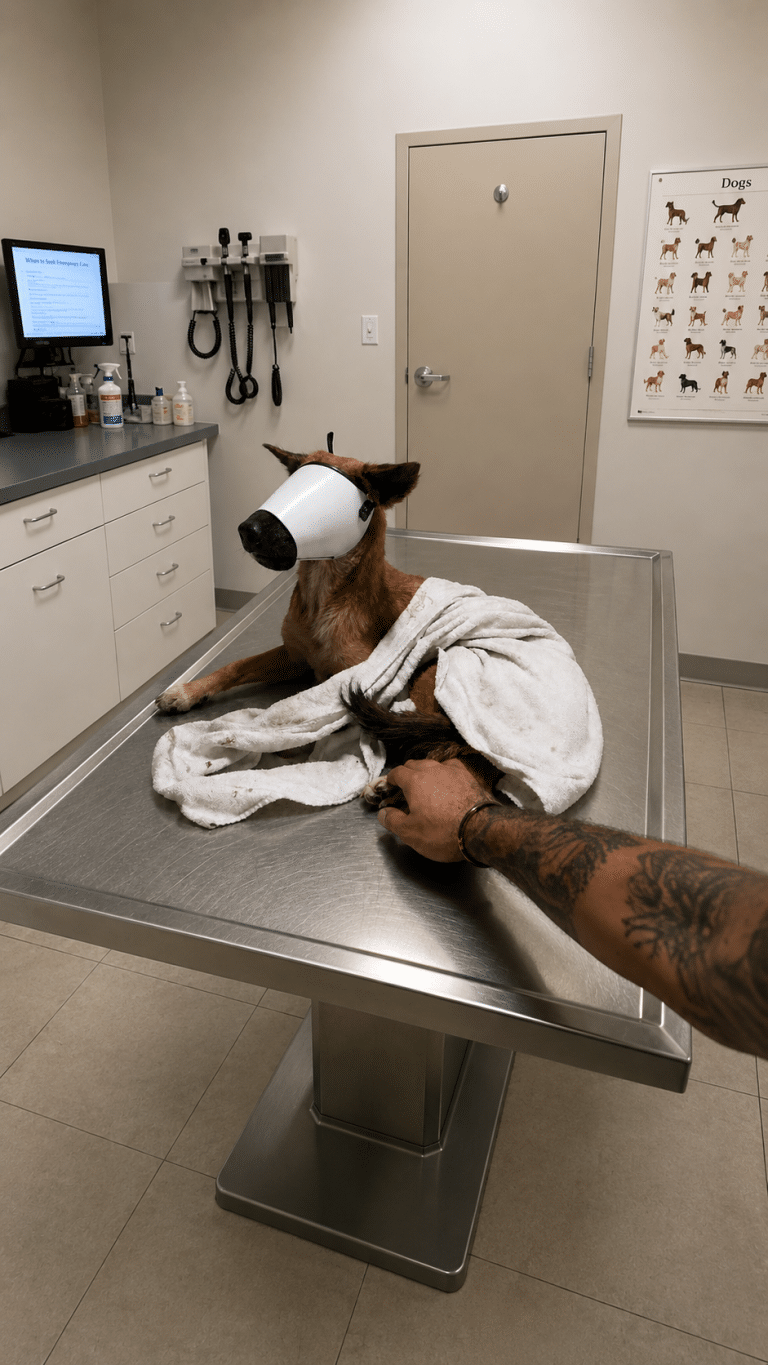
Querubim could barely stand when rescuers found him beside the road.
His small body appeared exhausted. His movements were uncertain. And the injuries affecting his face made it clear that he needed urgent medical attention.
Yet when someone approached to help, he tried to escape.
It was a painful contradiction.
The people coming toward him wanted to save his life, but Querubim seemed too frightened to understand that he was finally being offered kindness.
He had already lost his sight.
And for the moment, fear appeared to be guiding almost everything he did.
What followed would require far more than emergency treatment. Querubim needed extensive medical care, a difficult period of physical recovery, and something that could not be provided through surgery alone.
He needed to discover that people could be trusted again.
A Frightened Dog Who Could No Longer See the World
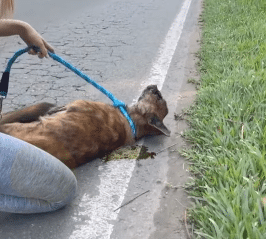
The rescue began when Querubim was discovered lying near a roadside, visibly weak and in serious distress.
His condition immediately concerned the people who found him.
He appeared disoriented and physically depleted. Even before a veterinary examination, it was clear that the injuries around his eyes were severe.
The damage had progressed to the point that his vision was already gone.
For any dog, losing sight changes how the surrounding world can be understood. Familiar visual signals disappear, and sounds, smells, and physical contact take on greater importance.
For Querubim, this loss came alongside significant pain, weakness, and fear.
The rescuers did not know everything he had experienced before they found him.
They could see only the condition in which he had been discovered and the way he reacted when help approached.
Instead of remaining still, Querubim desperately attempted to move away.
His body seemed scarcely strong enough to support him, yet he continued trying.
That response made the situation particularly difficult.
The people attempting to rescue him needed to get close enough to help, but their presence frightened him.
Moving too quickly could make his panic worse.
And leaving him where he was would mean allowing his already serious condition to continue without treatment.
So the rescuers chose patience.
The Difficult Moment When Help Finally Reached Him
There was no simple way to explain safety to Querubim.
He could not see the people approaching him. He could not recognize their intentions through facial expressions or reassuring gestures.
He could only respond to what he heard, felt, and sensed nearby.
When the rescuers moved closer, his immediate reaction was to retreat.
Even standing and walking required enormous effort.
Several times, he appeared close to losing his strength as he struggled to get away.
The rescue team understood that forcing the situation too quickly would only increase his distress.
They approached cautiously, spoke in gentle voices, and allowed the frightened dog to respond at his own pace.
The process demanded restraint.
Querubim was not an aggressive animal confronting the people around him. He was a seriously injured dog reacting defensively to unfamiliar contact.
That distinction mattered.
His attempts to escape were not a reason to abandon him. They were another sign of how much help he needed.
The rescuers continued working carefully until they were finally able to bring him into their care.
It was the first major turning point.
For the first time in this recorded journey, Querubim was no longer facing his injuries without medical assistance.
He had been found.
Someone had stayed.
And now he had a chance to receive the treatment his condition demanded.
VIDEO: Blind and Too Frightened to Accept Help, Querubim Tried to Escape His Rescuers
The Medical Reality Behind His Injuries
Once Querubim arrived at an emergency veterinary clinic, the focus shifted from getting him to safety to understanding the extent of his condition.
Veterinarians needed to examine the serious damage affecting his face and determine what could still be treated.
Because of the severity of the injuries, he was sedated so the team could clean and evaluate the affected area properly.
The findings were difficult.
According to the rescue account, a severe infection complicated by untreated myiasis had caused irreversible damage to both eyes.
Myiasis is a condition involving fly larvae in living tissue. In Querubim's case, the damage described by the veterinary team was extensive.
His eyesight could not be restored.
That reality changed the purpose of his treatment.
The medical team could not return Querubim to the life he had known before losing his vision.
Instead, they needed to address his injuries, support his weakened body, and give him the best possible chance of living comfortably without sight.
His physical condition made the challenge even greater.
After what appeared to be a prolonged period without adequate treatment, Querubim was extremely fragile.
He needed stabilization before doctors could proceed with the more demanding stages of care.
The rescue team also understood that the road ahead would not be short.
Treatment would involve surgery, medication, monitoring, and continued support.
And even if the physical injuries improved, Querubim would still have to learn how to feel secure in a world he could no longer see.
For the people caring for him, saving his life was only the beginning.
A Surgery That Could Help Him Move Beyond the Pain
After Querubim's condition became stable enough, veterinarians performed reconstructive surgery to address the extensive damage to his face.
It was an important step in his recovery.
The goal was not to restore his lost vision. That was no longer medically possible.
Instead, the procedure focused on repairing the injured area and supporting his longer-term healing.
The operation was delicate, and the period afterward brought additional challenges.
Querubim experienced significant swelling and painful complications.
At times, his caregivers were concerned about whether the healing process was progressing as it should.
Recovery was not a steady movement from suffering to comfort.
There were setbacks.
There were periods when his condition required particular attention.
And there was the continuing uncertainty that accompanies caring for an animal recovering from such extensive injuries.
Yet the rescue team and veterinary staff remained committed to his treatment.
Every stage demanded patience.
His body needed time to recover from the procedure. The damaged tissue needed careful attention. His overall strength had to return gradually.
For Querubim, the challenges were physical and emotional at the same time.
He was being treated by people whose intentions were kind, but he had not yet learned to feel comfortable with their touch.
This made his recovery especially meaningful.
The caregivers were not simply treating an injury.
They were helping a frightened, blind dog experience a different relationship with the people around him.
One built on predictable voices, careful movement, and gentle contact.
Healing could not be rushed.
Neither could trust.
The First Signs That Fear Was Beginning to Fade
One of the most important changes in Querubim's journey happened away from the operating table.
It appeared in his response to ordinary human contact.
During the early stages of care, touch could easily frighten him.
Without sight, he could not watch someone approach or anticipate every movement around him.
An unexpected hand could produce an anxious reaction, even when the person reaching toward him intended only to provide comfort.
His caregivers needed to remember this during every interaction.
They approached gently.
They used familiar voices.
They gave him opportunities to recognize their presence before making contact.
Little by little, his behavior began to change.
The dog who had once tried desperately to escape human attention started becoming more comfortable around the people caring for him.
He began recognizing familiar voices.
Gentle physical contact no longer always produced the same frightened response.
And eventually, he started wagging his tail when caregivers approached.
These changes might seem small compared with the surgery he had survived.
But they represented an entirely different kind of progress.
Medical treatment was helping his body recover.
Consistent kindness was helping him feel secure.
For an animal whose earliest recorded response to rescuers had been panic, learning to relax around people was a significant achievement.
Querubim was beginning to discover that human presence did not always mean something frightening was about to happen.
Sometimes a familiar voice simply meant that someone who cared about him was nearby.
Sometimes touch could be gentle.
Sometimes he could remain where he was instead of trying to run.
And those moments gradually became part of his new life.
Learning to Live Confidently Without Sight
As Querubim continued recovering, his ability to move through everyday surroundings improved.
Blindness remained a permanent part of his life.
But it did not prevent him from developing new ways to navigate the world.
His caregivers observed him becoming more comfortable moving through rooms.
He learned to walk more confidently in familiar spaces and to proceed carefully beside people outdoors.
He also gradually became capable of negotiating stairs.
For a dog recovering from severe injuries, these activities were meaningful accomplishments.
Each required him to rely on senses other than sight.
He could not visually judge the distance to nearby objects or look ahead to understand the layout of a room.
Instead, he needed to build confidence through repeated experience and the guidance available to him.
His progress was evident in ordinary activities.
Moving independently.
Eating without assistance.
Responding when someone called him.
Walking beside a caregiver.
Climbing carefully rather than remaining uncertain about the next step.
These were not dramatic accomplishments in the way a major operation might be.
They were the quiet skills that made everyday life possible.
For Querubim, they represented growing independence.
For the rescuers, they provided evidence that the frightened dog they had discovered beside the road was beginning to experience life differently.
He was not simply surviving medical treatment.
He was adjusting to his circumstances and participating more confidently in the world around him.
The Dog Who No Longer Responded to Everything With Fear
The contrast between Querubim's first days and his later recovery is striking.
At the roadside, his body had been weak and his behavior dominated by the need to escape.
He had been severely injured, unable to see, and uncertain about the people trying to approach him.
After veterinary treatment and continued care, his appearance and behavior changed dramatically.
The reconstructed area of his face still carried visible signs of what he had experienced.
His vision did not return.
Those were lasting consequences of his condition.
But other parts of his life had changed.
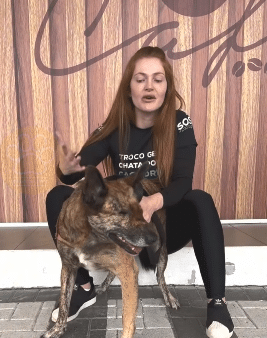
Querubim became affectionate and playful.
He appeared increasingly relaxed around his caregivers.
Instead of immediately retreating from human contact, he began seeking and accepting the companionship of people he recognized.
His wagging tail became a familiar expression of that change.
There is something particularly moving about this part of his recovery.
It would have been impossible to undo every consequence of his injuries.
No amount of kindness could bring back his sight.
Yet kindness, together with medical care, could help him build a life that was no longer defined entirely by fear.
His physical scars remained.
His behavior told a different story.
The animal who once struggled to get away from rescuers had become comfortable enough to enjoy their company.
He could move forward without seeing the path ahead.
And he could accept the presence of people without treating every approach as a threat.
What His Recovery Required From the People Around Him
Querubim's transformation did not happen through one dramatic moment.
It depended on many forms of care working together.
The rescuers first had to bring him to safety despite his fear.
Veterinarians then needed to assess and address the severe injuries that had cost him his sight.
After surgery, his recovery required continued attention through swelling, complications, and the gradual healing process.
And throughout it all, his emotional needs remained important.
A dog recovering from a major physical injury may also struggle with unfamiliar handling and surroundings.
For Querubim, blindness added another layer of difficulty.
He could not use sight to anticipate the movements of the people around him.
That made patience and consistency especially valuable.
His caregivers helped him become comfortable with familiar voices and gentle touch.
Over time, those experiences allowed him to respond with greater confidence.
The work was not limited to medical procedures.
It included the everyday process of helping him function independently and feel comfortable in his surroundings.
This is what made his recovery so much more than a change in appearance.
The veterinary team helped address the damage to his body.
The people caring for him afterward helped him adapt to his permanent loss of vision.
Both parts of that journey mattered.
His progress shows how closely physical healing and emotional security can be connected.
When an injured animal receives consistent care, recovery can involve more than the disappearance of immediate medical danger.
It can also mean discovering ways to enjoy ordinary life again.
A Second Chance That Did Not Require Perfect Healing
Near the conclusion of Querubim's rescue journey, the people involved expressed gratitude to the veterinary professionals and supporters who helped make his treatment possible.
They also acknowledged the considerable medical expenses involved in his care.
His case required extensive attention over months, including procedures, medication, and continued recovery support.
For animal rescue organizations, these responsibilities can create serious financial pressure.
Providing medical treatment for a critically injured animal is rarely a simple undertaking, especially when care continues long after the initial emergency.
Querubim's progress reflects the combined efforts of the people who refused to leave him behind.
But perhaps the most important part of his story is what recovery came to mean.
His injuries were not completely erased.
He remained blind.
The changes to his face were permanent reminders of the condition in which he had been found.
And still, the dog who emerged from treatment was affectionate, responsive, and capable of enjoying his life.
He no longer needed sight to recognize a familiar voice.
He did not have to see a caregiver's face to become excited when that person approached.
He could respond to gentle touch, move through familiar surroundings, and experience companionship.
The loss of his vision had changed his life profoundly.
It had not taken away every possibility of happiness.
When Querubim was first discovered, his instinct was to get away from the only people trying to help him.
By the end of his recovery journey, those same kinds of human interactions had become a source of comfort.
That transformation is the heart of his story.
A rescue did not restore everything he had lost.
It gave him medical care when he urgently needed it, patient support when he was afraid, and the opportunity to build confidence despite permanent blindness.
Querubim's second chance was never about becoming the dog he had been before.
It was about helping him live well as the dog he is now.
And whenever he walks confidently beside someone he trusts, his journey offers a quiet reminder:
A life can still hold comfort, connection, and joy even when some wounds never fully disappear.


