
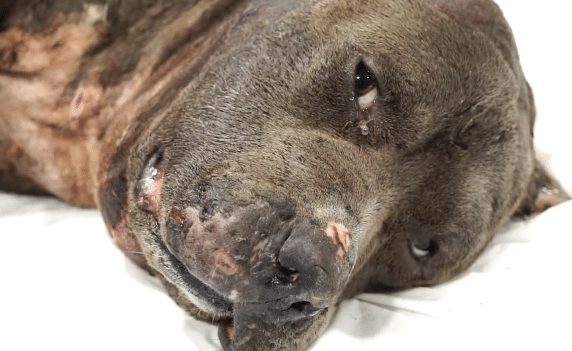
Betsy lay almost motionless on the veterinary examination table.
Her body showed signs of extraordinary suffering. Serious injuries covered her face, neck, and legs, and one of her ears had been badly damaged. Even the experienced veterinary professionals examining her were deeply concerned about what they were seeing.
Yet amid the uncertainty, one detail stood out.
Betsy remained gentle.
She did not struggle against the people approaching her. She did not respond with aggression. Instead, the exhausted pitbull allowed the veterinary team to begin helping her.
No one could promise that she would recover.
But the people standing beside that examination table were not ready to give up on her.
What followed would become a remarkable journey of medical care, patience, and a dog's gradual return to a life filled with movement, companionship, and joy.
The Quiet Dog Who Needed Someone to Believe in Her
When one of Betsy's rescuers first encountered her at the veterinary hospital, he feared she might not survive.
He would later remember that moment as one of the most difficult parts of her story.
Betsy's condition was extremely serious. She had sustained numerous injuries, particularly around her head and neck, and some affected areas showed signs of infection.
The veterinary team faced a complicated situation.
Before they could focus on rebuilding her strength, they needed to understand whether her weakened body could withstand the treatment required.
There were difficult questions.
How much pain was she experiencing?
Could her injuries be treated successfully?
Would her condition improve enough to give her a comfortable life?
At that stage, the answers were far from certain.
Based on the pattern of her injuries, rescuers suspected that Betsy had survived a serious encounter involving other dogs. They also considered the possibility of a connection to dog fighting, although the available account did not establish exactly what had happened to her.
Her past remained uncertain.
What could be seen clearly was the condition she was in when help reached her.
She needed substantial veterinary attention, and she needed it urgently.
For a time, the severity of her condition was so concerning that humane euthanasia entered the discussion as a possible outcome.
It was not a decision anyone could approach lightly.
The team had to consider whether treatment could realistically relieve her suffering and offer her a meaningful chance at recovery.
But Betsy gave them a reason to continue trying.
Despite everything her body had endured, she remained remarkably patient with the people caring for her.
That gentle response did not guarantee that she would survive.
It did, however, make the people around her even more determined to explore what could be done.
A Difficult Beginning and a Chance Worth Taking
The early stage of Betsy's care required a balance between urgency and caution.
Her injuries needed attention, but her weakened condition also made every step important.
The veterinary professionals could not simply wish away the damage or expect her body to recover immediately.
They had to work through the problems in front of them.
The rescue team also understood that a successful outcome would depend on much more than the first examination.
Betsy would need continued medical attention, careful observation, and people willing to remain involved even if her progress was slow.
There was no certainty that their efforts would succeed.
Still, they chose to give her that chance.
For Betsy, the change was significant.
Instead of facing her injuries without the care she needed, she was now surrounded by people who were trying to improve her condition.
The team could monitor her health.
They could provide appropriate treatment.
And they could make decisions based on how she responded.
It was the beginning of a long process, rather than the end of her difficulties.
VIDEO: Betsy Arrived With Severe Injuries and Little Strength — Watch Her Remarkable Journey Back to Life
The Months of Care That Slowly Changed Everything
Betsy's recovery was not a sudden transformation.
It developed through months of veterinary treatment and close attention to her changing condition.
The medical team worked to clean and manage her injuries, remove damaged tissue where necessary, replace dressings, and monitor her healing.
Some of the injuries around her head and neck were particularly challenging.
The affected areas required careful management, and the risk of complications made ongoing veterinary supervision essential.
For Betsy, treatment was not always comfortable.
Her body was already exhausted, and the healing process demanded more strength than she initially seemed to have.
Yet her caregivers continued.
They approached her recovery as a series of problems that needed to be addressed, one at a time.
The immediate concern was caring for her most serious injuries.
Then came the continuing work of managing those injuries as her condition changed.
As healing progressed, the team could begin looking beyond the initial crisis toward Betsy's ability to move comfortably and regain her strength.
None of those stages could be rushed.
Recovery from severe physical trauma is rarely a straight path. Even when improvement becomes visible, continued care remains important.
Betsy's story reflected that reality.
There was no single moment when everything suddenly became easy.
Her progress was built through repeated treatment, observation, and the willingness of her caregivers to continue supporting her.
The rescue team later emphasized that there had been no instant solution.
Their work involved persistence, long hours, and many ordinary acts of care that gradually produced extraordinary results.
A dressing changed.
An injury monitored.
A difficult day of treatment completed.
A small improvement that made the next stage possible.
Taken individually, those moments might not have seemed dramatic.
Together, they gave Betsy the opportunity to recover.
When Standing Up Became the Beginning of a New Life
As Betsy's injuries began healing, her physical abilities slowly improved.
At first, even standing was difficult.
Her body had been through so much that regaining ordinary movement became an important part of her progress.
But over time, those limitations began to change.
She grew stronger.
Her walking became steadier.
Then came another encouraging sign.
Her tail began to wag again.
It was a simple movement, but for a dog who had once been too exhausted to do much of anything, it meant something.
Betsy was beginning to participate in the world around her again.
Her caregivers also noticed that she was becoming more curious about her surroundings.
The dog who had once remained almost completely still during her first examination was showing more interest in life.
These changes did not erase the seriousness of what she had experienced.
They showed that recovery was taking place.
For the people caring for Betsy, her improvement offered reassurance that their continued efforts were making a difference.
And there was another part of her recovery that made her story especially moving.
Throughout the experience, Betsy continued to show affection toward people.
Her gentle behavior had been apparent during the earliest stages of treatment.
As her health improved, that same willingness to connect with humans remained.
Whatever had happened before her rescue, it had not prevented her from responding warmly to the people who helped her.
That mattered.
Physical healing was essential, but Betsy's future also depended on being able to enjoy ordinary experiences without the constant limitations of her injuries.
Walking comfortably.
Exploring her surroundings.
Playing.
Spending time with people and other dogs.
Those everyday pleasures gradually became part of her life again.
From a Veterinary Examination Table to Open Green Fields
The later footage of Betsy tells a very different story from the images recorded during her early treatment.
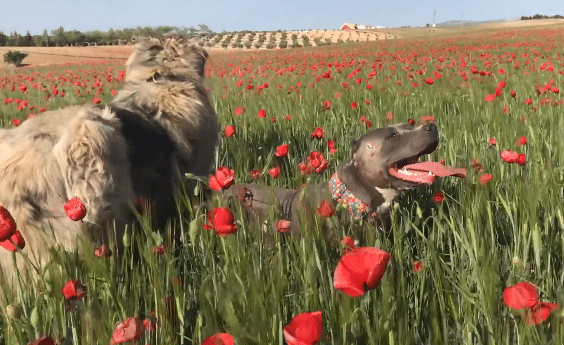
Instead of lying exhausted in a veterinary hospital, she is seen moving freely through open, grassy spaces.
She runs across green fields.
She splashes through water.
She plays alongside other dogs.
Her body, once severely weakened, appears healthy and strong.
There is energy in her movements and enthusiasm in the way she explores her surroundings.
It is a striking contrast.
During the early part of her journey, even standing required effort.
Now she can run.
During her initial examination, her injuries and exhaustion limited nearly everything she could do.
Now she can enjoy the simple activities that make a dog's life fulfilling.
And instead of spending her days focused on medical treatment, she is seen enjoying the freedom to move and play.
These scenes offer something more meaningful than a dramatic before-and-after comparison.
They show the practical results of recovery.
Betsy did not merely survive her injuries.
She regained the ability to enjoy life.
The transformation is especially moving because the earlier uncertainty was so serious.
Her rescuers had once faced the possibility that treatment might not be enough.
Seeing her run through the grass provides a powerful answer to that fear.
It shows how far she has come.
It also highlights the importance of the extended care that made such progress possible.
Every stage of treatment contributed to the opportunity she now has to live more comfortably.
The People Who Stayed Through the Hardest Days
Betsy's recovery required more than one person's efforts.
Veterinary professionals provided essential treatment.
Rescuers remained committed to her care.
Supporters and donors helped make the continuing work possible.
And throughout the difficult process, people continued investing time and resources in a dog whose future had once been deeply uncertain.
One of her rescuers would eventually describe Betsy as a living miracle.
It is easy to understand why he felt that way.
He had seen her when survival itself was in question.
He had witnessed the seriousness of her injuries and the challenges involved in treating them.
And later, he was able to see her healthy enough to run, play, and enjoy the world around her.
But Betsy's journey is also a reminder that remarkable recoveries are often the result of very practical work.
Veterinary care.
Consistent monitoring.
Financial support.
Time.
Patience.
And the difficult decision to continue treatment when the outcome is still uncertain.
None of those contributions should be overlooked.
The visible transformation may be what first captures people's attention, but the quieter work behind it is just as important.
A seriously injured animal cannot always recover through determination alone.
It needs appropriate medical care and people who are able to provide that care.
Betsy was fortunate to have both.
Her rescuers did not know at the beginning that she would eventually become the energetic dog seen in the later footage.
They could only respond to her condition, follow veterinary guidance, and support her through each stage.
As her health improved, the possibilities for her future expanded.
What began as an urgent effort to help a critically injured dog became a long-term commitment to restoring her quality of life.
The Happiness Betsy Deserved All Along
There is something deeply affecting about watching Betsy enjoy the freedom of an ordinary day.
She no longer appears as the fragile dog who could barely move during her first examination.
She is active.
She is playful.
She appears comfortable around people and other dogs.
Most importantly, the later footage confirms that her journey did not end with the frightening condition in which rescuers first encountered her.
She had a chance to recover, and that chance changed her life.
Her story does not need an imagined ending or a dramatic explanation of everything that happened before she received help.
The known facts are already meaningful.
Betsy arrived at a veterinary hospital with severe injuries and an uncertain prognosis.
Dedicated caregivers provided treatment over an extended period.
Her strength gradually returned.
She began walking more comfortably, showing curiosity, and expressing affection.
And eventually, she was healthy enough to run and play freely.
That is the transformation worth remembering.
Not every animal facing serious injuries will experience the same outcome. Medical realities differ, and even the most compassionate care cannot guarantee recovery.
But Betsy's experience demonstrates why careful assessment, ongoing treatment, and a willingness to support vulnerable animals matter.
For the people who helped her, the reward was not simply seeing her injuries heal.
It was seeing her enjoy being a dog again.
The green fields, the playful encounters, and the water splashing around her are ordinary pleasures.
For Betsy, they represent something she nearly lost.
A future.
A chance to feel comfortable in her own body.
And the opportunity to experience happiness beyond the difficult beginning of her story.
Perhaps that is the most enduring lesson of her recovery.
Compassion does not always produce an immediate result.
Sometimes it means showing up repeatedly, through uncertainty and slow progress, until healing finally becomes possible.
Betsy was once a dog whose survival seemed doubtful.
Today, the images of her running freely tell a different story.
One shaped by determination, skilled care, and people who believed her life deserved a chance.
And for Betsy, that chance made all the difference.


