
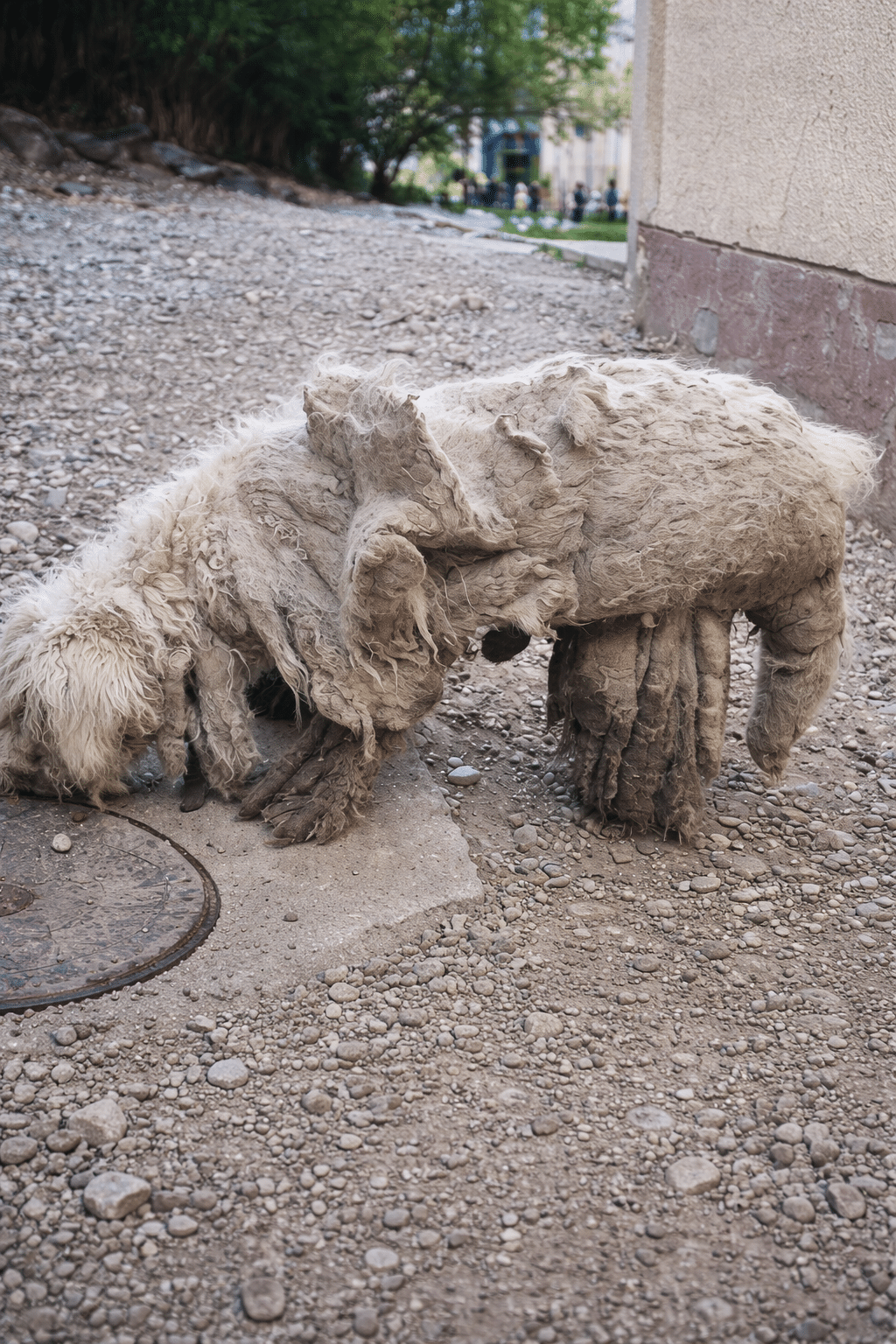
A thick, hardened coat wrapped around Beli’s small body so tightly that even the lightest touch could hurt.
By the time volunteers reached him in Sremska Mitrovica after more than an hour on the road, the white dog was carrying far more than ordinary tangled fur. Months of dirt and overgrown hair had compressed into dense mats that clung closely to his skin.
One volunteer described it as the most severe matting they had ever encountered.
But freeing Beli would require more than clippers.
He was frightened, uncomfortable, and unwilling to let anyone come close.
When Help Itself Felt Dangerous
The volunteers could see immediately that Beli needed care, but approaching him was another matter.
The coat surrounding his body had become so tight that movement pulled against his skin. Areas that should have been soft and flexible had hardened into a heavy shell.
Touch no longer meant comfort.
For Beli, it could mean pain.
That made his reaction understandable. Whenever someone tried to approach or handle him, fear took over and he became defensive.
The volunteers could not simply reach down and pick him up.
For two days, they worked patiently around his fear.
There was no quick solution and no safe way to force the situation. Beli had to be handled carefully, both for his own protection and for the people trying to help him.
Eventually, through careful coordination and persistence, they were able to guide him into a crate.
It was a small step in appearance.
For Beli, it was the beginning of freedom.
Once he was safely contained, the volunteers transported him to a veterinary clinic where the real work could begin.
A Coat That Could Not Simply Be Brushed Away
At the clinic, it became obvious that Beli did not need an ordinary grooming appointment.
The mats were too severe.
They had formed close to his skin, creating areas where removing them without careful preparation could cause further discomfort. Beli was also still defensive after so much prolonged sensitivity.
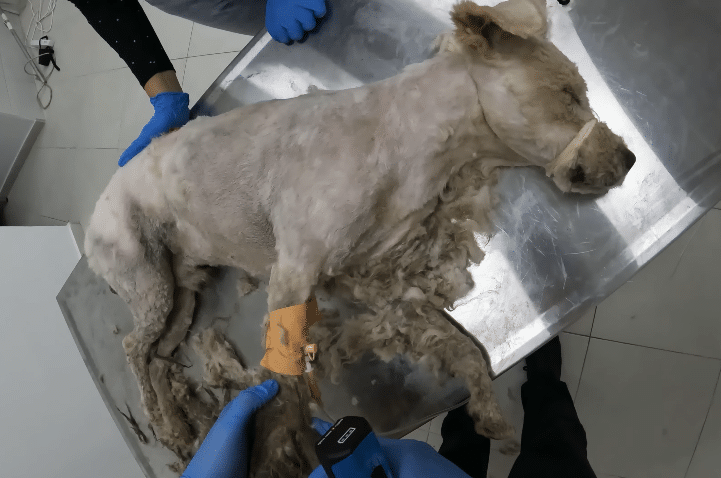
The veterinary team decided that mild sedation would be the safest option.
Before beginning, they performed blood tests and screened him for parasites, including Giardia and heartworm.
After everything visible on the outside, the results brought encouraging news.
Beli’s internal condition was stable.
That gave the team a safer path forward.
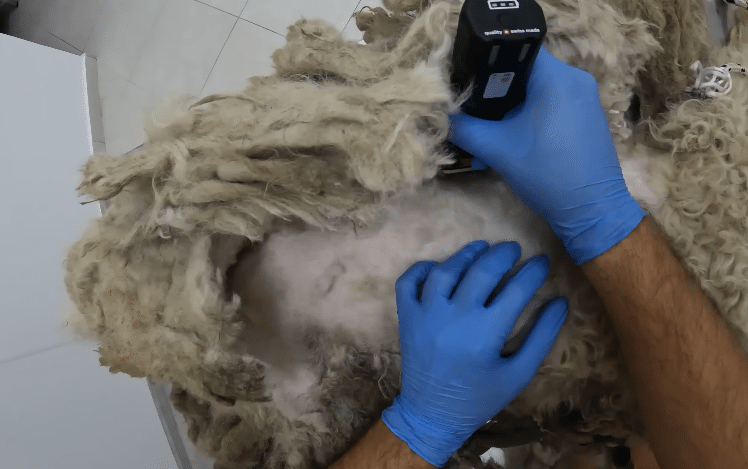
What followed was an unusually delicate grooming procedure—something the rescuers would later describe as a kind of “great surgery of fur.”
Clippers and specialized scissors were used slowly, section by section.
There was no rushing.
Some areas demanded particular care, especially beneath his tail and around his armpits, where the skin had been subjected to prolonged pressure.
Piece after piece came away.
With every section removed, more of the small dog hidden beneath the coat began to appear.
VIDEO: Beli Could Barely Be Touched — Then His Heavy Matted Coat Finally Began to Fall Away
The Dog Beneath the Heavy Layers
When the last major sections were removed, the discarded coat looked less like loose fur and more like a thick carpet lying on the floor.
It was dense, heavy, and difficult to imagine carrying day after day.
Yet Beli had been doing exactly that.
Without those layers surrounding him, his true size became visible.
He looked smaller.
Lighter.
His body was finally able to move without the same constant pulling against his skin.
The physical transformation was striking, but the change in his behavior mattered just as much.
As the pressure disappeared, some of the tension that had defined his earlier reactions also began to ease.
Beli had not suddenly become a different dog.
The source of much of his discomfort had simply been removed.
And for the first time in a long while, gentle movement no longer had to fight against a rigid coat.
His skin still needed time and treatment. Small affected areas along his back were linked to prolonged keratosis caused by the pressure of the matting, and veterinarians prescribed a 10-day course of antibiotics.
Healing would continue after he left the clinic.
But one enormous burden was already gone.
Behind Beli’s Condition Was a Different Kind of Hardship
As volunteers learned more about Beli’s life, his situation became more complicated than it first appeared.
He had not been living alone on the streets.
Beli had a home.
His owner was an elderly woman who had lost her husband five years earlier. Not long after that loss, Beli entered her life and became her companion in an increasingly quiet home.
She cared about him.
The problem was not a lack of affection.
Over the previous two years, financial hardship had made regular grooming increasingly difficult. As Beli’s coat grew, maintaining it became harder, and the situation gradually moved beyond what she could manage.
The matting did not appear overnight.
It built slowly.
One missed grooming became another. Tangled areas grew tighter. Eventually, the coat reached a point where ordinary home care was no longer enough.
For the volunteers, understanding that history changed what meaningful rescue looked like.
Taking Beli permanently away from the only home and person he knew was not the only possible answer.
There was another option.
Support both of them.
A local supporter—the same person who had originally shared Beli’s situation on Facebook—offered to help the woman care for him going forward.
Assistance would include parasite treatments, veterinary visits, and the ongoing care needed to prevent his coat from ever reaching the same condition again.
Instead of ending one relationship, the rescue created a support system around it.
A Second Chance That Did Not Require Losing His Home
After the procedure, Beli looked dramatically different.
The dense white shell that had hidden his body was gone.
A new protective collar replaced the old one, and he could stand and move without the same heavy coat pulling against him.
His posture appeared gentler.
His eyes seemed calmer.
Those changes did not erase what he had experienced, and his skin still needed time to recover. The prescribed antibiotics would continue for 10 days as his affected areas healed.
But the most difficult physical obstacle had already been removed.
Beli was no longer trapped inside his own fur.
And importantly, his future no longer depended entirely on an elderly owner trying to manage everything by herself.
She would have help.
There would be people available to assist with treatment and veterinary care.
The same community that had recognized Beli’s need was now working to make sure that need did not return.
That changed the meaning of going home.
He was not simply being returned to the circumstances that had allowed his condition to develop.
He was returning with a wider circle of support around him.
Sometimes Rescue Means Keeping a Bond Together
Animal rescue stories are often described as journeys from a difficult home into a completely new one.
Beli’s story followed another path.
The volunteers found a dog in serious discomfort and gave him the veterinary attention he needed. They removed a coat that had become impossible for him to live with comfortably. They arranged treatment for the remaining skin problems.
But they also looked beyond what was immediately visible.
They saw an elderly woman living with financial hardship.
They saw a dog who had become her companion after the loss of her husband.
And rather than assuming that separation was the only compassionate response, they helped create conditions in which that relationship could continue more safely.
That distinction matters.
Neglect can have many causes, and understanding those causes can determine what kind of help will actually last.
In Beli’s case, the answer was not simply to rescue him once.
It was to make future care possible.
Regular treatment.
Veterinary support.
People willing to step in when his owner could not manage alone.
The transformation began with scissors and clippers, but it did not end there.
Lighter Fur, Stronger Support
By the time Beli was ready to leave the clinic, he was carrying far less weight on his body and had far more support around his life.
His coat could grow again without becoming a prison, provided the promised care continued.
His owner would no longer have to face every challenge by herself.
And Beli could return to the home he knew while receiving the attention his health required.
Sometimes compassion means opening a door and taking an animal somewhere new.
Sometimes it means noticing that a person is struggling too—and helping them care for the animal they already love.
For Beli, rescue did not mean losing his home.
It meant being freed from the painful layers that had trapped him, receiving the medical care he needed, and returning to familiar surroundings with people now prepared to help protect his future.
The burden on the clinic floor told one part of his story.
The community that formed around him told the rest.
And that may be the most lasting part of Beli’s second chance: he went home lighter, more comfortable, and no longer dependent on one person carrying every responsibility alone.


