
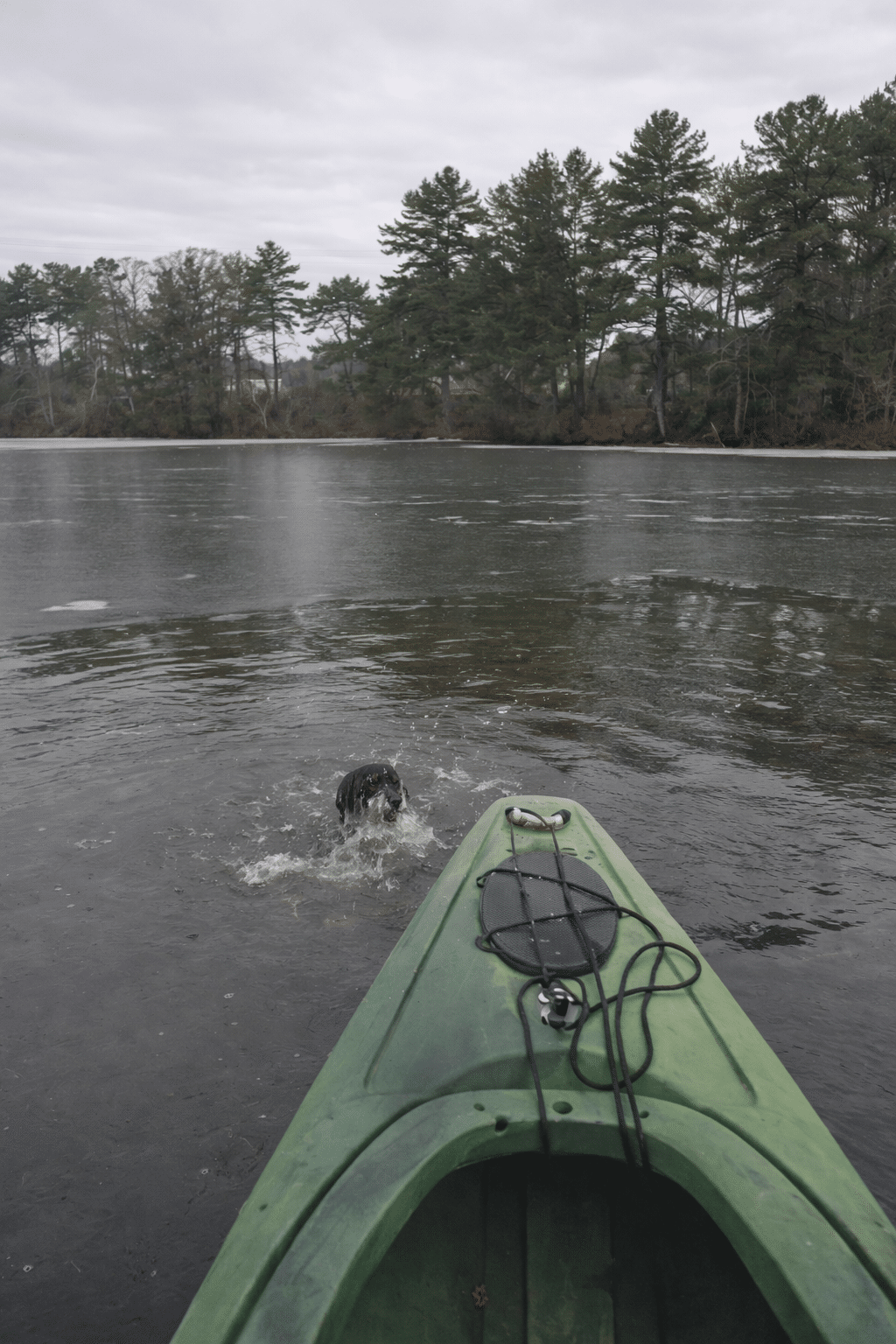
The river looked almost still from a distance.
Thin sheets of ice stretched across the surface, broken into fragile plates that shifted over dark, moving water. In the middle of that winter river, a gray-and-black dog was trying desperately to climb out.
His name was Barney.
His paws reached for the ice, but the slick surface offered almost nothing to hold onto. Each attempt ended the same way: his claws slipped, his body dropped back into the freezing water, and he had to begin again.
The danger was not difficult to understand.
Barney could not reach the bank.
He could not pull himself onto the ice.
And he could not keep fighting forever.
A Green Kayak Turned Toward the Trouble
Nearby, a man was moving across the water in a bright green kayak when something caught his attention.
At first glance, movement among broken pieces of ice might have been easy to dismiss.
But he looked again.
There was a dog in the water.
Once he understood what he was seeing, the kayaker changed direction and began paddling toward Barney.
That choice mattered because the situation was already getting worse.
Barney's coat was soaked, and his movements were beginning to slow. Every failed attempt to climb onto the ice required more effort. The water beneath him continued moving while the fragile surface around him provided no safe route back to land.
The man kept coming closer.
There was little room for hesitation.
One Reach Over the Side of the Kayak
Getting near Barney was only the first part of the rescue.
The kayak was small, the water was cold, and the dog was still partly surrounded by unstable ice. The rescuer had to get close enough to reach Barney without losing control of the boat.
Then came the moment on which everything seemed to depend.
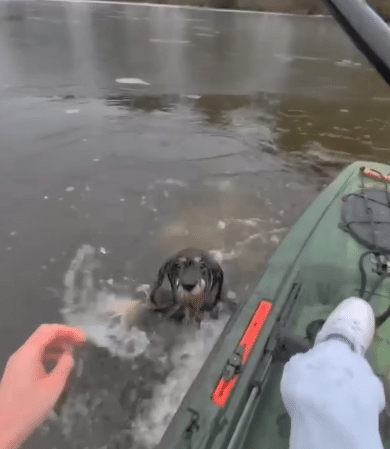
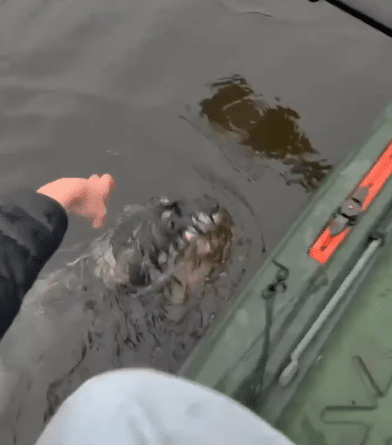
The man leaned over the side.
He reached toward Barney and grabbed a handful of fur at the back of the dog's neck.
It was not an elegant rescue.
There was no time for that.
It was a firm, urgent grip meant to get Barney out of the water as quickly as possible.
With a hard pull, the kayaker hauled him upward and into the boat.
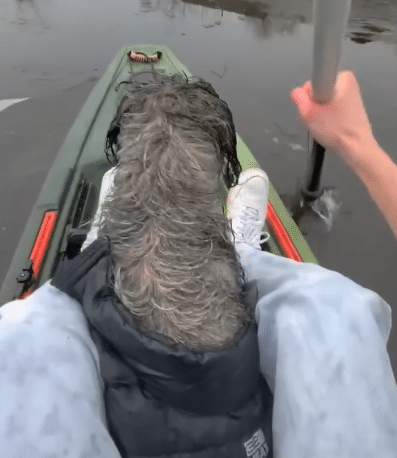
Cold water splashed across the kayak as Barney came over the side. Once inside, the dog collapsed into the small space, trembling after his struggle in the freezing river.
For the first time since the ordeal began, he was no longer fighting simply to keep himself above the water.
He was in the kayak.
And someone was beside him.
VIDEO: Barney Was Losing His Fight With the Ice — Then a Kayaker Reached Down
“I’ve Got You, Buddy”
The rescue did not become quiet simply because Barney was out of the river.
He was still shaking.
The cold had not disappeared, and neither had the fear of what had just happened.
The man began speaking to him.
“You’re okay… I’ve got you, buddy.”
Then came another reassurance.
“It’s alright. You’re safe.”
They were simple words, spoken while the rescuer steadied himself and the kayak.
At one point, he admitted something just as plainly:
“I’m cold and scared too, little guy.”
There was something deeply human in that moment.
The man did not pretend the situation was easy. He did not need a dramatic speech. He was cold, Barney was frightened, and they still had to make it back to shore.
So he did the only thing that mattered.
He kept Barney close and started paddling toward land.
As he moved, the rescuer called to a woman waiting on the riverbank.
“What’s your dog’s name?”
Her answer came back:
“Barney!”
Until then, the kayaker had been rescuing a dog he did not know.
Now the animal curled beside him had a name.
Barney.
Someone was waiting for him.
Someone knew exactly who was out there on that freezing river.
The man continued toward shore carefully, keeping the kayak as steady as he could while Barney remained beside him.
The Moment Barney Reached Solid Ground
The journey back was shorter than the struggle that had brought Barney into the kayak, but it carried its own tension.
The rescue was not finished until he was safely off the water.
When the kayak finally reached the shallow edge near land, the man guided Barney toward the bank.
For a brief moment, the dog hesitated.
Then he jumped.
His paws touched solid ground again.
Only minutes earlier, those paws had been scraping helplessly against ice that would not hold him. Now Barney was back on shore and reunited with the person who had been waiting there through the rescue.
There was no need for an elaborate celebration.
The important thing was simple.
Barney was no longer in the freezing river.
The desperate struggle between broken sheets of ice was over.
The woman who had watched from land could finally reach him again.
A Rescue Built on a Single Decision
What makes Barney's rescue memorable is how quickly everything changed.
One moment, a man was moving across the river in his kayak.
The next, he noticed something that did not look right.
He could have continued on.
Instead, he turned toward it.
That decision brought him close enough to see Barney's danger, close enough to reach over the side of the kayak, and close enough to pull the exhausted dog out of the water.
There were no complicated tools described in the rescue.
There was a kayak.
There was a man willing to act.
And there was a dog who needed help immediately.
Sometimes courage appears in exactly that form.
Not as a grand plan made in advance, but as a decision made in the few seconds when someone realizes another life is in trouble.
The man could not change the temperature of the river.
He could not make the ice stronger.
But he could change his direction.
And that was enough to change Barney's story.
When Kindness Moves Toward the Danger
Barney's rescue is powerful because it began with something ordinary: someone paying attention.
The river looked quiet, but it was not safe.
The movement among the ice could have been overlooked, but it was not.
And when the kayaker understood what was happening, he moved toward the dog instead of away from the danger.
His actions were urgent, but his voice remained calm.
“I’ve got you, buddy.”
Those words did not pull Barney from the river by themselves.
The man's hands did that.
His kayak did that.
His decision to turn around did that.
But the words reveal another part of rescue that is easy to miss.
Sometimes helping means more than removing an animal from immediate danger. It also means offering steadiness in the middle of fear.
Barney could not understand everything happening around him.
But he was no longer struggling alone.
A stranger had seen him.
A stranger had reached for him.
And that stranger stayed with him until the kayak reached solid ground.
There are moments when hope does not arrive loudly.
Sometimes it looks like a bright green kayak changing direction on a cold river.
Sometimes it is one hand reaching over the side.
And sometimes it begins with four simple words:
“I’ve got you, buddy.”


