
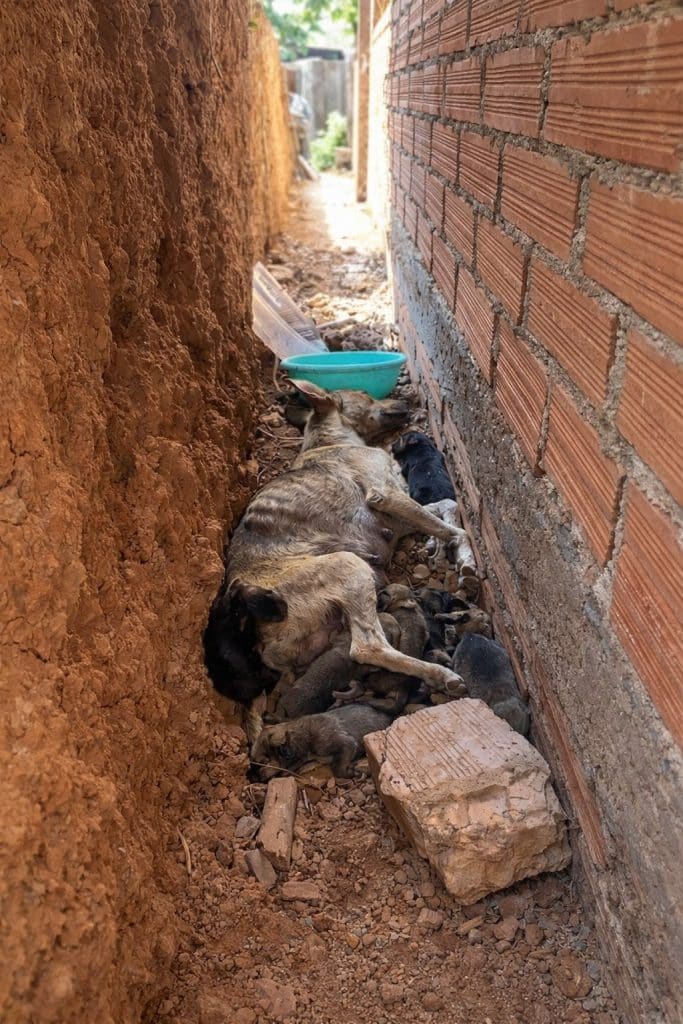
In the narrow space between two deteriorating walls, an elderly dog lay curled around seven tiny lives.
Her body was thin. Her movements were weak. Even lifting herself seemed beyond her strength.
Yet she had positioned herself around her newborn puppies, keeping them close to the little warmth she could provide.
When rescuers discovered her, they were looking at a mother who had almost nothing left to give.
And still, she was giving everything she had.
The dog would later be named Isadora.
She was 15 years old, an age when most dogs deserve peaceful days, comfortable bedding, and the security of knowing someone will care for them.
Instead, Isadora had been struggling to survive in a cramped, unsanitary space with seven completely dependent puppies.
Her rescue would become more than a race to save one exhausted dog.
Eight lives were depending on what happened next.
Hidden Between Two Walls, With Seven Lives Depending on Her
The first sign that something was alive between the walls was a faint movement.
It was easy to overlook.
The narrow opening offered little room, and the figure inside was so frail that rescuers initially struggled to make sense of what they were seeing.
Then they moved closer.
The elderly dog was not alone.
Pressed against her body were seven newborn puppies, all huddled together in the confined space.
Isadora had curled herself around them.
Although she was struggling with severe weakness and exhaustion, she remained close to the puppies that relied on her for warmth and nourishment.
It was an extraordinary responsibility for a dog in such a fragile condition.
Newborn puppies cannot care for themselves. They depend on their mother and, when necessary, human caregivers for feeding, warmth, and protection.
In that narrow gap, those basic needs were difficult to meet.
There was no reliable supply of food, no comfortable shelter, and no safe place for a nursing mother to recover her strength.
According to the account of the rescue, Isadora's previous owner was no longer caring for her or the puppies.
The full circumstances of how the family ended up between the walls were not explained.
What rescuers could see, however, was enough to understand the urgency.
Isadora was painfully thin.
Her body trembled.
She appeared barely capable of standing, yet the puppies remained pressed closely against her.
At 15 years old, she was facing the physical demands of nursing seven newborns while struggling with her own condition.
It was a situation that could not continue safely without help.
The Gentle Rescue That Changed Everything
Getting Isadora and her puppies out of the confined space required care.
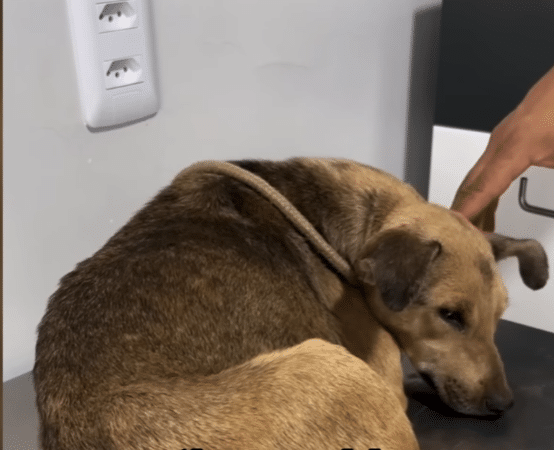
The elderly mother was already extremely weak, and her frightened reactions showed how difficult unfamiliar human contact had become for her.
Rescuers approached gently.
They carefully lifted Isadora, taking her fragile condition into account, then gathered her seven puppies so that the entire family could be moved to safety.
For the first time since being discovered, the mother and her newborns were no longer confined between the damaged walls.
But being carried out was only the beginning.
Isadora's condition suggested that she urgently needed medical attention. The puppies were equally vulnerable, and their small size made their situation especially concerning.
Their survival could not be taken for granted simply because they had been found.
What mattered now was whether their weakened bodies could respond to treatment and consistent care.
There was also another challenge.
Isadora had been trembling with fear, and the people trying to help her were still strangers.
She needed more than immediate physical assistance.
She needed a safe environment where unfamiliar hands would gradually become associated with comfort rather than danger.
And her seven puppies needed the opportunity to grow beyond the vulnerable first days of life.
The rescuers had brought them out of the narrow space.
The next stage would determine how much of their strength they could regain.
VIDEO: Rescuers Find a 15-Year-Old Mother Dog Protecting Seven Newborn Puppies Between Two Walls
At the Clinic, the Family Faced a Difficult Fight
The veterinary examination revealed how serious the situation had become.
Isadora was in critical condition.
Her age, extreme weakness, and ongoing trembling made her recovery particularly concerning.
She needed attention not only for her physical condition but also for the fear that continued to affect her reactions.
And then there were the puppies.
All seven required urgent medical care.
According to the rescue account, they were dealing with severe anemia, breathing difficulties, joint problems, and signs of neglected health needs.
For animals so young, those findings made the first stage of treatment especially important.
The veterinary team began providing care immediately.
The puppies' breathing needed to be monitored. Their nutritional needs had to be addressed. Medication and supportive treatment required careful attention.
There was no single solution that could instantly reverse the effects of their difficult beginning.
Instead, the family needed a consistent routine.
Small interventions.
Regular observation.
Care repeated throughout the day and night.
For Isadora, there was an additional physical burden. She had been caring for seven puppies while her own body was struggling.
Her recovery would require support for her as an individual patient, not only as a mother.
It would have been easy to focus entirely on the newborns because of their size and immediate vulnerability.
But Isadora mattered just as much.
She was an elderly dog who had endured considerable hardship, and she deserved a chance to recover without having to carry that burden alone.
The caregivers understood that the family needed ongoing attention.
And they committed themselves to providing it.
Every Two Hours, Another Small Chance to Grow Stronger
The first stage of recovery was built around a demanding care schedule.
The puppies needed feeding every two hours.
Breathing difficulties required oxygen support when necessary.
Medication had to be administered carefully, and their condition was monitored as treatment continued.
This was not the kind of recovery that could be measured by one dramatic moment.
Much of the progress happened through repetition.
A feeding completed.
A period of steadier breathing.
Another careful examination.
Another opportunity for the puppies to receive the support their small bodies needed.
For the caregivers, the routine continued through the day and night.
For Isadora, the environment was completely different from the place where she had been discovered.
She was no longer left to manage everything inside a narrow gap between walls.
Human caregivers were now helping meet the needs that had overwhelmed her.
Yet her maternal behavior remained evident.
Despite her weakness, Isadora continued cleaning her puppies and allowing them to nurse.
She stayed close to them as they received care.
These were familiar behaviors for a nursing mother, but in Isadora's condition, they carried particular significance.
She was still responding to her puppies while also beginning her own recovery.
Her presence gave the family a connection to the life they had known before rescue, while the veterinary team provided the medical support they had been missing.
No one could guarantee how quickly things would improve.
In the beginning, each small sign of stability mattered.
And during the first week, there was still considerable uncertainty.
The First Time Isadora Lifted Her Head
The first week passed with Isadora remaining fragile.
Recovery was not immediate.
Her caregivers continued watching her closely, aware that a dog of her age and condition might need time before meaningful improvements became visible.
Then came a small change.
Isadora lifted her head.
It was not a dramatic movement.
She did not suddenly stand up or begin walking confidently.
She simply raised her head, showing a little more responsiveness than before.
For an elderly dog who had initially seemed almost unable to move, that small action was encouraging.
It suggested that the care she was receiving might be helping her regain some strength.
The following days brought further improvement.
By the second week, the trembling that had previously affected her body was beginning to ease.
Her expression appeared less fearful.
She was no longer reacting to every nearby movement with the same degree of alarm.
And perhaps most importantly, she began accepting gentle touch from the people caring for her.
That change meant something different from the physical progress.
Medical treatment could support her body, but becoming comfortable with human contact required an environment where she could gradually experience safety.
There was no need to rush her.
No need to demand affection or immediate trust.
As her condition improved, Isadora was allowed to become more comfortable at her own pace.
The contrast with her first appearance was striking.
The elderly dog who had trembled between two walls was beginning to relax in the presence of people.
She was still recovering.
She was still a senior animal with considerable needs.
But her days were no longer defined only by exhaustion and fear.
Seven Little Puppies Begin Discovering Their World
While Isadora slowly regained her strength, her puppies were changing too.
At the time of rescue, they had been newborns struggling with serious health concerns.
Their lives had revolved around staying close to their mother and receiving the care necessary to survive.
With proper nutrition, warmth, monitoring, and medical treatment, their condition began to improve.
Their breathing became more stable.
Their bodies grew stronger.
As time passed, the puppies also became more active.
The first movements were uncertain.
Tiny legs had to learn how to support growing bodies.
The world beyond their mother was unfamiliar, and their early attempts to explore were still unsteady.
But those movements represented progress.
The puppies were no longer simply lying together in the confined space where they had been found.
They had room to move.
They had opportunities to explore.
And they were beginning to experience the natural curiosity of young dogs.
Soon, their tentative steps developed into playful activity.
They moved around more confidently.
They began running and interacting with their surroundings.
The same seven puppies who had once required urgent medical attention were now showing the energy expected of growing young dogs.
For their caregivers, it was a meaningful transformation.
Each stage reflected the value of the continuous attention they had received.
But it also drew attention back to Isadora.
During the family's earliest and most difficult days, she had kept those puppies close despite her own weakness.
Now, as they grew more independent, she was finally reaching a stage when she no longer had to provide for all their needs without support.

A Softer Place for an Elderly Mother to Rest
As days became weeks, Isadora's condition continued to stabilize.
Her breathing grew steadier.
Some of her strength returned.
The trembling that had once been so noticeable was no longer dominating her movements.
She had also become more comfortable with the people caring for her.
The changes were gradual, but together they marked an important recovery.
There was another difference that did not require a veterinary examination to appreciate.
Isadora now had soft bedding.
Instead of resting on the uncomfortable surface of a cramped space between deteriorating walls, she could lie somewhere warm and protected.
The change in her surroundings was simple but profound.
She no longer needed to use her body as the puppies' only defense against an unsafe environment.
The puppies were being cared for.
Their health had improved.
They were active, growing, and developing the confidence to explore their surroundings.
And their mother could finally receive the attention she needed as an elderly dog.
For a 15-year-old animal, comfort has particular importance.
Physical recovery matters, but so does having a quiet place to rest, access to appropriate care, and freedom from constant uncertainty.
Isadora had been found at a time when even basic movement seemed exhausting.
Now, she was able to rest in safety while her puppies continued to grow.
The rescue account describes a family that had moved from critical danger into a much more stable stage of recovery.
It does not establish what their eventual adoption arrangements would be.
But it does confirm something important.
Isadora and her seven puppies had survived their immediate crisis, and their condition had improved significantly with care.
The Eight Lives That Compassion Helped Protect
There is something especially moving about the sight of an elderly mother dog surrounded by her newborn puppies.
At 15, Isadora had already lived a long life.
Yet when rescuers found her, she was still caring for seven young animals who depended entirely on her.
She could not provide a safe shelter.
She could not secure the medical treatment they needed.
And she was too weak to protect herself from the conditions around her.
What she could do was remain close.
She kept her puppies against her body, continuing the maternal care that was still within her strength.
That was the situation rescuers encountered when they noticed movement between two walls.
Their decision to intervene changed the family's immediate future.
Careful rescue removed them from danger.
Veterinary treatment addressed serious health concerns.
Regular feeding and close monitoring helped the puppies become stronger.
And patient, gentle attention gave Isadora the opportunity to recover both physically and emotionally.
Her story is not about a sudden transformation in which every problem disappeared.
It is about the quieter process of giving vulnerable animals the conditions they need to heal.
Some progress came through treatment.
Some came through nutrition and rest.
Some appeared in the smallest visible changes: a lifted head, less trembling, a willingness to accept a gentle hand.
And some appeared in seven puppies taking uncertain steps before eventually beginning to run and play.
Those moments did not happen all at once.
They happened because care continued after the first rescue was over.
Isadora's journey reminds us that saving an animal is often only the beginning of a much larger responsibility.
A frightened dog may need time to feel safe.
A weakened body may require ongoing treatment.
Newborn puppies may need constant support before they can grow into healthy, active young dogs.
Compassion matters most when it continues beyond the moment someone is first discovered.
For Isadora, that compassion meant no longer having to face hardship alone.
For her puppies, it meant the chance to grow, explore, and experience a safer world.
And for the elderly mother who had spent her remaining strength protecting them, it meant something beautifully simple.
A warm place to lie down.
Seven growing puppies nearby.
And finally, the chance to rest.


