
For most dogs, movement is part of life from the beginning.
There is room to stretch, places to explore, changing scents to follow, and open ground beneath their paws.
Teddy had known something very different.
For four years, his world had been defined by a breeding cage.
Metal bars marked the edges of everything he knew. The floor beneath him was hard, and there was little space for the kind of free movement most dogs experience without ever having to think about it.
He learned to live within those limits.
Then one day, the door opened.
And for Teddy, the unfamiliar world outside was suddenly waiting.
Four Years of Learning Where the World Ended
A small cage does more than restrict movement.
Over time, it can become the only geography an animal understands.
Teddy had spent years turning within the same narrow boundaries. He could lie down, stand, reposition himself, and move only until another barrier stopped him.
There were no long walks described in his past.
No open fields.
No distant horizon inviting him forward.
His life had been shaped by confinement, and that history did not disappear simply because someone opened the cage.
When rescuers finally gave Teddy the opportunity to step outside, they were changing far more than his physical surroundings.
For the first time in years, there was no wall immediately in front of him.
There was space.
But Teddy did not charge toward it.
The Door Opened, but Teddy Needed Time
Freedom is often imagined as an instant celebration.
A rescued dog races forward. A tail begins wagging. Everything changes in a single dramatic moment.
Teddy's reaction was quieter.
He stepped carefully.
Then he stopped.
He looked around before moving again.
The ground was different. The air around him was different. Most importantly, the familiar boundaries that had surrounded him for years were gone.
That absence of walls was something Teddy had never learned how to understand.
His rescuers did not force the moment.
They stayed nearby and allowed him to explore at his own pace.
There was no demand that he suddenly behave like a dog who had spent his whole life outside.
Every cautious step mattered.
Because after four years of limitation, simply choosing to move forward was already a beginning.
VIDEO: After Four Years Behind Bars, Teddy Steps Into Freedom and Sees the Ocean
Freedom Came One Careful Step at a Time
Teddy's hesitation was not a failure to appreciate his new life.
It was part of adjusting to it.
For years, caution had made sense. His environment had taught him that movement ended quickly and that there was little beyond the space directly around him.
Now the rules had changed.
The people beside him gave Teddy something especially important: time.
They did not drag him toward unfamiliar places or turn his first moments of freedom into a test.
Instead, they remained close while he observed.
He could stop.
He could look.
He could decide when to take the next step.
That patience allowed the outside world to become something Teddy could discover rather than something he had to endure.

Then Teddy Met Something With No Visible End
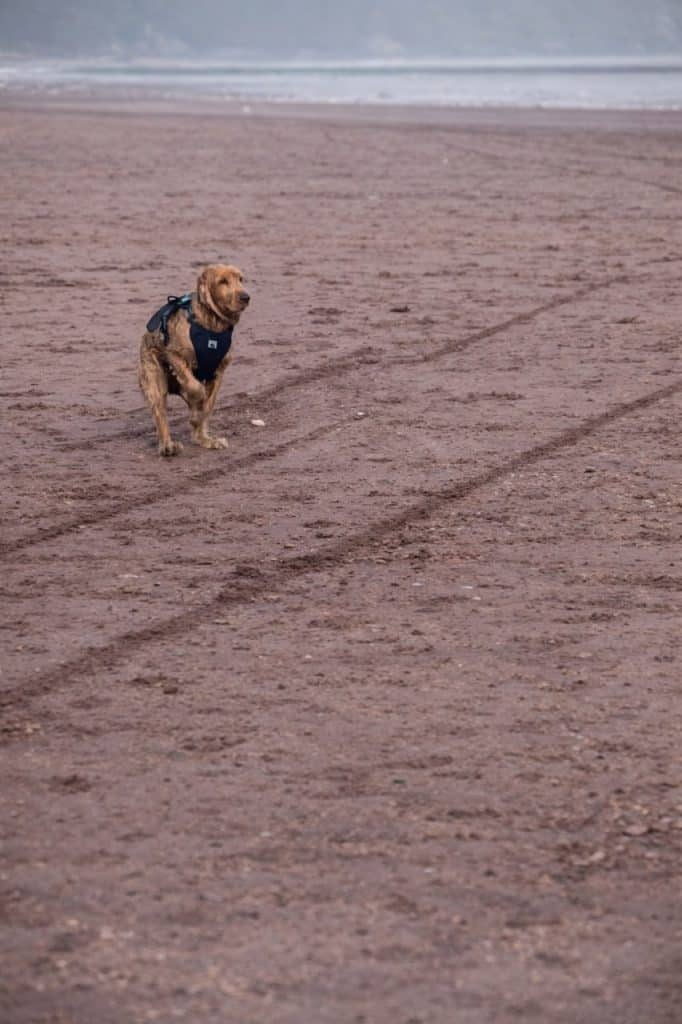
Not long afterward, Teddy was taken to a beach.
For a dog whose entire life had been defined by boundaries, the scene could hardly have been more different from the cage he had known.
Sand stretched beneath his paws.
Wind carried the scent of salt through the air.
Waves moved toward shore and then disappeared again.
Beyond them was the horizon.
There were no bars framing it.
No nearby wall marking the point where Teddy had to turn around.
The view simply continued.
Teddy stood still.
He did not immediately race toward the water.
He did not leap into the waves.
He watched.
That quiet reaction made the moment powerful.
After years in which every direction had ended within a few feet, Teddy was standing in front of something that appeared almost limitless.
There was no need for a dramatic response.
His stillness said enough.
Sand Beneath His Paws Was Something Entirely New
Even the ground required adjustment.
Sand moves.
It shifts under weight in a way that concrete does not.
Teddy stepped onto it cautiously, feeling the surface change beneath him.
He paused.
Then he tried again.
Each step introduced another sensation his confined life had never prepared him for.
There was the movement of the waves.
The changing air.
The open space surrounding him.
And instead of being overwhelmed and pushed onward, Teddy was allowed to investigate all of it gradually.
He sniffed.
He watched.
He moved a little farther.
Nothing had to happen quickly.
That was part of the gift.
For perhaps the first time, Teddy had enough space to choose where he wanted to go.
Curiosity Slowly Began Replacing Caution
The transformation was not sudden.
There was no single instant when Teddy forgot four years of confinement.
Instead, change appeared through small decisions.
Another step.
A longer pause near the shoreline.
A willingness to continue walking.
The more time Teddy spent in the unfamiliar environment, the less rigid his movements appeared.
His caution remained, but curiosity began to exist beside it.
That mattered.
Curiosity means looking beyond the place where you are standing.
It means noticing something new and deciding that it might be safe enough to approach.
For Teddy, those choices represented a kind of progress that could easily be overlooked if someone expected a dramatic celebration.
He did not need to sprint across the beach for the moment to be meaningful.
Walking willingly was enough.
Rescue Can Be Quiet
Some rescue stories are defined by emergencies.
Teddy's story, as described here, unfolded differently.
There was no need to invent dramatic medical scenes or instant transformations to understand the significance of what happened.
The change was already profound.
A dog who had spent four years inside a breeding cage was finally experiencing open space.
A dog accustomed to hard boundaries was learning that he could continue walking without immediately reaching another wall.
A dog whose movement had always been limited was now standing beside an ocean.
That contrast carried its own emotion.
Rescue was not only the moment Teddy left the cage.
It continued in every experience that helped him understand that the world could now be larger than the space he had known before.
The Ocean Became More Than a Destination
For the people watching Teddy, the beach offered a simple but powerful image.
Behind him was a life measured by confinement.
In front of him was a horizon that seemed to have no end.
The ocean did not erase his past.
Nothing could change the fact that Teddy had already spent four years living behind bars.
But the past no longer controlled the size of his world.
He could walk along the shore.
He could stop when he wanted.
He could take in unfamiliar scents and sounds.
He could decide whether to move closer to the water or remain where he felt comfortable.
Those freedoms may seem ordinary.
For Teddy, they were new.
A Life No Longer Measured by the Size of a Cage
There was no dramatic finale waiting at the end of Teddy's first experience with the ocean.
There did not need to be.
The meaningful image was much simpler:
Teddy walking beside the water.
Not racing.
Not being pulled forward.
Just moving.
The waves continued beside him, and the open horizon remained ahead.
Four years of confinement had taught Teddy to approach unfamiliar things carefully. Freedom did not instantly erase those lessons.
Instead, he entered his new world in the way that felt possible for him.
Slowly.
Thoughtfully.
One step at a time.
That may be one of the most important things Teddy's story reveals about rescue.
Opening a cage door can happen in a moment.
Learning that the world beyond it is safe can take much longer.
Teddy did not need to become fearless overnight.
He only needed the opportunity to discover what had been missing from his life.
Space.
Choice.
Movement.
And the chance to keep going.
For years, every direction Teddy chose eventually brought him to another barrier.
Now, beside the ocean, he could look forward and see no bars at all.
And when he began walking along that shoreline on his own terms, the world that had once been impossibly small finally started to feel open.


