
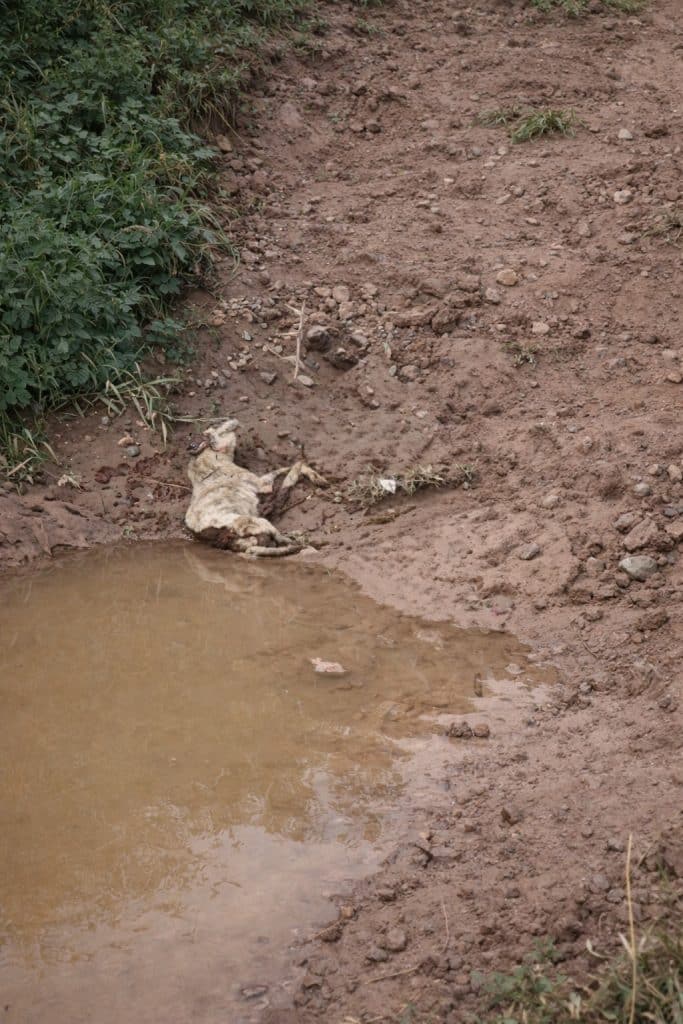
The car pulled away from the muddy riverbank, leaving a tiny dog behind.
There was no shelter around him. No familiar person waiting nearby. Only wet ground, the sound of flowing water, and a small, exhausted animal who could barely move.
His fur was soaked. His paws were stuck in the mud. When he tried to shift his body, there was almost no strength left to carry him.
He made faint crying sounds.
Then the car was gone.
Several people had witnessed the abandonment near the riverside road. But for the little dog, the immediate problem was no longer the vehicle disappearing into the distance.
It was the mud beneath him.
And the frightening possibility that he might not have enough strength to survive until someone reached him.
The dog would later be called Camilo.
At that moment, however, he was simply a fragile life stranded beside the water, waiting for help he could not reach on his own.
A Small Figure Across the River
From the opposite bank, people noticed something unusual near the muddy shoreline.
A little dog was lying there, almost motionless.
Even from a distance, it was clear that something was terribly wrong.
Camilo was alive, but he appeared dangerously weak. The wet mud surrounded his small body, making movement difficult. He could not simply stand up and walk away from the place where he had been abandoned.
For anyone watching, the distance between the two sides of the river suddenly felt much greater.
Reaching him would not be as simple as walking down a path.
The ground was soft and unstable. Anyone attempting to cross it would need to move carefully, knowing that each step could sink into the mud.
Meanwhile, Camilo had no way to understand whether help was coming.
His condition left little room for delay.
Concerned members of the community contacted local animal rescuers, explaining that a dog was trapped near the water and appeared unable to escape.
Four volunteers responded.
They understood the difficulty of the location, but they also understood something more important.
Leaving him there was not an acceptable option.
Some rescues begin with an animal running toward an outstretched hand.
Camilo's rescue would be different.
He was too weak to come to anyone.
The rescuers would have to make their way to him.
Nearly an Hour Through the Mud
The volunteers began the difficult approach toward the riverbank.
Progress was slow.
The soft ground made every step uncertain, and moving across the muddy area required far more effort than the distance might have suggested.
There was no quick route to the little dog.
Every careful movement brought the rescuers slightly closer, but Camilo remained where he had been left.
He barely lifted his head.
He did not bark at the approaching strangers or attempt to run away.
Instead, he quietly watched them.
His stillness was especially worrying. A frightened dog might normally try to retreat from unfamiliar people, but Camilo appeared to have almost nothing left to give.
His body was already struggling with exhaustion and weakness.
The volunteers continued forward.
They had seen him from a distance, but reaching him revealed the seriousness of his condition more clearly.
His breathing was shallow.
His small body was extremely weak.
And the thick mud that had kept him trapped was only part of what he was suffering.
Nearly an hour passed before the volunteers finally reached him.
Imagine how different that hour must have felt on either side of the rescue.
For the people moving through the mud, each step was progress.
For the little dog lying helplessly beside the river, there was only waiting.
Yet he was still breathing when they arrived.
That was enough reason to keep fighting for him.
The volunteers carefully lifted Camilo out of the mud, supporting his fragile body as they carried him away from the shoreline.
He could not rescue himself.
But four people had made sure he would not have to.
It was the first major turning point in a journey that was still far from over.
VIDEO: Camilo Was Abandoned in Riverbank Mud, Too Weak to Stand — Watch Four Rescuers Finally Reach Him
The Danger Followed Him to the Clinic
Getting Camilo away from the river was a moment of relief.
It was not the end of the emergency.
After arriving at a veterinary clinic, the little dog continued showing troubling symptoms that could not be explained by exhaustion alone.
He repeatedly vomited.
For the medical team, this raised serious concerns about what might have happened before he was abandoned.
The veterinarians suspected that Camilo may have swallowed something toxic.
The exact substance was not confirmed in the account, but his symptoms were serious enough to require immediate attention.
His already weakened body was now dealing with another threat.
The veterinary team began urgent treatment.
His stomach was carefully flushed in an effort to remove the suspected harmful material, while supportive medical care was provided.
There was no guarantee of a quick recovery.
Camilo had arrived in a fragile state, and his repeated vomiting made the situation even more concerning.
The same little dog who had barely been able to move in the riverbank mud now depended on the care of people determined to help him recover.
It is easy to think of rescue as the moment an animal is carried to safety.
But the difficult work often continues after that first moment.
Being removed from danger is one step.
Helping a weakened body begin to heal is another.
For Camilo, the next several days would show just how meaningful the smallest signs of progress could become.
The First Tiny Bites That Brought Hope
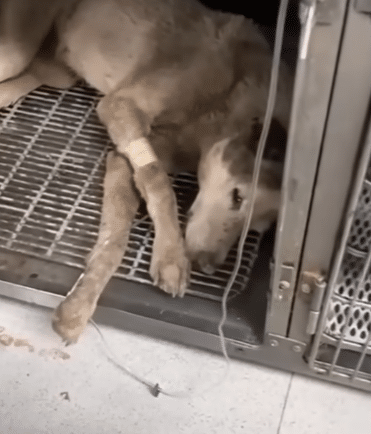
The day after his rescue, Camilo remained under close veterinary observation.
He was still receiving intravenous fluids, and the medical team continued watching his condition carefully.
His body needed support.
His digestive problems had not disappeared immediately.
After the frightening symptoms that followed his arrival, even the simplest change mattered.
Then Camilo showed interest in food.
He sniffed at what was offered.
And eventually, he took a few small bites.
It was a modest moment.
There was no sudden transformation. No instant return of strength. Camilo was still a patient who required medical attention and careful monitoring.
But those little bites meant something.
A dog who had recently been too weak to stand was beginning to show an interest in eating again.
His digestive system appeared to be settling, and the vomiting gradually became less frequent.
The medical team had reason to feel cautiously encouraged.
Recovery was beginning to look possible.
For an animal in good health, eating a small amount of food might be an ordinary part of the day.
For Camilo, it was a sign that his body was responding after an extremely difficult experience.
The people caring for him could not erase what had happened beside the river.
They could, however, help him through the days that followed.
And for the first time since his rescue, there was a visible reason to hope that those days would become easier.
One Bowl of Food, One Step Toward Strength
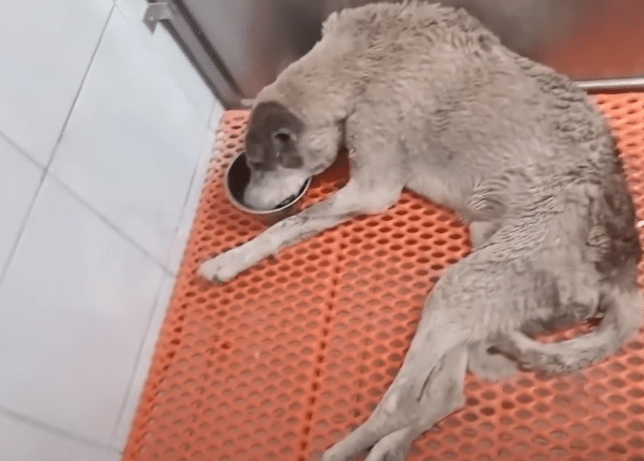
By the third day, Camilo had made another important improvement.
He approached his food bowl and began eating on his own.
Nobody needed to force him.
The little dog who had been struggling through repeated vomiting was now choosing to eat without assistance.
That simple action carried enormous meaning.
It suggested that some of the strength he had lost was beginning to return.
For his caregivers, watching Camilo eat independently was more than an encouraging medical observation.
It was evidence that the efforts to help him were making a difference.
The improvement continued.
On the following day, Camilo managed to finish an entire meal.
Just a few days earlier, even the thought of him eating normally had seemed uncertain.
Now his appetite was returning.
His eyes appeared brighter, and his breathing had become steadier.
He was still thin.
He was still physically fragile.
And the damage caused by his ordeal could not be undone in a matter of days.
But he was no longer showing only signs of decline.
He was beginning to regain some of the ordinary abilities that every healthy dog should be able to enjoy.
Eating without assistance.
Responding to his surroundings.
Resting while his body recovered.
These were not dramatic achievements from the outside.
They were quiet signs of a life gradually moving away from danger.
Camilo's progress also showed why recovery cannot be measured by one good moment alone.
The first small bites had been encouraging.
A full meal was another step.
Each improvement mattered because it followed a period when his condition had been so uncertain.
The journey was happening slowly.
And that was enough.
Learning That Human Hands Can Be Gentle
Camilo's physical recovery was only one part of his experience.
There was also the question of how he responded to people.
The dog had been abandoned beside a river, left in a place where his weakness made escape impossible.
After that experience, it was understandable that unfamiliar human contact might require patience.
During his early time in care, Camilo remained cautious.
He watched the people around him.
Their movements, voices, and attempts to approach did not immediately lead to complete trust.
Instead, he observed quietly.
The veterinary team continued caring for him, allowing that relationship to develop gradually.
Day by day, his behavior began to change.
He became more accepting of affection.
Gentle petting no longer seemed as unfamiliar or unsettling.
He started to relax during those moments of contact.
There was no single dramatic event that marked the return of his confidence.
It appeared in small changes.
A calmer response.
A willingness to accept touch.
An increasing sense of comfort around the people caring for him.
For a dog who had been left helpless beside a river, these moments were particularly meaningful.
They showed that his recovery was not limited to his appetite or his breathing.
He was also becoming more comfortable in the presence of others.
Of course, nobody could know exactly what Camilo remembered or understood about his abandonment.
Animals cannot explain their experiences in words.
But their responses can reveal when they are becoming more relaxed and secure.
In Camilo's case, that change was becoming visible.
The same people who helped his body heal were also giving him opportunities to experience patient, gentle care.
And he was slowly learning to accept it.
Five Days After the Riverbank
Five days after the rescue, Camilo was not yet fully recovered.
His body still needed time to regain strength.
Standing for extended periods remained difficult, a reminder of just how weak he had been when the volunteers first reached him.
But the difference between his condition at the river and his condition in the clinic was remarkable.
His coat had been cleaned.
His eyes were alert.
His appetite had improved.
And his behavior suggested that he was becoming increasingly comfortable with the care he received.
The dog who had once been unable to pull himself free from thick mud was now making steady progress.
He was not completely healthy.
That distinction mattered.
Recovery was still underway, and his caregivers had to respect the limits of his physical condition.
But the veterinary team believed he might soon be well enough to leave the clinic and continue recovering in a safe environment.
It was an encouraging possibility rather than a confirmed final outcome.
For Camilo, the future was opening again.
There was still healing ahead.
There would still be a need for patience and careful attention.
Yet his circumstances had changed profoundly.
He was no longer alone beside the river, struggling to move while the water flowed nearby.
He was receiving care.
He was being monitored.
And he had people looking after his needs as his strength slowly returned.
Four People Made the Difference
Camilo's story began with an act of abandonment that left him in immediate danger.
It could have ended at the muddy riverbank.
He was too weak to walk away, and the difficult terrain prevented help from reaching him quickly.
But people on the opposite side of the river noticed him.
They did not ignore what they saw.
They contacted rescuers.
And four volunteers took on the difficult task of crossing the mud to bring him to safety.
Their decision gave Camilo a chance to receive the veterinary treatment he urgently needed.
That care helped him move through the next critical stage of his ordeal.
First came the medical intervention.
Then the careful observation.
Then a few small bites of food.
Then an entire meal.
And eventually, a little more trust in the gentle hands around him.
None of those changes happened all at once.
Together, they marked the beginning of something much more hopeful than the scene where Camilo had first been found.
His complete recovery had not yet been confirmed, and his story should not be given an ending that had not happened.
But five days after being rescued, there was clear reason to believe that his life was moving in a better direction.
Sometimes compassion is measured not by grand gestures, but by the willingness to do something difficult for a vulnerable animal.
To notice when others might look away.
To cross muddy ground when the journey is slow.
To provide care when improvement comes in small, uncertain steps.
And to remain patient while trust returns.
Camilo could not follow the car that left him behind.
He could not climb out of the mud on his own.
But when four strangers made their way toward him, his circumstances began to change.
He was no longer a little dog stranded beside the water.
He was Camilo.
A dog with a name, people caring for him, and a chance to keep healing.
And after everything he had endured, that chance meant more than enough.


