
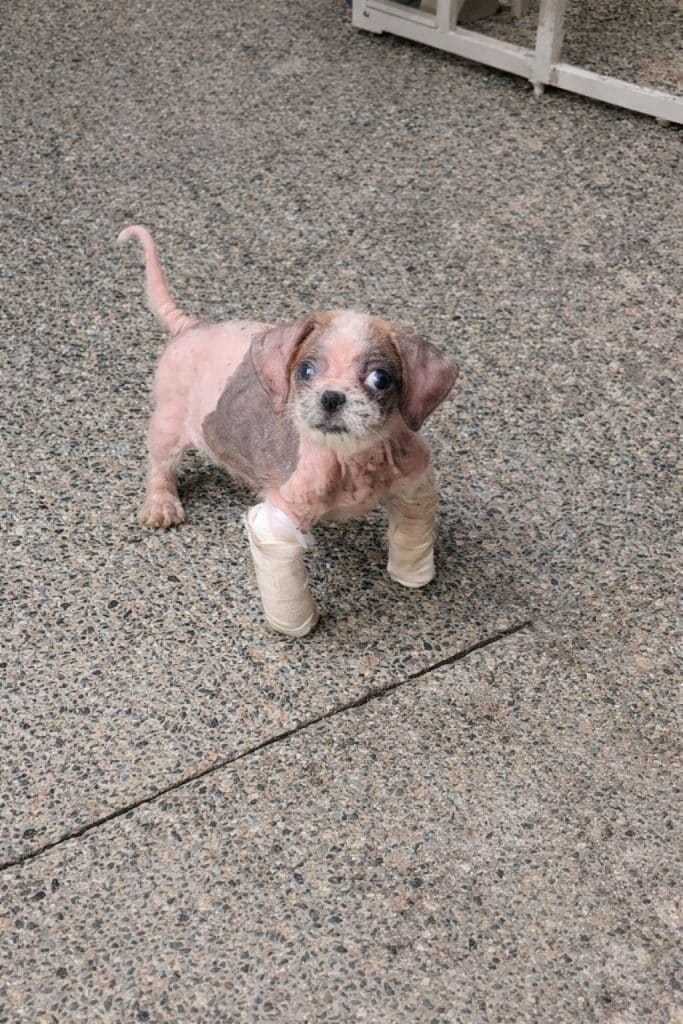
At only five months old, Allie should have been discovering the world with the boundless curiosity of a healthy puppy.
Instead, she was found inside a trash bin.
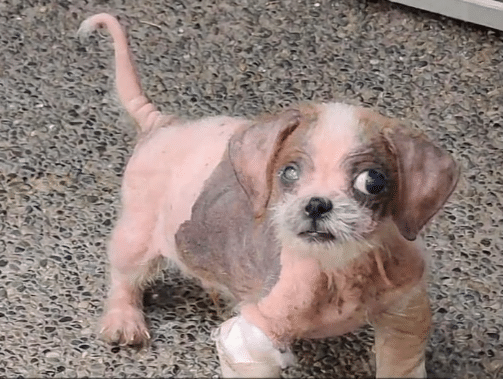
Her little body was exhausted. Much of her fur was gone, her skin was severely irritated, and her legs struggled to support her weight.
She had already lost the sight in one eye.
It was difficult to imagine how such a young dog had reached this condition, or how much longer she could have survived without help.
Yet beneath everything that was wrong, there was one important sign.
Allie was still alive.
And that meant there was still a chance for her story to change.
The Little Puppy Almost Hidden From the World
A trash bin was the last place anyone should have found a vulnerable puppy.
But that was where rescuers discovered Allie, a tiny dog whose physical condition suggested she had been struggling for some time.
She was severely underweight and visibly weakened. Large areas of her coat were missing, exposing inflamed skin that needed veterinary attention.
Her legs trembled beneath her, making even simple movement difficult.
Then there was her eye.
Allie had already lost vision in one eye, adding another challenge to an already serious situation.
For such a young animal, these problems would have been difficult enough individually. Together, they made her circumstances particularly concerning.
When the rescuers approached, Allie did not put up a struggle.
She remained quiet.
There was no sudden burst of energy, no excited greeting, and no clear indication that she understood what was happening around her.
She simply watched.
Her stillness made the moment especially moving. A puppy who should have been playing and exploring was instead conserving what little strength she had.
The people who found her could not know exactly what she had experienced before being left there.
Her full history remained unknown.
What they could see, however, was enough to understand that she needed help.
And this time, someone was there to give it.
A Second Chance Began With One Simple Decision
Allie's rescue was not the end of her difficulties.
It was the beginning of a much longer process.
Getting her out of the trash bin removed her from immediate danger, but it could not reverse the physical problems that had already developed.
Her skin needed treatment.
Her weakened body needed nourishment.
Her remaining vision needed protection.
Most importantly, she needed time to recover without facing another period of uncertainty.
For the first time in the story we know, Allie's needs became someone's responsibility.
That distinction matters.
Rescue is sometimes imagined as a single dramatic moment when an animal is carried into safety. But the lasting difference often comes afterward, through the ordinary work of providing food, medical attention, and consistent care.
Allie was about to experience that kind of care.
She was taken to a veterinary clinic, where her condition could be examined and a treatment plan established.
There, the visible problems affecting her skin finally had a medical explanation.
And while her diagnosis was serious, it offered something that had seemed almost impossible when she was first discovered.
A path toward recovery.
VIDEO: Found Weak and Nearly Hairless in a Trash Bin — Watch Allie's Incredible 90-Day Recovery
A Difficult Diagnosis, but Not the End of Her Story
Veterinary examination revealed that Allie was suffering from demodectic mange.
This skin condition is associated with mites and can cause significant hair loss and inflammation, particularly when the condition becomes severe.
For Allie, the effects were already extensive.
Her skin was deeply irritated, and the missing patches of fur left her appearance dramatically different from that of a healthy young puppy.
But the diagnosis also meant the veterinary team had a clearer understanding of what needed to be addressed.
Treatment would take patience.
There was no single moment when her damaged skin could suddenly become healthy or her missing fur could instantly return.
The process required ongoing attention and careful management.
Allie received medicated treatments intended to help her skin recover.
Her caregivers also paid attention to protecting the vision she still had.
Because one eye had already lost its sight, preserving her remaining ability to see was an important part of her care.
Meanwhile, her weakened body needed nutritional support.
Her meals included gentle, nourishing foods such as rice and pumpkin, helping her receive the energy she needed during recovery.
These were not glamorous changes.
A meal.
A treatment.
Another day of rest and attention.
But for a puppy whose future had recently been so uncertain, they represented something meaningful.
Her needs were being met.
And the people caring for her were prepared to give the process the time it required.
The First Two Weeks Brought a Reason to Hope
Progress was not immediate.
During the early stage of treatment, Allie remained quiet and reserved.
Her body had been through a great deal, and there was little reason to expect a rapid change in her strength or behavior.
Her skin needed time to respond to treatment.
Her weight and energy needed time to improve.
Even the simple act of becoming comfortable around people was a gradual process.
But slowly, encouraging signs began to appear.
The fragile puppy was responding to the care she received.
Her condition improved enough that, after approximately two weeks, she was able to leave the veterinary clinic.
That milestone was significant.
It did not mean every problem had disappeared.
Her skin still needed to heal, her coat still had to grow back, and her confidence was only beginning to return.
But she had moved beyond the most difficult early stage of her treatment.
Allie was no longer simply the severely weakened puppy discovered in a trash bin.
She was a recovering young dog with a future that was beginning to look different.
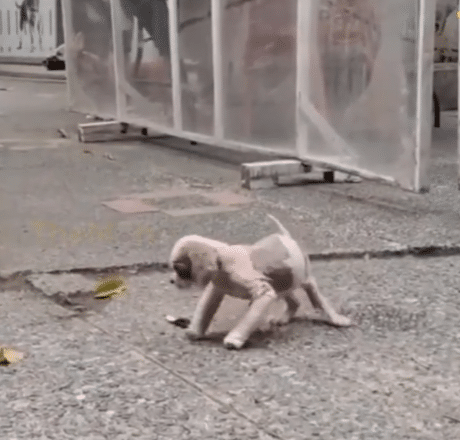
Leaving the clinic also marked a shift in the kind of progress that could be observed.
Medical treatment had given Allie an opportunity to regain her physical health.
Now, with continued care, other parts of her personality could begin to emerge.
The changes would be small at first.
But they would become increasingly difficult to miss.
By Day 50, the Puppy Beneath the Illness Was Emerging
Around the fiftieth day of her recovery, Allie's appearance had changed noticeably.
The skin that had once been severely inflamed was healing.
Her coat was returning.
At first, the new fur appeared gradually, filling in areas that had previously been bare.
Over time, more of her natural coloring became visible.
White and brown fur began to replace the appearance that had defined her during the earliest days of rescue.
She was becoming recognizable as the young, beautiful dog she had always been beneath the effects of her illness.
But her physical recovery was only part of the transformation.
Allie's behavior was changing too.
The puppy who had once remained silent and withdrawn began showing curiosity about the people around her.
She followed them from room to room.
She looked up with interest.
And she started wagging her tail.
For a dog recovering from such difficult circumstances, these ordinary behaviors were meaningful signs of progress.
A wagging tail might seem like a small thing.
For Allie, it reflected a change from the quiet, weakened puppy who had barely responded when rescuers first approached.
She was beginning to participate in the world around her.
Instead of simply lying still, she was exploring.
Instead of remaining distant, she was seeking companionship.
Her recovery was becoming visible not only in the condition of her coat, but also in the way she moved through everyday life.
It was as though the illness had obscured the playful young dog waiting underneath.
Now, that personality was becoming easier to see.
More Than a Beautiful Transformation
It would have been easy to focus entirely on Allie's dramatic change in appearance.
After all, the difference between the puppy found in the trash bin and the dog she became was remarkable.
But the most important parts of her progress could not be measured by her growing fur alone.
She was becoming stronger.
Her behavior was becoming more confident.
She was developing an interest in the people and spaces around her.
These changes happened over weeks, not hours.
And that gradual pace is part of what makes her journey so meaningful.
The story does not describe a sudden cure or an effortless transformation.
Instead, it shows what can happen when a vulnerable animal receives consistent treatment, appropriate nutrition, and the time necessary to heal.
The support Allie received helped her move from a condition of serious weakness toward a life with far more comfort and freedom.
Her remaining visual impairment was still part of her history.
The past could not simply be erased.
But those realities did not prevent her from making extraordinary progress.
By the time her recovery approached the three-month mark, Allie was ready for another major change.
This time, it was not about a medical appointment or a new stage of treatment.
It was about finding a place to belong.
Ninety Days Later, Allie Finally Had a Home
Three months after being rescued, Allie's life reached a milestone that would once have been difficult to imagine.
She found a home.
A man named Sir Gary welcomed her into his life, giving the once-abandoned puppy a permanent place where she could feel safe and cared for.
For Allie, the change meant far more than having a roof over her head.
She now had room to explore.
She could move freely through the house and spend time discovering the yard.
The dog who had once struggled to stand was now enjoying the freedom to move with confidence.
And her playful personality continued to surprise.
One of the most memorable details of Allie's new life was her ability to balance on a skateboard.
It was an unexpected skill for a dog whose early circumstances had been so difficult.
Imagine comparing those two moments.
A five-month-old puppy lying weakly inside a trash bin.
And ninety days later, that same dog confidently balancing on a skateboard.
The contrast says a great deal about how far she had come.
Her new life also included companionship and the comfort of a secure home.
Instead of facing another uncertain day, Allie could enjoy familiar surroundings and the care of someone who had chosen to make her part of his life.
The transformation was not simply from sick to healthy.
It was from abandonment to belonging.
The Everyday Happiness She Nearly Missed
The most touching part of Allie's new life may not be the skateboard or even the remarkable return of her white-and-brown coat.
It may be the ordinary experiences she can now enjoy.
Moving through a home without having to search for safety.
Exploring a yard with curiosity.
Being close to someone who welcomes her presence.
Resting in warmth and comfort.
These are simple parts of life for many beloved family dogs.
For Allie, they represent a future that once appeared far from certain.
Her early condition had been severe enough to raise serious concerns about her survival.
Yet the puppy who seemed so fragile when she was discovered continued to improve as the weeks passed.
Her story also illustrates an important distinction between physical recovery and emotional adjustment.
Veterinary treatment helped address the visible illness.
Consistent care gave her the opportunity to become more comfortable in her surroundings.
As her strength returned, she began showing the behaviors people naturally associate with a happy young dog.
Following people.
Exploring.
Wagging her tail.
Playing.
There was nothing extraordinary about these activities on their own.
What made them extraordinary was knowing where Allie had started.
The smallest signs of normal puppy behavior had become reminders of the life she was finally able to enjoy.
What Allie's Journey Teaches Us About Second Chances
Allie's story began with a puppy in a place where no animal should have been left.
She was only five months old.
Her body was weak, her skin was severely affected by mange, and she had already lost vision in one eye.
At that point, her future was uncertain.
But the people who found her did not define her by the condition she was in.
They recognized an animal who needed help.
From that decision came a series of meaningful steps.
Veterinary treatment.
Nourishing food.
Time for her skin to heal.
Space for her confidence to develop.
And eventually, a home with Sir Gary.
None of those steps could have been skipped.
The playful dog she became at ninety days was the result of an ongoing process rather than one dramatic rescue moment.
Her experience reminds us that helping an abandoned animal is not always about witnessing an immediate transformation.
Sometimes, the most important progress happens quietly.
A little more strength.
A healthier patch of skin.
A curious glance.
The first signs of a wagging tail.
Given enough patience and appropriate care, those modest improvements can eventually become something much larger.
Allie will always have a past that includes abandonment and serious illness.
But her story no longer ends there.
Today, she is remembered not only as the fragile puppy discovered inside a trash bin, but as a lively white-and-brown companion who found safety, affection, and a permanent home.
And perhaps that is the most meaningful part of her ninety-day journey.
The same little dog who once lay too weak to resist help eventually gained the confidence to explore a yard, follow the people she trusted, and even balance on a skateboard.
She was given the chance to recover.
Then she was given a place to belong.
Allie did not need a perfect beginning to have a beautiful life.
She needed someone to notice that her life was worth saving—and people willing to care for her long enough to see her thrive.


