
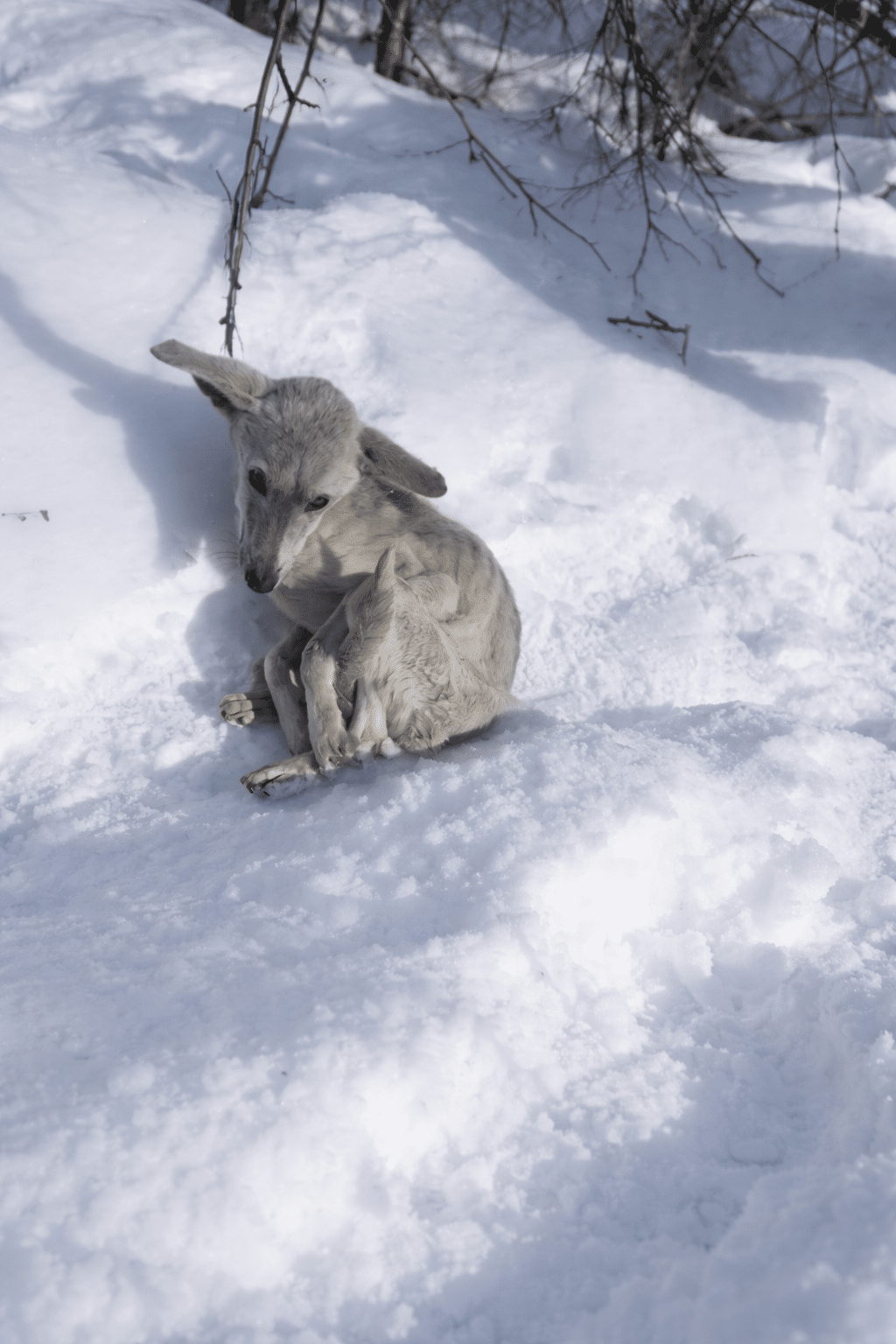
Some dogs are rescued with only hours separating them from a very different ending.
For Izya, that moment came in the middle of a brutal winter.
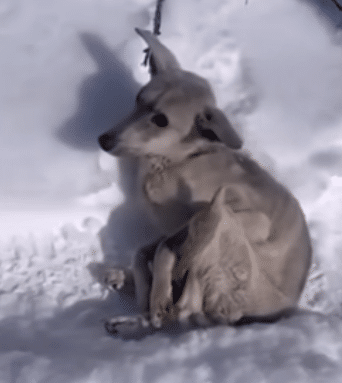
He was curled tightly against the frozen ground, his thin body shaking as snow surrounded him. There was almost no protection between his fragile frame and the bitter air. Every rib could be seen beneath his skin, and even lifting his head seemed to require more strength than he had left.
The nighttime temperature in the area had been falling as low as –21°C.
And Izya had not simply wandered away from home.
He had been left outside deliberately.
A Dog Left to Endure the Cold
When rescuers reached Izya, his condition immediately showed how serious the situation had become.
He was extremely thin and exhausted. His body had been surviving on almost nothing, while the freezing weather placed even more strain on him.
Yet getting him to safety was not as simple as carrying him away.
According to the source, Izya's owner initially refused to surrender him. The man described what was happening as a way of “teaching him a lesson.”
The rescuers continued negotiating.
Eventually, after payment was made, the owner agreed to let Izya go.
There was no emotional farewell.
As Izya was carried toward the vehicle, the man walked away without looking back.
For the people taking Izya to safety, however, that moment meant something very different.
Whatever had happened before was now behind them.
Their immediate concern was whether his weakened body could recover from it.
The Clinic Revealed How Close He Had Come
Once Izya arrived at the veterinary clinic, the extent of his physical decline became clearer.
He was critically malnourished.
His ribs stood out sharply, and much of his muscle mass had disappeared. Blood testing showed severe anemia associated with prolonged starvation.
There was also evidence of an older leg injury that had healed poorly, leaving a permanent scar.
Each finding added another piece to the same picture: Izya had not reached this condition overnight.
His body had been struggling for a long time.
And outside the clinic, the winter continued.
With temperatures reaching –21°C at night, a dog in Izya's condition had very little reserve left to protect himself from the cold.
Rescuers had reached him near the edge of collapse.
Saving him from the snow was only the first step.
VIDEO: Found Starving in –21°C Cold, Izya’s Long Journey to Safety Had Just Begun
Recovery Had to Begin Slowly
Izya could not simply be given a large meal and expected to recover.
After prolonged starvation, his body needed careful support.
The veterinary team created a gradual feeding plan built around small, frequent portions. Supplements and probiotics were introduced carefully, while IV fluids helped stabilize him during the earliest stage of treatment.
The changes were measured in small steps.
A little more food tolerated.
A little more strength.
A body slowly receiving what it had been missing.
But physical recovery was only part of what the caregivers could see.
Izya was deeply frightened.
Sudden noises could send him shrinking toward the floor. During his first short walks, he sometimes stopped completely and stood frozen in place.
Even gentle contact could make him flinch.
Nothing about those reactions could be rushed away.
So the people caring for him changed their behavior around his fear.
They moved quietly.
They kept their voices soft.
They did not force him closer when he wanted space.
For a dog that had learned to expect discomfort, ordinary kindness still seemed unfamiliar.
Trust would have to develop at its own pace.
The Smallest Changes Started to Matter
Recovery did not arrive in one dramatic moment.
Instead, it appeared through details that might have seemed insignificant to anyone who had not seen Izya at the beginning.
By the sixteenth day, his bloodwork had improved.
His appetite was stronger.
He began carrying his head higher.
Those were important signs that his body was responding to care, but another change soon revealed something just as meaningful.
One afternoon, his tail moved.
It was not a wild, confident wag.
It was small.
Cautious.
Almost uncertain.
But it was there.
For the caregivers who had watched him recoil from sounds and touch, that tiny movement represented something larger than excitement.
Izya was beginning to relax.
Little by little, he watched the people around him with more curiosity and less immediate fear.
Gentle strokes along his back lasted longer before he pulled away.
The world outside his resting space no longer appeared to frighten him in quite the same way.
There was no sudden transformation.
There was repetition.
Food arriving when expected.
Hands that did not hurt him.
Voices that remained calm.
Days passing without punishment.
That consistency became part of his recovery.
His body was learning that meals would continue.
And Izya was slowly learning that safety could continue too.
Fifty Days Later, Another Door Opened
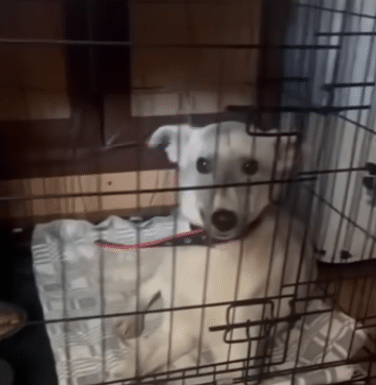
Fifty days after his rescue, Izya was considered ready to leave the clinic.
The dog being prepared for that journey was very different from the trembling animal first carried in from the cold.
He was stronger, but the next transition still required patience.
During the drive, Izya remained watchful as he looked through the window.
Soon, the car stopped at the place that would become his new home.
A wide garden waited outside.
Inside, there was a soft bed and a calmer kind of welcome.
No one demanded immediate affection from him.
No one expected him to behave as though the past had disappeared.
His new family offered something much more useful.
Time.
That mattered because Izya was still learning how to live without constantly preparing for something to go wrong.
The home also included resident cats.
At first, Izya kept his distance from them and watched cautiously.
Again, no one forced the relationship.
The animals were allowed to become familiar with one another gradually.
With time, the tension eased.
Spaces that had initially been approached with hesitation became ordinary parts of daily life.
Curiosity slowly took the place of uncertainty.
For Izya, home was becoming more than a new location.
It was becoming a routine he could trust.
The Winter That No Longer Defines Him
The image of Izya curled in the snow is difficult to connect with the dog he later became.
His coat grew healthier and fuller.
His legs became steadier.
Instead of lying weak against frozen ground, he could run across grass.
His eyes no longer moved anxiously toward every small sound in the same way they once had.
Those changes did not erase what happened to him.
The old injury remained part of his history.
So did the severe malnutrition, the fear, and those first uncertain days of treatment.
But survival is not the only chapter of Izya's story.
What happened after the rescue matters just as much.
He experienced regular meals instead of prolonged hunger.
Quiet care instead of fear.
A soft place to rest instead of frozen ground.
And eventually, a family willing to let trust grow without demanding it.
His recovery was built through consistency rather than one dramatic gesture.
A carefully portioned meal.
A calm voice.
A patient walk.
A cautious tail wag.
Another safe day.
Then another.
Izya's journey is a reminder that rescuing an animal can begin in a single urgent moment, but healing often happens much more slowly.
A dog may be carried away from danger in minutes.
Learning that the danger is truly over can take much longer.
For Izya, patience made that learning possible.
The bitter winter that nearly overwhelmed his weakened body is now part of the past.
It no longer represents where he belongs.
Today, the most important part of his story is not the snow he survived, but the safety that finally followed.
Winter became only a season.
And Izya finally had a home in which to watch it pass.


