
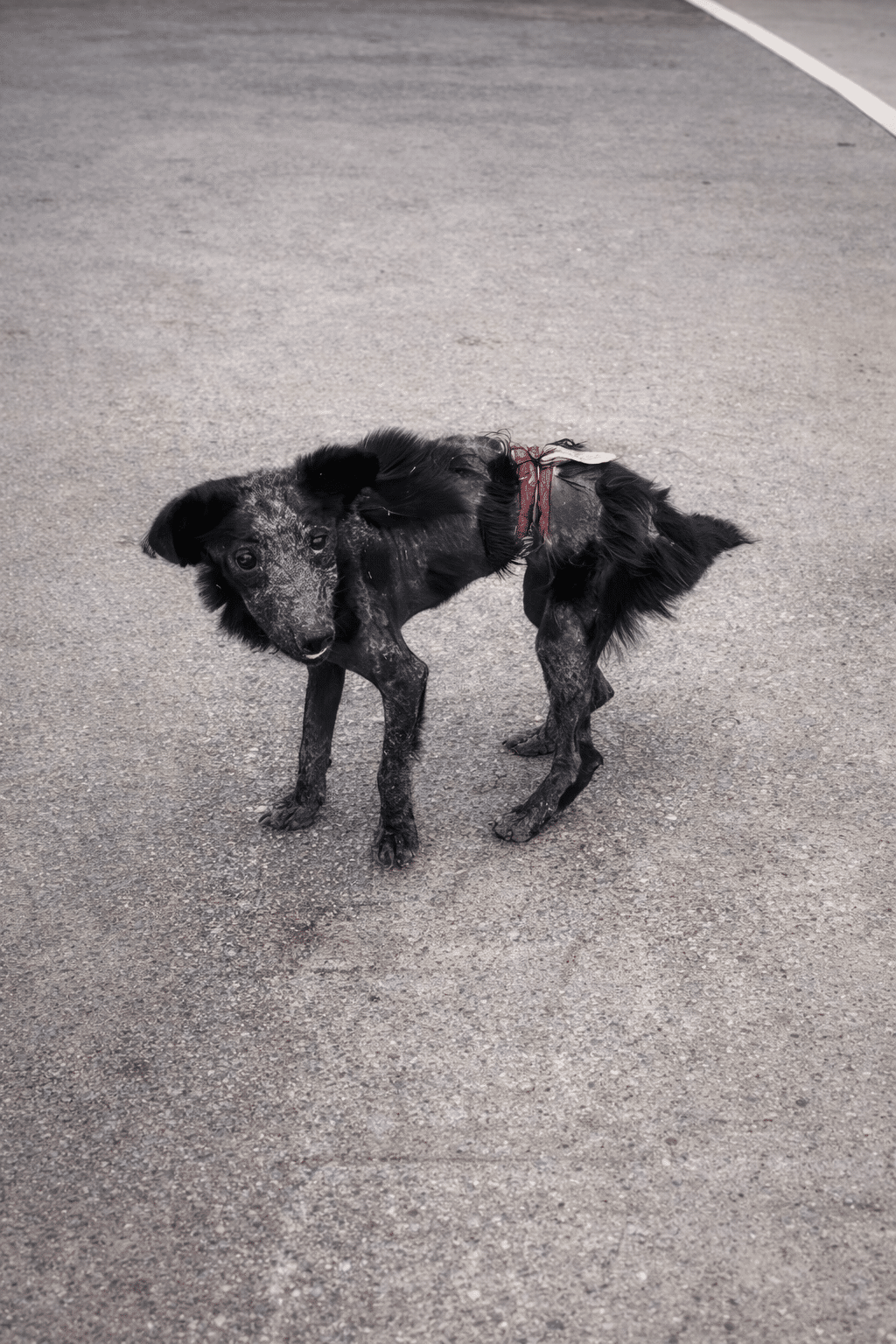
The rubber rope around Vicky's waist had become so tight that even walking was painful.
Yet the little stray dog continued moving through the streets of Fuzhou, frightened of the very people who might have been able to help her.
She had no way to remove what was hurting her.
And whenever someone approached, fear made her pull away.
By the time rescuers learned about her condition, Vicky needed more than someone willing to offer food or shelter. She needed medical attention, careful handling, and people patient enough to earn her trust.
Finding her would take three difficult days.
Helping her feel safe again would require something just as important.
Time.
A Small Dog Carrying a Painful Burden
Vicky's situation first came to the attention of rescuers after a compassionate local woman noticed the injured stray.
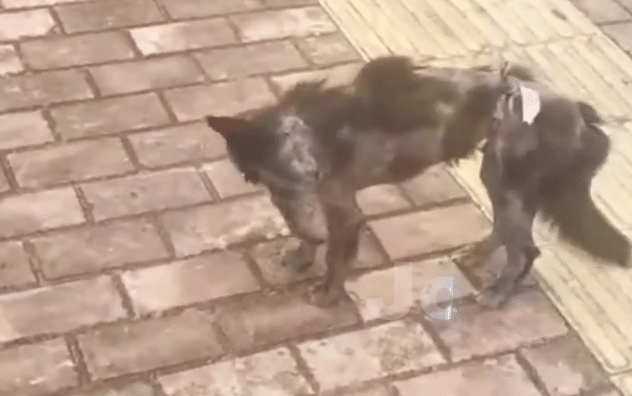
A thick rubber rope had become wrapped tightly around the dog's waist.
Rather than slipping loose as Vicky moved, the restraint remained in place, putting painful pressure on her body.
Walking had become increasingly difficult.
For a dog surviving outdoors, the ability to move freely is essential. Finding food, seeking a safe place to rest, and avoiding unfamiliar situations all depend on being able to walk without severe discomfort.
Vicky was trying to manage those ordinary challenges while carrying an injury that was growing worse.
The woman who spotted her understood that something had to be done.
She attempted to approach Vicky, hoping to remove the restraint and ease her suffering.
But Vicky was terrified.
Each time the woman came close, the little dog reacted defensively, snapping to keep the unfamiliar person away.
It was not difficult to understand why the situation was so complicated.
Vicky was already hurting. She had no reason to know that a stranger reaching toward her was trying to help.
From her perspective, keeping people at a distance may have seemed like the safest choice.
The woman eventually recognized that she could not manage the rescue alone.
Instead of giving up or attempting to force contact with the frightened dog, she contacted a rescue organization.
That decision marked the beginning of Vicky's second chance.
Four Hours Away, Someone Answered the Call
When the rescue team received information about Vicky, they began the four-hour journey to Fuzhou.
They knew they were searching for a small dog with a serious physical problem.
What they did not know was exactly where she would be when they arrived.
Stray animals do not remain in one place simply because someone is looking for them. A frightened dog may move between streets, open spaces, and quieter areas, making even a familiar neighborhood difficult to search.
The rescuers began by asking people who spent time in the area.
They spoke with restaurant workers.
They questioned nearby residents.
They looked for anyone who might have noticed a small injured dog moving through the neighborhood.
Every conversation offered the possibility of another clue.
But as the first day passed, Vicky remained missing.
The team continued searching until daylight faded.
Still, there was no sign of her.
They had traveled hours to help an animal they had never met, only to discover that reaching her would be harder than expected.
And somewhere in Fuzhou, Vicky was still living with the painful restraint around her body.
The rescuers could not know whether she had found somewhere to rest or whether her condition was becoming more difficult.
They only knew that she had not yet received the help she needed.
When the Rain Made Everything Harder
The second day brought heavy rain.
The streets were soaked, and the search became physically exhausting.
The rescue team checked parks and narrow alleyways, moving through the areas where Vicky might have wandered.
They looked across empty lots.
They searched abandoned factories in the industrial district.
Each new location carried the same question.
Could she be here?
The work required persistence because there was no guarantee that the next place would reveal anything.
Hours passed without a successful sighting.
Rain continued to make the search unpleasant, while exhaustion grew with every unsuccessful attempt to locate her.
By then, the rescuers had spent two days following the possibility that Vicky might still be somewhere within reach.
The uncertainty was difficult.
A dog in her condition could not simply be expected to wait in one spot until help arrived.
And without finding her, the team could do nothing to relieve the pressure around her waist or arrange the medical care she needed.
There was still one choice available.
They could keep looking.
That decision would make all the difference.
The Roadside Sighting That Changed Everything
On the third day, the rescuers continued searching around the industrial area.
After leaving one factory location, they drove for nearly an hour.
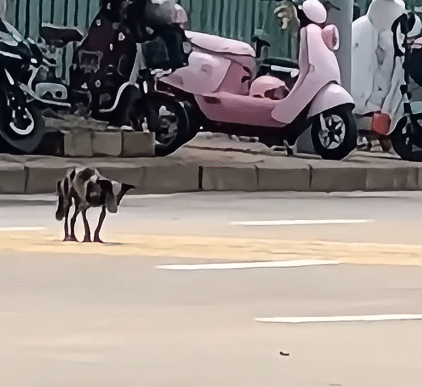
Then someone noticed a small figure moving carefully along the roadside.
It was Vicky.
After two days of unsuccessful searching, the dog they had been trying so desperately to find was finally in front of them.
But locating her was only the first part of the rescue.
Vicky was still frightened.
Her earlier defensive behavior had already shown how difficult it would be to approach her safely.
If the rescuers moved too quickly, they risked frightening her into retreating again.
So they chose a quieter approach.
They sat nearby rather than chasing her.
They put food on the ground.
And they gave her the space to decide whether she felt comfortable moving closer.
There was no immediate rush toward an embrace.
No attempt to overpower her.
Just people waiting patiently beside a frightened animal who had already endured so much discomfort.
At first, Vicky remained cautious.
Then something small happened.
Her tail moved in a gentle wag.
It was a simple movement, but after days of fear and pain, it offered the rescuers an encouraging sign.
She was beginning to relax.
Slowly, the distance between Vicky and the people trying to help her became smaller.
The team continued working at her pace until she finally allowed them close enough to lift her safely.
After three days of searching, Vicky was no longer wandering beyond their reach.
She was on her way to the veterinary clinic.
VIDEO: Three Days of Searching for Vicky — The Roadside Rescue That Finally Brought Her to Safety
The Veterinary Examination Revealed More Than One Injury
Reaching the clinic was a major step forward, but the rescue team soon learned that Vicky's medical needs were serious.
The rubber rope was not the only problem affecting her.
During the examination, veterinarians found that Vicky was dangerously underweight.
She also had a fractured femur, an injury involving the thigh bone.
And the rubber restraint around her waist had caused significant damage to the surrounding tissue.
These findings helped explain why her movements had been so difficult.
Vicky had been trying to survive outdoors while dealing with several physical challenges at once.
Her body needed professional care.
The veterinarians moved quickly to address the most urgent concerns.
Vicky underwent emergency surgery to remove the embedded rubber rope and treat the damaged area.
The medical team carefully removed the restraint, cleaned the affected tissue, and attended to her injuries.
For the first time since the painful rope had tightened around her body, the source of that constant pressure was finally gone.
It was an important moment.
The restraint could be removed through medical treatment.
But rebuilding Vicky's strength would require continued care and patience.
Surgery was not the end of her journey.
It was the beginning of recovery.
A Quiet Place to Begin Healing
Vicky did not suddenly become confident simply because she had been rescued.
During the first days of recovery, she remained weak, timid, and easily startled.
That was an important part of her condition to recognize.
Although the immediate physical danger had been addressed, her behavior still reflected the fear she had shown on the streets.
The people caring for her needed to give her time.
There was no reason to expect a frightened dog to become comfortable with human attention overnight.
Instead, her recovery was supported through ordinary, consistent acts of care.
She received nutritious meals.
She had a warm place to rest.
Gentle voices replaced the hurried approaches that had once made her react defensively.
These details might appear small compared with the urgency of emergency surgery.
For Vicky, however, they formed the daily environment in which healing could begin.
Food helped support her weakened body.
Rest gave her the opportunity to recover.
And calm human attention allowed her to experience people without the same immediate fear that had shaped her behavior before the rescue.
Progress came gradually.
There was no single moment when everything changed.
Instead, her caregivers began noticing small improvements.
Her appetite returned.
Her eyes appeared brighter.
She became less fearful of the people around her.
Each improvement was meaningful because it reflected something Vicky had been missing while struggling on the streets.
A growing sense of safety.
The Small Changes That Meant So Much
One of the most encouraging parts of Vicky's recovery was the change in how she responded to people.
During the first attempt to help her, human contact had seemed threatening.
She had snapped defensively because she was frightened and in pain.
Later, on the roadside, she had shown her first small sign of acceptance with a gentle movement of her tail.
Now, as recovery continued, that cautious acceptance began developing into greater confidence.
She no longer seemed to live in the same constant state of fear.
Her body was getting stronger.
Her appetite had improved.
And she gradually became more comfortable in her surroundings.
The change was visible in the way she carried herself.
Vicky began standing taller.
Her walking became more confident.
Instead of automatically shrinking away when people approached, she started looking toward them.
That shift was especially important.
The people she had once tried desperately to avoid were now associated with food, warmth, and care.
Trust was no longer limited to one cautious roadside encounter.
It was becoming part of her daily experience.
Of course, the progress described in her rescue story does not mean every medical concern had disappeared or that her future required no further care.
What it does show is that Vicky had moved beyond the frightened, injured condition in which rescuers first learned about her.
She was gaining strength.
And she was learning that being near people did not always have to mean danger.
What Three Days of Persistence Made Possible
It is easy to remember the moment Vicky was finally found.
A small dog walking beside the road.
A rescue team approaching with food and patience.
A gentle tail wag that suggested fear was beginning to soften.
But that moment was only possible because of everything that happened before it.
The woman who first noticed Vicky could have walked away after discovering how difficult she was to approach.
Instead, she asked for help.
The rescuers could have ended their efforts after the first unsuccessful day.
Instead, they searched again.
Heavy rain and exhaustion could have brought the second day to an end without any intention of returning.
But the team continued into a third day.
The outcome of those decisions was not guaranteed.
They had no way of knowing exactly when or where Vicky would appear.
They could not be certain that she would allow anyone to approach her once she was found.
Yet they continued because the little dog needed assistance, even if she could not understand what they were trying to do.
That persistence changed what was possible for her.
Without the search, the rubber restraint might have remained in place longer.
Without the careful roadside approach, her fear could have prevented rescuers from reaching her.
Without veterinary treatment, her serious medical needs would have remained unaddressed.
And without the quieter work of recovery, her journey toward trusting people would have been incomplete.
Each stage mattered.
A Second Chance Built on Patience
Vicky's transformation was not defined by one dramatic rescue moment.
It was made possible by a series of compassionate choices.
Someone noticed her suffering.
Someone asked for help.
Others traveled for hours, searched through difficult conditions, and refused to stop when finding her seemed increasingly unlikely.
When they finally reached her, they understood that kindness sometimes means resisting the urge to rush.
They sat down.
They offered food.
They waited.
Later, veterinary professionals addressed her injuries, and continued care helped her grow stronger and more comfortable.
The frightened dog who had once kept everyone at a distance began looking toward people with greater confidence.
That is the lasting significance of Vicky's story.
Her recovery was not simply about removing a painful restraint.
It was also about giving a vulnerable animal the time and care she needed to begin feeling safe.
Not every rescue happens quickly.
Not every frightened animal immediately accepts a helping hand.
And not every sign of progress is dramatic enough to capture attention.
Sometimes it is a tail moving gently.
Sometimes it is an appetite returning.
Sometimes it is a dog standing a little taller than she did the day before.
For Vicky, those small changes became the visible signs of a second chance.
And behind them were three days of searching, a careful rescue, necessary medical treatment, and the steady kindness of people who chose not to give up.
Her story leaves behind a simple reminder.
Compassion matters most when it is accompanied by patience.
Because sometimes, saving a life begins with the decision to keep looking.


