
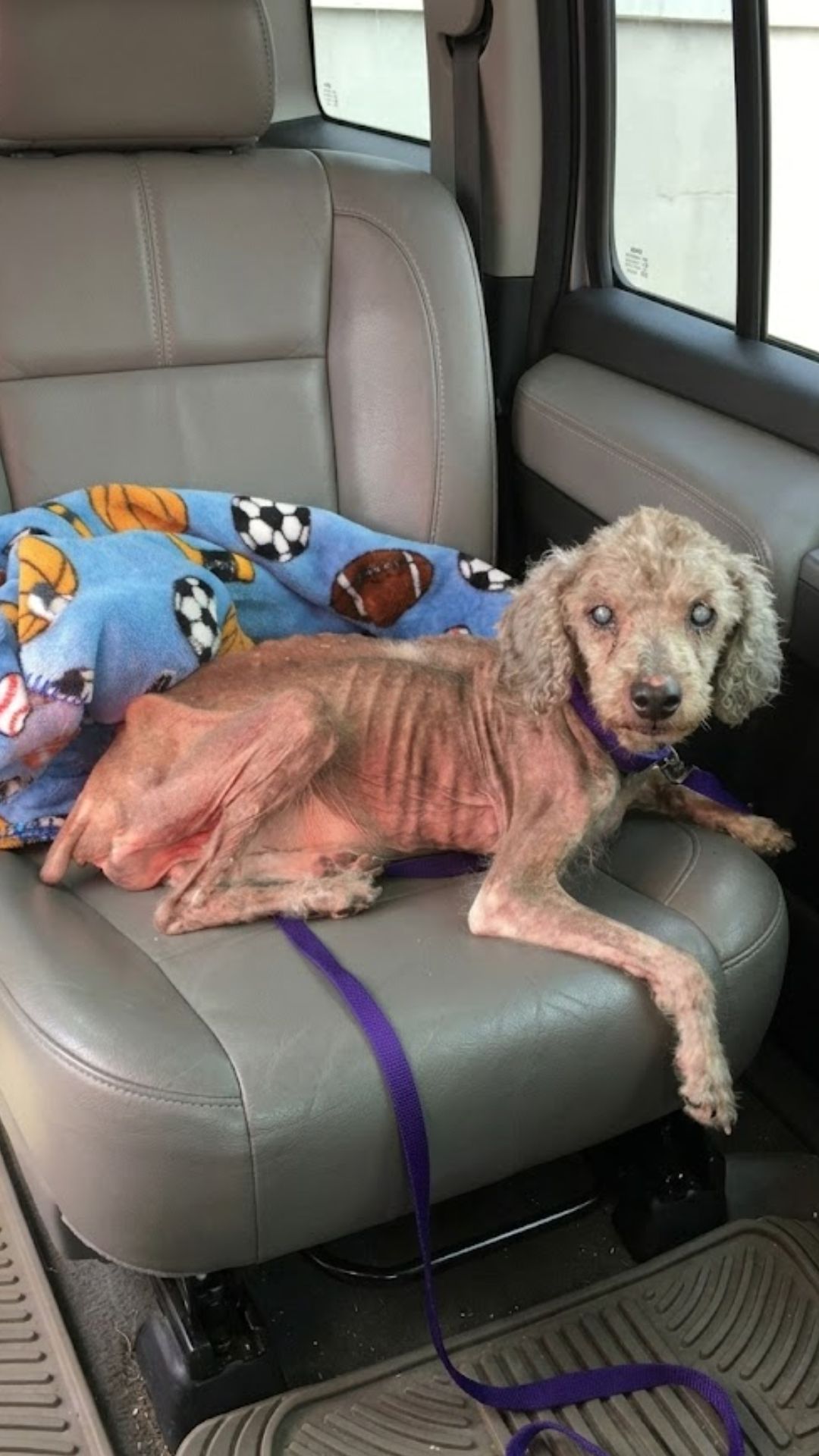
He stood behind a dusty window, so thin and still that a woman walking past the house could barely tell what she was looking at.
There was no barking to catch her attention.
No scratching against the glass.
Only a faint movement from a small figure that seemed almost lost in the shadows.
The woman stopped and looked again.
It was a dog.
A poodle whose body had become so frail that his bones were clearly visible beneath his skin.
That quiet discovery on a residential street in Tampa, Florida, would become the beginning of an extraordinary journey for a nine-year-old dog named Beni.
But saving him from the house was only the first challenge.
Beni had endured such severe neglect that even the simple act of eating had become difficult. And when people finally stepped forward to help him, they would discover that his medical problems were far more complicated than his appearance suggested.
The Small Figure Nobody Had Noticed
The woman had been taking an ordinary walk when something behind a house window caught her eye.
At first, the shape did not resemble a living animal. It seemed more like an abandoned object resting near the glass.
Then it moved.
That slight movement was enough to make her look more carefully.
Behind the window stood an extremely thin poodle, silent and almost motionless.
His condition was alarming.
There was no energetic greeting, no excited tail, and no attempt to demand attention. He simply remained there, visible through the dusty glass.
Nobody passing along the street could have known how long he had been living in those conditions.
What mattered was that someone had finally noticed.
The woman returned home and contacted the authorities.
Her decision set a rescue in motion.
When officers entered the property, they discovered that the poodle was not the only animal inside.
Three dogs had been confined in the house without food or water.
The situation was critical for all of them.
Although the dogs were removed from the property, two were already in such poor condition that they died shortly afterward.
The third dog was Beni.
He was still alive, but his survival was far from certain.
At nine years old, Beni should have been enjoying the quieter comforts many senior dogs come to appreciate.
Instead, he had been found in a condition that suggested prolonged hardship.
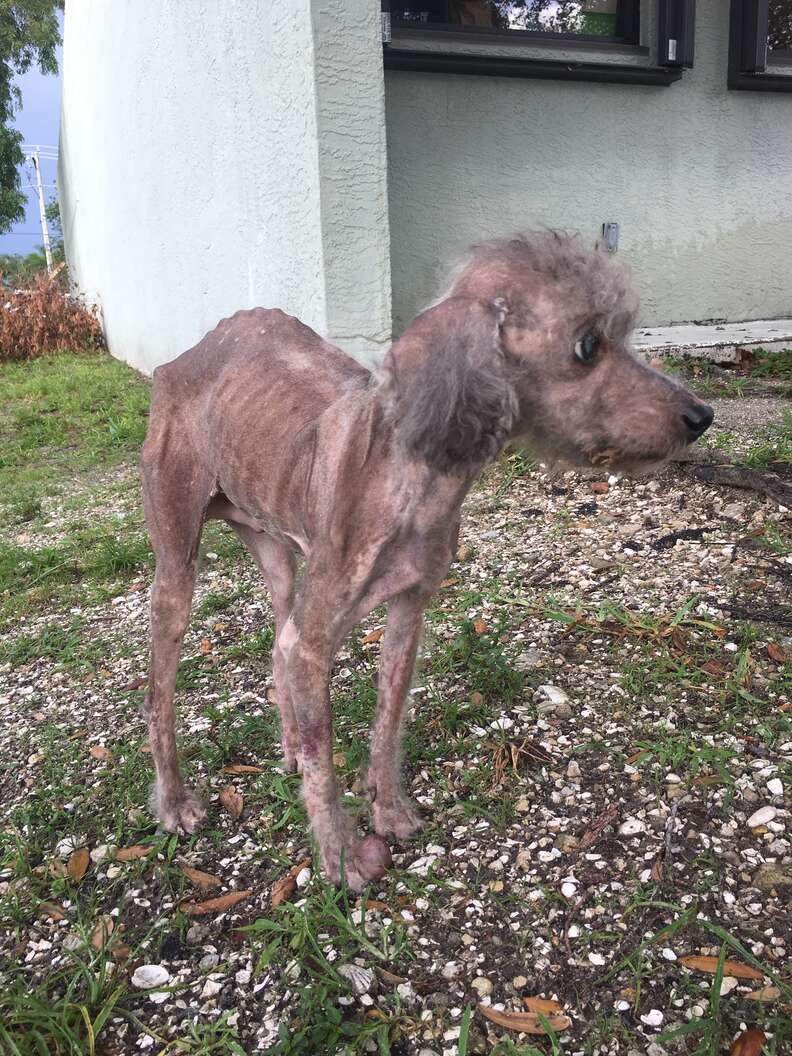
His body was severely underweight. Much of his coat was missing, and his skin showed signs of inflammation and infection.
He also had diabetes and a large tumor on one of his feet.
Each problem required attention. Together, they made his medical outlook deeply concerning.
The shelter responsible for his care faced a difficult decision.
Given the seriousness of his condition, euthanasia was scheduled.
After surviving inside the house, Beni was now facing the possibility that his rescue might not lead to a new life.
A Photograph Reached Someone Who Could Help
Sometimes, an animal's future changes because the right person sees a single photograph.
For Beni, that person was Debbie Goldsberry, the founder of Senior Paws Sanctuary.
An email arrived with information about the elderly poodle.
It included his photograph and details of his medical condition.
What Debbie saw was a dog facing enormous challenges, with very little time remaining for someone to intervene.
She understood the seriousness of the situation.
She also believed Beni deserved an opportunity to receive care.
According to the account of his rescue, Debbie recognized that without someone stepping forward, he would not survive.
Rather than allowing his scheduled euthanasia to proceed, she arranged to bring him into the sanctuary's care.
Volunteers organized transportation from the Tampa area to Fort Myers, approximately two hours to the south.
For a healthy dog, a journey of that length might be uneventful.
For Beni, whose body was dangerously weak, even transportation required concern and careful attention.
Yet the trip represented something he had not been offered inside the house.
A chance.
Someone had looked beyond his age, illness, and fragile appearance and decided that his life was still worth fighting for.
VIDEO: The Forgotten Poodle Was So Weak He Struggled to Eat — Then Someone Gave Him a Chance
When Even Eating Became a Challenge
Reaching veterinary care did not mean Beni's difficulties were over.
In fact, one of the most troubling signs of his condition became apparent when caregivers tried to feed him.
Food was placed before him.
He showed some interest and would take it into his mouth.
But then he stopped.
He seemed unable to continue the familiar process of chewing and swallowing.
It was as though an action most dogs perform instinctively had become unfamiliar to him.
Drinking water presented another challenge.
Beni's diabetes made proper hydration especially important, yet he was not readily drinking on his own.
For the people caring for him, these difficulties revealed just how much support he needed.
Providing a bowl of food was not enough.
He had to be helped through the gradual process of accepting nourishment again.
His severely weakened body also meant that feeding could not be rushed.
The source account describes how his stomach had become so diminished that large portions could make him ill.
Caregivers needed to offer carefully measured amounts while watching how he responded.
It was a delicate situation.
Beni needed nourishment to regain strength, but his condition demanded patience.
Recovery would not be measured by how quickly he could finish a meal.
At first, simply accepting a little food or water would be meaningful progress.
That distinction is easy to overlook.
To someone watching a healthy dog eat, a few mouthfuls might seem ordinary.
For Beni, they represented something much greater: the possibility of beginning to recover from the neglect he had experienced.
A Safe Place Where Nothing Had to Be Rushed
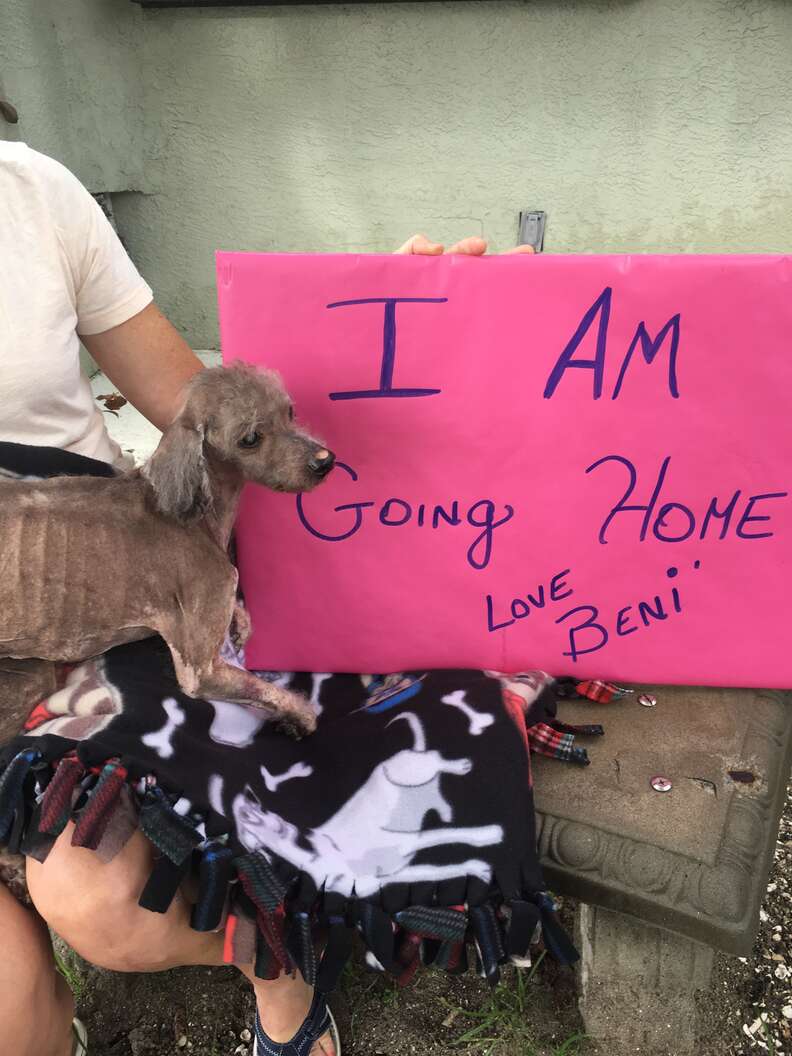
Debbie welcomed Beni into Senior Paws Sanctuary, where other rescued dogs were already receiving care.
The surroundings were different from the house where he had been found.
There were people watching over him.
Food was available.
And there was someone willing to remain beside him while he struggled through the earliest stages of recovery.
Still, Beni did not immediately become an affectionate, energetic companion.
He was quiet and withdrawn.
His behavior reflected the seriousness of his condition, and there was no reason to expect a sudden transformation.
Debbie responded with patience.
She spent time holding him, speaking gently to him, and staying close.
Those moments mattered alongside the practical work of caring for his physical health.
A senior dog recovering from severe neglect may need more than food and medical attention. The emotional side of care can also require time, consistency, and a calm environment.
For Beni, trust could not be demanded.
Neither could strength.
The sanctuary could provide him with a safer place, but his body still had to respond at its own pace.
Debbie continued caring for him without expecting immediate improvement.
And eventually, there was a change.
Beni began to look toward her with greater awareness.
Then came a tiny sip of water.
After that, he accepted a small bite of food.
These were modest steps by ordinary standards.
But for a dog who had struggled even to swallow, they represented meaningful progress.
His caregivers had waited for evidence that he could begin participating in his own recovery.
Now they were seeing it.
One small action at a time, Beni was beginning to move forward.
The Little Signs That Meant Everything
Beni's improvement was gradual.
There was no single moment when all his medical problems disappeared.
Instead, his progress became visible through a series of small changes.
With consistent care and appropriate feeding, his thin body began to gain weight.
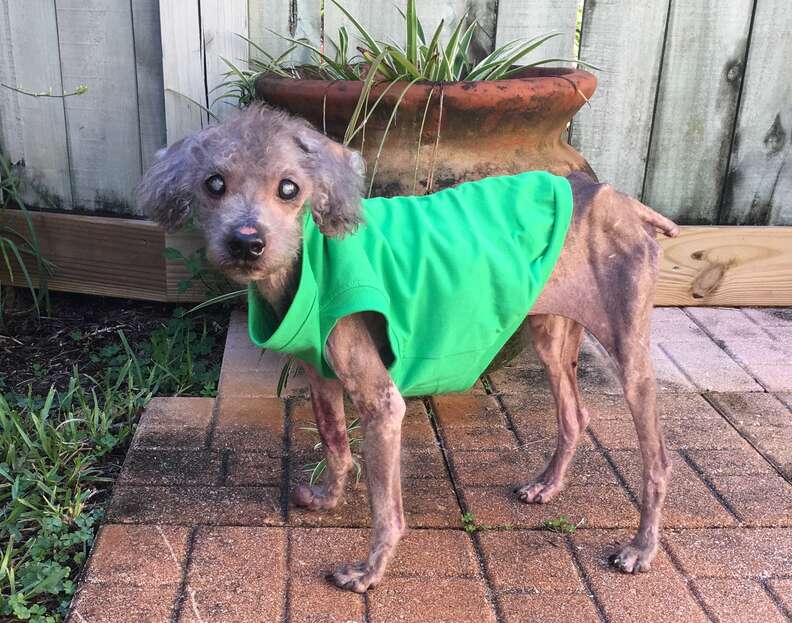
His coat, which had been severely depleted when he was rescued, started to grow back.
Soft, dark fur gradually replaced some of the bare areas that had made his appearance so troubling.
He was beginning to look more like the poodle he had always been.
Yet one of the most memorable changes had little to do with his weight or coat.
It was the movement of his tail.
At first, the wag was small and uncertain.
But it was unmistakable.
Beni was beginning to respond to the affection around him.
For Debbie, who had spent so much time helping him eat, drink, and become comfortable, that small gesture carried enormous meaning.
It suggested that the quiet dog who had once stood almost motionless behind a window was becoming more engaged with the people around him.
His progress was not simply a matter of appearance.
His behavior was changing, too.
He was gradually becoming more responsive and comfortable.
Moments like these are especially meaningful in senior dog rescue.
A healthier coat or an increase in weight can be seen in a photograph.
But the first relaxed response to affection, or the first movement of a tail, can reveal a different side of recovery.
For Beni, both kinds of progress mattered.
He was not returning to the life he had known before.
He was discovering a different one.
An Unexpected Diagnosis Changed His Future Again
As Beni grew stronger, the changes in his daily life became increasingly encouraging.
His diabetes became manageable with care.
He regained strength.
He even started playing.
For a dog who had once been too weak to eat normally, those developments were remarkable.
But his medical journey was not finished.
The large tumor on his foot still required attention.
During surgery to remove it, veterinarians discovered that Beni had advanced cancer.
It was another serious diagnosis for a dog who had already endured so much.
The discovery changed the way his future had to be considered.
Although his recovery from neglect had been encouraging, cancer introduced an additional challenge that could not be ignored.
The account of Beni's story does not establish that his cancer was cured.
His long-term prognosis remained uncertain.
That uncertainty made the care he was receiving even more significant.
Debbie and the people around him could not promise that every medical problem would disappear.
They could, however, continue providing comfort, attention, and the best quality of life possible.
And Beni was showing that he could still enjoy the days available to him.
He greeted people warmly.
He welcomed affection.
His tail, once still, now moved frequently.
The little dog who had appeared almost lifeless behind a window was becoming an affectionate companion.
His diagnosis remained serious.
But it did not erase the progress he had made or the comfort he was now able to experience.
What Matters Most Is the Life He Has Today
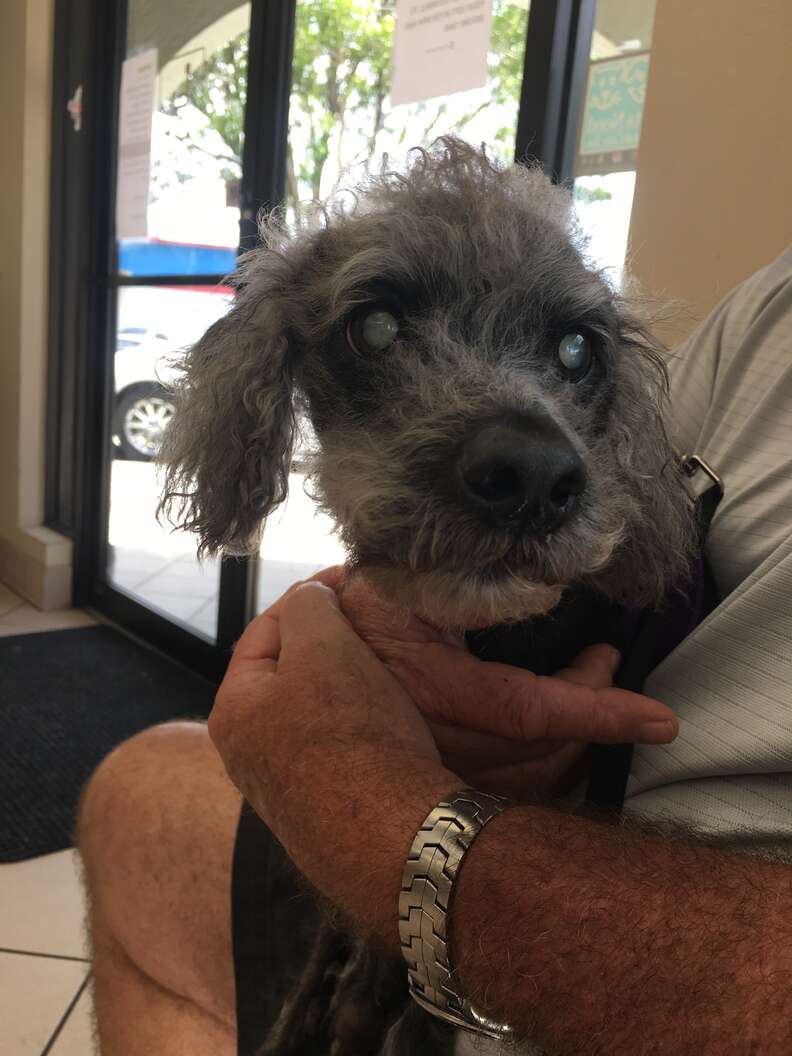
There is something especially moving about seeing Beni resting comfortably in someone's arms.
His dark coat has returned.
His body is no longer the fragile outline first noticed through that dusty window.
And instead of remaining distant and withdrawn, he now responds to the people who care for him.
These changes do not mean his health challenges have ended.
They mean that his circumstances have changed.
He has a place where his needs are recognized.
He has people willing to manage his condition.
And he has companionship rather than isolation.
Debbie's approach to Beni's future is centered on a simple goal.
She wants each day of his life to feel special.
It is a compassionate response to a situation in which no one can guarantee how much time remains.
For a dog living with advanced cancer, quality of life is not a small consideration.
It is central to every decision about his care.
A comfortable place to rest, appropriate food, medical support, and gentle attention can make an enormous difference to an animal's daily experience.
For Beni, these things are no longer absent.
He does not need to understand the medical terminology surrounding his condition to experience comfort.
He can respond to a familiar person.
Enjoy a gentle touch.
Show excitement.
And rest in the presence of someone who cares.
These ordinary experiences have become the most meaningful part of his new life.
The Window That Changed Everything
Beni's journey began with something so small it could easily have been missed.
A woman walking past a house noticed movement behind a window.
She could have continued down the street without looking again.
Instead, she paid attention.
That choice led to the discovery of three neglected dogs and gave one surviving poodle an opportunity for a different future.
The rescue could not save every animal found in the house.
And even for Beni, reaching safety did not guarantee complete recovery.
He faced serious illness, difficulty eating, a long period of rehabilitation, and eventually a cancer diagnosis.
But his story also shows what patient, compassionate care can accomplish.
A dog who could barely accept food learned to eat again.
A severely underweight body gradually regained strength.
A withdrawn senior poodle began welcoming affection and showing happiness.
His future remains uncertain, but his present is no longer defined solely by neglect.
There is a profound difference between merely surviving and having the opportunity to feel safe and cared for.
Beni has experienced that difference.
He may never have the long, uncomplicated retirement that every senior dog deserves.
But thanks to one observant passerby, the people who responded to her call, and Debbie Goldsberry's willingness to help, he has been given something precious.
Time surrounded by care.
His story is a reminder that helping an animal does not always mean being able to fix everything.
Sometimes, it means refusing to let that animal face its remaining days without kindness.
And for Beni, the little poodle once overlooked behind a dusty window, that kindness has changed the life he is living.


