
Sometimes, danger does not look dangerous at all.
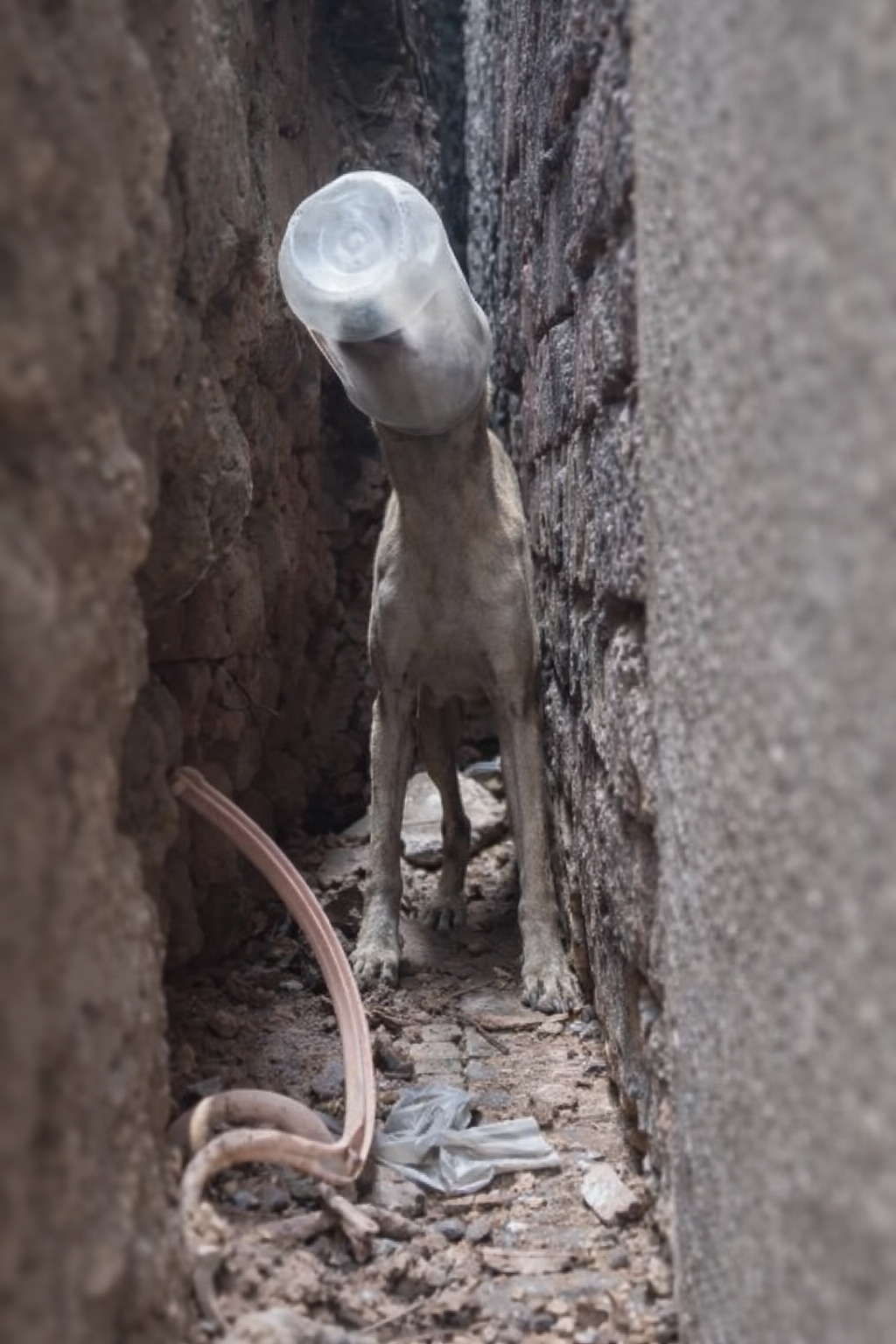
For one frightened dog, it looked like an ordinary plastic container — the kind that could easily be tossed aside and forgotten.
But by the time someone noticed him, that simple piece of discarded plastic had become a trap.
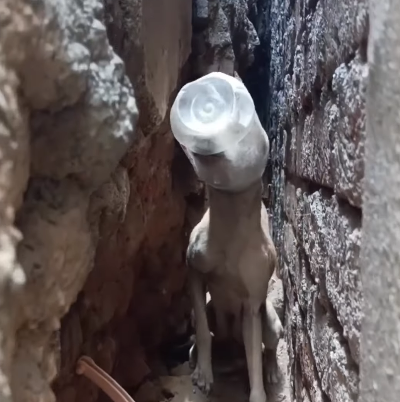
He was wedged inside a narrow space between two brick walls, his head completely enclosed by the container. He could not see what was around him. He could not reach food. And every attempt to pull himself free seemed to leave him more frightened and exhausted.
Trapped Where He Could Barely Move
The dog’s situation was immediately alarming.
His body shook as he struggled inside the tight gap. His legs moved restlessly against the ground, but there was almost no room for him to escape.
The plastic container remained firmly around his head.
For a hungry stray animal, something like this can happen with frightening simplicity. A discarded container may still carry the scent of food. An animal pushes its head inside searching for whatever remains, only to discover that getting back out is far more difficult.
That appeared to be the danger facing this dog.
What had once been an ordinary household object had become a barrier between him and the world around him.
He could not simply shake it loose.
And because he was already trapped between the brick walls, his ability to move was even more limited.
The scene was a quiet reminder that discarded waste does not always become harmless once people stop thinking about it.
For animals searching for food, it can remain part of their environment — and sometimes become a serious hazard.
Someone Saw Him Before It Was Too Late
The most important moment in the story came when someone noticed that the dog was in trouble.
A call for help reached the Animal Warriors Conservation Society, and rescuers responded to the scene.
But freeing him was not as simple as pulling the container away.
The dog was frightened, confined inside a narrow space, and moving unpredictably. Any sudden action could have increased his panic.
So the rescuers approached carefully.
They needed to control the situation without adding more fear to an animal that could not even see the people trying to help him.
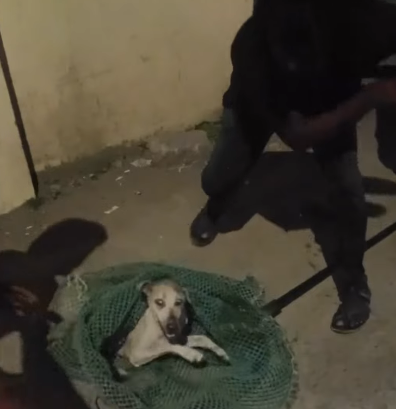
A specialized net was used to secure him gently.
There was no frantic pulling.
No unnecessary force.
Instead, the rescue depended on patience and controlled movement.
Once the dog was stable enough, one rescuer moved closer to the plastic container and carefully took hold of it.
For several tense moments, everything depended on one simple action.
Getting it off.
VIDEO: Trapped Behind Brick Walls With Plastic Over His Head, He Finally Felt It Slide Away
The Moment the World Came Back Into View
Then the container came free.
After being unable to see beyond the plastic surrounding his head, the dog suddenly had light and open space in front of him again.
He blinked rapidly.
For a brief moment, he appeared almost still, adjusting to the sudden change.
Then he moved.
He rushed forward from the narrow space that had held him, finally able to see where he was going.
The rescue itself had taken only a careful motion at the end.
But what that motion gave back to him was enormous.
His vision.
His ability to move freely.
His chance to leave the trap behind.
A Small Object Had Become an Invisible Cage
Once the plastic was removed, the difference was immediate.
The dog was no longer fighting against something he could not understand.
The tight brick passage was still there, but the barrier around his head was gone.
His body appeared to relax as he moved away from the place where he had been trapped.
It is easy to look at a discarded plastic container and see nothing more than trash.
For an animal, however, that same object can become something entirely different.
Stray dogs often search wherever food smells remain. They do not understand the shape of a container or whether an opening will allow them to pull their head back out.
They simply follow hunger.
That is why an item that seems harmless to a person can become dangerous when it is left where animals can reach it.
In this case, help arrived.
The dog was seen.
Rescuers had the equipment and patience to free him.
Not every animal caught in discarded waste is noticed so quickly.
One Small Habit Can Remove the Danger
The rescue also carried a practical message.
Plastic bottles and containers should be disposed of in a way that makes it difficult for animals to become trapped inside them.
Before throwing away suitable plastic containers, simple steps such as crushing or flattening them can reduce the chance that an animal will push its head inside.
Responsible disposal matters too.
The familiar principle of reducing, reusing, and recycling may sound ordinary, but stories like this show why those habits extend beyond keeping streets clean.
Waste remains somewhere after it leaves our hands.
And animals may encounter it long after we have forgotten it exists.
A container with traces of food inside can be especially tempting to a hungry animal.
For people, taking a few extra seconds before disposal may feel insignificant.
For a dog searching for something to eat, those few seconds could remove a dangerous trap from its path.
Compassion Can Begin Before a Rescue Is Needed
This dog’s story ended with freedom from the plastic container.
But its larger lesson begins much earlier.
Rescue is often associated with the moment someone arrives to help an animal already in danger. Yet compassion can also mean preventing that danger from appearing in the first place.
It can be as simple as noticing what we leave behind.
Thinking about where waste may end up.
Making sure a bottle, jar, or container cannot easily trap an animal.
And choosing to dispose of everyday items responsibly.
The dog between those brick walls could not remove the container by himself.
He depended on someone seeing that something was wrong.
Fortunately, someone did.
That moment of attention led to a careful rescue, and a discarded object that had taken away his sight and freedom was finally removed.
Not every act of kindness is dramatic.
Sometimes it is a rescuer moving slowly toward a frightened animal.
Sometimes it is a passerby stopping long enough to notice.
And sometimes it happens before an animal ever needs rescuing at all — when a person takes one extra moment to make ordinary trash a little safer.
Small choices can be easy to overlook.
For animals living close to the things humans throw away, they can matter far more than we realize.


