
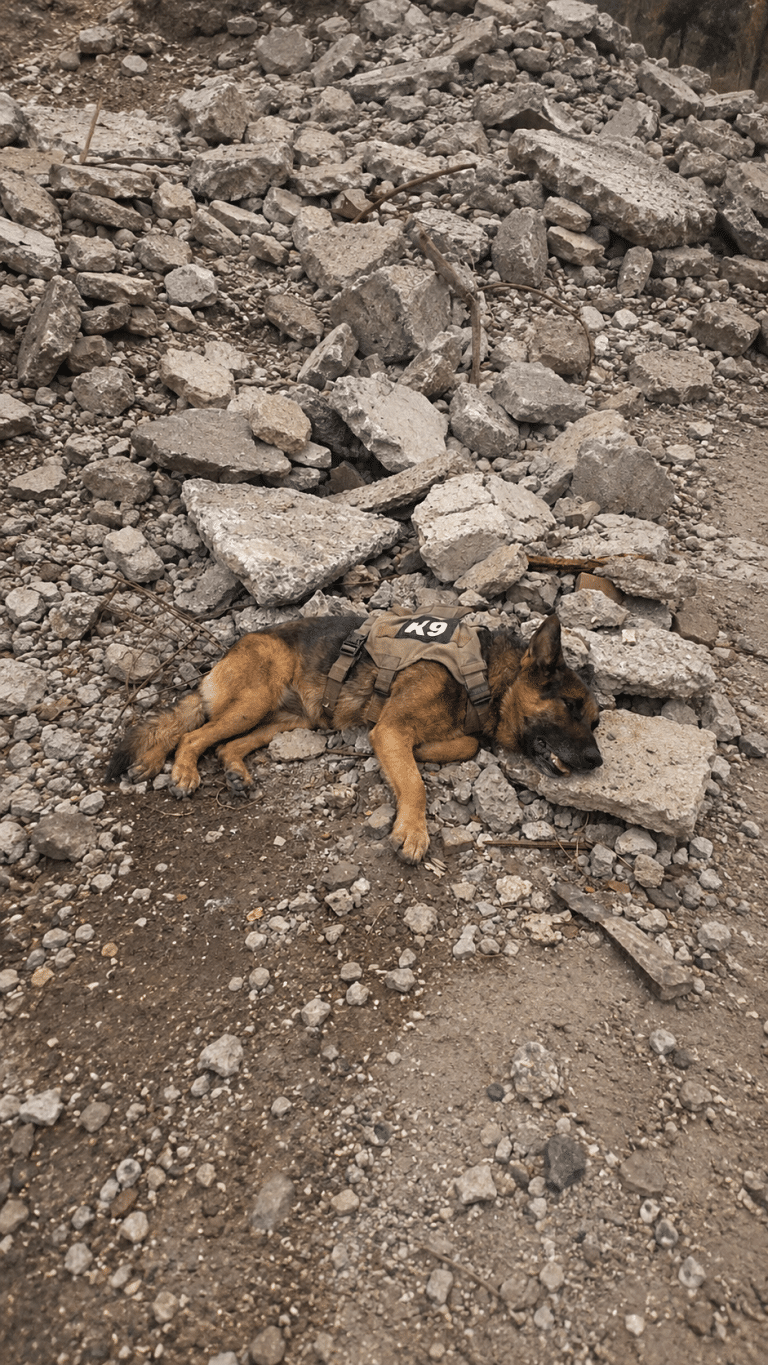
The German Shepherd stood quietly while soldiers secured a specialized tactical vest around its body.
There was nothing ordinary about this piece of equipment.
Beneath its carefully fitted protective layers was technology designed to help soldiers understand what lay ahead in potentially dangerous environments.
A camera. An audio transmission system. Protective armor.
All carried by a dog trained to work alongside military personnel.
For the soldiers watching, the equipment offered something valuable: an opportunity to gather information from a distance before entering an uncertain location.
But for anyone who has ever loved a dog, the scene carried another meaning.
Here was an animal preparing to take on a demanding assignment, relying on the people who had trained it and trusted its abilities.
The technology was impressive.
The partnership behind it was even more meaningful.
A Quiet Moment Before an Extraordinary Assignment
The footage begins with a familiar military working dog undergoing an unfamiliar preparation.
Soldiers carefully adjust specialized equipment around a German Shepherd.
The vest resembles protective gear used in demanding tactical environments, but a closer look reveals that it serves a purpose beyond physical protection.
Mounted on the equipment is a system capable of transmitting live video and audio.
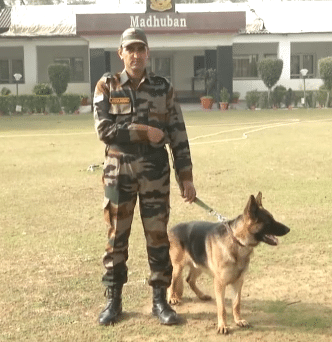
The innovation comes from the Indian Army's Military Dog Unit, which developed the setup to support operations in locations where conditions may be difficult to assess from outside.
Instead of relying entirely on what soldiers can see from their own positions, handlers can receive information from the dog's surroundings.
That difference matters.
A doorway may hide an unfamiliar environment.
A narrow passage may be difficult for personnel to examine without entering.
A tunnel or enclosed space may contain obstacles that are not immediately visible.
With a camera-equipped working dog, military teams can potentially gain a clearer understanding of such locations before deciding how to proceed.
The dog becomes an important part of that information-gathering process.
Yet the demonstration also raises a question that naturally comes to mind when watching an animal carry sophisticated equipment.
Can a dog still move comfortably and efficiently while wearing it?
The footage offers a closer look at how the system performs during a field exercise.
Protection Designed Around the Dog's Abilities
Military working dogs are valued partly because they can move through environments that present challenges for humans.
Their speed, agility, powerful senses, and specialized training make them useful in situations where conventional equipment alone may not provide enough information.
But adding armor and electronic devices presents a practical challenge.
Protective equipment must serve its purpose without unnecessarily interfering with the animal's movement.
That balance is central to the system shown in the demonstration.
The tactical vest combines protective materials with equipment for gathering and transmitting information.
The camera provides a live visual feed.
Audio technology allows sounds from the surrounding environment to be transmitted.
The protective armor is intended to provide an additional layer of safety during demanding assignments.
Together, these features create a system that supports both the dog's operational role and the soldiers depending on the information it gathers.
According to Lieutenant Colonel V. Kamal Raj, who leads the unit, the technology functions as a "force multiplier."
In practical terms, that means helping military personnel accomplish more by improving the information available to them.
It does not eliminate uncertainty.
It does not make dangerous environments completely safe.
But it may allow teams to recognize potential problems earlier and make more informed decisions.
The importance of that ability becomes especially clear when the German Shepherd begins moving with the equipment attached.
The Moment the German Shepherd Begins to Move
During the demonstration, the dog does not simply stand while the equipment is displayed.
It begins a field exercise.
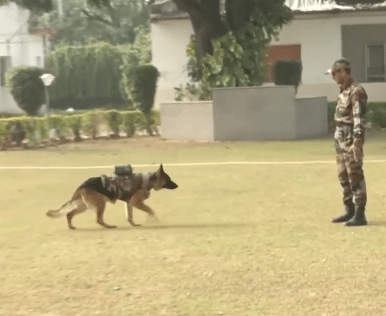
The German Shepherd runs, changes direction, and navigates obstacles while wearing the specially designed vest.
Its movements provide an important look at the equipment's practical purpose.
A camera system would be of limited use if it prevented a working dog from performing the movements required during an assignment.
The footage instead shows the animal demonstrating considerable agility despite the additional gear.
It is a striking combination.
Traditional canine training.
Modern protective equipment.
Real-time surveillance technology.
And an animal carrying out the movements it has been trained to perform.
For viewers, the sight offers a glimpse of how working dogs may be supported by technology that once seemed more closely associated with robotic devices.
But the most important part of the demonstration remains the dog itself.
The cameras can transmit information.
The armor can provide protection.
Neither can replace the animal's training, responsiveness, or ability to navigate the environment.
VIDEO: Watch a German Shepherd Run Through a Military Exercise Wearing Protective Armor and Live Camera Equipment
The exercise brings the design into focus.
The German Shepherd moves through the training area while soldiers can use the mounted monitoring system to observe its surroundings.
It illustrates a possible advantage of combining canine mobility with remote observation.
Rather than treating the animal as a replacement for soldiers, the system allows the dog and its handlers to contribute different abilities to the same mission.
The dog explores.
The equipment transmits.
The soldiers observe and interpret the information.
Each part serves a different purpose.
And each depends on the others working effectively.
There is something quietly remarkable about watching such advanced technology being carried by an animal whose most valuable qualities remain entirely natural.
Why These Dogs Are Trusted With Such Important Work
Military working dogs have supported human teams for decades.
Their responsibilities can include patrol duties, detecting explosives, searching designated areas, and assisting with specialized security operations.
These roles require much more than physical strength.
They demand sustained training, discipline, responsiveness, and the ability to work closely with a handler.
A military dog must be able to recognize instructions while navigating environments that may be unfamiliar or demanding.
Its handler, meanwhile, must understand how the animal responds and what its behavior may communicate.
This relationship is especially significant when the dog works beyond the handler's immediate reach.
A camera can provide useful visual information, but it cannot replace the experience and judgment involved in working with a trained animal.
That is why the new Indian Army equipment represents an addition to an existing partnership rather than a replacement for it.
The dog's abilities remain essential.
Technology simply offers another way for those abilities to support the team.
There is also a difficult reality behind this work.
Some military assignments involve areas where hazards may be present but cannot be identified immediately.
Working dogs may be used to assist personnel in evaluating such environments, including places where explosive hazards or other security concerns are possible.
These are serious responsibilities.
The development of protective equipment acknowledges that the animals performing them deserve attention to their safety.
A protective vest cannot guarantee that a working dog will remain unharmed.
Nor does a remote camera remove every danger associated with an operation.
Still, measures intended to improve protection and awareness are meaningful steps.
For an animal carrying out specialized duties alongside humans, every practical improvement in safety matters.
The Relationship No Camera Can Replace
One of the most memorable elements of the footage happens before the field exercise fully begins.
The soldiers are adjusting the German Shepherd's equipment.
The movements are careful and deliberate.
The vest must be positioned correctly.
The attached technology must remain secure.
The dog must be ready to move.
It is a practical preparation, but it also reflects the close coordination required between handlers and military working dogs.
These animals are not independent devices that can simply be switched on and sent forward.
Their effectiveness depends on training and cooperation.
A handler learns to work with the dog's strengths.
The dog learns to respond to the handler's direction.
Over time, that cooperation becomes a central part of how the team functions.
The protective camera system may change the kind of information soldiers can receive during an assignment.
It does not change the importance of that relationship.
In fact, it may make the handler's responsibility even more significant.
Live footage must be interpreted.
The dog's movements must be understood.
Decisions must account for both the mission and the animal carrying out its assigned role.
The result is not simply a dog wearing sophisticated equipment.
It is a trained animal working within a coordinated human team.
And that distinction deserves recognition.
An Innovation That Also Raises Questions About Animal Safety
When people see a German Shepherd moving through an exercise while wearing armor and cameras, attention naturally turns toward the technology.
How much can the camera reveal?
How effectively can the system transmit information?
Can it help soldiers avoid entering uncertain areas before they understand the conditions?
These are important questions.
But another consideration deserves equal attention.
How can new equipment support the dogs themselves?
The purpose of protective armor is to reduce exposure to certain hazards, while the camera system provides information that can help handlers make decisions.
Both features may contribute to safer and more controlled operations when used appropriately.
However, protective gear alone is not a complete safety solution.
A dog's well-being also depends on suitable equipment, appropriate training, careful handling, and responsible decisions about the conditions in which it works.
The demonstration shows that the German Shepherd can perform agile movements while wearing the system.
It does not establish how the equipment performs in every operational environment or how much protection it provides under all circumstances.
Those questions remain important as technology develops.
Innovation is most meaningful when it improves what a working team can accomplish without overlooking the needs of the animals involved.
For military dogs, that means recognizing them as living partners rather than merely platforms for electronic equipment.
Could This Technology Help Dogs Save Lives Beyond the Military?
Although the equipment was developed for military applications, the underlying idea has potential relevance to other forms of emergency work.
Imagine a trained search dog equipped with a camera while assisting rescuers in examining an area that is difficult for humans to access.
Live video could potentially help responders understand the surrounding conditions.
Audio transmission might provide additional information from locations where direct observation is limited.
Such possibilities could be useful during certain search-and-rescue operations, including responses to damaged structures or natural disasters.
These are potential future applications, not confirmed outcomes of the Indian Army demonstration.
Any wider use would require equipment designed for the specific task and careful consideration of animal safety.
Still, the concept is worth exploring.
Dogs already contribute to search operations through abilities that technology has not fully replaced.
Their senses and training can help human teams locate people and investigate areas that are difficult to assess.
Adding suitable monitoring equipment might someday provide rescuers with another valuable source of information.
The goal would not be to ask dogs to face unnecessary risks.
It would be to help trained teams work more effectively while taking every reasonable measure to protect the animals assisting them.
That possibility gives this military demonstration significance beyond its immediate setting.
The Courage Behind the Equipment
By the end of the footage, the most lasting impression may not be the camera, the armor, or the sophisticated transmission system.
It may be the sight of a German Shepherd moving confidently through its field exercise while carrying equipment designed to support a demanding role.
The dog does not understand the technology in the way its human handlers do.
It responds to the training and direction that guide its work.
The soldiers depend on that cooperation, just as the animal depends on them to make responsible choices about its assignments.
That shared responsibility is at the center of the story.
Modern systems can improve communication.
Protective materials can provide additional safeguards.
New designs can expand the ways trained dogs assist human teams.
But none of those advances should diminish the importance of the animals themselves.
The Indian Army's camera-equipped protective vest shows how military technology is being adapted to work with the capabilities of specially trained dogs.
It also offers a reminder that progress should be measured not only by what new equipment allows a team to do, but by how well it supports the people and animals using it.
The German Shepherd in the demonstration represents something larger than a technological achievement.
It represents the longstanding relationship between humans and working dogs.
A relationship shaped by patience, discipline, trust, and responsibility.
And as new tools continue to emerge, one principle deserves to remain unchanged:
The dogs helping protect human lives deserve protection, care, and respect in return.


