
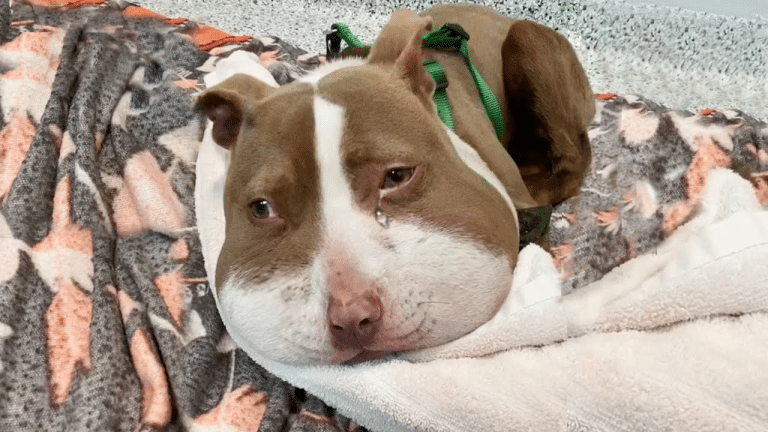
Mika could barely make a sound, yet she kept moving from one doorway to another.
The tiny dog was alone on a quiet street, exhausted and frightened. Her face was swollen, her body trembled, and a rope had tightened so severely around her neck that even breathing had become difficult.
She needed someone to notice.
But without the strength to bark properly, getting help was especially difficult.
There was no way of knowing how long Mika had been suffering or what circumstances had brought her to that street. What was clear was that her condition required urgent attention.
Then a photograph of her began circulating through the community.
People who saw it were deeply concerned. The image showed a small, vulnerable animal in distress, and it soon reached people determined to find her.
For Mika, that photograph became the beginning of an entirely different future.
The Little Dog Who Could No Longer Call for Help
There is something particularly painful about seeing an animal searching for help when it can hardly communicate its distress.
Mika had been wandering along a quiet street, approaching door after door despite her weakened condition.
The rope around her neck had become deeply embedded in the surrounding skin. Her face was irritated and swollen, and the pressure made breathing and vocalizing extremely difficult.
Even ordinary movements appeared to require considerable effort.
Yet she continued searching.
Perhaps the most troubling part of Mika's situation was how easily her suffering might have gone unnoticed.
A frightened dog does not always approach people confidently. A weak animal may not have the energy to run toward someone or make a sound loud enough to attract attention.
Mika was living through that uncertainty.
She needed assistance, but the very injury that made her situation urgent also limited her ability to ask for it.
When her photograph began spreading, the response was immediate.
People wanted to know where she was.
They wanted her to be found before her condition became worse.
And most importantly, they wanted her to receive the care she could not find on her own.
The photograph did more than show a dog in need.
It connected Mika with people willing to act.
Searching the Quiet Streets for Mika
After learning about Mika's condition, rescuers began looking for her.
They searched the nearby streets and narrow alleys, paying attention to places where a frightened, exhausted dog might have taken shelter.
Finding her was not guaranteed.
Mika was weak, and nobody knew exactly where she might have gone after the photograph was taken.
She could have been resting somewhere out of sight. She might have continued moving despite her injuries. Her limited ability to make noise made the search even more difficult.
The rescuers had to remain patient and observant.
They called for her and listened for any movement.
Each street presented another possibility.
Each quiet corner was worth checking.
Eventually, their efforts brought them to the little dog they had been searching for.
Mika was still in a severely weakened condition.
She had very little strength left, and moving appeared difficult. But as the rescuers came closer, her eyes followed them.
That small response mattered.
Although she was exhausted, she remained aware of the people approaching her.
The team understood that she needed gentle handling.
They moved slowly, avoiding unnecessary movements that might frighten her or aggravate the injury around her neck.
Then they wrapped Mika in soft blankets.
For a dog who had been wandering alone with such a painful condition, this was an important change.
She no longer had to keep searching along the street.
Someone had finally reached her.
The rescuers lifted her carefully and carried her away to receive help.
There were still serious concerns about her condition, and nobody could be certain how quickly she would recover.
But the first essential step had been taken.
Mika was no longer alone.
A Difficult Injury That Needed Gentle Hands
The rescuers brought Mika directly to a veterinary clinic.
There, Dr. Miranda and Dr. Yao began examining her and evaluating the damage caused by the rope.
Her condition was more serious than the team had hoped.
The pressure around her neck had caused severe irritation and infection, leaving the surrounding tissue badly affected.
Because the rope was embedded, removing it was not a simple matter of cutting it loose.
The veterinarians needed to work carefully to avoid causing additional injury.
Mika had already endured significant discomfort. Every part of her treatment required attention to her fragile condition.
Yet throughout the examination, she remained remarkably gentle.
She did not fight against the people caring for her.
She allowed the veterinary team to work, even though her body was exhausted and the affected area was extremely sensitive.
For those helping her, there was a clear priority.
The rope had to be removed safely.
Only then could Mika begin recovering without the constant pressure around her neck.
VIDEO: Mika Wandered From Door to Door Unable to Bark — Until Rescuers Found Her and Removed the Painful Rope
The Moment the Rope Was Finally Gone
The veterinary team worked with patience and precision.
Removing the embedded rope required hours of delicate treatment.
The damage around Mika's neck meant the procedure had to be approached with exceptional care. The doctors needed to address the immediate problem while protecting the already irritated tissue.
It was an important moment in her rescue.
Finding Mika had removed her from danger on the street.
But medical treatment was necessary to address the condition that had been making her life so difficult.
Finally, the procedure was completed.
The rope was gone.
Mika was still weak, and her recovery would require continued care. The affected skin needed time to heal, and her strength would not return immediately.
Nevertheless, an enormous source of discomfort had been removed.
For the veterinary team, it was a moment of relief.
The little dog who had struggled to breathe and make herself heard had made it through a crucial stage of treatment.
There was no sudden transformation.
No instant return to normal.
Only a fragile animal who had finally received the help she desperately needed.
And sometimes, that is where the most meaningful part of recovery begins.
Small Changes That Meant Everything
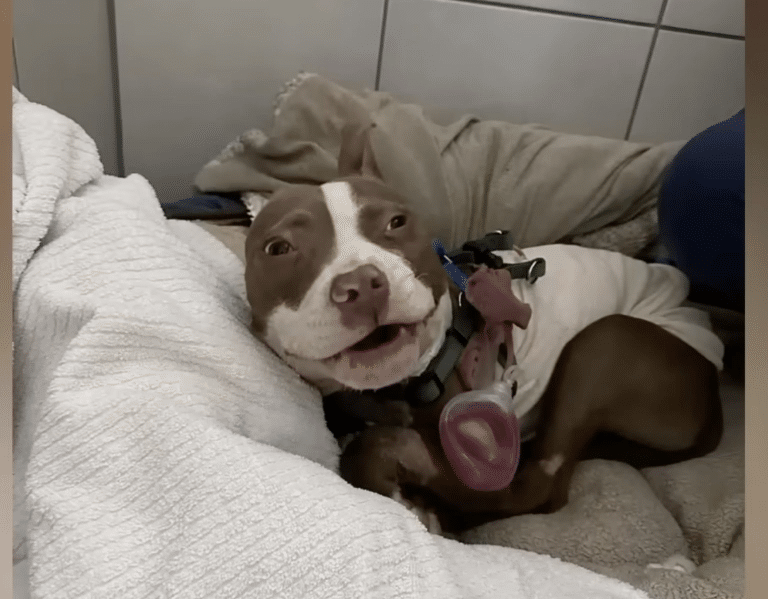
After treatment, Mika was moved to a quiet recovery area.
Her surroundings were now very different from the streets where she had been found.
There was a soft place to rest.
There was fresh water and nourishing food.
There were people looking after her condition and making sure she received the attention she needed.
Most importantly, the rope was no longer pressing against her neck.
Mika could begin recovering in a safe, peaceful environment.
At first, progress was slow.
The changes were not dramatic enough to notice from one moment to the next. Healing took time, especially after such a serious injury.
Gradually, the swelling around her face and neck began to decrease.
Her affected skin started improving.
Her coat also became healthier as she received consistent care.
But physical healing was only one part of Mika's transformation.
The people looking after her began noticing something different in her behavior.
The exhausted expression she had carried during her rescue slowly softened.
She started showing curiosity about her surroundings.
Then her tail began to wag.
Small playful gestures followed.
These were ordinary behaviors for a healthy, comfortable dog, but for Mika, they represented meaningful progress.
The frightened animal who had barely been able to move was beginning to show her personality.
She was no longer spending every moment struggling with her condition.
She had opportunities to rest, interact, and respond to the gentle attention around her.
Every improvement was another indication that she was moving forward.
Learning That the World Could Be Gentle
As the weeks passed, Mika became increasingly comfortable with the people caring for her.
Her recovery was not limited to the medical treatment she received.
She was also learning how to enjoy experiences that had once seemed far beyond her reach.
At the clinic, Mika began exploring the garden.
Initially, she approached her surroundings cautiously.
She had good reason to be uncertain. Her earlier experiences had left her frightened, and unfamiliar situations could still make her hesitate.
But nobody forced her to move faster than she was ready to.
Her caretakers allowed her to become comfortable at her own pace.
Gradually, her confidence increased.
The garden became a place where she could move more freely.
She began running around with other dogs.
Toys attracted her attention.
Playtime became part of her routine.
These changes revealed a different side of Mika.
The little dog who once seemed overwhelmed by exhaustion now had enough energy to explore and enjoy companionship.
She also began displaying affection toward the people who looked after her.
Something as simple as resting her head against a caretaker became a meaningful sign of trust.
It was not a dramatic gesture.
It did not require words.
But it showed how much her relationship with people had changed.
Instead of keeping her distance, Mika was becoming comfortable with closeness.
She could seek out gentle attention and enjoy being beside someone she trusted.
There were still difficult moments.
Unexpected sounds sometimes made her nervous.
Unfamiliar situations could cause her to withdraw.
Her caretakers understood that these reactions would not necessarily disappear simply because her physical injuries had improved.
Building confidence takes patience.
Mika was given that patience.
She had time to investigate new surroundings, experience ordinary routines, and discover that the people caring for her would continue treating her gently.
Little by little, her hesitation gave way to greater comfort.
Her progress was not measured only by her improved appearance.
It could also be seen in how she moved through her surroundings and responded to those around her.
A Different Dog, Months After Her Rescue
Months after Mika was found, the change in her condition was remarkable.
The tiny dog who had wandered along a quiet street, struggling to breathe beneath a painfully tight rope, had become stronger and healthier.
Her coat was bright.
Her steps were steady.
The swelling and discomfort that had once dominated her condition were no longer what defined her appearance.
She had regained the energy to play and explore.
She enjoyed spending time outside and interacting with other dogs.
And she had developed affectionate relationships with the people she trusted.
Looking at her now, it was difficult to imagine how vulnerable she had been when rescuers first found her.
Yet her transformation had not happened overnight.
It was the result of many small steps.
First came the search that brought her to safety.
Then came the careful veterinary treatment that removed the rope.
Afterward, there were days of rest, food, attentive care, and gradual physical improvement.
Finally, there were the quieter changes that accompanied her growing confidence.
A relaxed posture.
A wagging tail.
An interest in toys.
A willingness to approach someone for affection.
Together, these small signs told the larger story of Mika's recovery.
Her body had been given the chance to heal.
And her daily experiences had given her opportunities to build trust.
The Comfort of Finally Belonging
Mika's life is now filled with ordinary experiences that once seemed uncertain.
She has a warm place to sleep.
She receives regular meals.
She can enjoy sunny afternoons and spend time near the people who love her.
She is surrounded by the security and companionship that every dog deserves.
Perhaps one of the most meaningful aspects of Mika's journey is how much value there is in these simple comforts.
For a dog who once wandered from doorway to doorway in distress, having a safe place to rest represents an extraordinary change.
A comfortable bed is no longer something out of reach.
A gentle touch is something she can welcome.
Hearing someone call her name can be part of an affectionate daily routine.
The people who cared for Mika saw more than a physical recovery.
They watched a frightened animal gradually become a confident, playful companion.
They saw how consistent care helped her become comfortable with the world around her.
And they witnessed the difference that patience could make.
Mika's recovery did not erase what happened before she was rescued.
Her earlier suffering remains part of her story.
But it no longer defines the life she lives today.
The Photograph That Helped Change a Life
Mika's journey began with a photograph of a tiny dog in serious distress.
Someone saw her condition.
Her image was shared.
People became concerned.
Rescuers went searching.
Veterinarians provided the treatment she needed.
And through a long period of care and recovery, Mika gradually regained her health and confidence.
Each step depended on someone being willing to help.
Without the photograph circulating through the community, the rescuers might not have known where to begin looking for her.
Without their determination to find her, Mika might have remained on the street with an increasingly serious condition.
And without careful veterinary treatment, the injury around her neck could not have been properly addressed.
Her story illustrates how different acts of compassion can come together to change an animal's circumstances.
Not everyone who saw Mika's photograph could have personally rescued her.
Not everyone could provide medical treatment.
But the attention her situation received helped connect her with those who could.
That connection mattered enormously.
There are animals whose suffering is quiet.
They may be too frightened to approach.
Too exhausted to move.
Or, like Mika, physically unable to make themselves heard.
Their need for help is no less urgent simply because they cannot express it loudly.
Mika was fortunate that people recognized her distress and responded.
Today, the most memorable thing about her is no longer the rope that once made breathing so difficult.
It is the healthier, affectionate dog she has become.
She can run, play, relax beside her family, and enjoy the everyday comforts of a safe home.
The little dog who once went from door to door looking for help no longer has to search for someone willing to care.
She has found that care.
And in Mika's life, it has made all the difference.


