
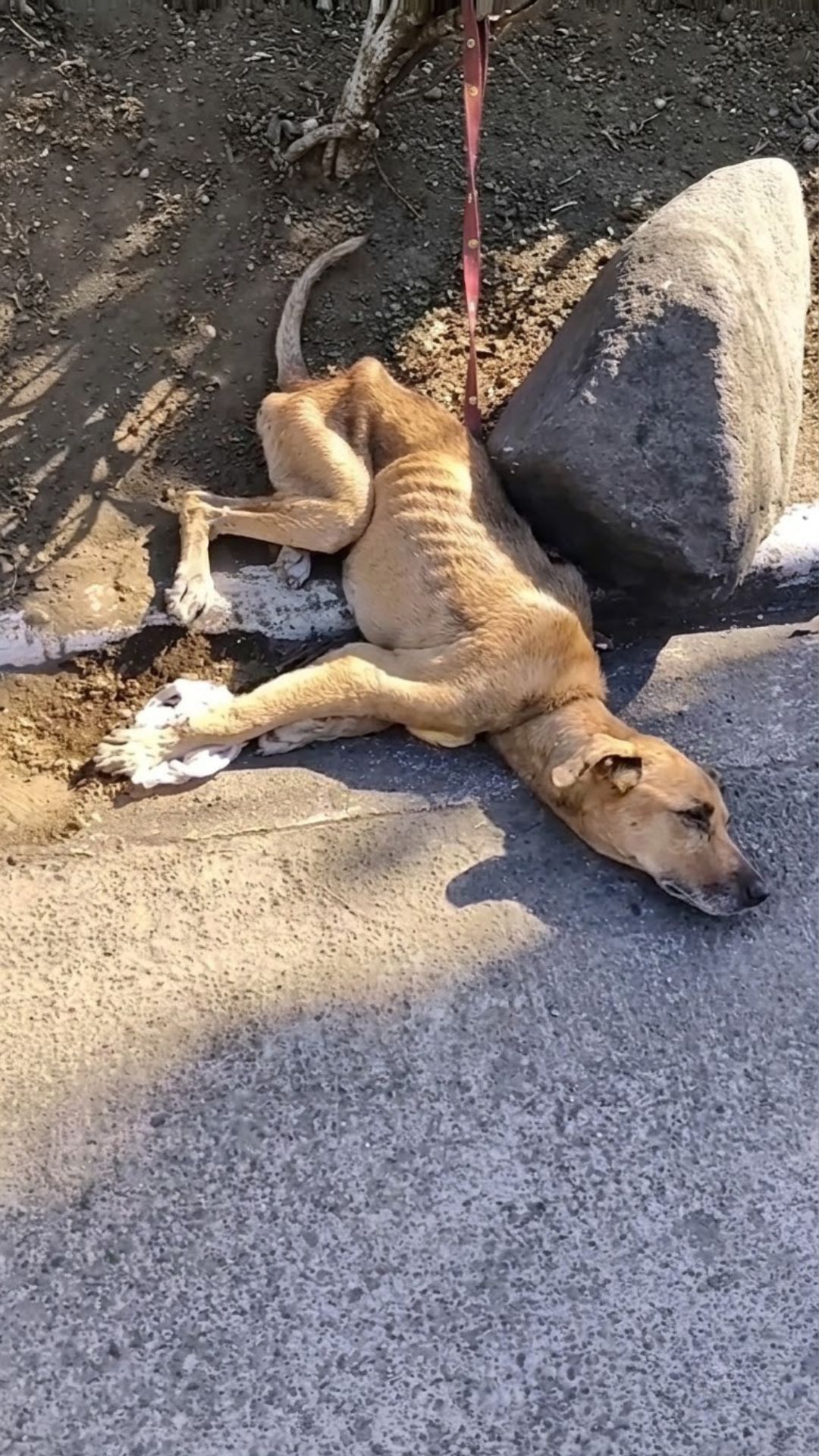
The concrete beneath Magma had been baking in the afternoon sun, and the heavy chain attached to him offered no way to escape the heat.
He could barely move.
His front legs were badly swollen, his head hung low, and even the simple effort of shifting his weight appeared beyond his strength.
When rescuers approached, he did not rush toward them.
He did not try to run away.
He simply watched through tired, cloudy eyes.
It was difficult to know how long he had been lying there or what had happened before anyone found him. But one thing was painfully clear: this dog needed help, and he could no longer reach it on his own.
What followed would not be a quick or easy recovery.
For Magma, even learning to eat again would become a milestone worth remembering.
A Dog Who Had Almost Nothing Left to Give
The rescuers from Happy Animal Club found Magma in a condition that immediately raised serious concerns.
The afternoon heat was intense. His chain restricted his movement, and his weakened body remained against the hot concrete.
Both front legs appeared swollen, leaving him unable to support himself properly.
The team placed food and water nearby, hoping he might respond.
But Magma showed little interest.
Ordinarily, a dog offered food after a period of hardship might show some sign of curiosity or hunger. Magma barely reacted at all.
His lack of response worried the rescuers.
He seemed to have reached a point where even basic movements required more energy than he could manage.
They approached carefully, keeping their movements gentle and unhurried.
Magma remained mostly still.
Then one rescuer reached toward his swollen paw.
At the light touch, he let out a quiet cry.
It was not loud.
Yet it revealed something his stillness had concealed: he was in considerable discomfort.
The rescuers understood that he needed professional medical attention as soon as possible.
Standing beside him in the afternoon heat, they faced a difficult reality.
There was no reason to believe that waiting would make his condition better.
And every additional moment left him exposed.
The Journey Away From the Burning Concrete
Moving Magma required special care.
His limbs were painful, his body was exhausted, and he could not simply stand up and walk toward the rescue vehicle.
The team did not spend time looking for a more convenient way to transport him.
Instead, they carefully lifted him, trying to avoid unnecessary pressure on his injured legs.
For a dog who could barely respond to food or water, even being carried was a significant ordeal.
But remaining where he had been found was not an option.
The rescuers brought him directly to their vehicle and began the journey to an emergency veterinary clinic.
During the drive, Magma remained visibly uncomfortable.
Small movements of the vehicle caused him to whimper. His body trembled, and the team could only continue toward the clinic while trying to keep him as comfortable as possible.
There was no immediate relief.
No sudden transformation.
Only the difficult first step of getting him somewhere he could receive help.
This was the point at which Magma's circumstances began to change.
He was no longer lying helplessly at the end of a chain.
People had seen his suffering, responded to it, and taken responsibility for helping him.
But the greatest challenges were still ahead.
What the Veterinary Examination Revealed
At the emergency clinic, the medical team began assessing the extent of Magma's condition.
The initial findings explained why his recovery would require more than rest and regular meals.
Blood tests showed that his body was severely weakened.
X-rays revealed fractures involving several small bones in the toes of one front paw.
These injuries helped explain why standing had become so difficult for him.
The swollen legs and exhausted appearance that rescuers had noticed were only part of the problem.
His body needed medical support, while his injured paw required time and careful management.
The available information did not establish exactly how those fractures had occurred.
Whatever had happened before his rescue remained uncertain.
What mattered now was ensuring that his condition did not deteriorate further.
Veterinary staff started intravenous fluids to support his weakened body and help address the losses he had experienced.
For the first two days, the priority was stabilization.
His caregivers could not rush the process.
They needed to address his immediate physical needs while observing how he responded.
And although he was finally receiving medical attention, one essential part of his recovery remained unexpectedly difficult.
Magma would not eat.
VIDEO: Found Chained Under the Scorching Sun, Magma Was Too Weak to Stand — His Fight to Recover Began Here
When Even Eating Became a Struggle
Food was one of the things Magma's weakened body desperately needed.
Yet offering it was not enough.
When caregivers brought soft food close to him, he turned away.
Even with a meal placed within easy reach, he showed little willingness to eat.
It was another troubling sign.
His body had endured severe physical stress, and he remained frightened and uncomfortable.
For the people caring for him, the challenge was not simply providing food.
It was finding a way to help him receive nourishment when he could not yet manage a normal meal.
So they began feeding him carefully with syringes.
Small amounts at a time.
Slowly enough to work with his limited strength and reluctance.
This was not an easy solution.
Each feeding required patience, attention, and the willingness to continue even when progress was difficult to see.
There was no dramatic improvement after the first attempt.
No immediate appetite.
No sudden eagerness to accept what was being offered.
Instead, his caregivers returned to the same quiet task, helping him take in the nourishment he needed.
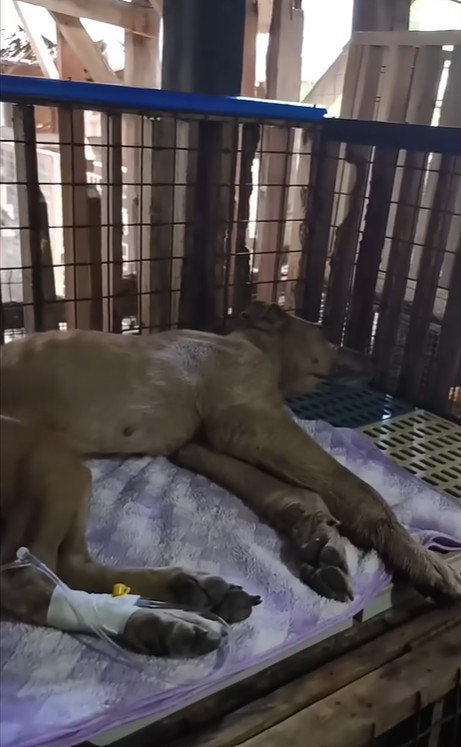
It would have been easy to measure Magma's progress only by the larger things he could not yet do.
He could not walk normally.
He was still frightened.
He still needed assistance with something as basic as eating.
But recovery does not always begin with visible strength.
Sometimes, it begins with the simple fact that a vulnerable animal has people willing to provide care consistently, even when improvement comes slowly.
The Happy Animal Club team continued working with him.
They had also given him a name.
Magma.
The name reflected their hope that, beneath his exhaustion, there was still enough determination to carry him through the difficult days ahead.
At first, that determination was hard to recognize.
Then his behavior began to change.
The Unexpected Signs That Magma Was Becoming Stronger
During his first week of recovery, Magma started reacting more actively to the people around him.
But those early signs of returning energy did not look like affection.
He growled.
He snapped when hands approached his face.
Feeding sessions sometimes brought defensive reactions.
To someone unfamiliar with frightened animals, his behavior might have seemed like a setback.
His caregivers saw it differently.
For days, Magma had been so weak that he barely responded to what happened around him.
Now he had enough energy to express discomfort and resist interactions that frightened him.
That did not mean his fear was gone.
In many ways, it had become more visible.
But it also meant the exhausted dog who had once lain almost motionless was beginning to respond to his surroundings again.
His caregivers did not treat those defensive reactions as misbehavior deserving punishment.
They recognized that he needed time.
They gave him space when he was uncomfortable and continued approaching him with care.
Every feeding session required balancing his physical needs with his emotional uncertainty.
Every interaction was another opportunity to show him that a nearby hand did not necessarily mean pain.
Trust could not be demanded from him.
It had to develop gradually.
And for Magma, that process was still in its earliest stages.
Then came a moment that gave the team another reason to hope.
He tried to get up.
After spending so much time too weak to move normally, Magma managed to lift his body from the recovery bed.
It was a modest movement.
He was not suddenly healthy, and there was no indication that his injured paw had completely healed.
But he was making an effort that had seemed beyond his strength when rescuers first found him.
For the people who had seen him lying under the afternoon sun, this mattered enormously.
The dog who had needed to be carried away from the concrete was beginning to regain some control over his body.
It was a small step.
But it was a step forward.
Day Ten: The Meal That Changed Everything
By the tenth day, Magma had already shown encouraging signs of physical improvement.
He was more responsive.
He had made an effort to rise.
He was gradually becoming more familiar with his caregivers.
Yet one important milestone had remained out of reach.
Eating independently.
Until then, syringe feeding had been essential to helping him receive nourishment.
The team had continued offering food and working patiently with him, understanding that his reluctance would not necessarily disappear just because his strength was improving.
Then Magma approached the food.
This time, he did not turn away.
He began to eat.
On his own.
For the first time since his rescue, he was taking a meal without relying on a syringe.
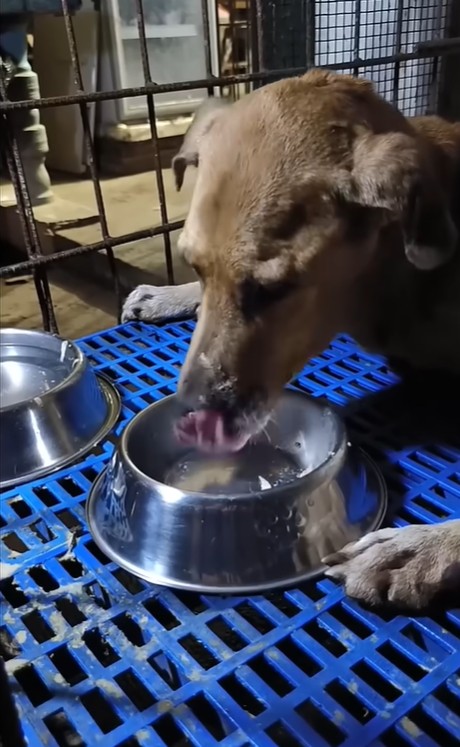
There was something deeply meaningful about that moment.
It was not simply that Magma had finally eaten.
It was that an ordinary action, one most healthy dogs perform without hesitation, had become possible again after days of weakness and uncertainty.
He still needed encouragement.
At times, the reassuring touch of a familiar caregiver helped him continue eating.
His fear had not vanished, and his recovery was not complete.
But he was showing a growing willingness to accept the care being offered.
The people working with him could see the difference.
His progress was no longer limited to surviving another day of treatment.
He was beginning to participate in his own recovery.
A little more movement.
A little more responsiveness.
And now, an independent meal.
None of those milestones erased what he had endured.
Together, however, they offered a clearer picture of the strength he was slowly regaining.
Learning That Gentle Hands Can Mean Safety
Physical treatment was only one part of Magma's recovery.
The emotional difficulties he displayed were also significant.
His reluctance to eat, his defensive reactions, and his discomfort around approaching hands showed how much reassurance he still needed.
The circumstances of his earlier life were not fully known.
It would be impossible to say exactly what experiences had shaped his fear.
What the caregivers could observe was how he responded to them now.
At first, human contact often made him uncomfortable.
Later, the presence of familiar people began to help him through feeding sessions.
This was a meaningful change, even if it did not happen all at once.
Trust often develops through repeated experiences of safety.
For Magma, those experiences came during ordinary moments of care.
Food being offered without punishment.
Space being respected when he became defensive.
Gentle contact from people who had learned to recognize his reactions.
And the steady return of caregivers who continued helping him despite the difficulties.
There was no single moment when all his fear disappeared.
Instead, the changes were gradual.
He began responding more openly.
He showed greater ability to move.
He started accepting food on his own.
The same dog who could barely acknowledge the rescuers beside him was now taking part in the routines meant to help him recover.
That progress reflected both his returning strength and the patience of those caring for him.
It also illustrated something important about frightened rescue animals.
A defensive reaction does not necessarily mean an animal is unwilling to form a bond.
Sometimes, it means that feeling safe will take longer than anyone wishes.
Magma's caregivers were willing to give him that time.
A Recovery Still Being Written
Magma's journey has not reached its final chapter.
His physical injuries remain an important part of his ongoing care, and the emotional effects of his earlier experiences may require continued patience.
The source does not confirm that he has fully healed or found a permanent home.
Those outcomes remain beyond what is currently known.
But his progress since the rescue is unmistakable.
When Happy Animal Club first reached him, Magma was chained to hot concrete, unable to support himself properly, and showing almost no response to food or water.
He needed to be carried into the rescue vehicle.
At the clinic, tests revealed a severely weakened body and fractured bones in one front paw.
His earliest days required intravenous support and careful assisted feeding.
He could not simply begin living like a healthy dog the moment he reached safety.
Recovery demanded more.
Medical care.
Nourishment.
Gentle handling.
Consistency.
And time.
Now, he has demonstrated that he can make an effort to rise and eat independently.
His caregivers have also observed encouraging changes in his ability to accept their presence and reassurance.
These are not the dramatic transformations often associated with happy endings.
They are quieter.
But for Magma, they represent meaningful progress.
One caregiver described his first independent meal as an especially important turning point. Although he remained frightened, his willingness to eat suggested that something in his response to care was changing.
The people helping him could finally see the results of the patient work they had continued through his most difficult days.
The Meaning of One More Chance
Magma's story began with a dog lying helplessly under a punishing sun.
It could easily have remained a story about suffering that went unnoticed.
Instead, rescuers recognized the urgency of his condition and chose to act.
Their intervention did not immediately solve everything.
The journey to the clinic was uncomfortable.
Medical examinations revealed serious injuries.
His first days of care were difficult.
Even feeding him required repeated effort.
But the team continued because Magma's condition, however severe, did not make his life any less deserving of attention.
That decision gave him an opportunity he had not been able to create for himself.
Today, his recovery remains a work in progress.
He still needs support, and there may be more challenges ahead.
Happy Animal Club continues to rely on supporters to help provide veterinary treatment, food, shelter, and care for vulnerable animals.
Magma's experience shows why those resources matter.
A rescue is not always completed when an animal is lifted into a vehicle or brought through the doors of a clinic.
Sometimes, the most important work begins afterward.
It happens during the difficult feeding sessions.
During the cautious attempts to move again.
During the moments when a frightened animal starts accepting reassurance.
And during the slow return of ordinary behaviors that once seemed impossible.
For Magma, one of those moments arrived on day ten.
He walked toward his food and began eating without the syringe.
Such a simple action.
Such a meaningful change.
His future is still unfolding, and no one can yet say exactly how far his recovery will take him.
But the dog who once had almost no strength to respond is now moving, eating, and gradually learning to trust.
He has not recovered everything.
He has, however, been given something essential.
The opportunity to keep healing, surrounded by people who have not given up on him.
And for a dog once lying helplessly at the end of a chain, that opportunity means more than words can easily express.


