
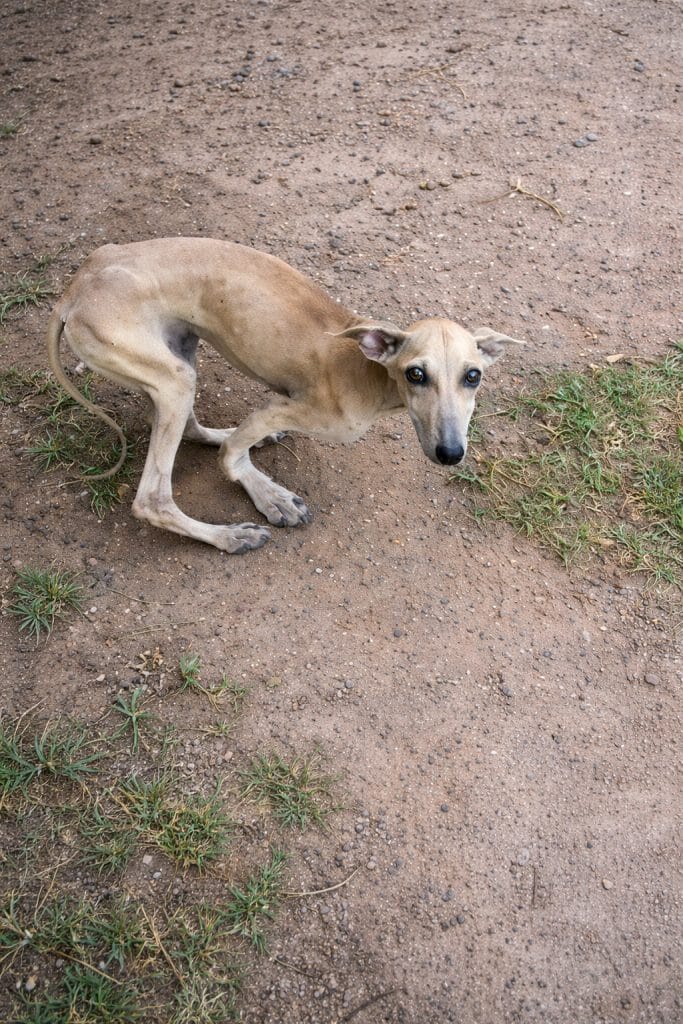
Dash had spent so much of his life struggling to move that something as ordinary as walking had become an enormous challenge.
His front legs bent inward at unnatural angles. His body was painfully thin, and each attempt to move across the pavement demanded an effort that most dogs would never have to experience.
While other dogs could run, explore, and play, Dash faced a much smaller goal.
He was simply trying to get from one place to another.
For a long time, people saw his condition without offering the help he desperately needed.
But the most remarkable part of Dash's story isn't only what he endured.
It's what happened when someone finally gave him the opportunity to heal.
And how a dog who once struggled to stand eventually discovered what it felt like to run.
A Life Measured in Painful Steps
Before his rescue, Dash's physical condition revealed how difficult his life had become.
He was severely underweight. His ribs were clearly visible beneath his fur, and his small frame showed the effects of prolonged hardship and inadequate care.
Yet his weight was only part of the problem.
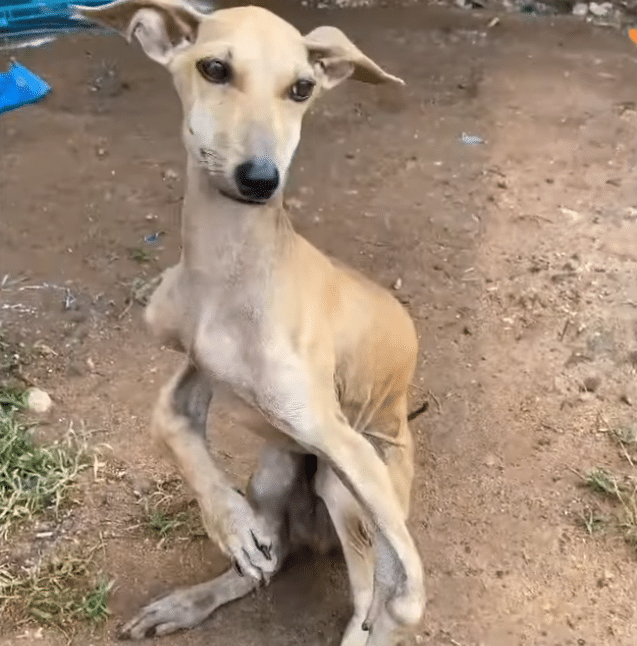
Both of his front legs had developed abnormally, bending inward so sharply that he couldn't place his paws on the ground in a normal standing position.
This meant that even basic movement required an extraordinary amount of effort.
Instead of walking comfortably on his paws, Dash had to push himself forward using his bent front joints.
Across hard pavement, every small distance became a physical challenge.
The very thing that should have come naturally to him had become a daily struggle.
There was no dependable supply of food.
No comfortable bed where he could rest his tired body.
No secure home where he could recover from the demands of simply surviving.
The source of Dash's leg deformities was not explained, and the full history of his life before rescue remained unclear.
What was visible, however, needed no explanation.
His body was weak, his movement was severely restricted, and he had been living without the consistent care he needed.
Still, Dash continued to move.
Slowly.
Awkwardly.
One difficult effort after another.
His expression seemed to carry more exhaustion than anger. He appeared worn down by a life in which even the simplest activities came at a cost.
For a dog in his condition, each passing day without help meant more time spent coping with limitations he could not overcome alone.
The Moment His Struggle Was Finally Seen
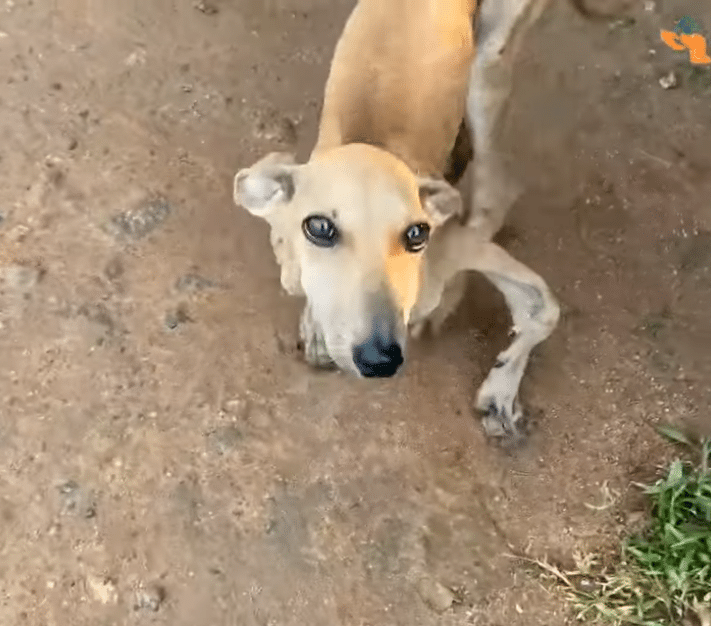
Dash's circumstances began to change when rescuers finally reached him.
By then, he was so weak that he offered no resistance as they approached.
There was no desperate attempt to escape.
No prolonged struggle.
He simply allowed them to help.
The rescuers understood that lifting him required particular care. His fragile body needed support, especially around his abnormally positioned front legs.
They gently picked him up, taking the pressure away from the limbs that had carried his weight so painfully.
For Dash, it was the beginning of an entirely different experience.
He no longer had to force himself across rough pavement just to reach another place.
He was being carried.
And for once, someone else was taking responsibility for his safety.
That change might have appeared small from the outside.
But for an animal who had spent so long struggling without dependable care, it marked a profound turning point.
The hard ground was replaced with warm bedding.
The uncertainty of his previous life gave way to a protected environment.
Instead of being left to manage his condition alone, Dash now had people willing to help him recover.
His legs had not suddenly become stronger.
His body was still thin.
He still faced significant physical challenges.
But something important had changed.
He finally had the support that made treatment possible.
And that was where his second chance truly began.
VIDEO: Dash Could Barely Walk on His Bent Front Legs — Then Rescuers Gave Him a Chance to Heal
Finding Freedom in the Water
One of the first important stages of Dash's rehabilitation took place in a therapy pool.
For a dog whose legs had made ordinary movement so difficult, water offered a very different experience.
On land, his front limbs had to cope with the pressure of supporting his body.
In the pool, the water helped carry some of that weight.
This allowed Dash to practice moving without the same burden that had made walking across the ground so challenging.
It was an important step toward rebuilding his strength.
But it was not an instant transformation.
At first, Dash moved cautiously.
His body had spent so long adapting to its limitations that even supported movement required time and practice.
The rehabilitation process demanded patience rather than speed.
Each session gave him another opportunity to use his muscles and gradually improve his coordination.
There were no dramatic shortcuts.
No single exercise that solved everything.
Progress depended on repeating small movements until they became a little easier.
Over time, his muscles began responding more effectively.
His confidence grew alongside his physical strength.
And the therapy pool became more than a place for exercise.
It offered Dash the chance to experience movement in a way that had previously been difficult for him.
For perhaps the first time, he could move without every effort placing the same painful pressure on his front legs.
That experience mattered.
Because recovery was not simply about changing how Dash's legs looked.
It was about helping him develop the strength and ability to use his body more comfortably.
A Difficult Operation and the Hope of Walking
As Dash grew stronger through rehabilitation, his veterinary team considered the next major step in his recovery.
Corrective surgery offered the possibility of improving the alignment of his front legs.
But the decision was not a simple one.
Orthopedic surgery required careful planning and precise treatment.
And even if the operation succeeded, Dash would still face a demanding recovery process afterward.
Surgery alone could not instantly restore the strength, balance, and coordination he had struggled to develop.
His body would need time to adapt.
Nevertheless, the potential benefit was significant.
With improved leg alignment, Dash might finally have the opportunity to stand and walk in a more natural position.
The veterinary team proceeded with the corrective operation.
And the surgery was successful.
His front legs were given the alignment they had previously lacked.
It was a major medical achievement in his journey, but it was not the end of his treatment.
In many ways, another difficult chapter was just beginning.
Dash still needed rehabilitation.
His muscles had to grow stronger.
His balance had to improve.
And he had to learn how to use legs that now functioned differently from the way he had known before.
For a dog who had spent so much time dragging himself forward on bent joints, standing normally would require much more than determination.
It would require practice.
Support.
And a great deal of patience.
The Small Steps That Changed Everything
After surgery, Dash's recovery continued through careful physical therapy.
Bandages were part of the healing process, while guided exercises helped him work toward better movement.
Nothing happened all at once.
At first, even standing could be uncertain.
Dash had to learn how to distribute his weight across his newly aligned legs.
He had to find his balance.
He had to become comfortable with movements that had once seemed impossible.
His early attempts were unsteady.
Sometimes he stumbled.
Sometimes he needed to stop and try again.
These were not failures.
They were part of learning to use his body in a new way.
A single movement might seem ordinary to a healthy dog, but for Dash, it represented progress that had taken considerable care and effort to achieve.
Each attempt offered another chance to strengthen his muscles and improve his coordination.
His rehabilitation was built around these modest achievements.
Not how far he could travel in one day.
Not how quickly he could walk.
But whether the next effort was a little more controlled than the one before it.
Then came a moment that captured just how far he had progressed.
Dash stood on his own.
Without collapsing.
Without needing to lean for support.
He simply remained upright.
For most dogs, standing is an everyday action that passes without notice.
For Dash, it represented the result of rescue, surgery, rehabilitation, and repeated effort.
The dog who had once struggled to support himself was finally discovering that his legs could hold him.
And that achievement opened the door to everything that followed.
When Every New Movement Became a Victory
Once Dash could stand more steadily, his rehabilitation moved forward.
He began taking careful steps indoors.
Those early walks were modest, but they gave him opportunities to practice using his improved balance.
With time, he progressed to short walks outside.
Then the distances gradually increased.
Each stage built on the one before it.
The physical changes became increasingly visible.
His previously underweight body began filling out.
The prominent ribs that had once revealed his frailty became less noticeable as he reached a healthier condition.
His muscles developed through exercise and regular movement.
His coat grew healthier and glossier.
But the transformation was not only physical.
Dash's behavior also began reflecting his improving circumstances.
The tired, subdued expression he had carried earlier gave way to greater curiosity.
He seemed increasingly interested in exploring his surroundings.
Movement was no longer defined only by the effort of getting through another difficult day.
It was becoming a way to engage with the world.
Walking could lead to something new.
Exploring could be enjoyable.
And every successful step appeared to make the next one a little less intimidating.
His recovery had taken time, and it continued to require care.
But the difference between the dog who had been rescued and the dog now learning to move confidently was becoming extraordinary.
The First Run Across the Grass
Eventually, Dash reached the milestone that seemed almost unimaginable when rescuers first found him.
He was able to run.
The moment unfolded on a stretch of soft grass.
Unlike the unforgiving pavement that had once made every movement so difficult, the grass offered a gentler surface beneath his paws.
Dash began moving forward.
One step.
Then another.
And then his pace changed.
He started running.
It was not the polished, effortless stride of a dog who had always enjoyed healthy movement.
His run still reflected a body that had been through an extraordinary recovery.
But that did not make the moment any less meaningful.
For the first time, Dash was moving with a freedom that had once seemed far beyond his reach.
His tail rose.
His body bounced with excitement.
He moved across the grass with an enthusiasm that revealed how different his life had become.
The contrast was remarkable.
Before rescue, Dash had been forced to push himself along on bent joints, struggling with the weight of his own body.
Now, after surgery and extensive rehabilitation, he could move forward on stable legs.
He was not simply reaching another place.
He was running because he could.
It was a moment that gave meaning to every difficult stage that had come before it.
The cautious movements in the therapy pool.
The carefully planned operation.
The uncertain first attempts at standing.
The small steps that gradually became walks.
All of them had contributed to this achievement.
And now Dash was experiencing something every dog deserves the opportunity to enjoy.
The simple pleasure of moving freely.
A Different Life for the Dog Who Once Struggled to Stand
Today, Dash is almost unrecognizable compared with the frail dog who first entered rescue care.
His front legs are straight and stable.
His body has become healthier and stronger.
The movements that once required such tremendous effort are now part of a much more active life.
He can walk with confidence.
He can explore.
And he can enjoy playful runs that would have been impossible before his treatment.
His recovery did not happen through one extraordinary moment.
It took a combination of compassionate rescue, veterinary expertise, corrective surgery, physical rehabilitation, and ongoing attention to his needs.
Each part mattered.
Without rescue, he might never have reached the care he required.
Without rehabilitation, his body would not have had the same opportunity to build strength.
Without surgery, the severe alignment problems affecting his front legs would have remained a major obstacle.
And without patient recovery afterward, even a successful operation would not have represented the full transformation that eventually took place.
Dash's story illustrates why helping an animal in need often involves much more than removing it from immediate hardship.
Safety is where healing can begin.
Medical care addresses problems that kindness alone cannot solve.
Rehabilitation makes gradual progress possible.
And consistent support gives a vulnerable animal the opportunity to rebuild a life.
There is something deeply moving about the distance between Dash's earliest struggles and his later achievements.
Not because his recovery was effortless.
But because it wasn't.
Every improvement had to be earned through treatment, practice, and time.
The dog who once had to fight to take another step eventually became a dog who could run across the grass.
His story is a reminder that progress does not always arrive quickly or dramatically.
Sometimes it begins with being gently lifted from the ground.
Sometimes it takes shape through careful exercises and uncertain first steps.
And sometimes, after a long journey, it appears in the simplest image of all.
A healthy dog moving freely across a patch of grass.
For Dash, that freedom was more than a physical achievement.
It was the life he had finally been given the chance to experience.


