
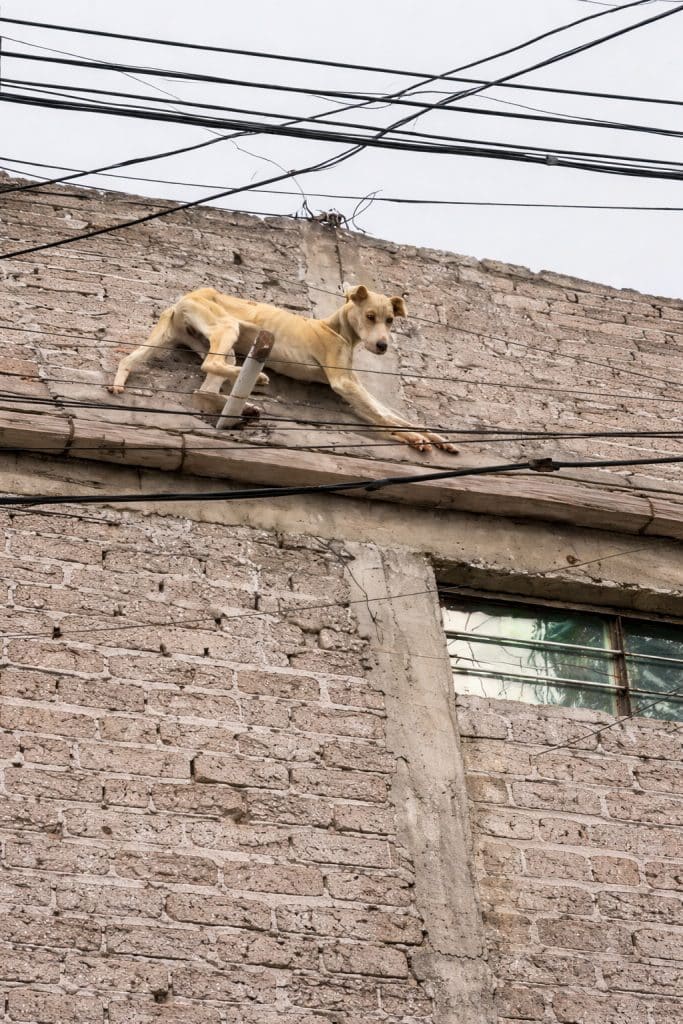
The chain around Valiente's neck allowed him only a few steps before pulling tight.
Above the streets of Los Reyes La Paz, Mexico, the thin dog lived on a narrow concrete ledge near the top of a brick building. There was little room to move, nowhere comfortable to rest, and no reliable source of food or clean water.
People passed along the street below.
Most never knew he was there.
For an unknown length of time, Valiente's entire existence was confined to that small space. Exposed to the heat of the day and the cold of the night, he grew weaker while the world continued around him.
Then, during one desperate attempt to escape, the very chain holding him prisoner placed his life in immediate danger.
What happened next would change everything.
The Lonely Life Above a Busy Street
Valiente was easy to overlook.
The unfinished brickwork surrounding his ledge helped conceal his thin body from anyone looking up from the street. His position high above the ground made him even harder to notice.
Yet there was nothing ordinary about the conditions in which he was living.
His ribs stood out beneath his dull coat. His muscles had weakened, and even remaining on his feet appeared to require considerable effort.
He had no proper protection from the weather.
Fresh drinking water was not consistently available. Food was uncertain.
And the heavy metal chain attached to his neck prevented him from leaving.
A few steps in one direction were all he could manage before the chain stopped him. He could not move somewhere cooler, seek shelter, or search for something to eat.
The ledge was both his living space and his prison.
How long had he been there?
The full history of his confinement was unknown. There was no confirmed account of when it began or how he had come to be left in such a vulnerable position.
What rescuers would eventually discover, however, was a dog whose condition reflected prolonged deprivation.
His body had become painfully thin.
His strength was fading.
Still, he had survived.
There was something particularly sad about the distance between Valiente and the people passing below him. Help was physically nearby, yet his suffering remained largely unseen.
Until one moment finally brought attention to the ledge.
When an Attempt to Escape Became an Emergency
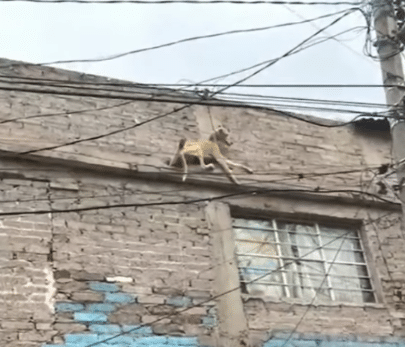
Valiente's desperate effort to get away from his confined space nearly ended in tragedy.
He attempted to climb away from the ledge.
But the chain around his neck did not give him enough freedom to reach safety.
Instead, it pulled tight.
For a frightening moment, Valiente was left hanging in a dangerous position, unable to pull his weakened body back onto secure footing.
The restraint that had limited his movement for so long had become an immediate threat.
This time, someone noticed.
His struggle brought attention to the situation, and a rescue team was contacted.
When the rescuers arrived, they found a dog who needed careful handling. Valiente was already severely weakened, and his precarious position made the rescue especially urgent.
They approached with the attention his fragile condition required.
Supporting his body, they worked to free him from the heavy chain around his neck.
Valiente offered no resistance.
He did not attempt to bite the people reaching toward him. He did not struggle against their hands.
He remained quiet as they helped him.
It was impossible to know exactly what he understood in that moment. After such a long period of confinement, these unfamiliar people represented a dramatic change in his surroundings.
But their purpose was simple.
Get him away from the edge.
Remove the chain.
Bring him somewhere safe.
The rescuers carefully freed him and carried him down from the building.
For the first time in an unknown period, Valiente was no longer restricted to that small concrete ledge.
His rescue had succeeded.
Yet the condition of his body made it clear that reaching the ground was only the beginning.
VIDEO: Chained Above the Street and Too Weak to Escape, Valiente Finally Gets the Help He Desperately Needed
The First Days Without a Chain
Once Valiente was safe, attention turned to his health.
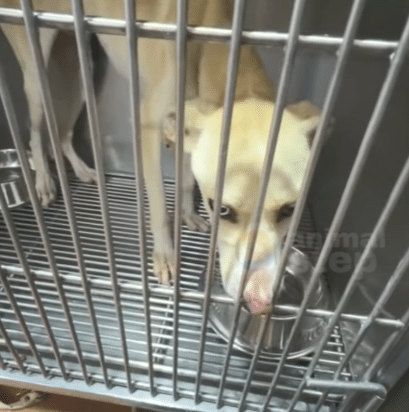
A veterinary examination confirmed that he was dangerously underweight and severely dehydrated.
His body had been pushed close to its limits.
The priority was not to rush his recovery. It was to give him the support he needed without placing additional strain on his weakened system.
He received fluids to address his dehydration.
His meals were carefully portioned so that his body could gradually adjust to regular nourishment again.
After living with uncertain access to food, Valiente approached each meal with striking urgency.
For him, a bowl of food was not something he had been able to take for granted.
Now, caregivers made sure that meals arrived consistently.
There was fresh water within reach.
There was a warm bed where he could rest.
And there were people who checked on him throughout the day.
These were basic comforts, but they marked a remarkable difference from the life he had known on the ledge.
He no longer had to remain exposed on rough concrete.
He no longer had to depend on whatever food might reach him.
Most importantly, there was no heavy chain preventing him from moving to a comfortable position.
Recovery, however, required much more than removing an object from his neck.
Valiente had spent an unknown amount of time isolated, restrained, and deprived of consistent care.
His physical weakness was visible.
The effect of those experiences on his behavior would take longer to understand.
In his new surroundings, he remained watchful.
Gentle contact could still make him hesitate. When someone entered the room, he followed their movements closely.
He did not behave aggressively.
He appeared uncertain.
His caregivers understood that forcing affection would not help him become comfortable.
Instead, they allowed him to adjust at his own pace.
They stayed nearby while he ate, spoke gently during his care, and gave him time to become familiar with their presence.
There was no single dramatic moment when everything changed.
Trust arrived through repetition.
A meal that was followed by another meal.
A quiet voice that returned without causing harm.
A hand that offered comfort without demanding a response.
Day by day, Valiente began to experience a different relationship with people.
One built on patience rather than restraint.
Small Signs That He Was Beginning to Trust
The changes in Valiente's behavior were gradual.
At first, he watched carefully whenever someone approached.
Then he became more comfortable with gentle hands.
He began relaxing when familiar caregivers entered the room.
Eventually, the sound of his name was enough to make him raise his head.
That name carried special meaning.
The rescuers called him Valiente, the Spanish word for "brave."
It was a fitting name for a dog who had endured such difficult circumstances and continued moving forward.
But his bravery was not measured by a lack of fear.
His cautious behavior showed that becoming comfortable again was a process.
He needed opportunities to discover that the people caring for him would respect his boundaries.
And he was given those opportunities.
While his body gradually regained strength through regular meals and veterinary care, his daily experiences became less frightening.
Familiarity replaced some of the uncertainty.
The presence of caregivers became reassuring rather than something to watch with constant suspicion.
His recovery was unfolding on two levels.
He was learning to live in a healthier body.
And he was learning what it meant to be safe around people.
Neither change could be hurried.
The Grass Beneath His Paws
As Valiente became stronger, his world began expanding beyond the places where he received care.
One of his early experiences was a bath.
The washing removed accumulated dirt from his coat and helped soothe his irritated skin.
After so much time without proper care, even this simple routine represented a meaningful step toward comfort.
Then came walks outdoors.
His caregivers introduced these outings during quieter evening hours, allowing him to encounter new surroundings without the pressure of busy crowds.
At first, he remained close on his leash.
Unfamiliar sounds made him stop.
New sights caught his attention.
The outside world offered far more than the few feet of concrete he had once been allowed to occupy.
Now there were different surfaces beneath his paws, unfamiliar smells, and spaces that did not end when a chain pulled tight.
One evening, Valiente stepped onto a patch of grass.
He lowered his nose and spent several moments investigating the soft ground.
For many dogs, grass is such an ordinary part of life that it barely deserves a second thought.
For Valiente, it was another discovery in a world that had only recently opened to him.
He also began meeting other dogs.
He watched them play and observed how comfortably they interacted with people.
These encounters gave him opportunities to become familiar with ordinary canine behavior in a safe environment.
His confidence did not appear all at once.
He still needed time to adjust.
But the frightened dog who had once stood helplessly at the end of a chain was beginning to explore life on his own terms.
Two Months Later, He Was Almost Unrecognizable
Valiente's recovery became increasingly visible as the weeks passed.
Regular, nutritious meals helped restore his weight.
His legs grew stronger.
His coat became healthier.
The sharp outline of his ribs gradually disappeared.
The most striking change was not limited to his appearance.
His posture began reflecting greater comfort.
He moved more confidently, explored unfamiliar places, and rested peacefully.
At times, he wore a comfortable sweater while continuing to rebuild his strength.
He also started showing interest in toys and play.
These were small developments, but together they revealed how much his life had changed.
Only two months after his rescue, Valiente looked remarkably different from the frail dog found above the street.
His body was fuller and healthier.
His eyes showed curiosity.
He could walk without the heavy chain that had once controlled every movement.
The transformation had required consistent care, patience, and time.
There was no instant recovery.
Every meal contributed to the strength he was regaining.
Every calm interaction offered another opportunity to become comfortable with people.
Every walk allowed him to discover something beyond the narrow ledge where he had once lived.
The physical distance between those two versions of Valiente was impossible to measure.
But the difference was clear.
One had been trapped, exhausted, and isolated.
The other was learning to move freely and enjoy the world around him.
A Home Where Nobody Would Leave Him Behind
Valiente's journey eventually led to something even more meaningful than temporary safety.
He found a permanent home.
After the uncertainty of his earlier life, he now had a family and a place where he belonged.
He also shared his new surroundings with other animals.
The companionship introduced him to daily experiences that had once been far beyond his reach.
There were comfortable places to sleep.
Food and water were reliably available.
The people around him provided the stability he had previously lacked.
And he had space to move.
At first, his movements across open ground were cautious.
Then, as his confidence grew, he began running with greater freedom.
The contrast with his former life could hardly have been greater.
Once, he had been unable to take more than a few steps without feeling the chain tighten around his neck.
Now, he could cross wide fields.
He could play with other dogs.
He could explore without a wall defining the edge of his world.
He also became comfortable around larger animal companions in his new home.
For Valiente, the pleasures of daily life were no longer limited to basic survival.
He had opportunities to play, rest, explore, and enjoy companionship.
The dog who had spent so much time confined above a street was finally experiencing what a secure home could offer.
The Life That Began When Someone Looked Up
There is no way to recover the time Valiente spent on that narrow ledge.
His full history remains unknown.
What is known is that he endured prolonged confinement, severe weight loss, dehydration, and isolation before a dangerous escape attempt finally brought him to the attention of rescuers.
His story could have ended very differently.
The chain around his neck had nearly turned his attempt to escape into a fatal accident.
Instead, someone noticed his struggle.
A rescue team came to help.
And that intervention gave Valiente the opportunity to recover.
The minutes required to remove the chain were only a small part of what followed.
His body needed nourishment and medical attention.
His behavior needed patience and understanding.
His growing confidence depended on repeated experiences of safety.
Through those experiences, he slowly became a different dog from the one discovered high above the street.
Today, the most meaningful images of Valiente are no longer those of a thin animal standing on a confined concrete ledge.
They are the moments of an animal moving freely through open spaces, interacting with companions, and resting in a place where he is cared for.
His story is a reminder that rescue is not always completed when an animal is carried away from danger.
Sometimes, that is only the first step.
Real recovery can mean rebuilding strength, becoming comfortable with gentle contact, and discovering that an unfamiliar world no longer needs to be feared.
For Valiente, freedom became more than the absence of a chain.
It became regular meals, safe surroundings, patient companionship, and a permanent home.
He was once a dog almost nobody noticed.
Now, he is a dog with a family, a future, and the freedom to take every step ahead without being pulled back.


