
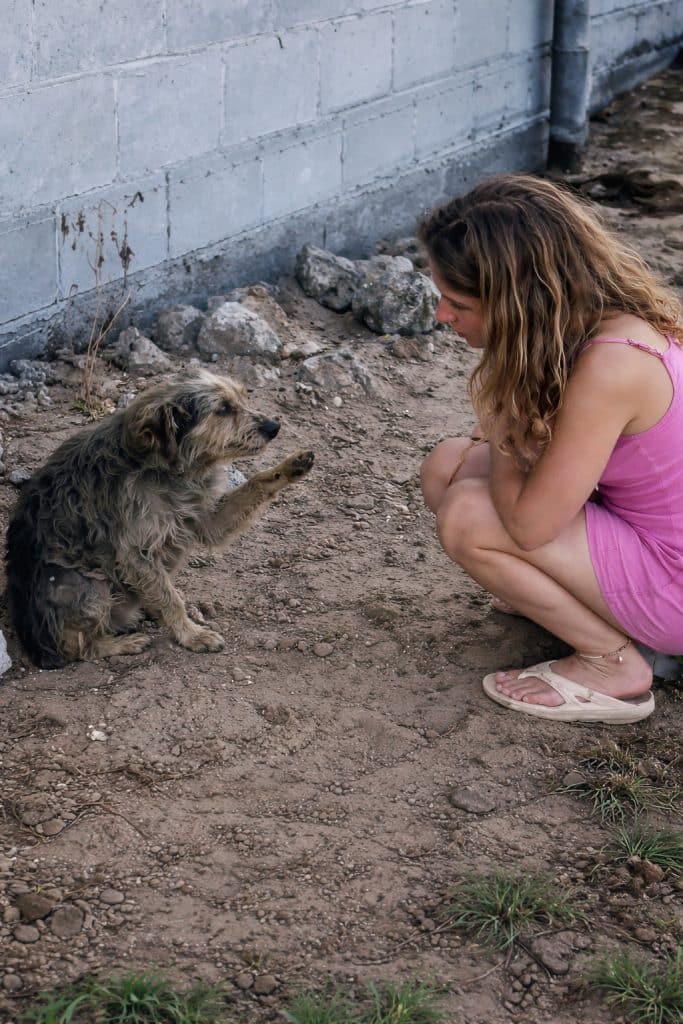
Tio was searching through a torn garbage bag beside the road when another dog rushed toward him.
He immediately stepped away.
There was no attempt to defend the food. No angry barking or struggle. He simply lowered his head and moved down the road, leaving behind what might have been his only meal.
For a dog living without dependable food or shelter, even a discarded bag of rubbish could mean the difference between eating and going hungry.
But Tio behaved as though losing that opportunity was something he had already learned to accept.
He walked away with his body held low, making no effort to return.
What happened next would gradually change the way this weary little dog experienced the world.
Someone had seen him.
And instead of allowing him to disappear down the road, they decided to follow.
A Lonely Dog Who Had Learned to Step Aside
There was something especially moving about Tio's reaction to being chased away.
The other dog approached aggressively, yet Tio offered no resistance. His response suggested a familiar pattern of retreating whenever another animal challenged him.
Perhaps experience had taught him that avoiding conflict was the safest choice.
His rescuers could not know everything he had endured. They had only his behavior and physical condition to help them understand how difficult his life might have been.
Still, those signs were difficult to overlook.
Tio appeared exhausted as he continued along the roadside. He walked without any clear destination, seemingly accustomed to searching for whatever food or shelter he could find.
The people who noticed him understood that approaching too quickly might frighten him.
So they followed at a distance.
They did not surround him or try to force an immediate encounter. Instead, they gave him room to move while looking for an opportunity to offer help.
It was a simple decision, but an important one.
Tio had just walked away from food because another dog claimed it.
Now someone was following him for an entirely different reason.
They wanted to make sure he had something to eat.
The First Meal Nobody Tried to Take Away
When the rescuers were close enough, they placed food on the ground.
Tio stopped.
Although he was clearly hungry, he did not immediately rush forward. He watched the people carefully, hesitating between the food in front of him and the uncertainty of approaching strangers.
His caution was understandable.
A dog who has spent a long time surviving outdoors may not instantly recognize a kind gesture as something safe.
The rescuers allowed him to make the choice.
They waited as he studied the situation.
Eventually, hunger and curiosity brought him closer.
He began to eat.
This time, nothing interrupted him.
There was no competing dog rushing toward the food. No sudden confrontation forcing him to abandon his meal.
For once, Tio could simply concentrate on eating.
The difference may have appeared small to an outside observer, but it represented a meaningful change in his immediate circumstances.
Someone had provided food specifically for him.
And they were willing to let him finish it.
When the rescuers gently lifted him, Tio did not bark or attempt to fight his way free.
His frail body trembled as they held him.
His stillness was not necessarily a sign that he already trusted them. Fear, fatigue, and uncertainty could all have contributed to his quiet response.
What mattered was that the rescuers handled him carefully and brought him away from the difficult conditions in which they had found him.
He would no longer have to search through that roadside garbage bag.
The little dog was also given something else.
A name.
Tio.
Until that moment, he had been a lonely animal trying to survive.
Now he was an individual whose needs, comfort, and future mattered to the people caring for him.
What His Rescuers Discovered Beneath His Tangled Fur
Bringing Tio to safety was only the beginning.
Once his rescuers could examine him more closely, they discovered that his outward appearance concealed several serious problems.
They estimated that he was approximately seven or eight years old.
His coat was badly tangled, with dirt and parasites trapped throughout the fur. It was clear that he had gone without regular grooming and proper care for a considerable time.
Even an ordinary bath revealed how much cleaning he needed.
As the rescuers washed him, the water became extremely dark.
Layer after layer of accumulated dirt began to come away.
But cleaning his coat was not simply about making him look better.
As the tangled fur was removed, the people caring for Tio could see injuries that had previously been difficult to notice.
He had older bite wounds that had not received appropriate treatment. Some had developed infections, making veterinary attention necessary.
There was another discovery.
Tio had no tail.
His rescuers did not know how or when he had lost it, and there was no reliable history to explain what had happened.
They could see the physical evidence of a difficult past, but they could not know the complete story behind it.
That uncertainty made gentle, practical care especially important.
Tio needed more than a bath and a meal.
He needed medical treatment, a safe place to recover, and people who would continue caring for him after the immediate rescue was over.
VIDEO: Chased Away From His Only Food, Tio's Journey From Fear to Family Began
Gentle Hands and the Beginning of Recovery
At the veterinary clinic, Tio received the attention his condition required.
The treatment included fluids, antibiotics, and care for his wounds.
His rescuers wanted to address the physical problems that had developed during his time without dependable care.
Yet there was another part of Tio's recovery that could not be treated with medication alone.
He remained cautious around people.
Throughout the examinations, he was remarkably quiet, watching those handling him with an uncertain expression.
The rescuers had already seen how easily he surrendered food rather than risk a confrontation.
His behavior during treatment showed a similar reluctance to resist.
It would have been easy to mistake his stillness for complete comfort.
But rebuilding confidence requires more than an animal allowing itself to be touched.
Tio needed repeated experiences in which people approached him gently, respected his limits, and provided care without frightening him.
The veterinary treatment addressed his immediate medical needs.
The daily routine that followed would give him opportunities to become more comfortable with his new life.
His injuries required attention.
His coat needed care.
And his confidence would have to develop at a pace he could manage.
A Small Mobile Home With Room for One More
After his veterinary visit, Tio did not move into a large house or a conventional shelter.
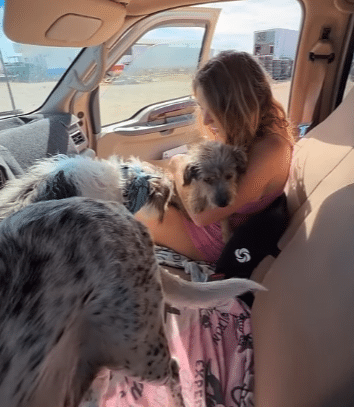
His rescuers welcomed him into their small mobile home.
Another rescued dog, Bodie, already lived there.
For Tio, this meant entering an unfamiliar environment with new sounds, new routines, and another animal sharing the space.
The home itself was modest.
But what it offered was something Tio had been missing.
Regular meals.
Clean bedding.
Warm blankets.
And people who expected him to remain part of their everyday lives.
Those comforts did not immediately make him relaxed.
In fact, one of Tio's earliest habits showed just how unfamiliar safety still felt.
Instead of settling comfortably inside, he often chose to hide beneath the nearby truck.
There, in a sheltered and shadowed space, he appeared more at ease than he did in the home prepared for him.
His rescuers did not interpret this behavior as a reason to force him indoors.
They allowed him to retreat when he needed distance.
If Tio preferred resting beneath the truck, they brought food close to his chosen spot.
They continued speaking to him gently and giving him opportunities to come forward on his own.
This approach gave Tio something he had rarely seemed to possess while living on the road.
A choice.
He could move toward the family without being pressured.
He could retreat without losing access to food or care.
And he could begin discovering that the people around him were not going to disappear simply because he was frightened.
There was no single moment when all his uncertainty vanished.
Instead, the family made room for him to adjust.
They understood that a dog accustomed to insecurity might need time before treating a new environment as home.
So they gave him that time.
Bodie Showed Him What Feeling Safe Could Look Like
Tio's new life included more than human companionship.
It also included Bodie.
Bodie was already comfortable living with the family. He moved confidently around the mobile home and appeared completely at ease staying near the people who cared for him.
Tio watched.
He could see Bodie receiving food without competing for it.
He observed him resting beside the family.
And he saw Bodie go outdoors while remaining part of the household's daily routine.
These ordinary moments offered Tio a different example of what life with people could be.
Gradually, he became more willing to leave his hiding place.
He emerged from beneath the truck more frequently.
He began exploring the campsite.
Eventually, he joined Bodie on short walks.
Each of these changes mattered because Tio was making them himself.
His family did not need to drag him toward companionship or demand that he immediately enjoy unfamiliar experiences.
They continued providing a predictable environment while allowing his curiosity to develop.
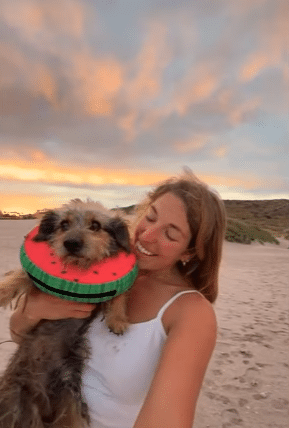
During his physical recovery, Tio wore a soft protective collar to prevent him from disturbing his healing wounds.
Even with the collar, he continued showing interest in his surroundings.
The same dog who had once moved away from a roadside meal was now beginning to participate in ordinary family activities.
His improvement was not measured only by the treatment of his injuries.
It was also visible in his willingness to explore.
And in the growing amount of time he chose to spend near the people and dog who had welcomed him.
The Ocean Became Part of His New World
As Tio became more comfortable, his life began to include visits to the beach.
The setting was very different from the roadside where rescuers had first encountered him.
Instead of searching discarded rubbish for food, he could walk across soft sand while accompanied by Bodie and his family.
But even pleasant experiences could be unfamiliar.
During his early visits, Tio appeared uncertain about the wide, open shoreline.
He stayed near Bodie.
He paused frequently.
And he looked back toward the people walking behind him, apparently checking their position.
His family responded with the same patience they had shown from the beginning.
If Tio stopped, they allowed him to stop.
If he wanted time to observe the waves, they gave him that time.
There was no need to hurry him through an experience that was still new.
Slowly, the outings became part of his routine.
The sound of the ocean and the feeling of sand beneath his paws were now associated with walks alongside familiar companions.
These experiences did not erase everything that had happened before his rescue.
But they gave him new patterns of daily life.
He could explore without having to search for his next meal.
He could pause without being chased away.
And he could remain beside the family without being left behind.
Over the following weeks, his posture and behavior began to change.
Rather than constantly following at a distance, Tio increasingly walked alongside the others.
He was no longer simply observing their lives.
He was becoming part of them.
The Small Daily Rituals That Built His Confidence
Not every important part of Tio's recovery happened at the beach or during an outing.
Much of it happened during the quiet routines of everyday care.
His family brought him meals consistently.
Sometimes they carried the food directly to wherever he had chosen to rest.
They provided blankets when the weather was cool, maintained clean bedding, and continued tending to his wounds.
Each morning, Tio encountered the same familiar people.
And each day offered another opportunity to discover that their care was dependable.
At first, he accepted these comforts while remaining reserved.
There was no sudden transformation into an outgoing dog.
He still needed distance.
He still sought familiar hiding places.
And he did not immediately respond to every gentle approach with visible enthusiasm.
But over time, small changes appeared.
He began raising his head when someone came near.
After eating, he sometimes remained close instead of immediately moving away.
These responses were modest, yet they showed that his behavior was changing.
Then another meaningful shift occurred.
Tio began resting in the open rather than always seeking shelter beneath the truck.
For a dog who had once seemed most comfortable hidden away, that decision was significant.
It suggested that he was becoming more willing to relax in the presence of his family.
His rescuers had not achieved this through one dramatic gesture.
They had built a predictable routine around him.
Food appeared when he needed it.
His injuries received care.
And the people who welcomed him continued to be there.
The repetition mattered.
Each dependable day gave Tio another reason to feel less guarded.
A Quiet Evening That Revealed How Far He Had Come
One of the most memorable moments in Tio's new life took place beside the ocean.
The family was watching the sunset.
A gentle rainbow stretched across the horizon, and waves moved toward the shore.
Tio was there with them.
Bodie was nearby.
Nothing dramatic happened.
There was no urgent rescue, medical procedure, or difficult confrontation.
The small dog simply remained close to his companions.
That quiet scene offered a contrast to the beginning of his story.
When rescuers first noticed Tio, he had been walking away from the only food he could find.
He moved as though stepping aside was easier than risking another confrontation.
Now he was sitting peacefully with the family that had cared for him through treatment, uncertainty, and slow adjustment.
He was not searching for a place to hide.
He was not retreating beneath the truck.
He stayed.
For Tio, this was one of the clearest signs of how much his life had changed.
He had learned, through repeated kindness, that remaining close to others could be comfortable.
The people around him had given him the freedom to choose that closeness.
And in that quiet moment beside the sea, he chose it.
He No Longer Had to Give Up His Place
Tio's story began with a painful image.
An aging dog was searching through roadside rubbish when another animal approached and drove him away.
He did not fight over the food.
He simply left.
That encounter revealed how vulnerable his life had become.
But it also led to the moment someone noticed him and decided that he deserved help.
His rescuers provided food when he was hungry, arranged veterinary care when they discovered his injuries, and welcomed him into their mobile home.
They did not expect immediate trust.
When he hid beneath the truck, they respected his need for space.
When he hesitated during walks, they allowed him to move at his own pace.
And when he began showing interest in the world around him, Bodie was there to share those new experiences.
Tio's progress came through treatment, consistency, and the ordinary kindness of people who remained committed to his care.
His coat became cleaner.
His injuries received the attention they needed.
And his behavior gradually reflected greater comfort with the family around him.
The most meaningful change was not that Tio became a completely different dog.
It was that he no longer had to live according to the same fearful routine.
He did not have to search through garbage for every meal.
He did not have to surrender his resting place whenever another animal approached.
And he did not have to treat every encounter with people as something to escape.
His new family had made a place for him.
A place with food prepared for him, bedding kept ready, and companions who noticed whether he was nearby.
There is something quietly powerful about the way Tio's journey ended.
He did not need to perform a remarkable act to prove that he belonged.
He only needed to feel comfortable enough to stay.
The dog who once walked away from a roadside meal now had a family, a canine friend, and a dependable place in their daily lives.
For Tio, home was not defined by the size of the mobile home or the distance his family traveled.
It was defined by the simple things that happened again and again.
A meal that was his.
A safe place to rest.
And familiar faces that were still there when he looked up.
After so much uncertainty, Tio finally had something he no longer needed to surrender.
A place where he belonged.


