
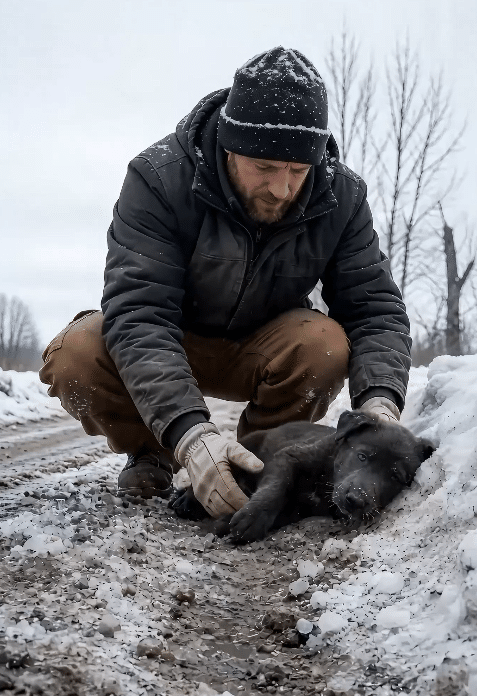
The little puppy was almost hidden beneath the snow when Caleb first noticed him.
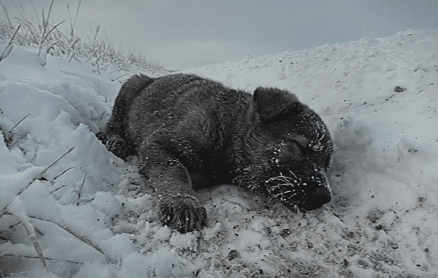
Along a quiet Montana road, a shallow ditch had become a dangerously cold place for such a small animal. The puppy lay nearly motionless, too weak to bark or struggle.
There was no excited movement when someone approached.
No playful wagging.
Only a fragile body fighting the cold.
Caleb, a volunteer with a local animal rescue, understood that the puppy needed help immediately.
He climbed down into the ditch, carefully gathered the little animal into his arms, and held him close against his coat.
At that moment, nothing mattered more than getting him somewhere warm.
Caleb believed he had found a helpless domestic puppy who needed a second chance.
He had no reason to suspect that the animal in his arms would one day require something far more difficult than rescue.
Something that would challenge his understanding of love itself.
He would eventually name the puppy Quartz.
And their journey was only beginning.
A Small Life Nearly Lost Beneath the Snow
Montana winters can be unforgiving, especially for an animal too young and weak to protect itself from the elements.
When Caleb spotted the tiny shape beside the road, snow was already accumulating around it.
The puppy had little energy left.
His lack of movement made the situation especially concerning. An animal that could barely respond had no obvious way to escape the freezing conditions.
Caleb did not know how long the puppy had been there.
He did not know where he had come from or what had happened before that morning.
Those questions would have to wait.
The immediate concern was warmth.
Caleb lifted the puppy gently, protecting his small body from further exposure while using his coat to help preserve heat.
It was a simple act of care.
But for an animal lying helpless in the snow, it represented the difference between remaining exposed and finally being brought toward safety.
The rescue did not involve a dramatic chase or a struggle to gain the puppy's trust.
Quartz simply had too little strength.
There was something especially moving about that quiet helplessness.
He was an animal who could not ask for assistance in any recognizable way.
Yet someone noticed him.
Someone stopped.
And someone chose to help.
The Quiet Days That Brought Quartz Back to Life
Once Quartz was safely inside Caleb's home, his world changed.
The freezing ditch was replaced by warm blankets.
Instead of lying exposed to the weather, he had a protected place to rest.
And instead of struggling alone, he had a person paying attention to his needs.
Caleb approached his care patiently.
Quartz needed food, warmth, and time to regain the strength that had nearly disappeared in the snow.
Recovery did not happen all at once.
It emerged through small changes.
His eyes gradually became more alert.
His legs grew stronger.
His curiosity began returning.
The puppy who had barely moved when Caleb found him slowly developed the energy to explore his surroundings.
For Caleb, watching those changes was deeply rewarding.
Each improvement offered reassurance that stopping beside the road had mattered.
There was no longer a helpless little body disappearing beneath the snow.
There was a growing animal with energy, awareness, and a future.
Quartz became part of Caleb's everyday life.
The attention required to help him recover also created a strong emotional connection.
Caleb had been there when Quartz was at his weakest.
He had watched the animal regain his strength.
And he had seen the frightened little survivor become increasingly confident.
But as Quartz continued to grow, Caleb began noticing something unusual.
This puppy did not behave quite like the dogs he knew.
At first, the differences were subtle.
Then they became impossible to ignore.
The Strange Instincts Caleb Could Not Explain
Quartz was attentive in a way that caught Caleb's interest.
He seemed unusually aware of the environment around him.
Small noises could capture his attention immediately.
Rather than responding with the familiar excitement of many household dogs, he often moved quietly and watched his surroundings with intense focus.
Caleb noticed how naturally that alertness seemed to come to him.
There was also his reaction to distant wolves.
Whenever howling could be heard, Quartz would become still.
His ears would rise.
His posture would change.
For a moment, his attention appeared completely drawn toward the calls.
It was not the ordinary curiosity Caleb expected from a young pet.
The response seemed deeply instinctive.
The more Quartz matured, the harder it became to dismiss these observations as harmless quirks.
Caleb loved the animal he had rescued.
But loving him also meant recognizing that something about his behavior deserved a closer look.
He began questioning whether Quartz was truly an ordinary domestic dog.
Eventually, he decided that understanding Quartz's background was essential to giving him appropriate care.
That decision led to a DNA test.
And the results would change everything.
VIDEO: Caleb Pulled a Freezing Puppy From the Snow — Then Discovered Quartz Was Mostly Wolf
The Discovery That Changed Everything
When the DNA results arrived, Caleb finally had an explanation for the behaviors he had been observing.
Quartz was not simply a German Shepherd or another familiar domestic breed.
According to the test, he was approximately 70 percent gray wolf and 30 percent German Shepherd.
He was a high-content wolfdog.
Suddenly, the things Caleb had noticed began to make sense.
The intense awareness.
The quiet, deliberate movements.
The remarkable attention he gave to distant howling.
Quartz was expressing natural behaviors connected to his wolf ancestry.
He had not been behaving incorrectly.
He had been behaving according to instincts Caleb had not initially understood.
That distinction mattered enormously.
A high-content wolfdog may resemble a domestic dog in certain ways, but its needs can be very different.
The source describes experts explaining that animals with substantial wolf ancestry require specialized knowledge, appropriate enclosures, considerable space, and safe opportunities to express their natural behaviors.
Love and good intentions alone do not necessarily provide those conditions.
Caleb had already given Quartz warmth and security.
He had helped him survive.
He had cared for him through recovery.
But understanding Quartz's identity raised another question.
Could an ordinary household provide the environment this growing animal genuinely needed?
For Caleb, the answer was difficult to accept.
Quartz was no longer simply a puppy he had rescued.
He had become family.
The Painful Choice Between Keeping Him and Helping Him Thrive
It would have been understandable for Caleb to want Quartz to stay.
Their bond had developed through a period of vulnerability and recovery.
Caleb knew the puppy's history from the moment he had been found in the snow.
He had provided the patience and security that allowed Quartz to become stronger.
Giving up their everyday life together would mean losing something precious.
But Quartz's welfare had to remain the priority.
As he grew, his need for a suitable environment became increasingly important.
A conventional backyard and family home could offer affection and protection, yet still fall short of what an animal with his ancestry required.
Quartz needed space.
He needed knowledgeable caregivers.
And he needed surroundings where his instincts could be expressed safely rather than constantly restricted.
Caleb faced a choice that many devoted animal rescuers find difficult.
He could focus on how much he wanted Quartz nearby.
Or he could consider what kind of future would offer Quartz the best quality of life.
Those were not necessarily the same thing.
Caleb began looking beyond his own home for an appropriate solution.
He contacted a specialized wolf sanctuary in the mountains.
It was a place equipped to care for animals like Quartz.
The decision was emotional, but its purpose was clear.
Caleb was not abandoning the animal he had saved.
He was extending that rescue into the next stage of Quartz's life.
The same concern that had made him climb into a freezing ditch was now guiding him toward a much harder act of compassion.
This time, helping Quartz meant allowing someone else to provide the care he needed.
A New Home Where Quartz Could Be Himself
The sanctuary offered something Caleb's home could not fully provide.
An environment created with wolfdogs in mind.
There was room to explore.
There were experienced caregivers familiar with the challenges and responsibilities of caring for animals with significant wolf ancestry.
And there were opportunities for Quartz to engage with his surroundings in ways better suited to his natural behavior.
The difference became apparent after his arrival.
Quartz began exploring the larger environment with growing confidence.
The instincts that had seemed unusual inside a household now had a more appropriate place to emerge.
He could move through open spaces.
He could investigate his surroundings.
And he could experience life in an environment designed to accommodate animals like him.
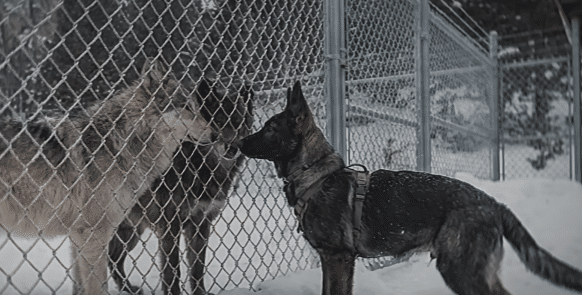
Over time, Quartz also developed connections with other animals at the sanctuary.
He gradually became part of a new pack.
That change was especially meaningful when compared with where his journey had begun.
The small puppy once lying helpless in a roadside ditch had grown into an animal capable of exploring a much wider world.
The sanctuary did not erase the care Caleb had given him.
It built upon it.
Without Caleb's intervention, Quartz might never have reached this stage.
Without Caleb's willingness to seek specialized care, Quartz might have spent his life in an environment poorly matched to his needs.
Both decisions were important.
One helped save his life.
The other helped improve the life he would go on to live.
The Bond That Continued After They Lived Apart
Moving Quartz to the sanctuary did not mean Caleb disappeared from his life.
Their relationship changed, but it did not end.
Caleb continued visiting whenever he could.
He also volunteered at the sanctuary, supporting the work being done for Quartz and other animals in its care.
Those visits allowed him to remain connected to the wolfdog he had once carried out of the snow.
Now, instead of watching Quartz recover inside his home, Caleb could observe him becoming more confident in surroundings suited to his nature.
He could see the space available for him to run.
He could watch him explore.
And he could witness the connections Quartz developed within his new environment.
There was something deeply reassuring about that transformation.
The animal Caleb had once protected against the cold no longer depended on the same kind of constant household care.
His needs had changed as he matured.
And Caleb had allowed his approach to change with them.
That flexibility was an important part of their story.
Rescue is often associated with bringing an animal home and keeping it safe forever.
But responsible care can take different forms.
Sometimes, a rescuer can provide everything an animal needs.
Other times, the most compassionate decision is to recognize that specialized help would offer a better future.
Caleb's choice demonstrated the difference between wanting an animal close and wanting the animal to thrive.
Quartz was still deeply important to him.
Their connection had simply taken a different shape.
A Rescue That Became a Lesson in Understanding
When Caleb first stopped beside that Montana road, he could not have known what Quartz would become.
He saw a small, vulnerable puppy trapped in the cold.
He responded to the immediate need in front of him.
There was no complicated plan.
No knowledge of the animal's ancestry.
Just a decision to help a living creature that could not help itself.
Everything that followed grew from that moment.
Quartz recovered because Caleb provided warmth, food, protection, and patient care.
His unusual behavior eventually led Caleb to investigate his background.
The DNA results offered a clearer understanding of his needs.
And that understanding helped guide the decision to move him to a sanctuary.
Each step required a different kind of responsibility.
First came the urgency of saving a life.
Then came the patience of helping that life recover.
Finally came the willingness to make a difficult choice based on what the animal needed most.
It is easy to imagine that a successful rescue must end with the rescued animal staying forever with the person who found it.
For many animals, that is exactly the right outcome.
But Quartz's experience shows why there cannot be one answer for every rescue.
His wolf ancestry created needs that deserved special consideration.
His growing confidence at the sanctuary demonstrated the value of finding an environment appropriate for him.
The important question was never simply whether Caleb could keep Quartz.
It was whether keeping him would provide the life he deserved.
Sometimes Love Means Giving Them More Than We Can Offer
There is a quiet contrast at the heart of Quartz's journey.
At the beginning, he was so weak that Caleb had to carry him away from the snow.
Later, he became strong enough to explore the spacious environment of a specialized sanctuary.
The distance between those two moments tells the story of a remarkable recovery.
But the most meaningful part may be Caleb's changing role.
At first, Quartz needed someone to hold him close.
As he grew, he needed that same person to understand why holding on was no longer the best choice.
Caleb did not stop caring when he arranged for Quartz to live somewhere else.
He continued caring in a different way.
He sought the knowledge he needed.
He listened to the guidance about high-content wolfdogs.
And he made a decision that placed Quartz's long-term welfare ahead of his own wish to keep him at home.
The result was not a traditional story of a puppy finding a permanent place on someone's sofa.
It was a story of a vulnerable animal finding safety, recovering his strength, and eventually reaching an environment where his natural needs could be met.
Quartz gained a new home.
He gained space to explore.
He gained the companionship of other animals like himself.
And he retained a connection with the person who had helped him survive.
That is what makes this rescue memorable.
The little animal hidden in a snowy ditch was given more than a second chance at life.
He was given the opportunity to grow into himself.
And Caleb learned that compassion does not always mean keeping someone close.
Sometimes it means understanding them well enough to let them go.
For Quartz, that difficult choice opened the door to a safer, more suitable future.
For Caleb, it became a lasting reminder that the greatest gift a rescuer can offer is not always a permanent home.
Sometimes, it is the courage to help an animal find the place where it truly belongs.


