
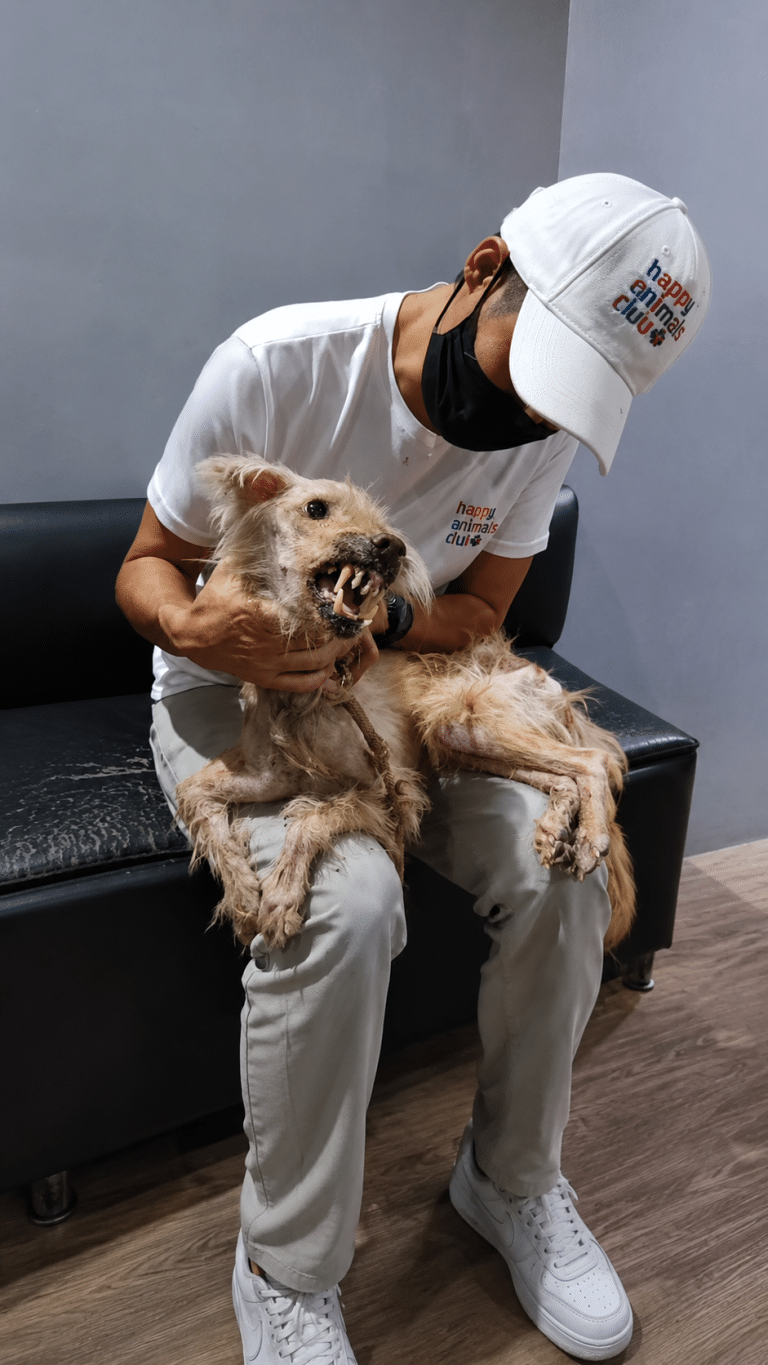
Under the bright lights of a gas station late one evening, a tiny dog wandered alone, his fragile body revealing just how difficult life had become.
People who noticed him often kept their distance.
It wasn't difficult to understand why.
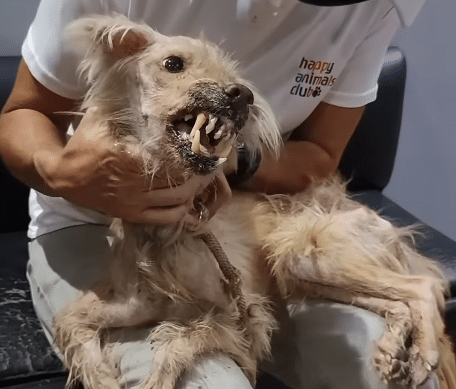
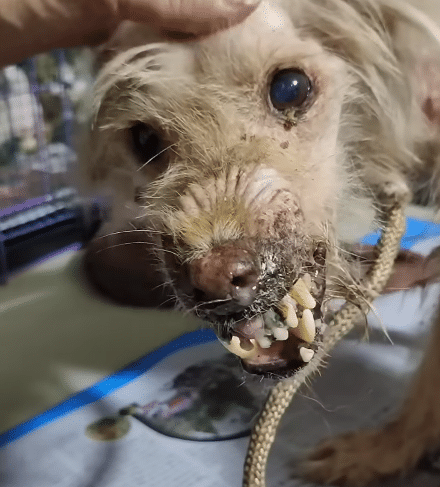
His coat was dirty and patchy. His ribs stood out beneath his thin frame. And two unusually long teeth extended from his mouth, creating an expression that strangers could easily mistake for a warning.
At first glance, he looked frightening.
But there was something else in his face that deserved attention.
Fear.
The little dog wasn't chasing anyone or looking for a confrontation. He was simply trying to find food, avoid danger, and make it through another day.
The people who eventually rescued him would give him an unforgettable name.
Giant.
And although he was anything but large, the name seemed fitting for a dog who had already endured so much.
The Little Dog Everyone Hesitated to Approach
Before Giant was rescued, almost nothing was known about his life.
No one could say how long he had been surviving outdoors or where he had come from. The source of his unusual dental appearance was also unclear.
What rescuers could see, however, was troubling enough.
His body was severely underweight. His uneven coat had missing patches, and his skin showed signs of prolonged discomfort.
He moved cautiously, keeping watch over his surroundings.
For an animal in that condition, even an ordinary encounter with an unfamiliar person could be frightening.
Giant's prominent teeth made his situation especially difficult.
Someone seeing him for the first time might assume he was aggressive. His appearance could discourage the very human attention that might have helped him.
Yet nothing about his physical condition suggested a dog capable of comfortably caring for himself.
He needed food.
He needed medical attention.
Most importantly, he needed someone willing to look beyond an unusual face.
There is a painful difference between an animal that presents a danger and one that is afraid of becoming vulnerable.
Giant's rescuers would soon discover just how important that distinction was.
A Small Meal Opened the Door to Rescue
When rescuers approached Giant, they understood that earning his cooperation would require patience.
He was already frightened, and rushing toward him could have made matters worse.
Instead of attempting to grab him immediately, they offered food.
It was a simple gesture, but an important one.
For a dog who had been searching for enough to eat, the meal provided a reason to remain nearby.
At first, Giant continued watching the strangers.
His hunger drew him toward the food, while his uncertainty made him cautious about the people offering it.
The rescuers allowed him to eat and gradually moved closer.
They kept their voices quiet.
Their movements remained controlled.
Nothing about the approach was meant to overwhelm him.
Eventually, the distance between Giant and the rescuers became small enough for them to carefully place a leash around his neck.
That moment could easily have gone differently.
Giant froze.
He appeared confused by the sudden change, unsure what the leash meant or what these unfamiliar people intended to do next.
His teeth were still visible, but he did not snap or attack.
He stood there, tense and uncertain.
For the rescuers, it was an important reminder that frightening appearances do not always reveal an animal's true temperament.
Giant had not suddenly become comfortable with people.
He was still scared.
But the first barrier between him and the help he desperately needed had finally been crossed.
VIDEO: Everyone Feared Giant's Unusual Teeth — Watch How Rescuers Gently Earned His Trust
His Growls Were Telling a Different Story
Even after the leash was secured, Giant remained nervous about physical contact.
When someone reached toward him, he sometimes responded with a low growl.
To an observer unfamiliar with frightened rescue animals, that sound might have reinforced the impression created by his teeth.
But the rescuers recognized that a growl can communicate discomfort and fear.
It does not automatically mean an animal intends to attack.
Giant had been surviving alone, and no one knew what experiences had shaped his response to people.
His hesitation was real.
So was his need for help.
Rather than treating his warning sounds as a reason to abandon the rescue, the team continued handling him carefully.
They respected his uncertainty while working to bring him somewhere safer.
The contrast was striking.
A dog whose appearance had made strangers avoid him was now surrounded by people willing to approach without judgment.
They weren't asking Giant to become affectionate or trusting immediately.
They were simply helping him through an unfamiliar situation, one small movement at a time.
Eventually, the rescuers lifted him into their vehicle.
The gas station, where he had wandered without anyone caring for him, was finally behind him.
There was no way to know whether Giant understood what was happening.
He had not yet learned that these people would provide the care he needed.
But something meaningful had changed.
He was no longer facing the streets alone.
The Veterinary Examination Revealed How Much Help He Needed
Once Giant reached the veterinary clinic, the seriousness of his condition became clearer.
His extreme thinness was impossible to overlook.
He had lost so much weight that his bones were plainly visible beneath his skin.
This was not simply a cosmetic concern.
His body needed proper nourishment and careful attention to rebuild strength.
The veterinary examination also identified a respiratory infection.
For a dog already physically weakened, this created an additional challenge.
His recovery would require more than a comfortable bed and a few meals.
He needed medical care, continued observation, and time.
Throughout the unfamiliar examination, Giant remained uneasy.
The clinic brought new people, unfamiliar handling, and experiences he had no obvious reason to trust.
His prominent teeth remained visible as he watched what was happening around him.
The same appearance that had frightened strangers at the gas station was still there.
But now it was being seen in a very different context.
His rescuers were no longer judging whether he looked approachable.
They were focusing on what his body needed to recover.
That change in perspective mattered.
Giant's unusual face had never been the most urgent part of his situation.
The real concerns were his poor physical condition, his infection, his uncomfortable skin, and his profound uncertainty around people.
And unlike the judgments strangers had made about his appearance, those were problems his caregivers could begin addressing.
A Soft Blanket Could Not Erase His Fear Overnight
After the veterinary visit, Giant was brought to the rescue shelter.
There, soft blankets and a quiet resting space offered a welcome contrast to the uncertainty of life outdoors.
His caregivers provided food, shelter, and the attention his condition required.
But being rescued did not instantly make him feel secure.
The shelter itself was unfamiliar.
Different sounds surrounded him. New scents filled the environment. Other rescued dogs were nearby.
For Giant, there was a great deal to process.
He tended to keep to himself.
Even gentle approaches could leave him hesitant.
His caregivers also discovered that his skin needed ongoing care.
Irritated areas, minor infections, and uncomfortable sores had to be addressed as part of his recovery.
These problems helped explain why Giant required such attentive treatment.
His needs were not limited to the respiratory infection found at the clinic.
His overall condition reflected multiple difficulties that could not be resolved in a single day.
Caregivers continued tending to him while allowing him the space he needed.
The important thing was not to demand an immediate change in his behavior.
A dog can be brought into a safe environment without instantly recognizing that the danger has passed.
For Giant, the work of learning to trust was only beginning.
Learning That Human Hands Can Bring Comfort
Physical recovery and emotional recovery do not always happen at the same pace.
A nutritious meal can begin addressing hunger.
Veterinary care can address medical problems.
A soft blanket can provide warmth and a comfortable place to rest.
But fear is not something a caregiver can simply remove.
Giant's behavior showed why patience was so important.
He was still inclined to watch unfamiliar movements carefully. He remained uncertain when people approached him, even though their intentions were now focused on helping him.
That uncertainty did not make him a difficult dog.
It made him a dog who needed time.
His caregivers continued offering gentle attention and a predictable environment.
They did not need him to become a different animal overnight.
He could remain cautious while receiving treatment.
He could be afraid while learning that food would be provided.
He could need space while still benefiting from the presence of people who cared.
Those small distinctions are essential in compassionate animal rescue.
A fearful dog may not welcome affection immediately, no matter how kindly it is offered.
Trust has to be built through repeated experiences in which the animal is handled gently and treated consistently.
For Giant, every calm interaction offered an opportunity to become more familiar with his new surroundings.
His progress was not described as a sudden transformation.
There was no confirmed moment when all his anxiety disappeared.
Instead, his story remained one of ongoing care.
And that was enough to be meaningful.
His Appearance Was Never the Whole Truth
One of the most memorable parts of Giant's rescue is how easily his outward appearance could have determined his future.
His protruding teeth were the first thing many people noticed.
His growls might have convinced someone else to stay away.
Combined with his neglected coat and fragile body, these features created an image that did not invite strangers to come closer.
But the rescuers responded to what Giant actually needed rather than what they feared he might be.
They saw a severely underweight dog searching for food.
They noticed his reluctance to be touched.
They recognized that his defensive behavior appeared to come from fear.
And they adjusted their approach accordingly.
That patience made the rescue possible.
There is an important lesson in the way Giant was treated.
Animals cannot explain their histories or describe why certain experiences frighten them.
People caring for them must pay attention to behavior, physical condition, and the circumstances in which those responses occur.
A growl is communication.
A frightened expression is not proof of a dangerous personality.
And an unusual physical feature should never determine whether an animal deserves compassion.
Giant did not have to look beautiful or behave perfectly to qualify for help.
He needed care because he was suffering.
That should have been reason enough.
Giant's Next Chapter Is Still Being Written
Giant's story does not end with a complete recovery or a confirmed adoption.
According to the account of his rescue, he still had significant healing ahead of him.
His body needed to regain strength.
His skin required continued attention.
His respiratory illness had added another challenge to an already difficult situation.
And emotionally, he was still learning to feel comfortable around the people caring for him.
But his circumstances had changed in a fundamental way.
He was no longer wandering around a gas station searching for food and avoiding potential threats.
He had been examined by veterinary professionals.
He had a sheltered place to rest.
His caregivers were addressing his physical needs and giving him opportunities to become familiar with gentle human contact.
His future remained uncertain, but he was no longer without support.
For a little dog who had spent an unknown amount of time surviving alone, that was a meaningful beginning.
Giant's name may sound amusing for such a small animal.
Yet it also captures something important about his journey.
Survival can demand an extraordinary amount of strength from even the smallest creature.
His body was fragile, but he had continued searching for what he needed.
When help finally arrived, his fear did not prevent his rescuers from offering it.
They stayed patient.
They gave him a chance.
And they helped him reach a place where healing could begin.
Giant's story reminds us that the animals who look the least approachable may sometimes be the ones who need understanding the most.
Not every frightened dog can immediately accept a gentle hand.
Not every rescued animal experiences a quick or easy transformation.
And not every act of compassion produces a dramatic ending.
Sometimes the most important change is quieter.
A hungry dog is given food.
A sick dog receives veterinary care.
A frightened animal is allowed time to feel safe.
For Giant, that change began when someone looked past his long teeth and recognized a tiny, vulnerable dog who deserved help.
His journey is not finished.
But he no longer has to make it alone.


