
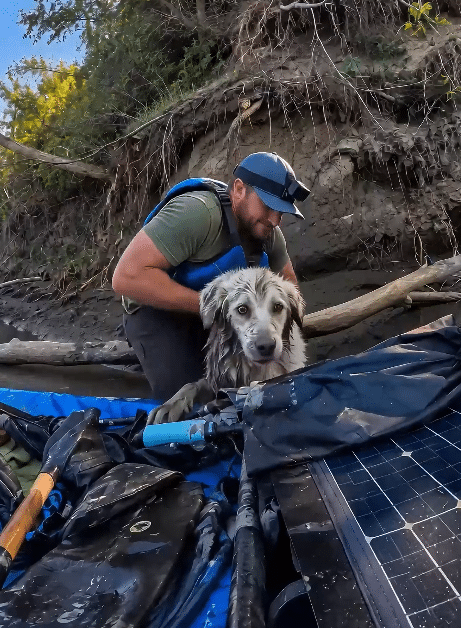
The bark was so faint that Tom Hudson almost missed it.
He was traveling by canoe through a remote stretch of the Canadian wilderness, surrounded by thick forest and miles of quiet riverbank. There were no nearby homes, no campsites, and no obvious reason to expect another living soul along that isolated shoreline.
Then the sound came again.
A dog was barking somewhere ahead.
It wasn't the strong, confident bark of an animal greeting a visitor. It was weak, barely carrying across the water.
Tom stopped paddling.
He listened, trying to determine where the sound was coming from. Whatever was making that noise seemed far from help, and the surrounding wilderness offered little indication of how it had gotten there.
He could have continued his journey.
Instead, he turned his attention toward the shore.
That simple decision would lead him to Ivy, a 14-year-old Pyrenean Mountain Dog whose family had been searching for her for two days.
And when Tom finally saw her, he understood just how urgently she needed someone to stop.
A White Dog Almost Hidden by the Riverbank
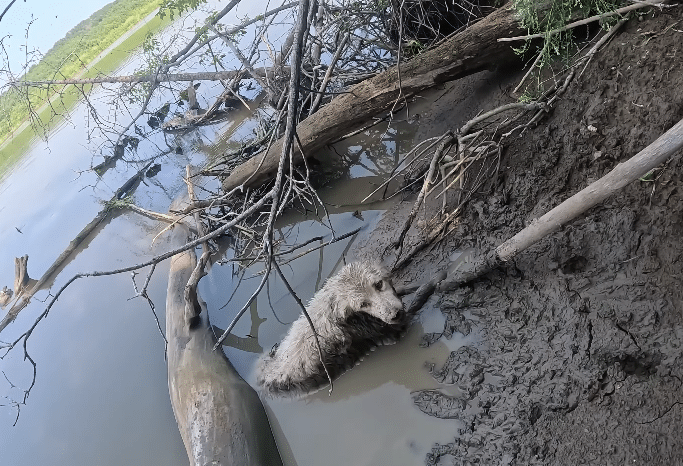
As Tom moved his canoe closer to the muddy shoreline, he began to make out a large white dog.
At first, her condition was difficult to take in.
Mud covered much of her once-beautiful coat. Her body was caught in the thick, wet ground, and she appeared almost completely drained of energy.
She could not simply stand up and walk away.
The mud had trapped her.
For an elderly dog, the situation was especially worrying. Ivy was no longer a young, energetic animal with endless strength to pull herself free. At 14 years old, every attempt to move appeared to demand more effort than she could manage.
There was no familiar home nearby.
No family member standing beside her.
Only the remote river, the muddy bank, and the sound of her increasingly fragile calls.
Tom had no way of knowing how long she had been in that exact spot. But her exhausted condition made one thing clear: she needed assistance.
When he approached, Ivy did not run or attempt to escape.
She simply watched him.
There was something deeply moving about that stillness.
Dogs often communicate through movement, but Ivy had very little strength left to offer. She could not greet her visitor with the energy of a healthy animal. She could not climb out of the mud to meet him.
All she could do was remain where she was and allow him to come closer.
For Tom, leaving her behind was not an option.
Two Days Missing, With No Way to Call Home
Ivy's identity would only become clear after her rescue.
She was a senior Pyrenean Mountain Dog, also known as a Great Pyrenees, and she had been missing from her family for two days.
Those two days had been filled with uncertainty for the people who loved her.
They had searched for their elderly companion without knowing where she had gone or what had happened.
In an area surrounded by wilderness, a missing dog can be difficult to locate. A large animal may seem easy to spot, but dense trees, uneven terrain, and remote shorelines can conceal even a dog with a bright white coat.
Ivy's situation was made more serious by her age and physical condition.
She was stuck in mud.
She was exhausted.
And she could not reach safety on her own.
The original circumstances of her disappearance were not explained. There was no confirmed account of exactly how she became trapped or how long she had struggled at the river's edge.
What was clear was that she had been separated from her family for two days before Tom discovered her.
By then, her weakness made the need for rescue unmistakable.
It is difficult to imagine a more vulnerable position for an elderly companion: unable to free herself, far from familiar surroundings, and dependent on someone hearing a call that was barely louder than the sounds of the river.
Yet that small bark had traveled far enough.
And someone had listened.
The Difficult Steps Between Ivy and Safety
Reaching Ivy was only the beginning.
The riverbank was covered in thick mud, making movement difficult for Tom as well. Every step required care, and pulling a large, exhausted dog free was not something he could accomplish simply by calling her toward him.
She was unable to stand independently.
He would have to reach her and help release her from the mud.
Tom worked patiently through the difficult ground.
There was no dramatic rescue team arriving from the forest. No specialized equipment was described in the account.
There was only one traveler who had heard an animal in trouble and decided to help.
The struggle required persistence, especially with Ivy so weak that she could contribute little to her own escape.
Slowly, Tom managed to free her.
The moment mattered for more than the obvious physical danger.
For the first time since she had become trapped, Ivy was no longer facing the riverbank alone.
A human being was beside her.
Someone had recognized her distress and responded.
She had been unable to move herself to safety, but the arrival of a stranger had changed what was possible.
After the effort of getting her out, another challenge remained.
Tom had saved the elderly dog from the mud.
Now he needed to find the people who were missing her.
VIDEO: A Faint Bark Stopped a Lone Canoe Traveler — And Led Him to a Senior Dog Trapped in Mud
The Search for the Family Who Loved Her
Getting Ivy away from the muddy bank was an enormous relief, but it did not answer the question of where she belonged.
Tom had encountered her in an isolated part of Canada. There were no obvious nearby homes to point him toward an owner, and Ivy could not tell him how far she had wandered.
But he did not treat the rescue as finished simply because she was no longer trapped.
He began asking questions.
He spoke with local residents and tried to find someone who might recognize the large white dog.
It was a different kind of search from the one he had just completed.
Along the river, he had followed a sound.
Now he had to follow information.
Each conversation offered the possibility of connecting Ivy with a household that knew her. Her age, appearance, and distinctive breed provided useful clues, but there was still no guarantee that the right person would be found.
Then someone recognized her.
The missing pieces began to come together.
Word of Ivy's discovery spread, and her family finally received the news they had been waiting for.
Their elderly dog had been found alive.
After two days of searching and worrying, they finally had an answer.
And it was the one they had hoped to hear.
Familiar Faces After Two Frightening Days
For Ivy's family, the uncertainty had been painful.
A beloved dog does not simply become part of a household through the years she spends there. She becomes part of its routines, familiar spaces, and daily companionship.
At 14 years old, Ivy had already lived a long life.
Her absence was more than an interruption to an ordinary day.
It meant that the people who cared about her did not know whether she was safe, whether she was injured, or whether they would see her again.
Two days passed without answers.
Then came the call.
Ivy was alive.
She had been found in difficult circumstances, but she was no longer alone beside the river.
The reunion brought her back into the company of the people she knew.
After the unfamiliar isolation of the wilderness, she was once again surrounded by familiar voices and faces.
There is a particular kind of relief that comes when a missing animal returns home.
The questions that have occupied every moment begin to fall away.
Where is she?
Is she safe?
Will we find her?
For Ivy's family, those questions finally had answers.
Their companion was home.
The experience had taken a great deal out of her, and she still needed rest and attention. But the most frightening part of her ordeal was over.
The elderly dog who had been too weak to escape the riverbank was now back with the people who loved her.
Gentle Care for a Dog Who Had Given Everything
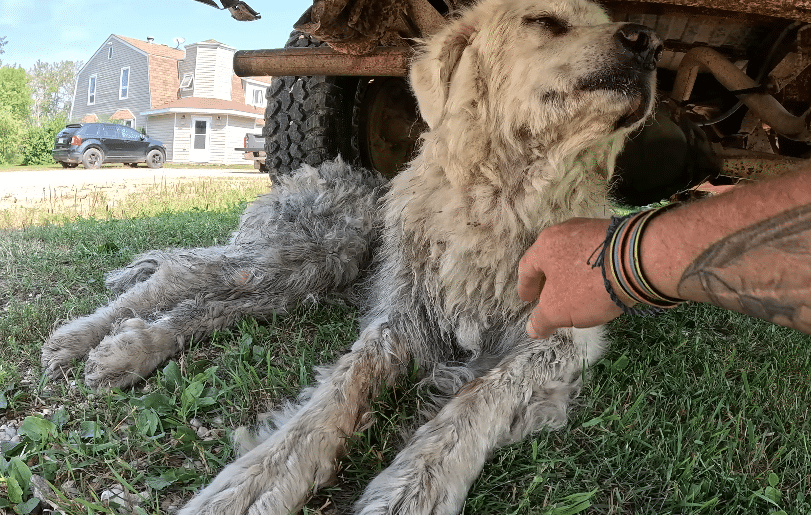
Although Ivy had been reunited with her family, she was still exhausted.
Her coat remained covered with mud from the shoreline, and she needed time to recover from the experience.
Tom continued helping after bringing her home.
The thick mud was carefully cleaned from her fur.
She was kept warm and given an opportunity to rest.
These were simple forms of care, but they were important for an elderly animal that had endured such a difficult experience.
There was no need to rush her back into ordinary activity.
Ivy needed comfort.
She needed a safe place.
And above all, she needed time.
The account does not describe a veterinary examination or a specific medical treatment, so her recovery should not be mistaken for a documented clinical process.
What it does describe is the gentle attention she received and the gradual return of her strength.
Her family could finally focus on helping her feel comfortable rather than wondering where she might be.
For two days, they had been separated from her without knowing what she was facing.
Now they could see her.
They could care for her.
And they could watch her begin to improve.
A Rescue That Turned Strangers Into Friends
Something else grew out of Ivy's rescue.
Tom had started his journey as a lone canoe traveler. He had not set out to find a missing dog or become part of another family's story.
But after helping Ivy, he was welcomed into the home of the people who loved her.
Her owners were grateful for his willingness to stop, investigate the distant barking, and undertake a difficult rescue.
They invited him to stay.
Rather than immediately continuing his canoe trip, Tom spent the night with Ivy's family.
They shared food and stories, and the unexpected events along the river became the beginning of a personal connection.
It was a striking change from the isolation of the earlier hours.
Tom had been traveling through wilderness where there seemed to be nobody nearby.
Now he was sitting with people he had met because he chose to help their dog.
The experience gave them something meaningful in common.
For Ivy's family, Tom was the stranger who had helped bring their companion home.
For Tom, the rescue became a memorable part of his journey, one that reached far beyond the riverbank where it began.
The family had regained Ivy.
And an unexpected friendship had begun.
Watching Ivy Become Herself Again
In the days that followed, Ivy continued to recover.
The exhaustion that had left her almost unable to move gradually eased.
Her energy returned.
So did the familiar personality her family knew and loved.
Her improvement was especially welcome because of her age. A 14-year-old dog recovering from such an exhausting experience deserves patience, comfort, and the security of familiar surroundings.
Ivy had those things again.
She was no longer stranded on a remote muddy shoreline.
She was no longer separated from the people who knew her.
And she no longer had to depend on a faint bark reaching someone traveling along the river.
The frightening episode had become part of her history rather than the end of her life.
That distinction matters.
Not every animal found in danger has a clearly documented outcome. Sometimes a rescue account ends as soon as an animal reaches safety.
Ivy's story continued beyond that moment.
Her family saw her strength return.
They watched her settle back into the peaceful life she had known before disappearing.
And the elderly dog who had seemed so helpless beside the water was able to enjoy her home again.
The Small Sound That Changed Everything
When Tom Hudson first heard the bark, he did not know there was a missing 14-year-old dog waiting somewhere along the shoreline.
He did not know that Ivy had been separated from her family for two days.
He had no reason to expect that his canoe journey would lead to a difficult rescue, an emotional reunion, or an invitation into a stranger's home.
All he knew was that he had heard something unusual.
A weak bark.
Then another.
He paid attention.
That was the first act of kindness in a chain of events that would change Ivy's situation completely.
He followed the sound, discovered her in the mud, worked to free her, and helped find the family who had been searching for her.
His compassion did not end at the riverbank.
He continued helping until Ivy was safely reunited with the people who loved her, and he remained involved as she received the comfort she needed.
There is no need to make the story larger than it was.
Its meaning lies in the ordinary decisions that made an extraordinary difference.
A traveler stopped paddling.
He listened carefully.
He chose not to ignore an animal in distress.
Because of those choices, Ivy's family received the news they had desperately wanted, and an exhausted senior dog was given the chance to recover at home.
The same journey also brought new friends together.
Ivy's story reminds us that helping an animal does not always begin with a grand plan or a carefully organized rescue.
Sometimes, it begins with paying attention.
With recognizing that a small sound may be the only way a vulnerable creature can ask for help.
And with being willing to change our plans when someone needs us.
On that quiet Canadian river, Ivy had very little strength left.
But her bark was heard.
And that was enough to bring her home.


