
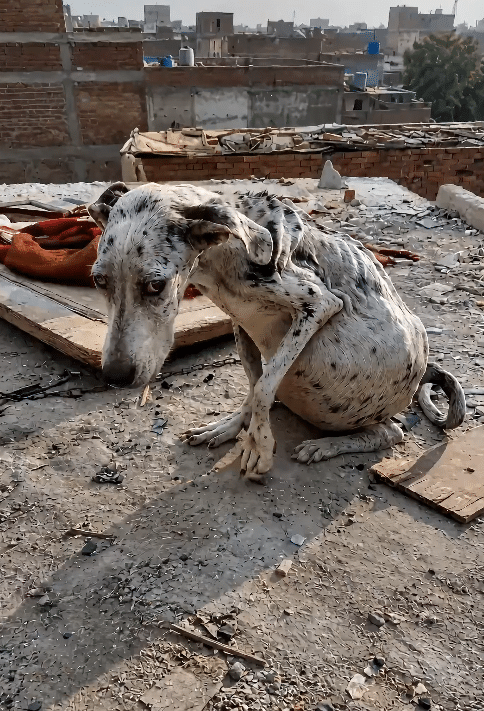
There was almost nothing left of Anglo but a fragile frame, trembling legs, and a pair of eyes that seemed too tired to ask for help.
His ribs were clearly visible beneath his skin. Standing required enormous effort. Even a few steps appeared to leave him exhausted.
When rescuers first encountered him, they could see that he had been struggling for some time.
But his appearance told only part of the story.
Something was happening inside Anglo's body that no one could understand simply by looking at him. And until veterinarians discovered the cause, even the most compassionate care might not have been enough to save him.
What followed was a journey through urgent medical treatment, uncertain recovery, and the slow rebuilding of trust.
For Anglo, surviving was only the first challenge.
Learning to enjoy life again would take much longer.
A Fragile Dog With a Hidden Medical Emergency
Anglo arrived at a shelter in Dublin in an extremely weakened condition.
His body showed unmistakable signs of serious physical decline. His bones stood out prominently, and his legs trembled when he attempted to move.
He had so little energy that even lifting his head seemed difficult.
The rescuers knew that he needed professional medical attention. His condition was far beyond what food and a comfortable place to rest could immediately resolve.
Once he was under veterinary care, another disturbing problem became apparent.
Anglo would not eat.
He also struggled to drink water, despite appearing severely undernourished.
For an animal already so weak, being unable to take in nourishment created an especially worrying situation. His body needed support, but something seemed to be preventing him from accepting it.
There was another detail the medical team could not ignore.
Although Anglo's frame was exceptionally thin, his abdomen appeared swollen.
He was also having difficulty passing waste normally.
Together, these symptoms suggested that his digestive system was experiencing a serious problem.
The veterinarians needed to understand what was happening before they could determine how to help him.
They began a more detailed examination, including ultrasound imaging and X-rays.
The images revealed something deeply troubling.
Anglo's stomach contained rocks.
Not food.
Not something that belonged inside a dog's digestive system.
Stones had accumulated inside him, creating a dangerous obstruction and preventing his body from functioning normally.
The rescuers believed someone may have deliberately forced Anglo to swallow the rocks before abandoning him. The circumstances could not be established from the medical findings alone, but the suffering he had endured was undeniable.
The discovery changed the urgency of his situation.
Anglo was not simply recovering from a period without enough food.
He was facing a medical emergency that required immediate intervention.
And despite everything his body had endured, he was still alive.
The Discovery That Made Surgery Necessary
The stones inside Anglo's stomach explained why ordinary feeding had not helped.
His digestive tract was obstructed, leaving him unable to eat normally and causing considerable discomfort.
His difficulty passing waste added to the medical team's concerns.
Every part of his condition seemed connected to the same problem.
The visible weakness.
The refusal to eat.
The swollen abdomen.
The exhaustion that followed even the smallest movement.
Veterinarians determined that surgery was necessary to remove the obstruction.
It was a difficult moment in Anglo's rescue.
Reaching the shelter had brought him out of immediate danger, but it had not resolved the threat inside his body.
He still needed an operation.
For a dog in such poor physical condition, the need for urgent treatment made his situation particularly serious.
There was little room for delay.
The veterinary team prepared to remove the stones, giving Anglo the opportunity to begin recovering from the condition that had kept him in such distress.
The operation became the turning point of his medical care.
During surgery, the veterinarians carefully removed the rocks from his stomach.
Stone after stone was taken out until the obstruction had been cleared.
The procedure was successful.
For the people caring for Anglo, the result brought enormous relief. A dangerous problem had finally been addressed, and the dog who had arrived barely able to stand now had a chance to recover.
But an operation could not immediately restore everything his body had lost.
He still needed food.
He still needed strength.
And after everything he had experienced, he needed time to feel comfortable again.
VIDEO: Anglo Was Too Weak to Eat — Then Veterinarians Discovered Stones Inside His Stomach
The First Meals After So Much Suffering
Removing the stones was an essential step, but Anglo's recovery did not happen all at once.
He had spent an extended period struggling with pain and an inability to eat normally. His body was depleted, and returning to regular meals required care and patience.
The people looking after him understood that recovery could not be rushed.
Instead of expecting him to eat full meals immediately, they began offering small portions of food.
Each feeding was carefully observed.
After surgery, the absence of the obstruction meant Anglo could begin taking nourishment again. But his earlier experience appeared to have left him hesitant.
Food had become associated with discomfort.
Now his caregivers needed to help him experience something different.
A meal that did not bring the same pain.
A little nourishment without the previous struggle.
A chance to eat while someone watched over his well-being.
At first, Anglo approached this new routine cautiously.
His hesitation was understandable given the condition in which he had been found. His body had endured a great deal, and his recovery was still in its early stages.
The people caring for him continued offering small meals and monitoring his response.
Gradually, things began to change.
He ate more comfortably.
He became more willing to accept food.
The uncertainty surrounding mealtimes slowly gave way to a healthier routine.
Then came a simple achievement that meant more than it might have appeared to anyone unfamiliar with his past.
Anglo began finishing his meals.
An empty food bowl is an ordinary sight in many homes.
For this particular dog, it represented something extraordinary.
He was finally able to take in the nourishment his body desperately needed.
Each meal contributed to his recovery, helping him move farther away from the frightening condition in which rescuers had first found him.
The change was gradual, but it was real.
And while Anglo's physical strength was returning, another kind of healing was beginning.
When Gentle Care Slowly Replaced Fear
Medical treatment could address the stones in Anglo's stomach.
It could not erase the difficult experiences that had shaped his response to the world.
The shelter staff recognized that physical recovery and emotional recovery were not necessarily the same thing.
A dog might begin eating again while remaining unsure of unfamiliar people.
He might regain the strength to move while still needing reassurance.
He might be physically safe without immediately feeling comfortable.
For that reason, Anglo's caregivers approached him patiently.
They did not demand affection.
They did not pressure him into interactions he was not ready to accept.
Instead, they allowed trust to develop through everyday care.
Gentle voices became part of his surroundings.
Human contact was offered with patience.
Small moments of progress were recognized without expecting him to change overnight.
The approach was simple, but it mattered.
Anglo needed more than survival.
He needed to experience consistent kindness.
Over time, his behavior began to reflect the difference.
The fearful expression that had marked his early days slowly softened.
He became more curious about what was happening around him.
Instead of remaining withdrawn, he showed increasing interest in his surroundings.
Comfort began replacing hesitation.
These changes did not come from a single dramatic event. They emerged through repeated experiences in which Anglo received care without being harmed.
For a dog who had arrived in such a distressed state, even small signs of relaxation represented meaningful progress.
The shelter staff gave him the time he needed.
And Anglo began responding.

The Day Anglo Found His Voice Again
As the weeks passed, the changes in Anglo became increasingly visible.
The dog who had arrived with nearly every rib showing began gaining healthy weight.
His body gradually filled out.
The sharp outline of his bones became less noticeable as his strength improved.
Eating regularly helped support his recovery, while the steady care he received gave him an environment in which to continue healing.
But the transformation was not only physical.
His energy changed too.
At first, movement had been a struggle.
Even standing had seemed difficult.
Now Anglo could explore the shelter with growing confidence.
The surroundings that might once have felt overwhelming became places he was willing to investigate.
He was no longer simply trying to get through each moment.
He was beginning to behave like a dog interested in the world around him.
Then came a milestone that especially delighted the people who had helped him.
Anglo barked.
According to the account of his recovery, it was the first time he had barked since being rescued.
For the staff who remembered how quiet and exhausted he had been, hearing his voice again was deeply meaningful.
A bark might seem like an unremarkable sound.
Dogs bark when they are excited, curious, playful, or responding to something around them.
But Anglo had once been too weak to do much of anything.
Now he had enough energy and confidence to express himself.
His voice was another indication of how far he had come.
The improvement was visible in his movement, his appearance, and his willingness to engage with his environment.
Little by little, the dog the rescuers had first met was becoming stronger.
He was eating.
He was exploring.
He was responding to people with greater comfort.
And he was finally able to enjoy the ordinary experiences that had once seemed impossibly far away.
A Family Who Saw More Than His Past
Anglo's recovery eventually reached another important turning point.
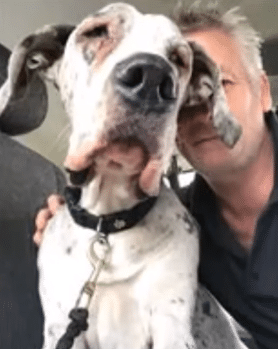
A family chose to adopt him.
For a dog who had entered rescue care in such poor condition, finding a permanent home marked a remarkable change in circumstances.
The family welcomed him as a companion, looking beyond the suffering that had brought him to the shelter.
They offered him the things he had needed for so long.
A safe home.
Regular, nutritious meals.
A comfortable place to sleep.
People who wanted him to be part of their lives.
For Anglo, the change meant leaving shelter care and beginning a new chapter in a permanent family environment.
He no longer had to face an uncertain future without someone responsible for his well-being.
He had people who had chosen him.
His new life also included other dogs, who became his companions.
The account of his adoption describes a joyful Anglo spending time outdoors, running across green fields and playing with his canine friends.
It was a striking contrast to his earliest days in rescue.
Once, his legs had trembled when he tried to stand.
Now he could run.
Once, taking a few steps had exhausted him.
Now he had the energy to chase his companions.
Once, food had been associated with distress.
Now he ate enthusiastically.
The difference was not simply that Anglo looked healthier.
His entire daily life had changed.
He could spend time with people who cared for him, enjoy the company of other dogs, and explore his surroundings without the physical limitations that had dominated his earlier condition.
His tail wagged.
He moved with confidence.
He showed the happiness and curiosity that his caregivers had worked so patiently to help him rediscover.
The image of Anglo playing outdoors became a powerful reminder of what his recovery had made possible.
The Life Waiting Beyond His Hardest Days
Anglo's journey began with a dog so weak that even standing seemed almost beyond his strength.
The visible signs of neglect were serious enough on their own.
What veterinarians eventually discovered inside his stomach made the situation even more urgent.
Without the removal of the stones obstructing his digestive system, his chances of recovery would have been severely limited.
But emergency surgery was only one part of the care he needed.
His rescuers brought him to safety.
Veterinarians treated the dangerous obstruction.
Caregivers helped him return to eating, regain weight, and become comfortable around people again.
Then a family opened its home to him.
Each stage mattered.
The surgery addressed an immediate medical threat, while the quieter days that followed allowed his body to recover and his confidence to grow.
His story also shows why rescuing an animal is not always a single act.
Sometimes it involves weeks of repeated care.
Offering food in manageable portions.
Respecting an animal's hesitation.
Allowing trust to return at its own pace.
Recognizing progress even when it arrives in small steps.
For Anglo, those efforts eventually led to a life that looked completely different from the one rescuers first witnessed.
He gained strength.
He became more comfortable with people.
He learned to enjoy his surroundings.
And he found a permanent home where he could continue living as a valued companion.
No amount of kindness can change what happened before his rescue. The difficult experiences that brought him into care remain part of his history.
But those experiences did not have to determine the rest of his life.
The dog who once struggled to lift his head was later able to race across open fields with other dogs.
The dog who initially refused food came to enjoy regular meals.
The dog who seemed overwhelmed by exhaustion found the energy to bark, explore, and play.
Anglo's recovery did not happen because one person could instantly make everything better.
It happened because people continued caring for him through each stage of a long and demanding process.
His story leaves behind an important reminder.
An animal's condition when it is rescued does not always reveal what its future can become.
With appropriate medical treatment, patient support, and a safe environment, a dog who has endured severe hardship may still have the opportunity to recover and experience a happier life.
For Anglo, that opportunity became a reality.
And perhaps the most meaningful part of his journey is not the frightening discovery that first placed his life in danger.
It is the ordinary happiness that came afterward.
A meal he can enjoy.
A family he can trust.
Other dogs running beside him.
And the freedom to move through the world without the suffering that once held him back.
Those are the moments that define Anglo's life now.
Not the stones that were removed.
Not the weakness that nearly overwhelmed him.
But the second chance that allowed him to become a healthy, happy dog with a family of his own.


