

The cars kept passing, but the dog beside the road would not move.
Near him lay another stray dog, the companion with whom he had shared his uncertain life. The night grew darker, traffic continued, and the world carried on around them.
Yet he remained in the same place.
Every so often, a quiet whimper broke the silence. He stayed close to his motionless friend, seemingly unable to accept that their time together had ended.
There was no way to know exactly what he understood about the loss. But his behavior revealed something deeply moving.
Even when his companion could no longer respond, he was unwilling to walk away.
For the rescuers who eventually found him, getting him to safety would be only the beginning. The greater challenge would come afterward, when they discovered just how difficult it was for him to adjust to life without the friend he had lost.
And the thing that finally seemed to comfort him was something no one might have expected.
A simple teddy bear.
The Friend He Could Not Leave Behind
Life on the streets offers little certainty for a homeless dog.
Food, shelter, and a safe place to rest can never be taken for granted. For two strays sharing that uncertain existence, companionship may become one of the few familiar parts of each day.
The dogs in this story had spent their lives together.
They had shared the difficulties of surviving outdoors, becoming close companions along the way. Whatever challenges they encountered, they had one another.
Then one of them was gone.
The surviving dog remained beside his companion on the roadside, refusing to leave even as vehicles continued moving past.
His small cries suggested distress. His attention remained fixed on the friend who could no longer rise.
It was not a dramatic display.
He did not run after the passing cars or wander away in search of something else. Instead, he continued his quiet vigil.
Sometimes the deepest attachments reveal themselves through the simplest behavior.
In his case, that behavior was staying.
There are many things people cannot know about the emotional lives of animals. We cannot ask a dog what he remembers or how he understands an absence.
But we can observe what he does.
And this dog was showing an extraordinary attachment to the companion he had lost.
A Rescue That Required More Than Kindness
When rescuers reached the roadside, they found a dog who was not ready to leave.
Their approach made him uneasy.
The people coming toward him intended to help, but he seemed reluctant to be separated from his companion. His attention repeatedly returned to the place where his friend lay.
For the rescue team, that created a delicate situation.
They needed to remove him from the roadside and bring him somewhere safe. But pushing him too quickly could have increased his distress.
So they approached with patience.
They spoke gently, kept their movements calm, and allowed him time to become comfortable with their presence.
There was no sudden transformation.
He did not immediately welcome these unfamiliar people simply because they offered help.
His trust had to develop slowly.
The rescuers continued reassuring him, giving him the opportunity to recognize that they were not there to hurt him.
Eventually, the exhausted dog allowed them to guide him away.
It was a meaningful moment.
He had spent the night beside the friend he had lost. Now, for the first time, he was moving toward a different future.
The roadside was behind him.
The painful absence of his companion was not.
The rescuers had succeeded in bringing him to safety, but they would soon learn that a warm place to sleep could not immediately restore the sense of companionship he had known.
VIDEO: A Loyal Dog Refused to Leave His Lost Friend — Until Rescuers Offered Him a New Chance
Safe at Last, but Still Searching for Someone
At the rescue center, the dog's circumstances changed.
He had a comfortable place to rest. Regular, nourishing meals replaced the uncertainty of street life. Volunteers surrounded him with gentle attention and opportunities for affection.
Everything necessary for his physical comfort was being provided.
Yet something still appeared to be missing.
The dog remained withdrawn.
Toys failed to interest him. Instead of eagerly exploring his surroundings, he often preferred to lie by himself.
The volunteers noticed another behavior that was especially touching.
Whenever he heard approaching footsteps, he would raise his head.
It was as though he were expecting someone familiar to appear.
Perhaps he was simply responding to the sound of another presence. No one could know exactly what he anticipated in those moments.
But against the background of his loss, the repeated gesture was difficult for his caregivers to overlook.
He had spent so much of his life with another dog beside him.
Now he was learning to live without that familiar companionship.
The rescue center could provide food, shelter, and kindness. What it could not provide was the return of the particular friend he seemed to miss.
That distinction mattered.
A rescue is often described as a moment when an animal is carried out of danger. In reality, the process of helping an animal feel secure can continue long after that first act of compassion.
For this dog, safety was an important beginning.
Emotional adjustment would require something more.
A Small Piece of the Past, Carefully Preserved
As the volunteers watched the dog's continued withdrawal, they began considering how they might offer him comfort.
They knew how closely he had remained beside his companion on the road.
They had also seen how little interest he showed in toys and ordinary distractions after arriving at the center.
Rather than trying to replace the friend he had lost, they decided to preserve a small reminder of their bond.
Before saying their final goodbye to the other stray, the rescuers had saved a little of his fur.
It was an uncomplicated keepsake.
Nothing expensive or elaborate.
Just a small amount of fur from the dog who had shared so much of the survivor's life.
The volunteers placed it inside a little fabric pouch and carefully sewed the pouch into the middle of a plush teddy bear.
The finished gift looked ordinary.
To someone unfamiliar with the story, it would have appeared to be nothing more than a soft stuffed animal.
But inside was something connected to the companion the grieving dog had known.
The rescuers hoped the familiar scent might provide reassurance.
There was no guarantee their idea would work.
They could not know whether the dog would recognize the smell, whether he would show any interest in the bear, or whether the keepsake would change his withdrawn behavior.
Still, the gesture offered a compassionate possibility.
Instead of expecting him to forget the past, they were giving him a gentle way to remain connected to it.

The Teddy Bear That Changed a Quiet Moment
The volunteers placed the teddy bear in front of him.
At first, the dog simply paused.
Then he lowered his nose toward the plush toy and began sniffing.
He examined it carefully.
He sniffed again.
What followed was the moment that made the small gift so memorable.
His body appeared to relax.
The anxious expression the rescuers had grown accustomed to seeing began to soften.
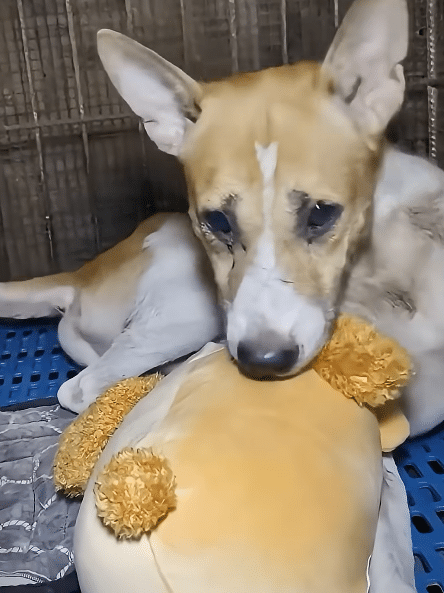
Then, slowly, he brought his paws around the teddy bear and pulled it close.
He held the toy against his chest.
There was no burst of excitement. No energetic barking or playful jumping.
He simply embraced the bear and closed his eyes.
For the people watching, the response was profoundly moving.
They had spent time trying to offer him comfort through food, rest, toys, and affection. Now, with this little keepsake, they were seeing a different kind of reaction.
The dog who had seemed so distant was holding something close.
The room grew quiet.
Some of the volunteers were moved to tears as they watched him settle around the stuffed animal.
No one could say precisely what he recognized.
It is impossible to know whether the fur reminded him of a particular experience, the presence of his companion, or simply a familiar scent that made him feel more comfortable.
But his response was unmistakably gentle.
He seemed calmer.
He appeared more at ease.
And for the people who had worried about him since the roadside rescue, that small change mattered enormously.
The teddy bear did not erase his loss.
It offered him something comforting to hold while he adjusted to a world that had changed.
Healing Came in Small, Ordinary Steps
The dog's recovery did not happen in a single moment.
The teddy bear brought a visible response, but the process of becoming comfortable in his new life continued over the following weeks.
Gradually, the rescuers noticed changes.
He became more receptive to their presence.
His tail began wagging more frequently, a welcome difference from the withdrawn behavior that had concerned his caregivers.
Walks, once overshadowed by his sadness, became activities he appeared to enjoy.
He also grew more willing to accept affection.
These were simple developments, but each one marked another step away from the isolation he had displayed when he first arrived.
For an animal adjusting to the absence of a longtime companion, progress does not have to look dramatic.
It may be seen in a relaxed posture.
A willingness to approach someone.
An interest in going outside.
Or the quiet comfort of resting without appearing constantly unsettled.
The rescuers could not give him back his former life.
What they could offer was consistency.
Regular meals.
A secure place to sleep.
Gentle care.
And the freedom to adjust without being rushed.
The teddy bear remained part of that environment.
It was not a substitute for human attention or for the many forms of care he received. Rather, it became a familiar object he could keep close as his confidence returned.
The same dog who had once shown almost no interest in toys now had a particular one that mattered to him.
And as his behavior slowly changed, his rescuers began to see that he was ready for something beyond the rescue center.
A New Family, With an Old Friend Still Close
Eventually, a loving family welcomed the dog into their home.
It was the future his rescuers had hoped he would have.
The stray who had once spent a lonely night refusing to leave his companion now had people committed to caring for him.
He had a safe home.
He had affection.
And he had the opportunity to enjoy life without the daily uncertainty of the streets.
But his new beginning did not mean leaving every part of his past behind.
The teddy bear went with him.
Sometimes it rested near his bed.
At other times, he slept with it tucked between his paws.
The little plush toy continued to accompany him, a quiet connection to the dog whose companionship had meant so much.
There is something especially touching about that detail.
The rescuers had not tried to distract him from his loss by overwhelming him with new experiences. They had recognized that a familiar reminder could be a source of comfort.
And even after his circumstances improved, the bear remained important.
The gift had begun as a thoughtful attempt to help a withdrawn animal feel less alone.
It became part of his new life.
His story was no longer defined only by the moment he stood beside his lost companion.
There were new moments now.
Gentle walks.
Welcomed affection.
Peaceful rest.
A family who wanted him.
And through those changes, the small keepsake remained nearby.
Some Friendships Remain Part of the Journey
The most meaningful part of this rescue is not simply that the dog survived life on the streets or eventually found a family.
It is the attention his caregivers gave to what happened after he was physically safe.
They recognized that his withdrawn behavior deserved patience rather than pressure.
They noticed that comfortable bedding and good meals, though essential, were not immediately enough to help him settle.
And they responded with an act of kindness that was both thoughtful and personal.
A little fur.
A fabric pouch.
A soft teddy bear.
None of those things was extraordinary on its own.
What made the gift special was the care behind it.
The rescuers understood that the surviving dog's attachment to his companion was part of his experience. Rather than treating that attachment as something to overcome quickly, they found a way to acknowledge it.
The resulting moment offered a powerful reminder about animal companionship.
Dogs form meaningful social bonds. Changes to those relationships can affect their behavior, and some animals need time and reassurance when a familiar companion is no longer present.
This dog's quiet vigil and subsequent withdrawal were consistent with the difficulty of such a loss.
His gradual return to affectionate behavior showed that he could also adapt to new relationships and a safer environment.
The teddy bear became a visible symbol of that transition.
He did not need to abandon every reminder of his old friend to enjoy his new home.
He could carry something familiar into a different chapter of life.
And perhaps that is the most enduring lesson in his story.
Compassion is not always about making a difficult feeling disappear.
Sometimes it means noticing what brings comfort, respecting the time recovery takes, and remaining present while someone finds their way forward.
One rescue brought a loyal dog away from a dangerous roadside.
Patient care helped him rediscover trust.
A welcoming family gave him a secure future.
And one small handmade gift remained beside him through it all.
The friend he had lost could not return.
But the life they had shared had not been entirely left behind.
Somewhere between the warmth of his new home and the teddy bear held gently between his paws, a once-lonely dog had found a way to rest peacefully again.


