
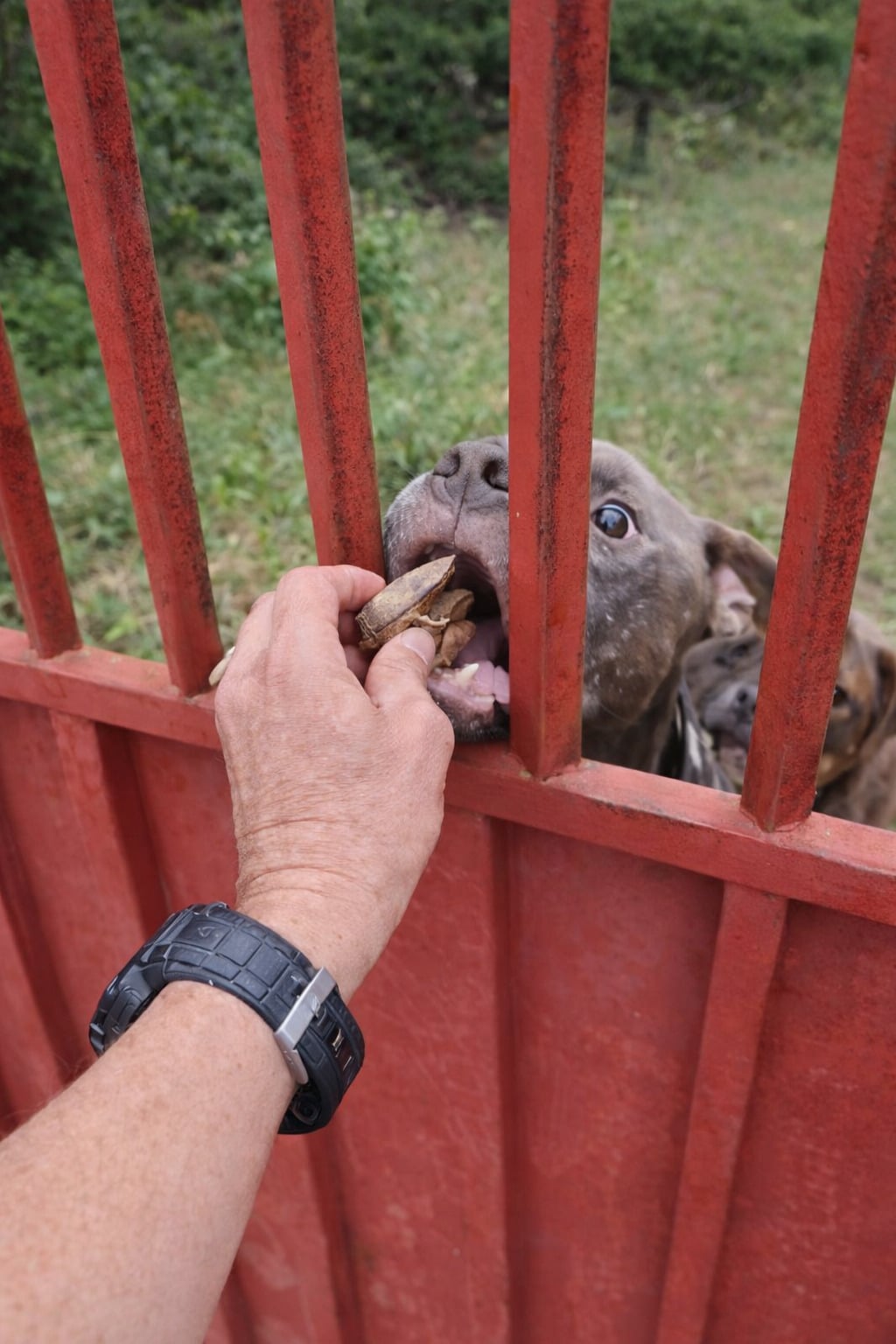
Four dogs stood behind a locked fence, their thin bodies revealing just how desperately they needed help.
They did not rush toward the people who had finally come to find them.
They did not try to hide.
Instead, they watched quietly, uncertain of what would happen next.
Among them was a tall Great Dane with a gray-and-black spotted coat. Its once-imposing frame had become painfully fragile, with bones clearly visible beneath its skin.
Every movement seemed to require effort.
Yet the dog remained standing, watching the strangers on the other side of the fence.
No one knew exactly how long the four animals had been confined in that isolated place.
But their condition made one thing clear.
They could not afford to be forgotten any longer.
Behind the Fence, Four Lives Were Fading
The discovery began with a routine report received by Paws Rescue.
The team was alerted to four dogs being kept inside a locked, fenced enclosure in a remote location. Information about their circumstances was limited, including how long they had been there and when they had last received proper care.
When rescuers reached the site, the seriousness of the situation became immediately apparent.
All four dogs were severely underweight.
Their coats were uneven and patchy, and their ribs stood out beneath their fur. They appeared exhausted, with little strength to spare.
The Great Dane was especially concerning.
Normally recognized for its impressive size and powerful build, the spotted dog looked remarkably vulnerable. Its height only made its thin condition more noticeable.
The contrast was difficult to ignore.
A dog that should have carried substantial strength was now struggling simply to remain on its feet.
The other three dogs were also in urgent need of attention.
Whatever their individual histories, they shared the same immediate circumstances: confinement, physical weakness, and an uncertain future.
What surprised the rescuers was how the dogs responded to their arrival.
There was no frantic attempt to escape.
No sudden retreat into hiding.
They simply observed the people approaching their enclosure.
Their quiet response was impossible to interpret with certainty. Exhaustion may have played a part, and the team had no way of knowing what experiences had shaped their behavior.
Still, the dogs' willingness to remain nearby gave the rescuers an opportunity.
The first challenge was not simply getting them out.
It was helping them feel safe enough to accept assistance.
A Little Food Became the First Bridge to Trust
The rescuers understood that suddenly entering the enclosure could frighten animals already weakened by prolonged hardship.
So they began with something simple.
Food.
Rather than rushing inside, they offered small portions through the fence and allowed the dogs to approach at their own pace.
It was a practical decision, but also a compassionate one.
The animals needed nourishment, yet they also needed to become comfortable with the people offering it.
At first, their movements were hesitant.
Weakness remained visible in the way they approached. Their bodies had endured so much that even these small actions seemed demanding.
But the food gave them a reason to move closer.
One cautious approach led to another.
The distance between the rescuers and the dogs gradually narrowed.
Trust was not established through force or hurried movements.
It grew through repetition, patience, and the simple experience of receiving food without being threatened.
For animals whose recent circumstances were largely unknown, that mattered.
The Great Dane remained somewhat farther back than the others.
Its spotted body was particularly thin, and it appeared to have limited energy for movement. Even so, it continued watching the rescuers as they worked.
The team did not pressure the dog to move faster.
There was no reason to turn an already difficult experience into another source of distress.
Instead, the rescuers allowed the situation to unfold carefully.
This was the beginning of an important change.
The four dogs were no longer simply animals waiting behind a barrier.
Someone had arrived with food, patience, and a plan to help them leave.
The Moment the Locked Enclosure Was Left Behind
Once the dogs had become more comfortable with the rescuers, the next stage could begin.
Each animal needed to be guided out safely.
The team approached carefully and placed leashes on the dogs one by one.
Despite their uncertain circumstances, the animals did not resist.
They were weak and tired, but they followed.
For the rescuers, every step mattered.
The dogs had been discovered in a place where their basic needs were clearly not being met. Leaving that enclosure meant reaching the first essential milestone in their recovery.
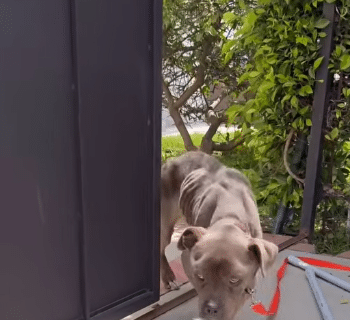
A leash could now guide them toward care rather than keep them confined.
The transition was quiet.
There was no dramatic struggle.
Only four exhausted animals moving away from the place where they had been found.
As they emerged into the open light, their physical condition became even more evident.
The Great Dane remained the most troubling case.
Its bones were sharply defined beneath its skin, making the extent of its undernourishment impossible to overlook.
The footage of the rescue included a simple message about the condition in which the dogs had been discovered:
"No dog should ever be left to reach this condition."
It was a reminder of why their rescue mattered.
These animals needed more than temporary relief from hunger.
They needed sustained care, medical attention, and the opportunity to regain strength.
VIDEO: Four Starving Dogs Waited Behind a Locked Fence — Watch the Gentle Rescue That Finally Brought Them Out
The footage documents a rescue shaped by patience rather than confrontation.
The team first offered food through the barrier, allowed the dogs to become familiar with their presence, and then guided them out individually.
For the Great Dane and its three companions, that sequence marked the difference between remaining in a dangerous situation and beginning a new chapter under human care.
Their journey was only starting.
And the next steps would be just as important as the rescue itself.
Four Fragile Bodies, One Urgent Need for Care
Getting the dogs outside the enclosure did not mean their difficulties were over.
Their physical condition demanded continued attention.
The rescuers had to think beyond the immediate success of removing them from confinement.
Severely undernourished animals cannot regain health through one meal or a single moment of kindness.
Recovery requires a steady approach.
The team carefully prepared the dogs for transportation.
Soft blankets were placed around their fragile bodies, providing comfort as they were moved into the vehicles.
The rescuers used calm voices and gentle handling throughout the process.
These were small actions, but they reflected an important understanding.
The dogs were already vulnerable. There was no benefit in adding unnecessary stress to their journey.
Their immediate destination was a veterinary clinic, where professional care could begin.
The Great Dane's condition made this stage especially significant.
The large spotted dog had very little visible body condition left. Its size, combined with its severe thinness, illustrated how serious the situation had become.
But the other three dogs could not be overlooked.
All four needed a chance to recover from their weakened state.
Each had made it out of the enclosure.
Now each needed a safe environment where food, rest, and medical attention could be provided consistently.
The rescue team's response focused on those needs.
Whatever had happened before the dogs were found, the priority was helping them survive and recover.
There were questions about their history that could not yet be answered.
How long had they been confined?
How had their condition become so severe?
The available account did not establish those details.
What it did show was the response of people who recognized that the dogs needed immediate help and chose to provide it.
That decision carried the animals from uncertainty toward their first real opportunity for healing.
At the Clinic, Recovery Began With Small Steps
Once the dogs reached the veterinary clinic, treatment began.
Their weakened bodies required careful attention.
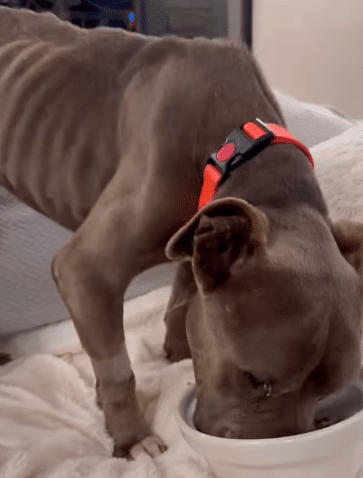
Food was introduced gradually, in measured portions appropriate for animals recovering from severe undernourishment.
This was important because the dogs could not simply be given unlimited food after arriving in such poor condition.
Their systems needed time and professional supervision as nourishment was restored.
The veterinary team also administered fluids to address their need for hydration.
Clean, comfortable bedding replaced the hard ground associated with their previous confinement.
These changes may sound ordinary.
Food.
Fluids.
A place to rest.
But for the four dogs, they represented essential foundations for recovery.
For the first time since their discovery, they were in an environment where their immediate needs could be monitored and addressed.
The Great Dane received particularly close attention.
The spotted dog lay quietly on an examination table while veterinary professionals monitored its fragile condition.
Its body still showed the severity of what it had endured.
Nothing about its recovery could be considered immediate or guaranteed.
The care team had to work with the condition in which the dog had arrived.
Yet the rescue account describes a subtle change beginning to appear.
The Great Dane's eyes, which had initially seemed distant and exhausted, gradually appeared more alert.
It was not a dramatic transformation.
There was no sudden return of strength.
But the change offered a small reason for encouragement.
A dog that had stood weakly behind a fence was now receiving the attention needed to begin rebuilding its health.
The same principle applied to all four animals.
Recovery was not something that could be rushed.
Their bodies needed nutrition and hydration.
Their behavior needed time to adjust.
And the people caring for them needed to remain patient as the dogs responded to their new surroundings.
For animals emerging from such difficult circumstances, consistent care was the most meaningful form of reassurance.
The Small Changes That Showed Healing Had Begun
As care continued, the rescuers began noticing gradual improvements.
Appetite returned little by little.
The dogs started showing signs of increasing strength.
Their early hesitation also began giving way to greater curiosity.
These were modest changes, but they were meaningful.
When an animal arrives in a severely weakened condition, progress does not always appear as a dramatic before-and-after moment.
Sometimes it is reflected in a growing willingness to eat.
Sometimes it is a little more energy.
Sometimes it is simply greater interest in the surrounding environment.
For the four rescued dogs, those early changes suggested that the care they were receiving was helping them move forward.
The difference between their discovery and their first period of recovery was significant.
Behind the locked fence, the dogs had little visible energy.
Their attention was focused on the people offering food from outside the enclosure.
At the clinic, their needs were being met through regular care and medical supervision.
They no longer had to depend on brief moments of assistance through a barrier.
Their new circumstances offered continuity.
That continuity was crucial.
One meal could ease immediate hunger, but restoring health required more than food alone.
The dogs needed steady nourishment, appropriate treatment, and enough time for their bodies to respond.
Their emotional adjustment mattered, too.
The source describes fear gradually softening into hesitation and then curiosity.
It is impossible to know exactly what the animals were feeling.
But those behavioral changes were encouraging signs that their surroundings were becoming more familiar and that human contact was no longer associated only with uncertainty.
The Great Dane remained an especially memorable part of the group.
Its height and spotted coat made it easy to recognize, but its fragile condition was what had first drawn attention.
Watching the dog begin to show signs of improvement highlighted the importance of continued care after the initial rescue.
Being removed from danger was essential.
Regaining strength would take longer.
The available account does not establish that all four dogs reached full health or found permanent homes.
Their future beyond the reported recovery period remains unknown.
What is confirmed, however, is meaningful.
They were discovered in serious need.
They were removed from confinement.
They received veterinary attention, food, hydration, and comfortable places to rest.
And their early recovery included encouraging changes in appetite, strength, and behavior.
Those are real steps forward.
They deserve recognition without turning an unfinished journey into a promised happy ending.
Their Second Chance Began With Someone Who Refused to Look Away
There is something particularly moving about the quiet nature of this rescue.
Four dogs were found in an isolated enclosure.
They could not explain what had happened to them.
They could not describe how long they had been waiting or what they needed most.
Their bodies communicated much of that story.
And when help arrived, their response was subdued.
The rescuers did not need dramatic gestures to make a difference.
They began with food.
They allowed the dogs to approach.
They used leashes carefully, provided blankets, and arranged professional medical care.
Each action addressed a real need.
Taken together, those actions changed the direction of four lives.
The Great Dane and its companions still faced a period of healing. Their weakened bodies could not recover instantly, and the extent of their longer-term progress was not fully documented.
But their circumstances had already changed in the most important way.
They were no longer trapped behind the fence where they had been discovered.
They were receiving care.
Their needs were being taken seriously.
And they had begun showing signs of improvement.
The lesson in their rescue is not that every difficult situation has an immediate or perfect ending.
It is that meaningful change can begin with a series of patient, compassionate decisions.
A report was taken seriously.
A team arrived.
Food was offered.
Trust was built.
Four dogs were guided into safety.
Then the quieter, longer work of recovery began.
For these forgotten animals, that was the second chance they desperately needed.
And their journey reminds us that rescue is not complete when an animal is carried away from danger.
It continues with every careful meal, every necessary treatment, and every patient act of kindness that follows.


