
Some dogs arrive at a rescue center needing more than food, shelter, or a comfortable place to sleep.
They arrive carrying the consequences of suffering that has gone untreated for far too long.
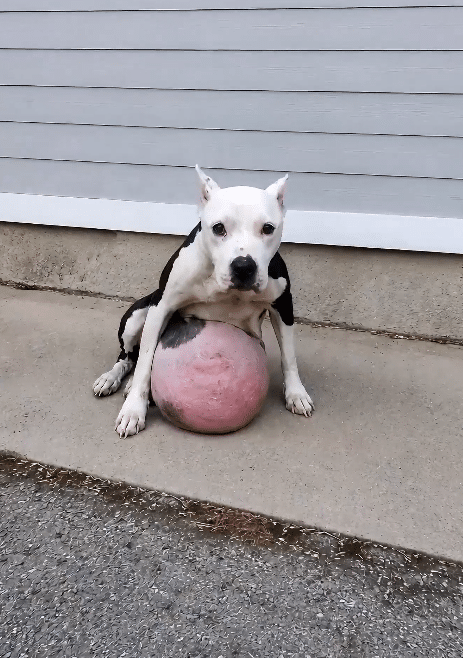
For Nina, an eight-year-old Pitbull Terrier rescued from North Memphis, that suffering was impossible to overlook.
Her body was painfully thin. She was exhausted, struggling with a serious infection, and running a dangerously high fever.
But there was another burden that made her condition especially alarming.
Attached to her body was an enormous tumor weighing nearly 13 pounds. Two additional growths had developed along her mammary line.
For a dog already weakened by prolonged neglect, these medical problems presented an extraordinary challenge.
And yet, Nina was still holding on.
She had survived long enough for someone to recognize that she needed help.
What followed would require careful treatment, a difficult surgical decision, and a long period of healing.
The Weight of Everything Nina Had Endured
By the time rescuers found Nina in North Memphis, her physical condition suggested that her health had been deteriorating for a considerable time.
The exact circumstances of her earlier life were not fully explained, but the signs of prolonged neglect were unmistakable.
Her severe weight loss showed how much her body had suffered.
The infection and high fever made her immediate medical condition even more concerning.
Then there was the tumor.
At nearly 13 pounds, the mass represented a substantial physical burden. Its size alone made Nina's situation very different from that of a dog needing ordinary veterinary attention.
The two smaller growths added another layer of concern.
There was no way to know her full prognosis simply by looking at her.
What was clear was that Nina needed professional medical care, and she needed it urgently.
Her rescuers faced a painful reality: helping her would involve much more than removing a visible growth.
First, she had to become strong enough to survive the treatment she desperately needed.
It is easy to think of animal rescue as a single turning point.
A dog is found. Someone offers help. The danger ends.
But Nina's experience shows how complicated that turning point can be.
Being rescued did not immediately take away her illness or discomfort. It simply gave her access to something she had been missing for far too long.
A chance to recover.
When Saving Her Meant Moving Carefully
After Nina arrived at the rescue facility, veterinary professionals began addressing the most urgent threats to her health.
Her condition was critical.
Although the large tumor needed attention, immediately proceeding with major surgery would have placed an already fragile dog under additional strain.
The first priority was stabilization.
Nina received treatment for her infection, careful rehydration, and nutritional support intended to help restore her depleted strength.
There could be no rushing this stage.
A body weakened by serious illness needs time to respond, and Nina's caregivers had to consider her overall condition before moving forward.
Her fever was especially important.
As treatment continued, her temperature began to improve. Gradually, her body showed signs that it was responding to medical care.
These were not dramatic changes.
There was no instant transformation from a severely ill dog into a healthy one.
Instead, Nina's early progress came through the kinds of improvements that can seem small until one understands what is at stake.
A fever beginning to settle.
A weakened body responding to treatment.
A little more stability than the day before.
Each improvement mattered because it brought the possibility of surgery closer.
The veterinary team was not simply preparing to remove a tumor.
They were working to give Nina the best possible opportunity to survive the procedure.
For a dog whose condition had once seemed so precarious, that opportunity meant everything.
A Difficult Decision and a Surgery She Needed
Eventually, Nina became stable enough for the medical team to consider the next major step.
The enormous mass still had to be addressed.
Its size and location made the operation particularly challenging, and the veterinarians understood that the procedure carried significant risks.
Even after her initial improvement, Nina was recovering from serious illness.
She was not entering surgery from a position of perfect health.
That uncertainty made the decision especially difficult.
Still, the medical team moved forward with the treatment she needed.
For Nina, the operation represented a crucial turning point in a journey that had already demanded so much from her.
VIDEO: Nina's Fight for a Second Chance — The High-Risk Surgery That Changed Her Recovery
During the procedure, the veterinary team carefully removed the enormous tumor together with the two additional growths.
The operation required precision because of the size of the main mass and its position on Nina's body.
It was a demanding procedure.
But Nina survived.
The surgical team successfully completed the operation, allowing her to begin the next stage of treatment without the enormous growth she had been carrying.
Examination of the removed tumors also provided important medical information.
The two smaller growths were found to be benign.
The large mass, however, was diagnosed as a soft tissue sarcoma, a type of cancer involving soft tissues.
That diagnosis was significant, even though the surgery itself had been successful.
Nina's recovery would still require close veterinary attention, and the source does not describe any additional cancer treatment or long-term monitoring plan.
What was confirmed was that she had made it through an exceptionally difficult operation.
For a dog who had arrived so weak and unwell, surviving surgery was an important achievement.
But it was not the end of her healing.
It was the beginning of another delicate chapter.
The Small Improvements That Made Recovery Possible
After surgery, Nina needed time.
Her body had already endured severe neglect, infection, fever, and the physical demands of a major operation.
Recovery could not be expected to happen overnight.
Under continued veterinary supervision, her caregivers monitored her surgical wounds and overall condition while supporting her return to strength.
At first, progress was modest.
Her appetite began to improve.
She gradually showed more energy.
Her movements became more comfortable as her recovery continued.
None of these changes might have seemed extraordinary in a healthy dog.
For Nina, however, they represented meaningful steps away from the condition in which she had been found.
Eating better meant her body was beginning to regain nourishment.
Moving more comfortably suggested that recovery was making a difference in her everyday life.
Resting without the same constant discomfort offered another sign of improvement.
There was no single moment when everything suddenly became easy.
Healing unfolded through a series of small changes.
One improvement made room for another.
Each day of successful recovery brought her a little further from the uncertainty that had surrounded her rescue.
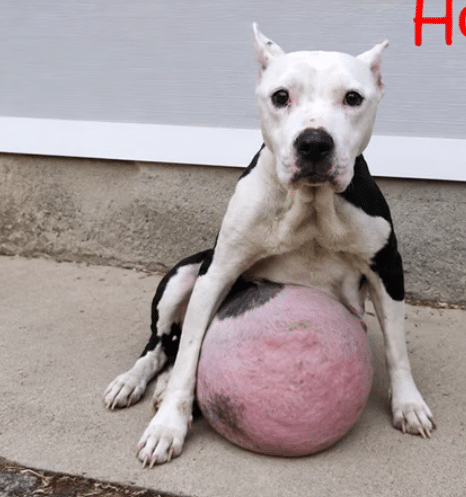
Perhaps the most striking part of Nina's transformation was how gradually it happened.
She did not need to demonstrate remarkable strength every day.
She needed consistent care.
She needed time to rest.
And she needed the opportunity to heal without being forced to struggle through illness alone.
Her medical team had addressed the immediate dangers, but restoring her overall well-being required patience beyond the operating room.
That is an important part of rescue work that people do not always see.
A successful operation can change the direction of an animal's life.
The days afterward determine how that animal begins living with the change.
For Nina, those days slowly brought back the ordinary comforts that serious illness had taken away.
A Foster Home Where She Could Finally Rest
When Nina had recovered enough to leave the intensive medical environment, she moved into a foster home.
It was another important milestone.
Her journey was no longer focused solely on surviving a medical emergency.
Now, she had a safe and peaceful place where her recovery could continue.
The difference was significant.
Instead of the insecurity associated with her earlier neglect, Nina experienced a steady routine, comfortable bedding, and gentle daily care.
There was no need to push her through recovery more quickly than her body could manage.
She could rest.
She could regain her strength.
She could gradually become familiar with being cared for in a calm environment.
For an animal recovering from a serious illness, these ordinary comforts matter.
A comfortable place to sleep is not a small luxury when a dog has spent so long struggling physically.
Consistent meals are not simply a routine when a body has been severely undernourished.
Gentle attention can become an important part of helping a vulnerable animal adjust to a safer life.
As Nina settled into foster care, the improvements became increasingly visible.
Her coat gradually regained a healthier shine.
Her body became stronger.
Her overall appearance changed as she continued to recover.
And the tired expression that had marked her earliest days began to give way to brighter, more attentive eyes.
The dog who had arrived at the rescue facility in critical condition was beginning to look very different.
Not because her past had disappeared.
But because her present had finally changed.
Rediscovering the Ordinary Joys of Being a Dog
Nina's recovery was not limited to her physical health.
Once she was safe in foster care, she also began adjusting to the experience of living without the constant pressures of her earlier condition.
She could rest peacefully.
She became more curious about her surroundings.
And she grew increasingly comfortable with the people looking after her.
These changes may sound simple.
But they were important for a dog whose life had recently been dominated by illness and discomfort.
Curiosity is easier when a dog has enough energy to explore.
Rest becomes more comfortable when physical pain and distress are no longer overwhelming.
Trust has an opportunity to develop when care is gentle and consistent.
Nina's foster environment provided the stability that allowed these changes to unfold naturally.
There was no need for a dramatic gesture to prove that she was improving.
Her progress could be seen in the way she moved, rested, and responded to the world around her.
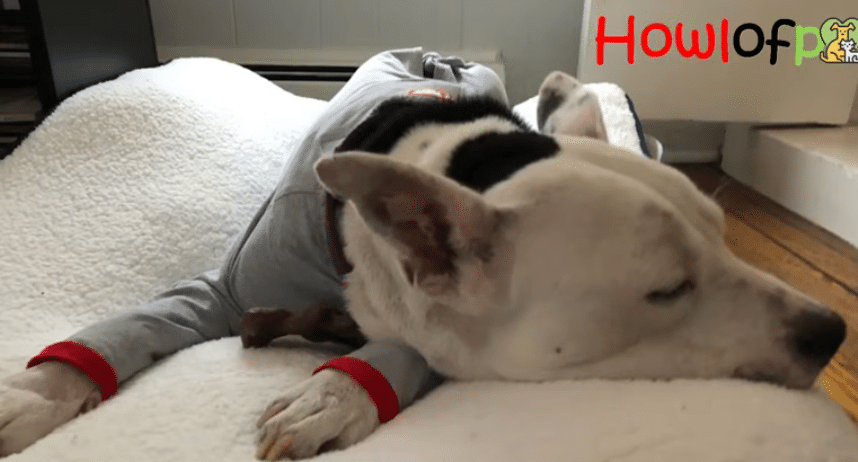
One of the most meaningful aspects of her journey was the return of these ordinary experiences.
A dog should be able to enjoy a comfortable place to sleep.
A dog should be able to eat without struggling through severe illness.
A dog should have the freedom to show curiosity about familiar surroundings.
For Nina, getting back to those simple parts of life had required an extraordinary amount of care.
Her rescuers and veterinary team helped her through the most medically dangerous period.
Her foster caregivers then provided the steady environment where her improvement could continue.
Different kinds of care were needed at different stages.
Together, they gave Nina the opportunity to recover.
And little by little, the signs of her earlier suffering became less visible in her daily life.
The Life Nina Has Today
Nina's story began with a deeply troubling discovery.
An eight-year-old Pitbull Terrier had been living with severe weight loss, a serious infection, high fever, and an enormous tumor that weighed nearly 13 pounds.
Her condition was critical enough that surgery could not be the first step.
She needed careful stabilization before veterinarians could attempt the procedure.
Then came the operation itself.
The massive tumor and two smaller growths were removed, and Nina survived the surgery.
Her recovery continued under veterinary supervision before she eventually moved into foster care.
Today, according to the account of her journey, Nina is healthy, safe, and receiving the care she needs.
Her transformation is especially moving because there was nothing effortless about it.
She did not recover through a single act of kindness.
She recovered through a series of important decisions, skilled medical treatment, patience, and continued support.
The people involved in her rescue understood that helping an animal in such poor condition requires commitment beyond the first emergency.
Nina needed someone to recognize that she was suffering.
She needed veterinary professionals to stabilize her fragile health.
She needed a surgical team willing to take on a difficult procedure.
And afterward, she needed a peaceful environment where healing could continue.
Every stage mattered.
Her story also offers a reminder that the consequences of neglect can be serious and long-lasting.
A dog may continue surviving even when its physical condition has become deeply concerning.
That survival should never be mistaken for an absence of suffering.
For animals like Nina, timely veterinary care can make a profound difference.
A Second Chance Built Through Compassion
There is something quietly powerful about comparing Nina's life at the beginning of her rescue with the life she eventually reached.
At first, she was an exhausted dog carrying an enormous physical burden.
Her fever, infection, and weakness made the possibility of recovery uncertain.
Later, she was a dog resting safely in foster care, growing stronger and becoming more comfortable with the world around her.
Between those two realities were many difficult steps.
Medical examinations.
Careful treatment.
A high-risk operation.
Close supervision.
And the steady support that allowed her to recover at her own pace.
Nina's story is not about an instant miracle.
It is about what can happen when a vulnerable animal finally receives the attention, medical care, and patience it needs.
Her improvement was gradual.
Her surgery was challenging.
Her recovery required time.
But the outcome gave her something she had been missing during her period of neglect.
The opportunity to live in safety and comfort.
Today, Nina is no longer defined only by the enormous tumor that once made her condition so alarming.
She is a dog who survived a critical illness, came through difficult surgery, and found a safe place to continue her life.
And perhaps that is the most meaningful part of her journey.
After everything her body had endured, Nina finally had the chance to experience the simple things every dog deserves.
Rest.
Comfort.
Gentle care.
And a life no longer centered on suffering.
Sometimes, a second chance does not need to look extraordinary.
Sometimes, it looks like a once-fragile dog finally resting peacefully, with the care she needed all along.


