
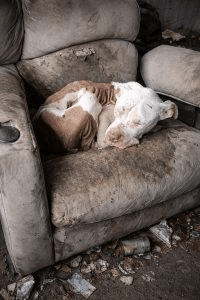
For weeks, Aniken waited inside a house where the people he loved no longer lived.
The rooms were silent. The familiar voices were gone. Doors that once opened throughout the day remained closed, and no one came home to call his name.
Yet the dog stayed.
He had no way of understanding why his life had changed so completely. The home was still familiar, even as everything that had made it safe slowly disappeared.
At first, there was still a place to shelter.
But there was less and less to eat.
Water became difficult to find. His once-healthy body began losing strength, and the simple act of moving around grew harder.
Outside, life continued in the Texas neighborhood.
Inside, Aniken was becoming dangerously weak.
And what eventually brought help to his door was something no one could have expected.
Another dog.
The Home He Could Not Leave Behind
For a dog accustomed to living with a family, a house can represent far more than walls and a roof.
It holds familiar sounds, routines, and places where safety once felt certain.
Aniken had known that kind of life.
Then, without the people he depended on, those familiar surroundings became a place of isolation.
Days passed without the care he needed.
His food supply dwindled. His physical condition deteriorated. The strength that had once allowed him to move comfortably through the house gradually faded.
Eventually, hunger and the need to survive drove him outside.
People living nearby began noticing an unusually thin dog wandering through the neighborhood.
His ribs were visible beneath his coat.
He moved slowly, as though even walking required more energy than he could comfortably spare.
There was no mistaking that something was wrong.
What the neighbors could see was already concerning. What they could not yet see was how serious his condition had become.
Aniken was not simply a stray dog looking for an occasional meal.
He was an animal whose health had been declining for a prolonged period, without the support he needed to recover.
And time was becoming increasingly important.
When Concern Turned Into a Search
The residents who noticed Aniken understood that he needed more than a little food or water.
He needed someone to intervene.
Their concerns eventually reached Friends of Reggie, a local animal rescue organization.
The report described a severely underweight dog who appeared to be struggling to survive.
Volunteers began searching the surrounding area.
They checked streets, yards, and other places where the dog had reportedly appeared.
But finding him was not straightforward.
Aniken had been seen in the neighborhood, yet he proved difficult to locate when help arrived.
The search continued over several days.
For rescuers, this uncertainty was particularly troubling. They knew the dog was already in poor physical condition, but they had not yet been able to examine him or bring him somewhere safe.
Every unsuccessful search left the same unanswered question.
Where had he gone?
Then, while the volunteers were still looking, a female dog approached them.
She was thin herself.
But rather than simply passing by, she behaved in a way that caught their attention.
She moved toward the rescuers, walked away, and repeatedly looked back.
The volunteers noticed the pattern.
It seemed almost as though she wanted them to follow.
They decided to see where she would lead them.
Her destination was an abandoned house.
And inside that house, the rescuers finally found Aniken.
The Dog Who Showed Them Where to Look
Aniken was lying on the floor.
He was so weak that he could not stand.
When the rescuers came closer, he managed little more than lifting his head.
After days of searching, the volunteers were finally face-to-face with the dog whose condition had caused so much concern.
But seeing him up close revealed an even more serious situation than the reports had suggested.
His body was severely underweight.
He appeared exhausted, and the visible effects of prolonged neglect were impossible to ignore.
He needed medical attention urgently.
There was another important part of the discovery.
The female dog who had guided the rescuers had stayed close to Aniken despite her own difficulties.
Her behavior had brought the volunteers directly to the place where he was lying.
No one could know exactly what she understood about his condition.
But her actions had made a meaningful difference.
Without her unexpected guidance, finding him might have taken even longer.
For Aniken, whose body had already become so fragile, that mattered enormously.
VIDEO: A Thin Female Dog Led Rescuers to an Empty House — Where Aniken Was Too Weak to Stand
The rescuers carefully lifted Aniken and carried him to their vehicle.
He was no longer being left to manage his condition alone.
The female dog was also brought to safety.
Both animals had endured hardship, and both now had a chance to receive the help they needed.
As Aniken was carried away, rescuers noticed his tense body beginning to relax.
It was a quiet moment.
There was no dramatic movement or sudden burst of energy. He was still extremely weak.
But the circumstances around him had changed.
Someone had finally found him.
And the work of saving his life was only beginning.
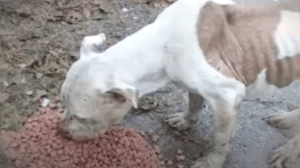
A Medical Examination Revealed the Depth of His Struggle
Once Aniken was under veterinary care, his rescuers learned that the visible weight loss was only part of the problem.
His medical examination uncovered several serious health concerns.
He was suffering from anemia, kidney disease, heart-related problems, parasites, mange, dental difficulties, and multiple infections.
Each condition created its own challenge.
Together, they made his recovery especially complicated.
Aniken's weakened body needed careful treatment, and his veterinary team had to consider more than simply helping him gain weight.
His health had deteriorated over an extended period.
Improving it would require ongoing medical supervision and a coordinated approach to care.
The team developed a treatment plan involving medication, repeated veterinary monitoring, and carefully managed nutrition.
Food was essential, but helping a severely malnourished dog recover required patience and appropriate medical guidance.
There could be no expectation that a few good meals would undo such extensive physical decline.
Aniken needed time.
He needed consistency.
And he needed people willing to continue caring for him even when improvement was slow.
For those following his rescue, the list of medical concerns was difficult to read.
The dog who had been found lying helplessly in an empty house was now facing several health problems at once.
Still, his caregivers continued working toward recovery.
Aniken accepted the treatment he was given, and his progress was monitored closely.
At this stage, even small improvements had significance.
A little more strength could mean another step forward.
A better response to treatment could offer encouragement that the care plan was helping.
His journey would not be quick.
But for the first time in a long while, his needs were being addressed.
The Kindness of Strangers Helped Keep His Recovery Moving
Comprehensive veterinary treatment brought another challenge.
The cost of Aniken's care was increasing.
He needed continued medical attention, and the rescue organization faced the expense of supporting an animal with several serious health conditions.
Friends of Reggie decided to share his story with the wider community.
They explained his situation and asked animal lovers to help support his treatment.
The response was extraordinary.
People who had never met Aniken began contributing.
Others sent messages of encouragement, moved by the sight of a dog who had endured such a difficult period and was finally receiving care.
The support reached beyond the neighborhood where he had been found.
People across the country learned his name.
For Aniken, those contributions helped make his ongoing treatment possible.
For the rescue organization, they represented something equally meaningful: a community of strangers willing to help an animal whose future had become uncertain.
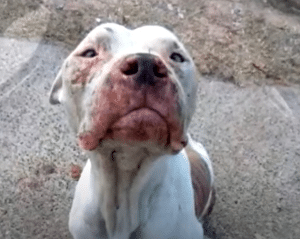
There was no single moment when all of Aniken's health problems disappeared.
Recovery unfolded gradually.
His nutrition was carefully managed, and his medical needs continued to be monitored.
Over time, the changes became noticeable.
He could eat larger amounts.
His movements grew stronger.
The dog who had once been unable to stand began regaining the physical ability to move with greater confidence.
These improvements were important because Aniken's condition had been so severe when he was found.
Progress had to be measured in small steps rather than dramatic expectations.
A body weakened by prolonged neglect needed opportunities to rebuild strength.
And an animal that had lived through such uncertainty also needed an environment where care could be counted on.
The contributions and encouragement from the community helped support that process.
Although those donors might never meet Aniken, their compassion became part of the reason he could continue moving forward.
His recovery belonged not only to the rescue organization and veterinary team, but also to everyone who had helped make continued care possible.
A Foster Home Gave Him Something He Had Lost
Eventually, veterinarians determined that Aniken was stable enough to move into foster care.
This marked a significant change in his life.
Until then, much of his journey had focused on immediate medical needs.
Now, he could experience something that had been missing for so long.
A dependable home environment.
His foster caregivers provided regular meals, a comfortable place to rest, and the steady attention of people who wanted him to recover.
There was no need to search for food.
No need to wander through the neighborhood while physically exhausted.
No need to remain inside an empty house hoping that familiar people would return.
For a dog whose life had been dominated by uncertainty, reliable daily care was meaningful.
And with that stability, another kind of recovery became visible.
Aniken's personality began to emerge.
At first, the physical changes were the easiest to notice.
His coat improved.
His posture changed as his strength returned.
The exhausted appearance that had defined his early rescue days slowly gave way to a healthier, more comfortable dog.
But his progress was not only physical.
The sadness and uncertainty that once seemed to dominate his expression began to lift.
He became more curious.
More confident.
More willing to trust the people around him.
There was no need to rush those changes.
Each day of reliable care gave him another opportunity to feel secure.
The process showed why rescuing an animal involves more than removing it from immediate danger.
Medical treatment can address many physical problems.
But helping an animal become comfortable in a home again depends on patience, kindness, and repeated experiences of safety.
Aniken was finally receiving all three.
The Dog Found on the Floor Was Beginning to Disappear
Looking at Aniken during his foster-care recovery, it became increasingly difficult to connect him with the dog the volunteers had first discovered.
The contrast was remarkable.
Before his rescue, he had been lying on the floor of an abandoned home, unable to rise.
He had almost no strength left.
His body was dangerously thin, and his future depended on receiving urgent help.
Now, although his recovery had required substantial medical attention, he was becoming stronger and more comfortable with ordinary daily life.
His appearance was changing.
So was the way he responded to the world around him.
Instead of spending his days trying to survive, he could begin behaving like a dog who felt cared for.
That distinction is easy to overlook.
A regular meal may seem ordinary.
A comfortable place to sleep may seem simple.
A gentle person offering affection may seem like a small thing.
But for Aniken, those experiences represented a complete transformation from the circumstances in which he had been found.

His foster home offered an important bridge between rescue and a lasting family life.
It gave him time to recover without the uncertainty that had surrounded him before.
It also allowed his caregivers to see the dog beyond his medical conditions.
Aniken was not defined only by anemia, kidney problems, or the severe weight loss that had made his rescue so urgent.
He was an individual capable of responding to affection and rebuilding trust.
And as he improved, the possibility of a permanent home became more than a distant hope.
At Last, Aniken Found a Family Who Would Stay
Aniken's story ultimately reached the outcome his rescuers had worked toward.
He found a loving family.
Today, he lives in a home where he is cared for, valued, and surrounded by affection.
The dog who once waited in silence for people who did not return now has people committed to his well-being.
It is a very different life from the one rescuers discovered in that abandoned Texas house.
Regular care has replaced uncertainty.
Comfort has replaced the struggle to survive.
And the isolation that once shaped his days has given way to companionship.
Yet the path to this ending was not built on one act of kindness alone.
It began with concerned neighbors who noticed a dog in trouble.
It continued with volunteers from Friends of Reggie who kept searching even when they could not find him.
It was changed by a thin female dog whose unusual behavior guided them to the house where Aniken lay.
Veterinarians then worked through his many health problems, while donors helped support the demanding treatment he required.
His foster caregivers provided the stability he needed to keep recovering.
And finally, a family welcomed him into a permanent home.
Each part mattered.
Without the neighbors' concern, his suffering might have continued unnoticed.
Without the search, he might not have been found when he was.
Without extensive veterinary attention, his serious medical conditions could not have been properly addressed.
And without sustained kindness after the rescue, he would not have had the same opportunity to rebuild trust.
Aniken's transformation is a reminder that compassion is often a series of decisions rather than one dramatic gesture.
Someone notices.
Someone chooses to help.
Someone continues showing up when the difficult work begins.
For Aniken, those choices changed everything.
He no longer has to remain in an empty house, waiting for familiar footsteps that never come.
He has a home that is filled with care.
A family that loves him.
And a life that extends far beyond the place where his rescuers first found him.
The most meaningful part of his story is not simply that he survived.
It is that he was given the chance to belong again.
After so much waiting, Aniken finally has a place where he is wanted.
And this time, he does not have to wait alone.


