
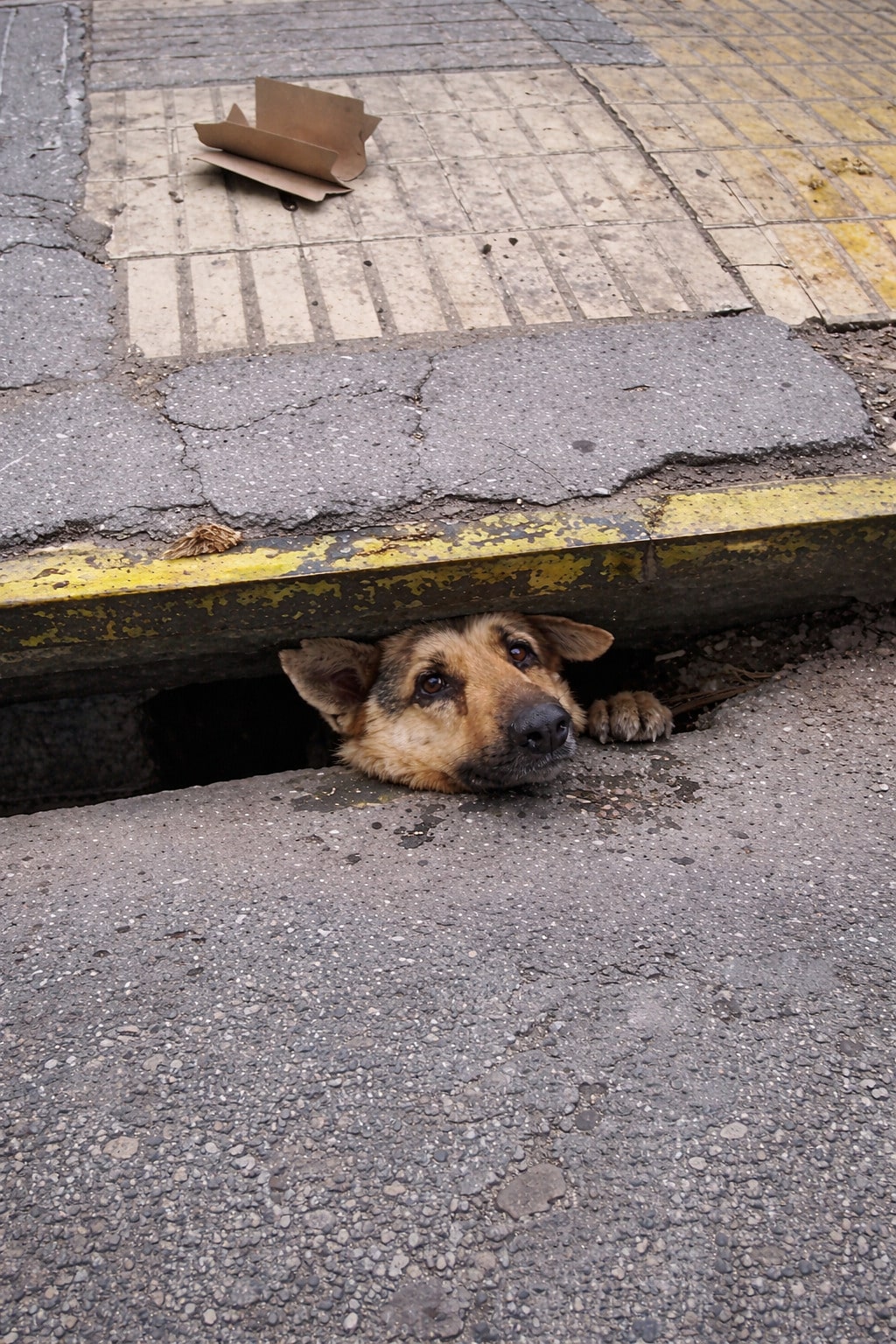
For more than four days, the dog could see a small piece of the world above him.
His head and front paws reached toward an opening in the sewer, but the rest of his body remained trapped beneath the streets.
He could breathe.
He could look up.
But he could not climb out.
Somewhere above, ordinary life continued in Bahía Blanca, Argentina. People went about their routines, unaware that an exhausted animal was waiting beneath the pavement.
The dog had no way of knowing whether anyone would notice him.
And as the days passed, his situation grew increasingly uncertain.
What eventually saved him was not one extraordinary act.
It was a series of ordinary people making the same compassionate decision.
They refused to look away.
Four Days in a Place He Could Not Escape
Nobody knows exactly how the dog entered the sewer system near the intersection of Roca and Terrada.
He may have wandered through an opening while exploring the area. He may have slipped into a space that was easier to enter than to leave.
The circumstances remain unknown.
What is clear is that once he was inside, he could not find his way back to safety.
The underground space was dark and confined. The surrounding pipes offered little room for movement, and the dog had no obvious route to the street above.
Somehow, he managed to position himself near an opening.
His head and front paws could reach toward the drain, allowing him to breathe and observe what was happening outside.
But that narrow connection to the surface was not enough to free him.
He remained there for more than four days.
Four days without the freedom to walk away.
Four days surrounded by an unfamiliar environment.
Four days in which his survival depended on circumstances beyond his control.
As time passed, the dog grew weaker.
Yet he continued holding on.
There was something especially troubling about how close he was to the outside world.
The street was right above him.
Help might have been only a short distance away.
But until somebody realized what was happening, that distance was impossible for him to cross.
The Moment Neighbors Finally Looked Down
The turning point came when residents near Roca and Terrada noticed something unusual around the sewer.
Instead of ignoring it, they investigated.
What they discovered immediately changed the situation.
A dog was looking up from beneath the street.
He appeared frightened and exhausted, but he was not barking continuously or struggling wildly to attract attention.
He simply remained near the opening, watching the people who had gathered above.
It was a quiet encounter.
No dramatic movement was needed to reveal the problem.
The animal was trapped.
And he needed someone to intervene.
For the residents, the discovery raised an urgent question: how could they get him out without putting him in further danger?
The answer was not immediately clear.
A sewer is not an easy place to reach an animal. Its narrow spaces and restricted access can make even a seemingly straightforward rescue complicated.
But the neighbors understood that doing nothing was not an acceptable option.
They began with what they could provide.
Food.
Water.
And attention.
Carefully, residents lowered nourishment toward the dog so he could continue surviving while a more complete rescue effort was organized.
Those small acts mattered.
After days underground, he was no longer facing the situation entirely alone.
People knew he was there.
People were watching over him.
And people were determined to find a way to bring him back to safety.
A Community Refused to Leave Him Behind
The neighbors' efforts did not stop with food and water.
They contacted emergency services and requested help for the trapped animal.
Soon, Civil Defense personnel and local responders from Bahía Blanca arrived to examine the situation.
The challenge was immediately apparent.
The dog was positioned inside a confined underground system, where access was limited and any attempt to remove him would require care.
His exhaustion added another concern.
He had already endured days in the sewer, and the rescuers needed to avoid creating additional stress or risking injury during the extraction.
There was no simple solution that could be rushed.
The responders had to assess the available access points, prepare equipment, and determine how to move the dog safely.
Above ground, concerned residents remained nearby.
They had helped sustain him while assistance was being arranged.
Now they were waiting for the moment when those efforts might finally lead to his freedom.
For the dog, the scene had changed.
The opening that had offered only a little air and a view of the street was now the focus of a coordinated effort to save him.
VIDEO: Four Days Trapped Beneath the Street — Watch the Community Come Together to Save Him
The Careful Work of Bringing Him Back to Safety
Rescuing the dog required more than simply reaching down and pulling him free.
The responders worked through the practical difficulties of removing an animal from the sewer without causing further harm.
They considered different approaches and coordinated their movements around the restricted space.
Patience was essential.
After more than four days underground, the dog was already exhausted. The rescue itself needed to be handled with as little additional distress as possible.
Every decision carried importance.
The goal was not merely to move him.
It was to bring him out safely.
The work continued while the residents watched with concern.
The dog had survived the long period of confinement, but he was not safe until he was completely out of the drainage system.
That uncertainty made the final stage of the rescue particularly meaningful.
The people involved had already committed themselves to helping him.
Now they had to complete the difficult part.
Gradually, their coordinated efforts began to succeed.
And then came the moment everyone had been hoping for.
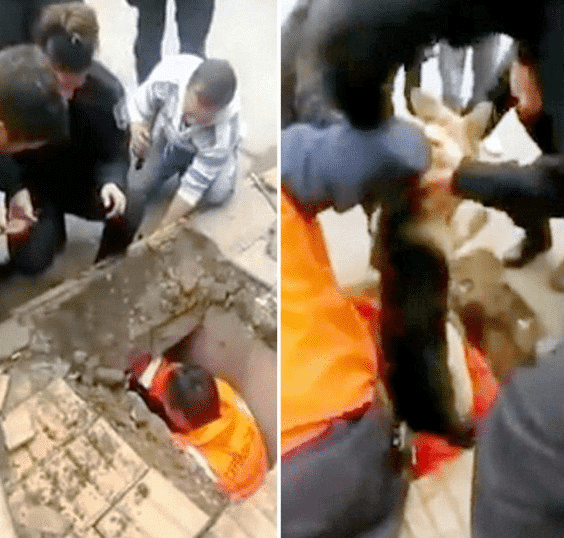
The dog was finally lifted free from the sewer.
After spending more than four days beneath the streets, he was back in the open air.
No longer confined.
No longer beyond reach.
Alive.
The relief surrounding his rescue was understandable.
For the neighbors who had discovered him, the outcome confirmed that stopping to investigate had made a difference.
For the emergency responders, their careful work had brought a vulnerable animal out of a dangerous situation.
And for the dog, the long wait underground was finally over.
His First Steps Toward Recovery
The rescue was a turning point, but it was not the end of the dog's journey.
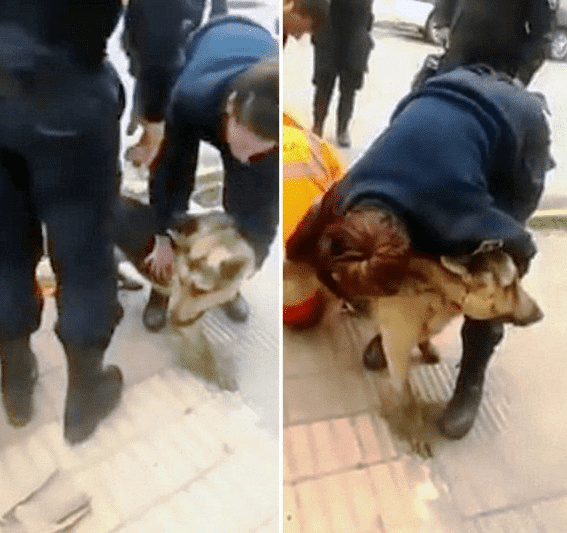
After being removed from the sewer, he was taken to a local facility where he could receive care and recover from the experience.
His immediate needs were simple but important.
He needed food.
He needed medical attention.
And he needed a quiet place where he could rest.
After days of confinement, those ordinary comforts represented a major change in his circumstances.
He was no longer trying to survive in a space that offered no safe way out.
Instead, people were providing what he needed while he regained his strength.
The dog was understandably shaken by what he had experienced.
Nevertheless, the early signs were encouraging.
As caregivers attended to him, he began showing signs of improvement.
His strength gradually returned.
The difficult days beneath the street had left him exhausted, but they had not taken away his opportunity to recover.
That distinction matters.
Being rescued does not always mean an animal immediately returns to normal.
The transition from danger to safety can take time, particularly after a prolonged and stressful experience.
For this dog, the available account describes a period of rest, nourishment, medical attention, and improving strength.
There is no need to imagine extraordinary treatments or dramatic setbacks to understand the importance of those steps.
Sometimes, the most meaningful progress begins with something as ordinary as a safe place to rest.
And that was what he had finally been given.
From Waiting Underground to Waiting for a Family
There is a striking difference between the dog's life during those four days and the future now available to him.
Underground, he had been waiting for someone to notice that he was trapped.
At the care facility, he was waiting for an entirely different kind of opportunity.
A permanent home.
According to the rescue account, the dog became available for adoption after receiving care.
That development gave his story another hopeful chapter.
The residents and responders had helped him survive.
Caregivers had provided the support he needed to begin recovering.
Now the possibility existed for a family to offer him something more lasting.
A home where he would be safe.
A place where he could receive regular meals and affection.
A life no longer defined by the danger of being trapped beneath the streets.
His eventual adoption was not confirmed in the account, so the search for a permanent family remained an open part of his story.
But the difference in his circumstances was already significant.
He had gone from being an unseen animal in a sewer to a dog whose future mattered to an entire group of people.
And because those people acted, he had a chance to find the security that every companion animal deserves.
The Small Decisions That Made a Life-Saving Difference
One of the most meaningful parts of this rescue is how many people contributed to its outcome.
The neighbors who first noticed the dog did not possess everything needed to free him.
They could not solve the entire problem themselves.
But they could recognize that something was wrong.
They could investigate.
They could bring food and water.
And they could call for professional assistance.
Those actions created the conditions for the rescue to succeed.
When Civil Defense personnel and other responders arrived, they brought the coordination and practical assistance needed to complete the extraction.
Afterward, caregivers took responsibility for supporting the dog's recovery.
Each contribution was different.
Each was necessary in its own way.
The story is a reminder that helping an animal does not always begin with a dramatic rescue.
Sometimes it begins with noticing something that others might overlook.
A movement beneath a drain.
An animal appearing where it should not be.
A situation that deserves a closer look.
The residents of Bahía Blanca did not know exactly how long the dog would survive underground or how difficult his rescue might become.
What they did know was that he needed help.
And they responded to that need rather than walking away.
Video footage of the operation later circulated online, allowing others to see the collective effort that had brought him to safety.
For viewers, the footage offers more than a look at an unusual animal rescue.
It shows what can happen when concern becomes action.
A Second Chance Made Possible by Kindness
The dog's story began with an unanswered question.
Nobody could explain exactly how he had become trapped beneath the streets.
For four difficult days, he remained in a place he could not escape, with only a narrow opening connecting him to the outside world.
Then someone noticed.
That single discovery set everything else in motion.
Neighbors brought food and water.
Emergency services were contacted.
Responders planned and carried out a careful extraction.
Caregivers helped him begin recovering.
And eventually, the dog was given the opportunity to seek a permanent home.
His experience could have ended very differently if the people above the drain had decided that the problem was someone else's responsibility.
Instead, they chose to help.
Not everyone involved performed the same task.
Not everyone had specialized equipment or rescue experience.
But each person contributed something that moved the situation toward a better outcome.
That is what makes this story worth remembering.
Compassion is not always a grand gesture.
Often, it is a willingness to pay attention, to offer what help is possible, and to involve others when a problem is too difficult to solve alone.
A dog who once spent days looking up through a sewer opening now has the possibility of a future filled with care and companionship.
His permanent home may still be waiting.
But the most important change has already happened.
He is no longer trapped beneath the city.
He has been seen.
He has been helped.
And because an entire community refused to leave him behind, he has been given another chance.


