
Some dogs ask for help by barking at a door.
Pax did something much quieter.
He kept returning to the same family's property, sitting near the fence or resting beneath a tree while the household dogs played nearby.
He never tried to force his way inside.
He didn't demand attention.
He simply stayed close enough to watch.
The homeowner began noticing the pattern. What started as occasional visits gradually became a daily occurrence. The same lonely dog would appear, spend time near the yard, and linger as though there was nowhere else he needed to be.
Nobody knew where he had come from.
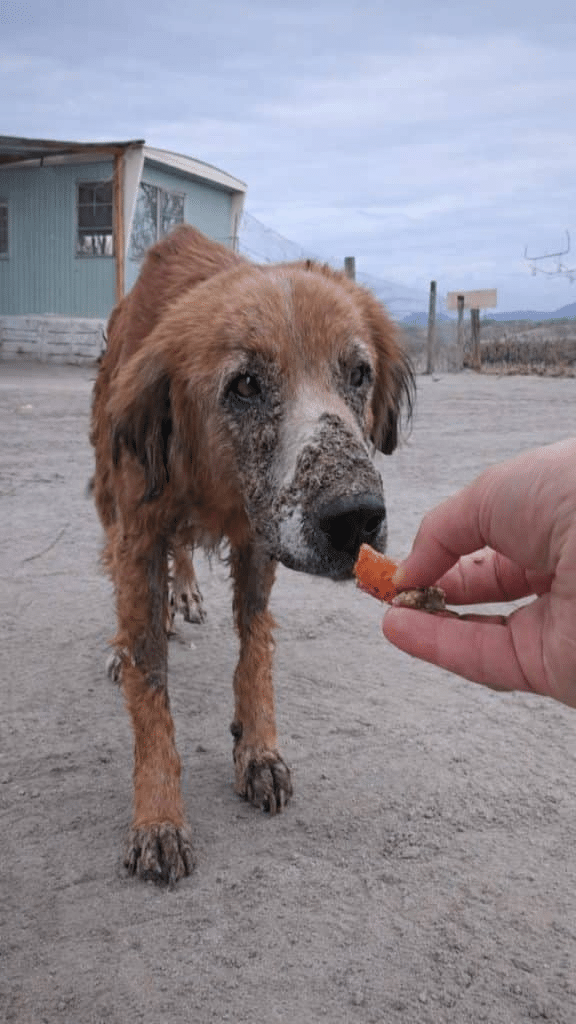
His coat was dirty and uneven, with noticeable patches of missing fur. His physical condition suggested that life outdoors had not been kind to him.
Yet there was something remarkably gentle about the way he behaved.
He seemed interested in the other dogs without showing aggression. Sometimes he watched them playing. Other times he settled nearby, content to remain within sight of the family.
It was a small, almost silent routine.
But it was enough for one person to realize that this visitor needed more than a temporary meal.
He needed a chance to belong.
The Dog Who Never Stopped Coming Back
At first, the homeowner responded in the simplest way possible.
He placed food and clean water outside.
Pax, who had not yet been given that name, returned to eat. But the food was only part of what kept bringing him back.
Even after eating, he often remained near the property.
That detail mattered.
A stray dog passing through might accept a meal and disappear. This dog repeatedly chose the same place, lingering near the fence and watching the animals who already had a home.
There was no way to know precisely what Pax remembered about his earlier life or what had brought him to this neighborhood.
His history remained a mystery.
But his condition was visible.
His fur had become patchy, and his skin appeared irritated. He looked like a dog who had spent a long time without consistent care.
Still, he showed a calm curiosity toward the household dogs.
Perhaps their familiar routine offered him a sense of security. Perhaps he simply enjoyed being near other animals.
Whatever the reason, he kept coming back.
The homeowner continued providing food and water, making sure the dog had at least some support.
Yet the more often Pax appeared, the clearer the situation became.
Feeding him was an act of kindness.
It was not a permanent solution.
The dog needed medical attention, safety, and people who could help him move beyond life on the streets.
Eventually, the homeowner contacted a local rescue organization.
That decision opened the door to a very different future.
A Gentle Rescue Built on Patience
When rescue volunteers arrived at the property, they found the stray resting nearby.
He noticed them immediately.
His eyes followed their movements, and his cautious posture showed that he was paying close attention to the unfamiliar visitors.
But he did not growl.
He did not threaten them.
He simply watched, uncertain about what they intended to do.
The rescuers understood that a dog who had been surviving outdoors might need time before accepting human contact.
So they avoided rushing toward him.
They lowered themselves closer to his level, spoke gently, and placed treats within reach.
Then they waited.
At first, the dog remained where he was.
He appeared interested in the food, but interest alone was not enough to overcome his hesitation.
The volunteers allowed him to make the next move.
Eventually, he took a careful step forward.
Then another.
The distance between the rescuers and the stray gradually narrowed.
There was no dramatic chase or struggle. Instead, the rescue depended on patience and the willingness to let a frightened animal decide when he felt comfortable enough to approach.
Finally, the volunteers were able to place a leash around his neck.
He accepted it calmly.
His body began to relax, and the people helping him saw the first signs that he might be willing to trust them.
They named him Pax.
The name means peace.
For a dog whose gentle personality had survived so much uncertainty, it seemed especially fitting.
And although the volunteers had successfully brought him into their care, they were only beginning to understand what he had been living with.
VIDEO: A Lonely Stray Kept Watching a Family's Dogs — Until Rescuers Finally Reached Him
The Medical Care He Had Needed for So Long
Leaving the property marked a major change in Pax's life.
The rescue team helped him into their vehicle, and he went along without resisting.
During the journey, he remained quiet and attentive, watching the people around him.
At one point, his tail gave a small wag.
It was a brief movement, but an encouraging one.
For a dog who had spent so much time managing life alone, accepting help from strangers represented a meaningful step.
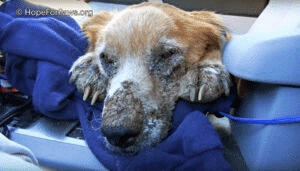
His rescuers took him to a veterinary clinic, where an examination revealed that his physical condition was more serious than his calm behavior suggested.
Pax had significant hair loss and skin irritation.
Mange had affected his coat, while inflammation in his ears and discomfort around his eyes added to the problems requiring treatment.
He also had wounds that needed veterinary attention.
These were not issues that could be solved with food and water alone.
His body needed proper medical care, and recovery would require consistency.
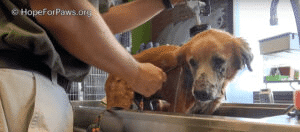
The veterinary team began addressing his condition.
They carefully cleaned his wounds, treated his ears, and bathed him with medicated products intended to soothe his damaged skin.
For Pax, these procedures introduced an entirely different kind of human attention.
He was no longer approaching people only for food.
He was receiving care directed at relieving the discomfort he had been carrying.
Despite the unfamiliar surroundings and treatment, he remained cooperative.
The staff could work with him gently, helping him through the medical attention he needed.
Nothing about his recovery was immediate.
Skin conditions require care over time. His missing fur would not return after a single bath, and the inflammation affecting his body needed ongoing treatment.
But the important change had already happened.
Pax no longer had to face those problems without help.
Someone was now responsible for making sure he received the care he needed.
Small Signs That Life Was Getting Better
The days following his rescue were devoted to helping Pax regain his health.
His caregivers continued the medication and treatments prescribed for his skin and ear problems.
Regular meals provided the nutrition his body needed as he recovered.
Each part of that routine served a purpose.
The medical treatment addressed the physical problems that had caused discomfort.
Consistent feeding supported his strength.
And the predictable presence of caring people gave him an opportunity to become more comfortable with human companionship.
Progress was gradual.
His damaged coat needed time to grow back.
The irritation affecting his skin did not disappear immediately.
Yet there were encouraging changes in his behavior.
Pax began lifting his head when caregivers entered the room.
He became more receptive to gentle affection.
His tail wagged with increasing frequency.
These were modest signs, but together they revealed a dog becoming more comfortable with his surroundings.
One particularly important change was his ability to rest peacefully.
For a stray dog, sleep can mean remaining alert to unfamiliar sounds and possible danger.
Pax was beginning to experience a different routine.
He could rest in a place where people were looking after him.
His physical recovery was underway, but the next part of his journey would involve something equally important.
He needed to learn what it felt like to live inside a home.
The Forgotten Dog Foundation became involved in supporting the next stage of his care.
With his condition stabilizing, the focus expanded beyond medical treatment.
Pax needed a safe, consistent environment where he could continue recovering and experience everyday family life.
A foster family opened their home to him.
For the dog who once spent his days sitting outside another family's fence, that invitation changed everything.
The First Time He Had a Bed of His Own
Entering his foster home was a new experience for Pax.
Instead of watching a household from a distance, he was now allowed to explore one.
He moved carefully through the rooms, taking notice of the unfamiliar surroundings.
The sounds were different.
The spaces were different.
Even the simple experience of being indoors required adjustment.
His foster family had prepared a bed specifically for him.
At first, Pax hesitated.
Then he stepped onto it.
He turned around and settled down.
It was an ordinary moment in the life of a household dog.
For Pax, it was part of a much larger transformation.
He no longer needed to find an outdoor place to rest.
There was a comfortable spot waiting for him, and the people around him expected him to stay.
As the days passed, his foster home introduced a reassuring rhythm.
Meals came regularly.
Medication was administered on schedule.
Walks became part of his routine.
Familiar voices and surroundings replaced the uncertainty that had defined his earlier days.
He began recognizing where his food would be served and where he liked to sleep.
Those experiences may seem small, but they are central to helping a rescued dog settle into a new environment.
Safety becomes easier to understand when it is repeated.
A meal appears again tomorrow.
The same caring people return.
A comfortable resting place remains available.
And little by little, the animal no longer needs to approach every moment with the same level of caution.
Pax was learning these lessons through the steady care of his foster family.
He had once watched other dogs enjoy that kind of routine.
Now it was part of his own life.
The Affectionate Dog Beneath the Neglect
As Pax's health continued improving, his personality became more visible.
His coat gradually filled in.
His skin healed.
The discomfort that had accompanied his medical problems eased with treatment.
But the changes were not limited to his appearance.
The quiet dog who once stayed at the edge of a yard began showing more confidence around people.
He greeted familiar faces with enthusiasm.
He carried toys around his foster home.
He showed interest in playing.
And when family members sat nearby, he often moved closer to them.
Affection, which he had initially accepted with some hesitation, became something he actively sought.
He rested his head on people's laps.
He followed members of the household from room to room.
Whenever he had the opportunity, he curled up near someone.
His gentle nature had been evident from the beginning.
What changed was his confidence in expressing it.
Pax no longer needed to remain a silent observer of family life.
He could participate.
He could approach someone for attention.
He could play, rest, and enjoy companionship without having to wait outside a fence.
His foster family offered him the space and patience to develop those habits naturally.
And as his recovery progressed, another possibility came into view.
Pax was becoming ready for a permanent home.
The Family Who Finally Chose Him
Eventually, a prospective adoptive family learned about Pax.
They were drawn to his gentle temperament and affectionate personality.
His earlier neglect and medical difficulties were part of his history, but they did not define the companion he had become.
When the family met him, Pax approached cautiously at first.
Then he relaxed.
His tail began wagging, and the meeting revealed the same warm nature his foster caregivers had come to know.
For a dog who had once struggled to find somewhere safe to stay, this was another meaningful step.
He was no longer the stray returning to a stranger's yard.
He was a dog being considered for a permanent place in someone's life.
The connection developed naturally, and the family decided to adopt him.
Soon afterward, the adoption became official.
Pax finally had a home of his own.
It was the outcome that so many people had helped make possible.
The homeowner had first noticed the stray repeatedly appearing near his property.
He had provided food, water, and eventually contacted rescuers.
The volunteers had approached the wary dog patiently and brought him into safety.
Veterinary professionals had treated the conditions affecting his health.
The Forgotten Dog Foundation had helped support his next steps.
His foster family had given him the consistency and affection needed to adjust to living indoors.
And finally, his adoptive family had welcomed him as a companion.
No single moment accomplished everything.
His second chance was built through a series of compassionate decisions.
One person noticed.
Others stepped forward.
And a dog who had once been overlooked was given the support he needed to begin again.
From Watching Through a Fence to Living at Home
Pax's life today looks remarkably different from the one he knew before his rescue.
His coat has recovered, and his eyes reflect the confidence he gained through consistent care.
He enjoys playing, resting comfortably, and spending time with the people who love him.
There is no need for him to return to someone else's property in search of company.
He has a family waiting for him.
And he has a place where he belongs.
What makes his journey especially moving is how quietly it began.
Pax did not create a commotion.
He did not demand that anyone rescue him.
He simply appeared at the same property again and again, watching the dogs who already had what he lacked.
A person noticed his persistence and took it seriously.
That attention led to food and water, then professional rescue, medical treatment, foster care, and finally adoption.
His story demonstrates why even simple acts of compassion can matter.
Providing food helped him through another day.
Contacting a rescue organization gave him access to care that one homeowner could not provide alone.
The patience of volunteers allowed him to accept help without being forced.
And the steady commitment of caregivers helped him become healthy and comfortable enough to join a permanent family.
Each contribution played a part.
Together, they gave Pax something far more lasting than a temporary place to rest.
They gave him a future.
His name, meaning peace, has taken on a deeper significance.
Once, it described the gentle dog rescuers met near a family's yard.
Now, it reflects the security of his new life.
Pax no longer sits beneath a tree watching other dogs play.
He no longer waits beside a fence, hoping to remain close to the warmth of a household.
He can walk through his own home, settle into his own comfortable space, and enjoy the affection of people who have chosen him.
For so long, he was on the outside looking in.
Today, Pax is finally home.


