
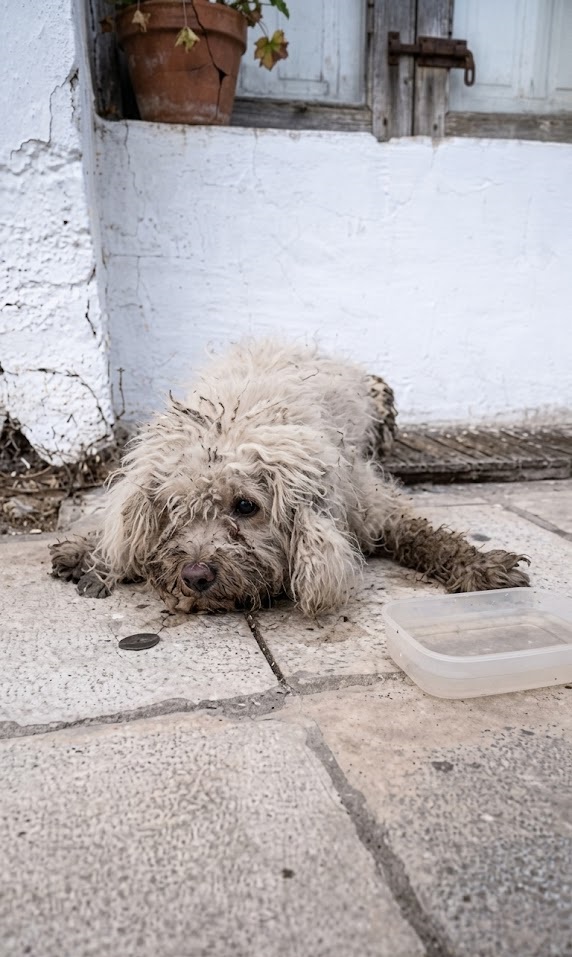
The small figure resting against the sidewalk barely moved.
From a distance, there was little to suggest that a living animal was hidden inside the thick, dirty mass. Tangled fur had become so tightly packed with grime and debris that the shape beneath it was almost impossible to recognize.
Someone walking past might have mistaken it for discarded material.
But volunteer Valya looked closer.
And beneath all those layers, she found a pair of eyes.
They belonged to Julian, a tiny dog whose body had become almost entirely concealed by a heavy, matted coat. He was exhausted, withdrawn, and unable to show the world the little dog he truly was.
He had been overlooked for so long that even his appearance seemed to have disappeared.
Yet he was still there.
Still watching.
Still capable of responding when someone finally stopped.
For Julian, being noticed would become the beginning of something much more important than a change in appearance.
It would become his chance to live with comfort and dignity again.
The Small Life Almost Hidden in Plain Sight
Valya had received a message asking for urgent help.
As a volunteer familiar with difficult rescue situations, she understood that an animal in need might require patience and careful handling. But nothing fully prepared her for the condition of the dog she encountered beside the sidewalk.
Julian's coat was not simply overgrown.
It had formed dense, hardened layers that obscured nearly every part of his small body.
The dirt and tangled material made it difficult to see where the fur ended and the dog began.
What should have been a protective coat had become a burden.
Julian was no longer easily recognizable as a poodle, and the extent of his neglect was visible before anyone even attempted to examine him.
But the most affecting detail was not the fur itself.
It was how little he moved.
There was no energetic greeting or eager attempt to approach the stranger who had come to help.
Instead, Julian remained quiet.
His eyes followed Valya from within the tangled mass, offering the first clear indication that the neglected figure was still aware of the world around him.
It was a moment that called for gentleness rather than urgency alone.
The person standing before him could not immediately undo everything that had happened.
But she could begin with something simple.
Water.
And the patience to let Julian decide whether he was ready to accept it.
A Bowl of Water and a Gesture That Changed Everything
Valya placed a bowl of water within Julian's reach.
Then she waited.
At first, he did not respond.
His stillness made the moment feel uncertain. The little dog appeared to have very little energy left to spare, and even a movement toward the bowl required effort.
Eventually, Julian shifted forward.
He began to drink.
It was an ordinary action, the kind that would barely attract attention in a healthy household pet.
For Julian, however, it carried a different meaning.
He was accepting something he needed from a person who had stopped to help.
Valya did not rush him.
She allowed the moment to unfold at his pace.
Then, as she carefully reached toward him, Julian responded in a way she would remember.
He gently touched her hand with his tongue.
There was nothing dramatic about the gesture.
No sudden burst of energy.
No extraordinary transformation.
Just a small, tired dog making contact with the person offering him kindness.
Yet that quiet response revealed something important.
Beneath the neglected coat was an animal still capable of trust and connection.
Julian had not lost the ability to respond to gentleness.
He only needed someone willing to recognize him.
And Valya had done exactly that.
The Loss That Left Julian Without the Care He Needed
As those helping Julian learned more about his background, a painful explanation began to emerge.
He had previously lived with an elderly woman.
She had recently passed away.
During the process of clearing her home, Julian had accidentally been left behind.
The available account does not establish precisely how long he remained without proper care.
That uncertainty matters.
There is no need to invent a long timeline to understand how serious his situation had become.
His physical condition already showed that he had gone without the attention his coat required.
For a small poodle, regular grooming is essential to keeping growing fur manageable. Without it, loose hair and dirt can become trapped, allowing tangles to develop into increasingly dense mats.
In Julian's case, moisture, grime, and debris had accumulated within his coat.
Over time, the tangled fur had formed a thick covering around his body.
It concealed his shape.
It made his condition harder to assess.
And it left him carrying a weight that no small dog should have to endure.
There was an additional sadness in the circumstances surrounding his neglect.
Julian had once had a home.
His situation was connected to the loss of his elderly owner and the confusion that followed, rather than a clearly documented act of deliberate abandonment.
Still, the consequences for him were real.
Whatever the precise length of time he had spent without adequate care, his condition had reached a point where outside help was essential.
The little dog lying on the sidewalk needed more than a kind word.
He needed people willing to look beyond the tangled fur and address the problems hidden underneath.
VIDEO: Julian Was Almost Unrecognizable Beneath Matted Fur — Until Someone Finally Stopped to Help
The footage associated with Julian's rescue brings attention to a reality that can be easy to overlook.
Neglect does not always announce itself through loud cries or obvious movement.
Sometimes an animal is so quiet, and its appearance so altered, that people may not recognize the life in front of them.
Julian's story began changing because Valya took the time to look closely.
But being discovered was only the first part of his journey.
The next challenge was helping him emerge from the coat that had hidden him for so long.
Four Hours to Reveal the Little Dog Beneath the Fur
Once Julian reached the veterinary clinic, it became clear that ordinary grooming would not be enough.
His fur had become too tightly compacted for a quick or simple trim.
Removing it required a careful, prolonged effort.
Veterinarians and volunteers worked together to free him from the hardened layers that surrounded his body.
The process lasted nearly four hours.
For Julian, that meant remaining in place while unfamiliar people carefully handled the coat he had been carrying.
It would have been understandable for an animal in his condition to become distressed.
But Julian responded with remarkable calm.
He did not struggle against the people helping him.
He did not panic.
He stood quietly as the work continued.
His stillness should not be mistaken for proof that he felt no discomfort. The source does not establish exactly what he experienced during the procedure.
What it does show is that he allowed the veterinary team to continue their careful work without resistance.
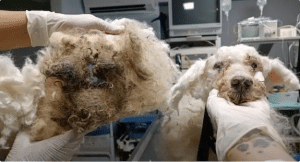
Little by little, the dense fur came away.
Each section removed made it easier to see the animal underneath.
And eventually, the transformation became clear.
The figure that had looked like a shapeless bundle on the sidewalk was actually a very small poodle.
Julian's delicate size had been concealed beneath the accumulated fur.
Without that heavy covering, the difference in his appearance was striking.
His body was visible again.
His natural shape could finally be recognized.
The dog who had seemed almost impossible to identify was no longer hidden.
But this moment was important for reasons beyond appearance.
Removing the matted coat also allowed veterinarians to examine Julian more thoroughly.
And what they discovered helped explain why this little dog needed continued, attentive care.
His Health Challenges Became Clearer Once the Fur Was Gone
With Julian's body no longer concealed beneath layers of tangled hair, the veterinary team could better assess his condition.
Their findings showed that his needs extended beyond grooming.
Julian was living with a heart condition.
He also had partial hearing loss and partial vision loss.
These were significant challenges for such a small dog.
They also gave his caregivers a clearer understanding of his behavior.
During his rescue, Julian had moved cautiously and remained unusually quiet.
At first, those behaviors might have seemed like signs of fear or withdrawal.
But his limited hearing and eyesight provided another important explanation.
A dog who cannot hear or see fully must interact with his surroundings differently.
Movements may be slower.
Approaches may require more caution.
Unfamiliar situations may take longer to understand.
For Julian, these limitations were part of his everyday experience.
His quiet manner was not evidence that he had nothing to offer.
Nor did his medical condition make him less deserving of affection or companionship.
It simply meant the people caring for him needed to understand and respect his abilities.
His rescue had revealed more than a small poodle beneath a neglected coat.
It had revealed an individual with specific needs, a gentle temperament, and a personality that had previously been difficult to recognize.
The Gentle Personality That Had Been Waiting to Be Seen
As Julian settled into the care of those helping him, his personality became easier to understand.
He was not a dog who constantly demanded attention.
He did not need to be the center of every interaction.
Instead, he showed a preference for quieter forms of companionship.
He seemed happiest resting near people he trusted, sharing their presence without requiring constant activity.
There was something especially touching about that preference.
After everything his body had endured, Julian did not need to become an energetic or outgoing dog to prove that his rescue had been worthwhile.
He could simply be himself.
Gentle.
Independent.
Comfortable with peaceful company.
His behavior offered a reminder that affection in animals takes many forms.
Some dogs express their attachment through excited greetings, constant movement, and an eagerness to play.
Others show connection through quieter choices.
They rest nearby.
They accept a familiar presence.
They appear content simply knowing that someone is close.
Julian belonged to this quieter group.
That did not make his companionship less meaningful.
If anything, understanding his nature was an essential part of giving him the life he deserved.
His partial hearing and vision loss also made patience especially valuable.
The goal was not to change his personality or expect him to behave like a dog without those limitations.
It was to provide surroundings and care that respected who he was.
And for a dog whose needs had been overlooked, that understanding represented an important change.
A Safe Place Without the Pressure to Become Someone Else
Julian's story did not end with a dramatic adoption announcement.
According to the available account, he remains in the care of a rescue organization.
There, he has access to greater stability, comfort, and understanding than he had during the period when he was left without proper attention.
Finding an appropriate permanent home may take time.
Julian's medical needs and sensory limitations are important considerations for anyone thinking about caring for him.
His quiet temperament matters, too.
He is not the kind of dog whose appeal depends on constant excitement.
A potential adopter would need to value the companionship of an animal who prefers calm surroundings and a gentle approach.
That does not make Julian an unsuitable companion.
It means the right environment is especially important.
There is a meaningful difference between finding any home and finding one suited to an individual animal's needs.
Julian's journey makes that distinction clear.
He has already experienced what can happen when his daily care is interrupted.
Now, the priority is stability and a quality of life that recognizes his vulnerabilities without allowing them to define his worth.
The rescue organization caring for him provides an important source of that support.
Although the original account does not confirm a completed adoption or a cure for his medical conditions, it does confirm a substantial change in his circumstances.
Julian is no longer lying unnoticed beneath a heavy covering of neglected fur.
His needs have been identified.
His temperament has been recognized.
And he is receiving care from people who understand that comfort matters just as much as appearance.
The Quiet Meaning of Julian's Second Chance
The most memorable moment in Julian's journey may not be the removal of his tangled coat.
It may be something much smaller.
A bowl of water placed beside him.
A patient volunteer waiting nearby.
And the gentle touch of his tongue against her hand.
That brief exchange came before the lengthy grooming process, before the veterinary examination, and before anyone fully understood the health challenges he faced.
It happened while Julian was still hidden beneath the fur that had made him so difficult to recognize.
And yet, even then, there was a connection.
Someone had stopped.
Someone had offered help.
And Julian had responded.
His story is a reminder that the value of an animal does not depend on its appearance, youth, health, or ability to attract attention.
A dog with limited hearing and eyesight is still capable of meaningful companionship.
An animal who prefers quiet company can still form important bonds.
And a neglected pet does not need an extraordinary transformation to deserve ordinary kindness.
Julian did not have to become a different dog to earn his place in someone's care.
He needed people to recognize the dog who had been there all along.
His future may still involve medical challenges and the search for a suitable permanent home.
But the change that has already happened is meaningful.
He has been found.
He has been freed from the heavy fur that concealed him.
He has received veterinary attention.
And he now has the opportunity to experience a more comfortable life.
For a little dog who was almost mistaken for a pile of debris on a sidewalk, that is no small beginning.
Sometimes compassion does not arrive with a grand gesture.
Sometimes it begins when one person notices a pair of eyes that everyone else might have missed.
And chooses not to walk away.


