
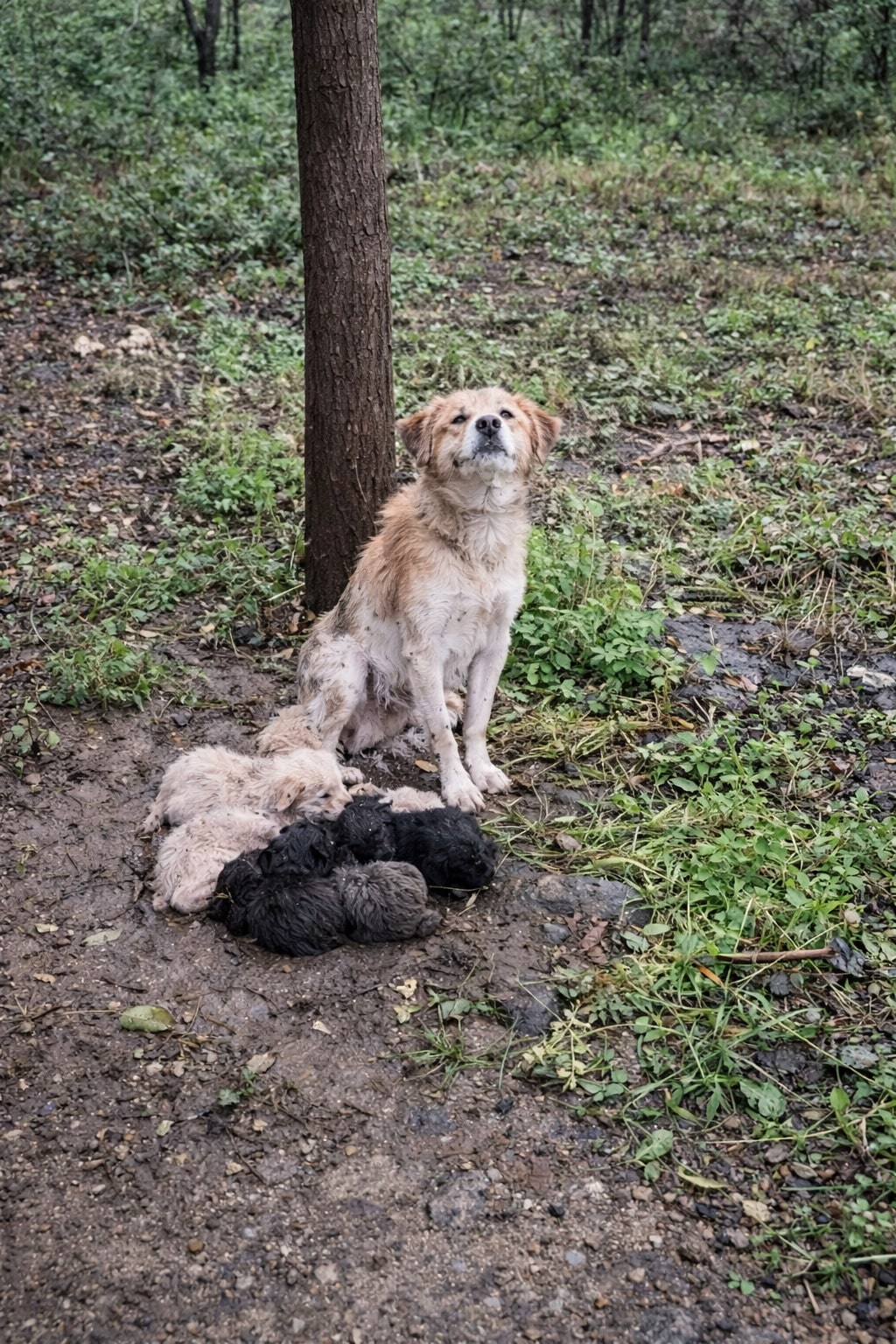
At just 2°C, a mother dog huddled beneath a large tree in the mountains, her body trembling as eight tiny puppies depended on her for warmth and survival.
The ground was wet from rain. The mountain air was bitterly cold. Her puppies were barely two weeks old, still too young to protect themselves from the conditions around them.
Yet even in her exhausted state, the mother remained watchful.
When an unfamiliar man approached, she positioned herself between him and her babies.
She was hungry. She was freezing.
But protecting her puppies came first.
What happened over the following weeks would become a remarkable example of how patience and consistent kindness can change the lives of animals who have learned to be afraid.
A Faint Cry Along a Mountain Road
The discovery began during a drive through the cold mountain roads.
A man traveling through the area noticed an unusual sound beneath the wind.
It was faint and uneven, almost difficult to distinguish from the surrounding noise.
But he listened more carefully.
Something was crying.
Rather than continuing his journey, he followed the sound toward a large tree beside the mountain road.
There, he discovered a small family struggling to survive.
Eight newborn puppies were gathered around their mother, who appeared weak from hunger and exposure to the cold.
At approximately two weeks old, the puppies depended heavily on her for nourishment and warmth.
Their mother was doing everything she could to keep them together.
The rain-soaked ground offered little comfort. With the temperature hovering around 2°C, their location left them exposed to conditions that could become dangerous for such young animals.
The man had found them alive.
But finding them was only the beginning.
Helping them would require something more complicated than simply approaching with good intentions.
The mother dog was afraid.
And she had eight vulnerable lives to protect.
Hunger Was Not Enough to Overcome Fear
The man returned with food and a cardboard box, hoping to provide immediate relief.
For a nursing mother struggling in freezing conditions, food was important. She needed enough strength to continue caring for her puppies.
But his first attempt revealed just how difficult gaining her confidence would be.
The mother stayed low and alert.
Her attention remained fixed on the stranger.
Even when food was available, she hesitated to approach him.
There was no way for her to understand why an unfamiliar person had suddenly appeared beside her shelter.
From her perspective, keeping a safe distance was the most cautious choice.
And with eight puppies depending on her, caution mattered.
The man did not try to force her into the cardboard box or remove the puppies against her resistance.
Instead, he placed the food nearby and stepped away.
It was a simple decision.
But it established the approach that would define the entire rescue effort.
He would help without demanding immediate trust.
He would return rather than disappear.
And he would give the mother enough space to become comfortable at her own pace.
That first encounter did not end with a dramatic rescue.
The family remained beneath the tree.
Yet something important had begun.
For the first time in this account, someone had noticed their struggle and chosen to do something about it.
The Long Journey That Became a Daily Promise
The following day, the man returned.
Then he came back again.
Each visit brought another opportunity to help the mother dog and her puppies.
He carried food, including chicken and sausages, and also brought warm milk as part of the supplies he offered.
His immediate priority was keeping the nursing mother fed.
The puppies were still dependent on her, making her condition especially important to the survival of the entire family.
But feeding them was only one concern.
The mother and her puppies were living in an exposed location where rain and wind could easily reach them.
A cardboard box alone could not provide the kind of protection they needed over time.
The man began using foam boxes and other supplies from his vehicle to construct a temporary shelter beneath the tree.
Piece by piece, their small living space became more protected from the weather.
It was not a permanent home.
It did not remove every difficulty.
But it offered a barrier between the young family and the cold mountain environment.
And the improvements continued.
VIDEO: A Freezing Mother Dog Guarded Eight Newborn Puppies as One Man Returned Day After Day to Save Them
There was another detail that made his commitment especially meaningful.
The journey was not a short walk from his home.
He drove nearly 30 kilometers into the mountains to check on the family.
Every day.
Sometimes he traveled in daylight. Other visits took place after darkness had fallen.
The distance did not change his routine.
Neither did the mother's initial reluctance to approach him.
He continued bringing supplies, speaking gently, and respecting her need for space.
This was not the kind of rescue measured in a few dramatic minutes.
It was measured in repeated journeys.
In meals delivered.
In improvements made to a makeshift shelter.
And in a frightened mother's gradual realization that the same person kept returning without threatening her puppies.
When a Mother Finally Began to Feel Safe
Trust did not arrive during the first visit.
Or the second.
For many days, the mother remained cautious.
She watched the man carefully, keeping enough distance to protect herself and her litter.
But as the visits continued, her behavior slowly began to change.
The source describes a gradual easing of the fear that had marked their earliest encounters.
Instead of retreating immediately whenever the man appeared, she eventually began staying nearby.
She watched him quietly.
Her body no longer showed the same constant trembling associated with those first frightening days.
For the man, this change meant his careful approach was beginning to work.
He had not won her confidence by forcing her to accept help.
He had earned it by remaining predictable.
Food continued to arrive.
The shelter continued to improve.
The puppies remained with their mother.
And the stranger who once seemed so threatening had become a familiar part of their daily surroundings.
There is something deeply moving about that kind of progress.
For a frightened animal, trust may not look like an enthusiastic greeting.
Sometimes it is simply the decision not to run away.
Sometimes it is staying close enough to watch.
And sometimes it is accepting help without feeling the need to defend everything precious.
For this mother dog, those small changes marked an important turning point.
Eight Little Puppies Discover a Kinder World
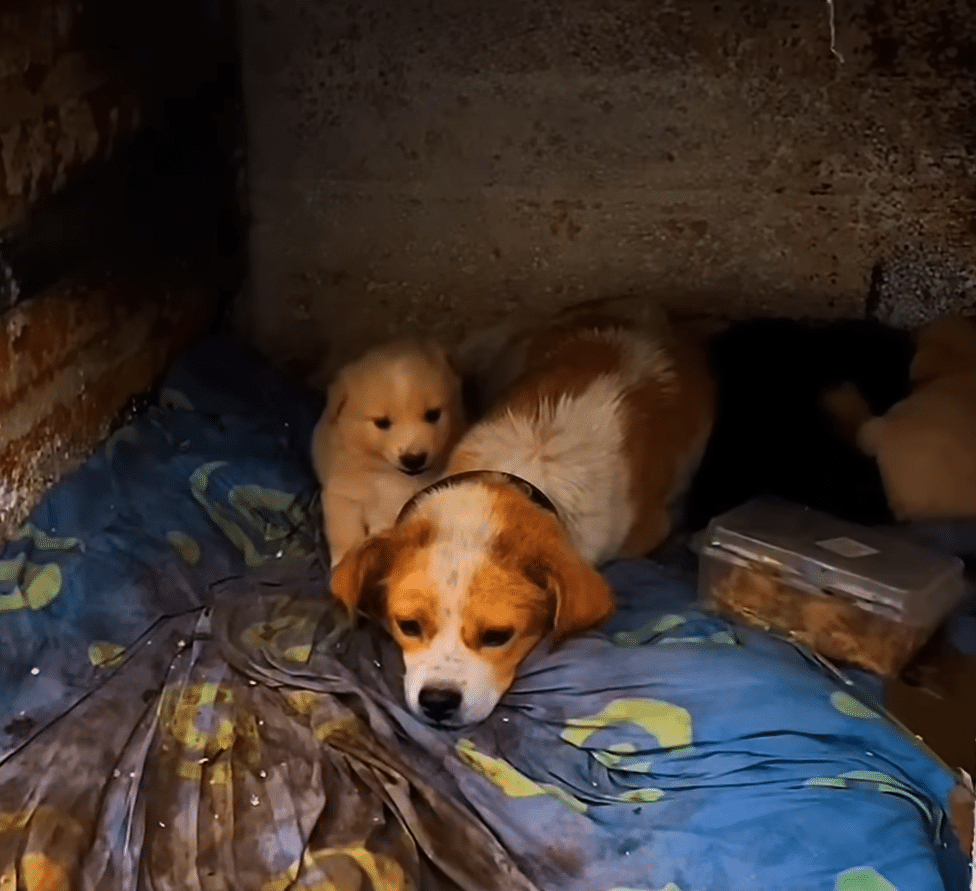
By the twentieth day, the family's circumstances looked very different from the moment they had been discovered.
The puppies were growing.
Their movements were becoming more confident.
Instead of remaining entirely huddled together, they had begun exploring the small shelter around them.
Their earliest playful steps brought a new kind of energy to the space beneath the tree.
The tiny animals that had once been crying in the cold were beginning to experience something closer to an ordinary puppyhood.
They could move around.
They could explore.
They could interact with the man whose daily visits had become familiar.
He continued improving their temporary home, adding stronger walls and warmer bedding to help protect them from the mountain wind.
Each improvement reflected the changing needs of the family.
At first, the goal had been immediate survival.
Keep the mother fed.
Reduce their exposure to rain and cold.
Make sure the puppies had a better chance of getting through another difficult day.
Now, the puppies were becoming active enough to investigate their surroundings.
And their response to the man revealed another change.
They began clinging to him.
Not with the fear their mother had initially shown, but with the familiarity that came from his repeated presence.
For a man who had spent so many days keeping his distance, it was a meaningful development.
The same family he had once struggled to approach was now growing comfortable around him.
The puppies were learning through their daily experiences that human contact could be associated with food, shelter, and gentle attention.
Their mother, meanwhile, no longer needed to react to every visit with the same intense caution.
The relationship had changed gradually.
And it had changed because the man had allowed it to happen without rushing.
One Decision That Kept the Family Together
As the story spread, people began expressing interest in adopting the puppies.
For eight growing young dogs, finding suitable homes could have provided a path toward long-term security.
But the man who had cared for them throughout those difficult weeks had another idea.
He did not want to separate the family.
After watching the mother protect her puppies and seeing them grow together beneath the tree, he chose to keep them all.
It was a significant commitment.
Caring for one rescued dog requires time, resources, and attention.
Caring for a mother and eight puppies meant taking responsibility for nine animals.
But by then, he had already spent weeks traveling into the mountains, feeding them, and improving their living conditions.
The rescue had become part of his daily life.
On day thirty-six, he made the decision permanent.
He brought the entire family home.
For the mother and her puppies, this marked the end of their time living beneath the mountain tree.
They now had access to a safe garden, proper shelter, and regular meals.
The cold, exposed ground where they had first been found was no longer their living space.
The temporary foam-box shelter had served its purpose.
A more secure environment had replaced it.
And most importantly, the mother and her eight puppies remained together.
The man had not simply helped them survive long enough to leave.
He had opened his home to the entire family.
By Day Sixty-Nine, Everything Looked Different
The clearest evidence of the family's progress came in the weeks after they moved.
By day sixty-nine, the puppies were described as healthy and playful.
They had grown far beyond the fragile newborns discovered beneath the mountain tree.
Instead of struggling through freezing conditions, they had a protected place to live.
Instead of depending on irregular opportunities for food, they received regular meals.
Their surroundings had changed.
Their daily experiences had changed.
And their mother had changed, too.
The dog who once trembled in the cold and kept a stranger away from her babies could finally rest without the same fear.
She no longer needed to remain beneath an exposed tree, trying to shield eight tiny puppies from rain and wind.
Her protective instincts had carried her family through their earliest hardship.
Now, she could care for them in safety.
The transformation was not sudden.
It had taken weeks of consistent effort.
Thirty-six days passed before the family was brought home, and their progress continued well beyond that move.
There was no single moment that accomplished everything.
No instant solution to the mother's fear.
No shortcut that replaced the need for patience.
Instead, the changes accumulated through daily acts of care.
A meal.
A return visit.
A better shelter.
A small sign of trust.
Then another.
Until the frightened family beneath the tree had become a group of healthy, playful puppies living with their mother in a safe home.
The Kindness That Continued After the First Rescue
One of the most memorable details of this story is the distance.
Nearly 30 kilometers.
That was the journey the man repeatedly made to reach a mother dog and eight puppies he had discovered by chance.
He could not immediately persuade her to leave.
He could not make her trust him simply because his intentions were kind.
What he could do was return.
And that was what he chose.
His persistence provided food while the mother was nursing, shelter while the family remained outdoors, and eventually a permanent home where they could stay together.
The rescue also reminds us that frightened animals do not always respond to kindness in the way people expect.
A dog may retreat from the very person trying to help.
A protective mother may appear unwilling to cooperate when she is simply trying to keep her puppies safe.
Respecting that fear can be just as important as recognizing the need for assistance.
In this case, patience made continued care possible.
The man gave the mother space.
He allowed familiarity to develop naturally.
And he remained committed even when the process demanded time and repeated effort.
By the end of the story, the outcome was unmistakably different from the beginning.
Nine dogs had moved from an exposed mountain shelter into a secure home.
Eight puppies were growing and playing.
Their mother could finally rest.
And the person who first heard their cries had become the one providing their long-term care.
The image of that first freezing day remains difficult to forget: a trembling mother beneath a tree, surrounded by eight tiny lives she was determined to protect.
But it is no longer the image that defines their future.
Their story ends in a garden, with food, shelter, and the family still together.
Sometimes the most meaningful act of rescue is not arriving once.
It is choosing to come back, again and again, until those who need help finally have somewhere safe to belong.


