
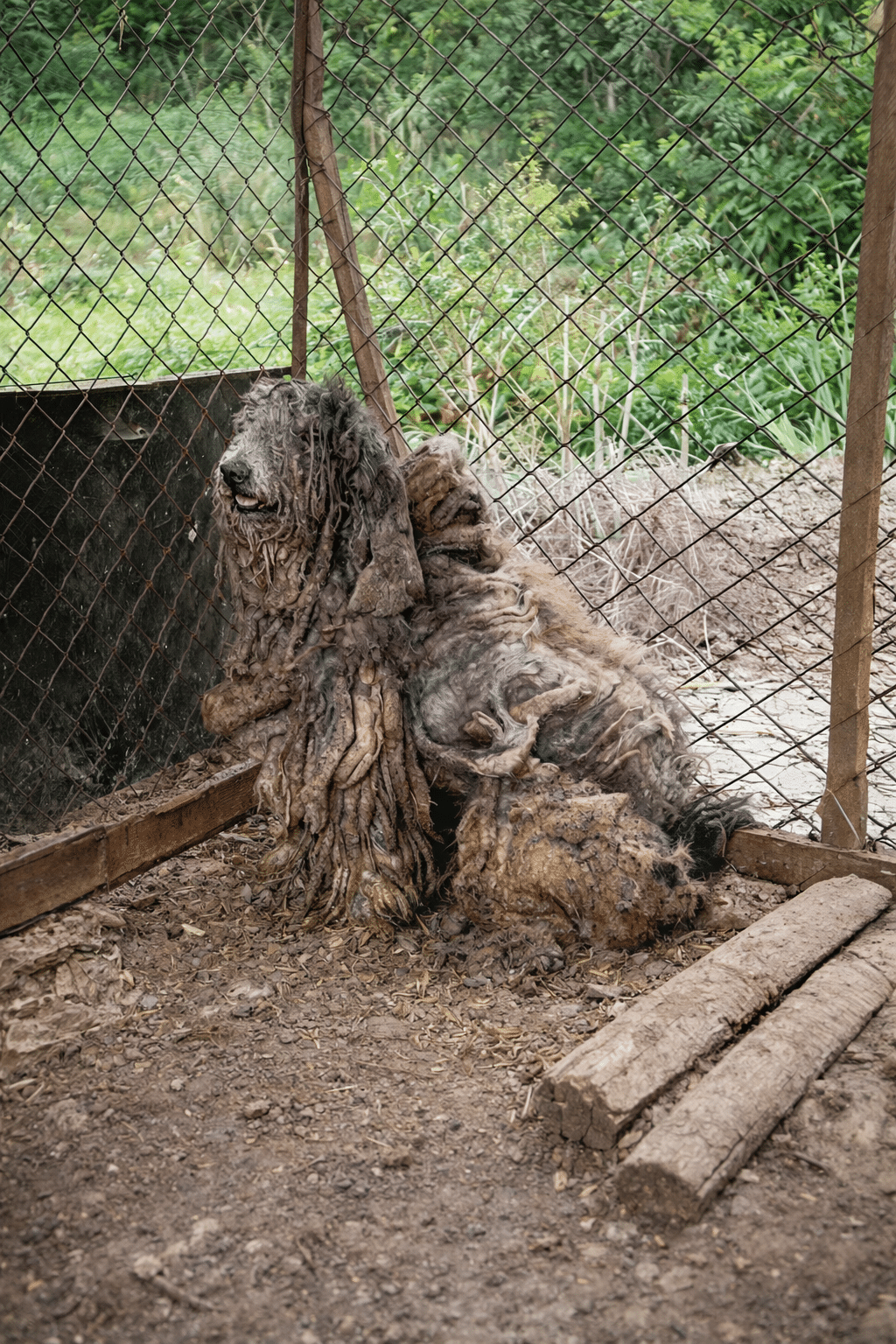
The cage door was finally open, but the large dog inside did not move toward freedom.
For four years, metal bars had defined the boundaries of his world. Now, with a rescuer waiting patiently outside, the Giant Poodle seemed unable to understand that he was allowed to leave.
He did not bark or struggle.
He simply hesitated.
It was a quiet moment that revealed something deeply troubling. Although the physical barrier had been removed, the effects of years of neglect would not disappear nearly as quickly.
And beneath the enormous weight of tangled fur, his body was in far worse condition than anyone could see.
Four Years Behind Bars, Almost Forgotten
Behind a small house stood a narrow metal cage that had become the Giant Poodle's entire living space.
According to the rescue account, the dog's elderly owner struggled with alcohol and had gradually stopped providing the consistent attention and care the animal needed.
Meals arrived unpredictably. Fresh drinking water was not always available. The cage became increasingly unsanitary.
At first, neighbors were aware of the situation.
Over time, however, the dog's circumstances became something people seemed to overlook.
The neglect continued.
Four years is an extraordinarily long period for a dog to spend confined to such a restricted space. For an intelligent, active breed like the Giant Poodle, the absence of normal movement, companionship, and regular grooming can have serious consequences.
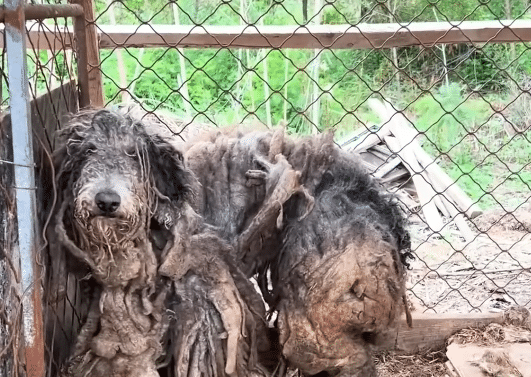
By the time help arrived, the dog's appearance had changed almost beyond recognition.
His coat had grown into dense, hardened tangles. Long sections of matted hair hung heavily around his body, concealing his face and making it difficult to see his true physical condition.
The rescuers could barely make out his eyes.
There was no energetic greeting.
No excited movement toward the people who had come to help.
Instead, they encountered a silent, withdrawn animal whose appearance spoke of prolonged neglect.
Even identifying the dog beneath all that fur was difficult.
But someone had finally come close enough to see that he needed help.
And this time, the cage would not remain closed.
The Door Opened, but Freedom Was Unfamiliar
The rescuer understood that opening the cage was only the first step.
A dog who had lived in confinement for years could not be expected to respond confidently to unfamiliar people or sudden changes.
Rather than pulling him out, the rescuer lowered himself near the entrance.
He spoke gently.
He waited.
Then he slowly extended a reassuring hand toward the frightened Poodle.
The dog had little reason to associate human contact with comfort. His stillness suggested uncertainty, and his hesitation made the need for patience unmistakable.
Nothing was forced.
The rescuer allowed the dog to experience a different kind of interaction, one that did not demand an immediate response.
Eventually, the Poodle was carefully guided out.
The moment marked the end of his confinement, but it also exposed how much work remained.
His matted coat was so extensive that removing it took more than an hour.
The grooming process required care because the dense fur had concealed serious skin problems.
As the heavy layers came away, the consequences of prolonged neglect became clearer.
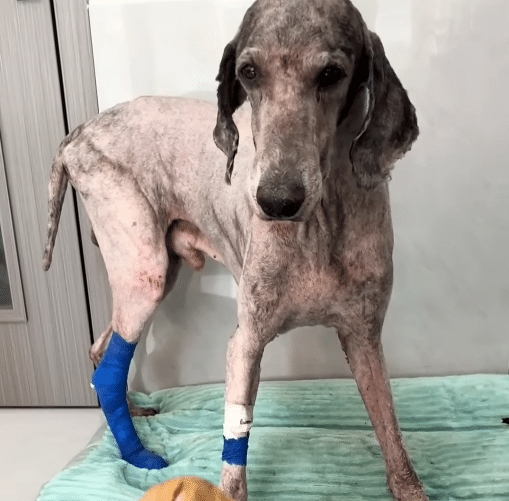
His skin showed widespread irritation, infection, and damage. Parasites were also present, adding to the discomfort he had endured.
The condition of his body was concerning.
Beneath the oversized coat was a severely weakened, underweight dog who needed immediate medical attention.
With the tangled fur removed, the rescuers could finally see the animal they were trying to save.
He was a Giant Poodle, a breed generally recognized for its intelligence, athletic build, and distinctive coat.
But his condition was far removed from the healthy appearance normally associated with the breed.
He had lost much of his strength.
His skin needed careful treatment.
And his body had been struggling for a long time.
The rescue was no longer simply about getting him out of a cage.
It was about giving a fragile animal the medical support and consistent care he had been missing for years.
VIDEO: Four Years Trapped Behind Metal Bars — Watch This Giant Poodle's Journey From Neglect to Freedom
A Fragile Body Facing Serious Health Problems
At the veterinary clinic, the examination revealed that the Poodle's difficulties extended well beyond his damaged coat.
He was severely underweight, and his body was dealing with a systemic infection.
He also had a high fever.
Further medical findings included signs of pneumonia, liver inflammation, and intestinal bleeding.
Together, these problems made his condition extremely serious.
What had initially appeared to be a grooming emergency was, in fact, a much broader medical crisis.
He needed careful treatment, close attention, and time.
His damaged skin required cleaning and appropriate antiseptic care. Each affected area had to be handled gently, with his weakened physical condition taken into account.
There was another difficulty.
Once the thick, matted coat was removed, the Poodle struggled to stay warm.
His body trembled frequently.
A small sweater was placed on him to help provide warmth while he recovered.
It was a simple act of care, but an important one.
For an animal who had spent years without reliable comfort, even basic necessities had become essential parts of his recovery.
Warmth.
Regular food.
Medical treatment.
A clean environment.
These were ordinary things that every dog should be able to depend on.
For this Poodle, they represented the beginning of an entirely different life.
Yet physical treatment alone would not solve everything.
Although his body was finally receiving attention, his behavior suggested that years of isolation had also affected his ability to feel secure around people.
The rescuers would have to help him recover in more ways than one.
The Smallest Tail Wag Became a Turning Point
During the early stages of his recovery, the Giant Poodle remained emotionally withdrawn.
When people approached, he often became motionless.
He did not immediately seek affection or respond with the familiar excitement many dogs show when they recognize a caring person.
His tail stayed still.
He appeared unsure how to respond to gentle attention.
For his caregivers, this meant moving slowly and allowing him to adjust at his own pace.
Food began arriving regularly.
Medication helped address his medical problems.
Human hands approached carefully, offering assistance without pressure.
These repeated experiences gradually created a sense of predictability.
The importance of that consistency was easy to underestimate.
A dog recovering from long-term neglect needs more than occasional kindness. He needs repeated opportunities to experience safety without fear.
For this Poodle, trust did not return through a single dramatic moment.
It developed through ordinary daily care.
The same gentle approach.
The same dependable meals.
The same patience, even when he showed little response.
Then, one day, something changed.
His tail moved.
It was not an enthusiastic greeting or a burst of excitement.
Just a small, hesitant wag.
The movement ended almost as quickly as it began.
But it was the first clear sign that his response to human attention might be changing.
After years of confinement and the early days of withdrawal, that brief movement carried considerable meaning.
He was beginning to respond.
He was beginning to engage with the people caring for him.
And, little by little, the fear that had shaped so much of his behavior appeared to be easing.
Healing Through the Ordinary Things He Had Been Missing
Recovery continued gradually.
The infected areas of his skin began to improve, and his injuries started healing.
His appetite returned.
At first, his condition had made even basic daily care a challenge. As his health improved, he began finishing his meals with growing enthusiasm.
That change mattered.
Regular nutrition was helping his weakened body rebuild.
The sharp outline of his ribs became less noticeable as he regained weight.
His legs grew stronger.
His eyes appeared clearer and more alert.
The physical transformation was encouraging, particularly considering how serious his medical problems had been when he first arrived at the clinic.
But the changes in his behavior were just as meaningful.
The Poodle began following his rescuer from one room to another.
Where he had once remained distant and unresponsive, he now showed an increasing desire to stay near the person who had helped him.
It was a significant shift.
Human presence was no longer something he only endured.
It was becoming something he actively sought.
Over time, he also became more comfortable with affection.
He started leaning into gentle touches rather than remaining rigid.
At times, he rested his head on someone's lap.
These quiet gestures were different from his earliest reactions.
They suggested that his experiences with consistent, compassionate care were helping him develop a new relationship with people.
There was no single moment that completed his emotional recovery.
Instead, progress appeared in small, observable changes.
The willingness to approach.
The ability to relax during contact.
The desire to remain close.
Each was a reminder that rebuilding confidence after prolonged neglect takes time.
The Poodle's medical crisis had demanded urgent intervention. His emotional recovery required something less dramatic but equally valuable.
Patience that continued long after the rescue itself.
Six Months Later, the Difference Was Remarkable
Six months after the cage door opened, the Giant Poodle looked and behaved like a very different dog.
His fur had grown back.
Instead of the dense, hardened mats that once concealed his body, he now had a clean, soft coat that received regular care.
His posture had improved.
The weakness that had been so evident during his rescue had given way to greater physical strength.
His eyes were brighter and more attentive.
Most importantly, his behavior reflected a growing sense of comfort in his surroundings.
The dog who had once hesitated at an open cage door now greeted the day with energy.
He played.
He explored.
He interacted with people.
These were activities that had been largely absent from his life during the years he spent confined.
The transformation was not merely cosmetic.
Removing his matted fur had revealed the extent of his suffering, but restoring his health involved much more than improving his appearance.
He needed treatment for serious medical conditions.
He needed sufficient food and warmth.
He needed a safe environment where daily routines could become dependable.
And he needed people willing to give him time.
Six months of care had helped him regain both physical strength and the confidence to engage with the world around him.
The contrast with his earlier life was striking.
Once, his movement had been restricted by metal bars.
Now, he could explore freely.
Once, he had withdrawn from human contact.
Now, he sought companionship.
Once, his body was hidden beneath a heavy, neglected coat.
Now, his healthy appearance reflected the attention he was finally receiving.
The dog had not simply survived his ordeal.
He had been given the opportunity to experience the ordinary joys of life that confinement had denied him.
The Life That Was Waiting Beyond the Cage
The most memorable part of this Giant Poodle's journey may not be the condition in which he was found.
Nor is it only the extraordinary difference in his appearance six months later.
It is the slow change in the way he responded to people.
When the cage first opened, he remained hesitant.
He could not immediately respond to freedom with excitement because everything beyond those metal bars was unfamiliar.
The rescuer did not demand confidence from him.
Instead, he offered gentle contact and allowed the dog to move forward gradually.
That same approach continued throughout the recovery process.
Care was provided consistently, whether the Poodle responded with affection or remained withdrawn.
His caregivers attended to his physical needs while giving him room to become comfortable.
And eventually, the small signs began adding up.
A moving tail.
A stronger appetite.
A willingness to follow someone.
A head resting peacefully on a person's lap.
These were not spectacular gestures.
They were signs of an animal slowly rediscovering comfort, curiosity, and companionship.
The story also illustrates why rescue cannot be measured only by the moment an animal leaves a dangerous environment.
Removing a dog from neglect is essential.
But what follows is equally important.
Veterinary attention, reliable nutrition, suitable grooming, safe surroundings, and gentle daily interaction all contributed to this Poodle's progress.
His journey was not instant.
It took months.
Even after his immediate medical crisis had passed, trust continued to develop through repeated experiences of safety.
The outcome described six months after his rescue offers a hopeful contrast to the image of the dog who once sat silently behind rusted metal.
He was stronger.
He was healthier.
He was playful and affectionate.
The cage that had confined him for four years was no longer part of his daily existence.
And the life beyond it had finally become something he could enjoy.
For this Giant Poodle, being rescued was the first step.
Learning that kindness could be dependable was the transformation that followed.
His recovery stands as a reminder that animals who have endured prolonged neglect may need considerable time to feel safe again.
But with appropriate treatment, patient care, and consistent compassion, meaningful change is possible.
Sometimes the most powerful evidence of a second chance is not a dramatic rescue scene.
It is a once-frightened dog, six months later, greeting another ordinary morning with a wagging tail.


