
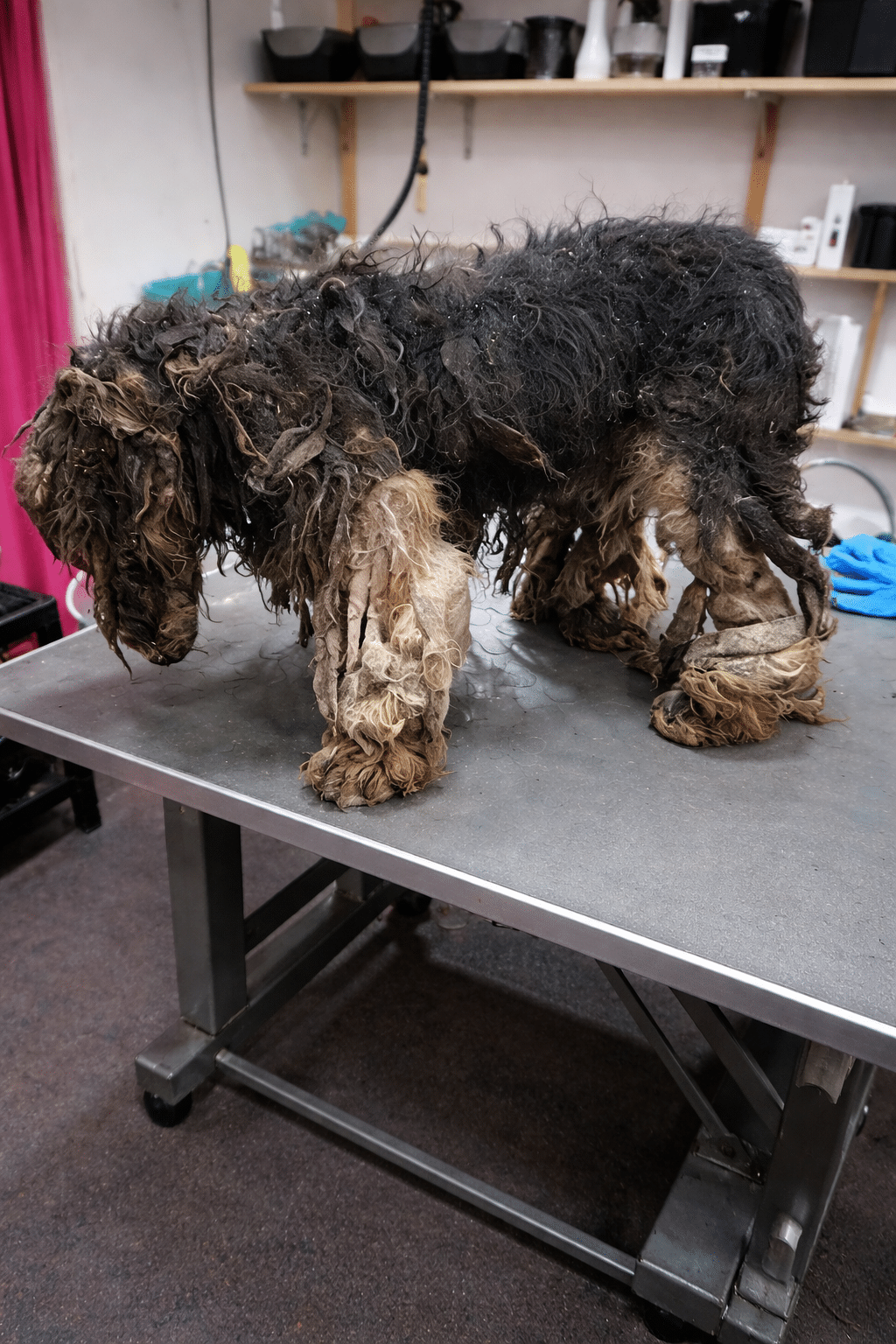
The little dog lay quietly on the grooming table, almost completely hidden beneath a thick, tangled mass of fur.
There was no barking.
No desperate attempt to escape.
Only a small, exhausted animal whose body had become nearly impossible to recognize.
For the rescuers standing beside him, the first challenge was simply understanding how much of the enormous, hardened coat could be safely removed.
What should have been soft fur had become a heavy covering of compacted knots, dirt, and debris.
Somewhere underneath it was a fragile little dog.
And as the team would soon discover, freeing him from that burden was only the beginning of a much more serious struggle.
The Little Dog Almost No One Could Recognize
When the small dog arrived in the rescuers' care, his appearance made the extent of his condition immediately clear.
His coat was no longer simply overgrown.
It had become a dense collection of hardened mats, with layers of tangled hair pressed tightly together.
Dirt and debris had gathered throughout the fur, creating thick, uneven sections that hung heavily from his small frame.
The shape of his body was difficult to distinguish.
His legs were partly obscured.
Even ordinary movement appeared to require considerable effort.
It was as though the coat that should have protected him had gradually become something he could barely carry.
The rescuers could not know every detail of his past from his appearance alone.
They did not know exactly how long he had been living this way or what circumstances had allowed his condition to become so severe.
But one thing was evident.
This had not happened overnight.
Such extensive matting suggested that his coat had gone without the attention it needed for a considerable period.
And for an animal with such a small body, that burden was especially concerning.
Yet his behavior was strikingly quiet.
He did not struggle against the people helping him.
He did not bark or attempt to pull away.
Instead, he remained still, watching with an exhausted expression as the rescuers prepared to begin.
His silence did not mean that everything was fine.
If anything, it made the team more aware of how carefully they needed to proceed.
They were looking at a dog who appeared to have very little strength left to spare.
Every Layer of Fur Required Another Careful Decision
The rescuers understood that removing the coat would involve much more than an ordinary grooming session.
The thickest mats were packed close to the skin.
Pulling at them could cause discomfort or injury, while rushing through the process with cutting tools could be dangerous.
There was no safe reason to hurry.
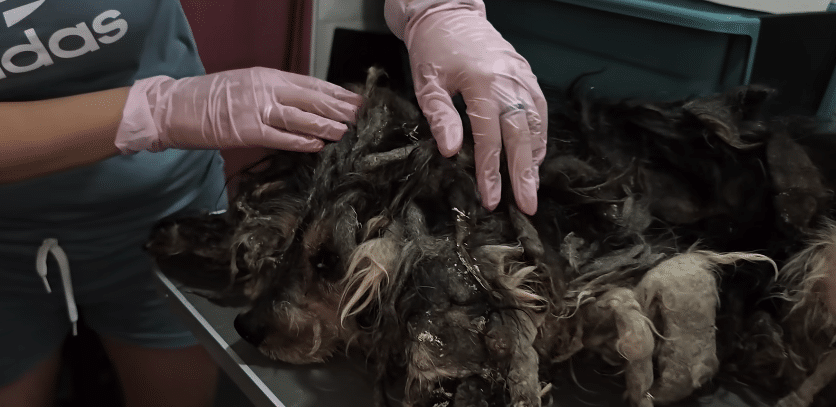
The team began with scissors, carefully separating the outer layers of hardened fur.
The task required patience.
Each section had to be approached individually, with attention to what might be hidden beneath it.
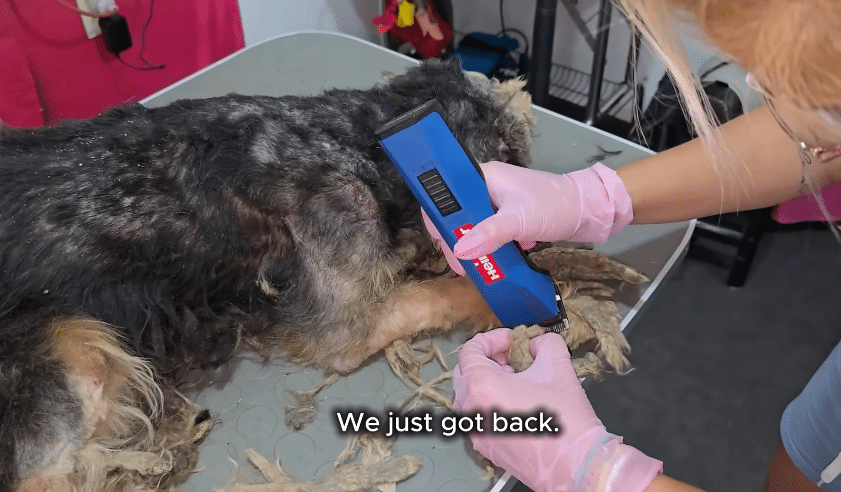
Once enough of the thick covering had been loosened, clippers could be used to continue the process.
Piece by piece, the tangled coat began to come away.
For the first time, parts of the dog's actual body became visible.
The difference was remarkable.
Underneath the enormous mass of hair was a much smaller animal than his original appearance suggested.
His compact frame had been hidden beneath layers of material that served no useful purpose and appeared to make movement unnecessarily difficult.
But the newly exposed skin brought another concern.
It showed redness and irritation in areas that had remained covered by the dense mats.
The team could see that this was not merely a cosmetic problem.
His coat had been affecting his physical comfort.
And beneath all that fur was an animal whose overall condition was already fragile.
Still, the dog remained remarkably passive throughout the careful work.
He appeared too exhausted to offer much response.
For the rescuers, his quietness was another reason to keep their movements measured and gentle.
The goal was not simply to reveal the dog underneath.
It was to help him without adding to the difficulties his body was already facing.
A Difficult Rescue Began to Reveal a Different Dog
As more of the tangled coat was removed, the transformation became increasingly visible.
The hardened layers that had concealed his body were gradually being separated and lifted away.
The small dog underneath had a naturally curly coat, but it had been buried beneath severe matting.
What the rescuers were uncovering was not a dramatic change in the animal himself.
It was the removal of something that had prevented anyone from seeing him clearly.
There was something deeply moving about that distinction.
The dog had been there all along.
His small frame, his delicate features, and his exhausted gaze had simply been hidden beneath the accumulated weight.
Now, slowly, the team was giving him a chance to be seen again.
But while the outward transformation was progressing, a much more important question remained unanswered.
How well could his weakened body tolerate the process?
VIDEO: A Tiny Dog Was Being Freed From Years of Tangled Fur — Then His Breathing Changed
The rescue footage captures the careful effort involved in removing the dog's heavy, matted coat.
It also reflects why such a rescue could never be treated as ordinary grooming.
Every section removed brought the team closer to freeing him.
Yet each moment also demanded attention to his physical condition.
The rescuers continued carefully, unaware that the greatest concern was about to shift from his fur to his survival.
The Moment His Breathing Changed Everything
During the removal of one particularly dense section of matting, a rescuer noticed a change.
The dog's breathing was no longer following the same pattern.
At first, the difference was subtle.
Then his breaths became shallower.
Soon, he was no longer responding as he had earlier.
The work stopped.
Immediately.
Until that moment, the rescuers had been concentrating on the difficult task of separating the hardened fur from his body.
Now their attention turned entirely to his health.
Whatever progress had been made on his coat no longer mattered.
The small dog needed urgent medical attention.
The team checked his condition and moved quickly to get him to a veterinary clinic.
It was a frightening change in an already delicate rescue.
The dog had arrived carrying an enormous physical burden.
Now there were signs that something much more serious might be happening inside his body.
The remaining mats could wait.
His health could not.
The Medical Emergency Hidden Beneath the Fur
At the veterinary clinic, the dog underwent emergency examinations.
The medical findings revealed that his difficulties extended far beyond the condition of his coat.
He was suffering from a significant heart condition.
He was also weakened by malnutrition and prolonged stress.
The physical burden of the severely tangled fur had added to an already vulnerable situation.
According to the account of his rescue, even the strain associated with the grooming process had been enough to overwhelm his fragile system.
It was a sobering discovery.
The rescuers had recognized that he was weak.
They had seen the redness and irritation beneath his coat.
They had understood that removing the mats required exceptional care.
But his medical condition showed just how little his body could safely endure.
For a dog in this state, completing a grooming session was no longer the immediate goal.
Stabilizing his health came first.
While veterinary professionals attended to him, the rescuers waited outside the treatment room.
They had already invested so much care in helping this small animal.
They had begun to uncover the dog who had been almost invisible beneath the hardened fur.
Now the uncertainty was no longer about whether his coat could be removed.
It was about whether he could recover from the sudden medical crisis.
Eventually, there was encouraging news.
Emergency care had helped stabilize his condition.
He had survived the critical episode.
But the danger of assuming that everything was now resolved remained.
His body was still extremely weak.
His heart condition required medical attention, and there was no reason to expose him to unnecessary strain simply to finish removing the remaining fur.
The rescuers had to change their priorities.
And that meant allowing him time.
The First Quiet Rest After a Difficult Rescue
Back at the rescue center, the small dog was finally able to rest.
A considerable portion of the thick, heavy coat had already been removed.
His real body shape was visible in a way it had not been when he first arrived.
The difference between his earlier appearance and his condition after grooming was significant.
He was still fragile.
He still needed care.
And the remaining work on his coat would have to wait until his health improved.
But at least one part of the burden had already been lifted.
The layers of hardened fur that had covered so much of his body were no longer entirely surrounding him.
The rescuers could now see the small dog beneath the mass of tangles.
It was progress, even if it was not yet a complete recovery.
There would be no benefit in forcing the next stage before his body was ready.
For now, rest and medical support mattered more than appearances.
That decision reflected something important about the rescue.
Helping an animal does not always mean completing every task as quickly as possible.
Sometimes it means recognizing when to stop.
Sometimes it means setting aside the original plan because the animal's needs have changed.
For this little dog, the emergency had made that lesson unmistakable.
He had already endured a great deal.
What he needed now was patient, attentive care.
A Transformation That Was About More Than Appearance
Looking at the dog after the partial grooming, it would have been easy to focus only on how different he appeared.
The enormous mats had concealed much of his body.
Removing them revealed a small, curly-coated dog who had been hidden beneath the weight.
But his rescue was never simply about creating a dramatic before-and-after image.
The condition of his coat was one visible part of a larger health concern.
The irritated skin, his weakened physical state, and the unexpected breathing emergency all showed why the team's cautious approach mattered.
The discovery of a significant heart condition also changed what his recovery would require.
There was no confirmed complete recovery at this stage.
No guarantee that every remaining mat could soon be removed.
And no established outcome beyond the medical stabilization and care described in his story.
Those uncertainties deserve to be acknowledged.
His improvement after emergency treatment was meaningful, but it did not erase the seriousness of his condition.
He would still need time.
He would still need medical support.
And the people caring for him would have to continue making decisions based on what his body could tolerate.
There is a quiet kind of compassion in that approach.
It asks people to look beyond what makes a rescue visually dramatic and concentrate on what actually helps the animal.
In this case, a complete haircut could wait.
His wellbeing could not.
The Second Chance That Began With Someone Refusing to Stop Caring
The small dog's story does not end with a fully restored coat or a confirmed return to perfect health.
It ends, for now, with something more modest and more meaningful.
He survived an unexpected emergency.
He received veterinary attention when his breathing became concerning.
He returned to the rescue center with much of the heavy matting removed.
And he was given the opportunity to rest while his caregivers considered the next steps.
It was not a finished transformation.
It was the beginning of a different kind of life.
Before the rescue, the weight of his tangled fur had made even ordinary movement appear difficult.
His small body had been obscured beneath hardened layers that had accumulated over a long period.
Once he entered the team's care, his needs were finally receiving attention.
Not just his coat.
Not just his appearance.
But the fragile life beneath it all.
His experience is a reminder that severe matting can be far more than an unpleasant grooming problem. It can conceal discomfort and make caring for an already vulnerable animal more complicated.
It also shows why a rescue cannot be measured by how quickly an animal's appearance changes.
Sometimes the most important moment comes when the scissors and clippers are put down.
When someone notices a subtle change.
When the decision to seek medical help becomes more important than finishing the work.
For this little dog, that decision helped give him a chance to continue receiving care.
His future was still uncertain, but he was no longer facing the same struggle without assistance.
The rescuers had discovered a small life beneath an extraordinary burden.
And even after the medical emergency interrupted their work, they had not abandoned him.
There was still healing ahead.
There was still more care to provide.
But for the first time in this difficult chapter of his life, the little dog had people willing to help him move forward at the pace his body needed.
That is where his second chance truly began.


