
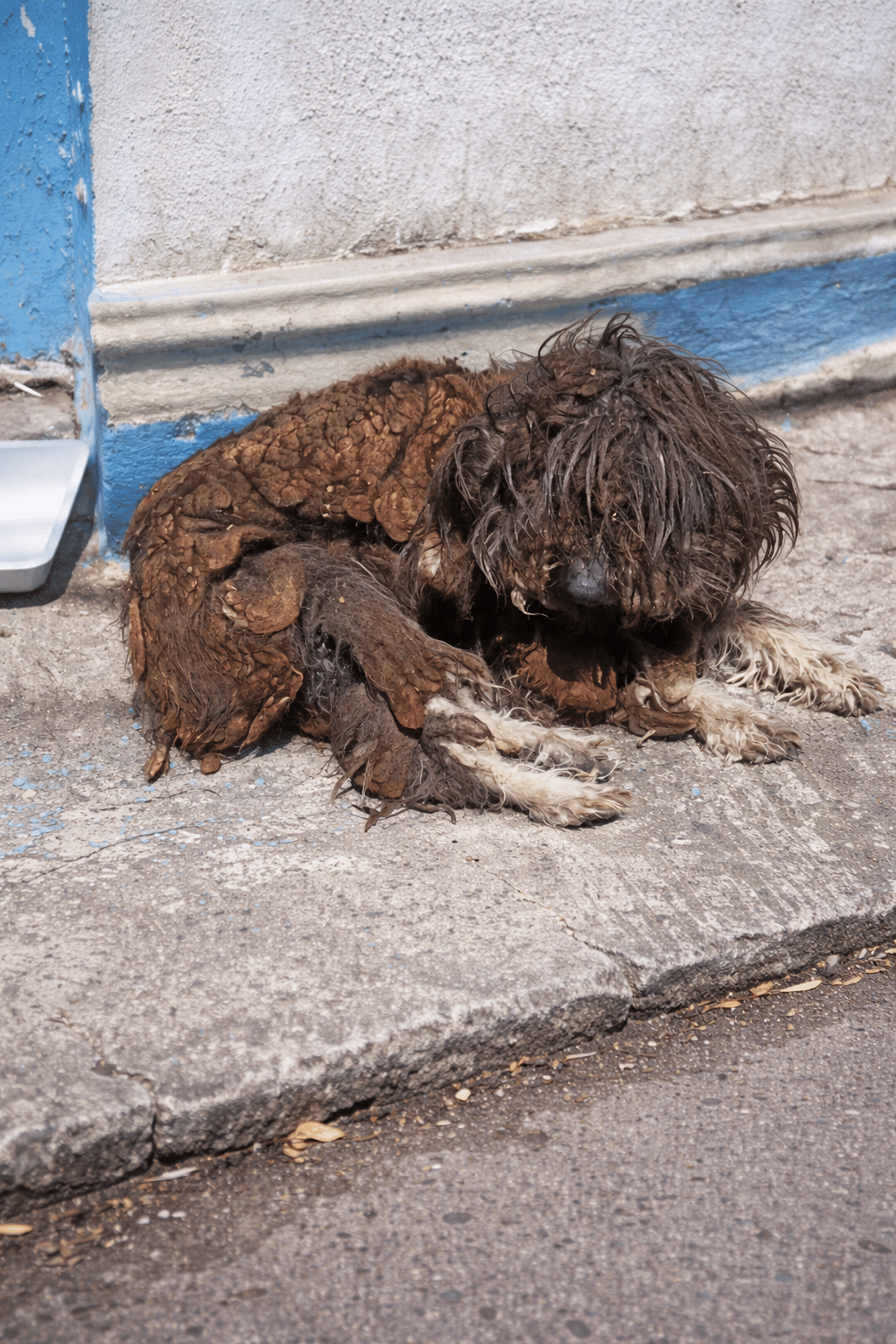
At first, there was almost no way to recognize the frightened animal beneath the thick, tangled fur.
What appeared to be a shapeless bundle on the southern outskirts of Quito was actually a young dog who had been living with severe neglect.
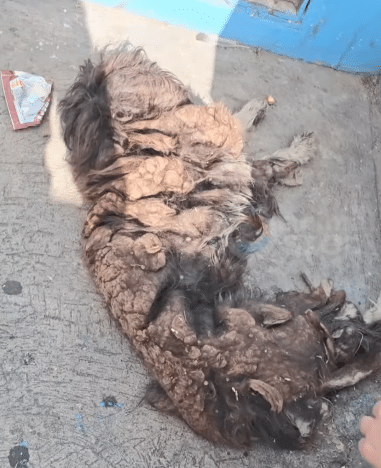
His coat had become so tightly matted that it concealed much of his body. His movements were restricted, and his natural appearance was almost impossible to make out.
Yet beneath those heavy layers, there was still a living, breathing animal.
One who was afraid of being approached.
One who had grown accustomed to keeping his distance from people.
And one whose life was about to change because someone finally looked closely enough to recognize that he needed help.
The Dog Almost Nobody Could Recognize
The condition of the dog was difficult to overlook once someone truly stopped to examine him.
His fur had accumulated into thick, compacted masses, losing the softness and shape of a normal coat.
Instead of following the outline of his body, the tangled hair seemed to surround him like a heavy covering.
It obscured his features and made even ordinary movement appear uncomfortable.
From a distance, a passerby might not have realized there was a dog beneath it all.
But his appearance was only part of the problem.
Whenever someone approached, he instinctively moved away.
He did not seem curious about the attention.
He did not approach in search of affection.
He retreated.
That reaction suggested that human contact had become something he associated with uncertainty rather than comfort.
There was no clear account of how long he had been living in this condition or what experiences had shaped his fear.
What was visible, however, was enough to show that he had been struggling for some time.
His fur was severely neglected.
His body was weak.
And his reluctance to interact with people made an already difficult situation more complicated.
For a dog in such a vulnerable condition, even accepting help could become a challenge.
The people trying to reach him needed to do more than provide physical care.
They first had to help him feel safe enough to receive it.
Only Three Years Old, Yet Already So Exhausted
When rescuers finally brought the dog into their care, they discovered something especially troubling.
He was only about three years old.
For such a young animal, his physical condition was remarkably poor.
He was underweight and visibly exhausted. The heavy fur covering his body had made normal movement difficult, and he appeared fragile.
The contrast between his age and his condition was striking.
A dog of three should still have many active years ahead.
Yet this young animal seemed burdened by circumstances that had worn him down far too early.
The rescue team also noticed how little he responded to what was happening around him.
He was unusually withdrawn.
He offered little engagement, and his behavior remained guarded even after he had been brought into a safer environment.
For an animal accustomed to avoiding people, the sudden presence of caregivers could not automatically erase that fear.
Rescue had changed his surroundings.
It had not yet changed how he reacted to human closeness.
That distinction mattered.
Removing him from his previous situation was an essential first step, but rebuilding his sense of security would require time.
The team needed to address the obvious physical problems while respecting the emotional distance he continued to maintain.
There would be no immediate transformation.
No expectation that he would become affectionate simply because someone had offered him help.
His recovery had to begin with the condition he was actually in.
And that meant moving slowly.
The First Steps Toward a Different Life
The rescuers began addressing the layers of fur that had concealed and restricted his body.
This was not simply a matter of improving his appearance.
Severely matted fur can interfere with an animal's comfort and movement. In his case, the accumulated coat had become an obvious burden.
Removing it was an important part of helping him regain physical ease.
But the process called for care.
The dog was already frightened and exhausted, and the people helping him understood that unfamiliar handling could add to his distress.
Instead of forcing quick progress, they approached the work patiently.
They carefully cut away the dense, tangled sections of fur.
They cleaned him and provided treatment for the problems that could be addressed.
Throughout the process, they avoided unnecessary noise and sudden movements.
Their goal was not only to remove the physical weight he had been carrying.
It was also to make the experience of being near people less frightening.
For an animal who repeatedly withdrew from approaching hands, even necessary grooming could be difficult to accept.
The rescuers therefore allowed the process to unfold gradually.
Each gentle interaction provided another opportunity for him to experience contact without panic.
Each calm moment offered a contrast to the fear that had previously guided his behavior.
Nothing about this required dramatic gestures.
The important work was quiet.
It involved consistency, gentleness, and allowing the dog to adjust at his own pace.
VIDEO: Hidden Beneath Severely Matted Fur, a Frightened Dog Begins His Journey Toward Trust
Removing the Fur Was Only Part of the Healing
As the rescuers continued caring for him, the physical changes gradually became visible.
The dense masses of hair that had hidden his body were removed, revealing the dog underneath.
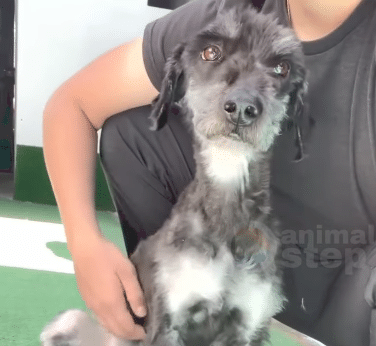
His natural coat was gray-black.
What had once looked like an indistinct bundle of tangled fur was beginning to look like the young animal he had always been.
For the first time in this part of his story, his body was no longer concealed beneath the same heavy covering.
The change was significant.
But it did not mean that all the effects of his previous condition had disappeared.
His body still needed to regain strength.
And his behavior continued to reflect the caution he had developed around people.
Physical recovery and emotional adjustment do not always happen at the same pace.
A dog can become cleaner and more comfortable while remaining uncertain about the people caring for him.
That was why the team's calm approach remained so important.
They continued providing gentle care without demanding an immediate response.
They did not treat his silence as unwillingness to improve.
They gave him room to become familiar with a setting where people were present without being threatening.
The difference between a frightening experience and a reassuring one can sometimes be found in the smallest details.
A movement made slowly instead of suddenly.
A hand offered without pressure.
A person remaining calm when the animal hesitates.
These ordinary acts can become meaningful when an animal has learned to avoid contact.
For this dog, the process of feeling safe was not separate from his recovery.
It was part of it.
The First Time He Did Not Pull Away
One of the most meaningful changes came during a remarkably simple interaction.
Someone reached toward him.
Previously, that movement would have been enough to make him withdraw.
He had repeatedly responded to approaching people by backing away, keeping as much distance as possible.
But this time, something was different.
He stayed where he was.
He did not immediately retreat.
He allowed the moment to pass without the same frightened reaction that had once seemed automatic.
It was a small change.
There was no dramatic display of affection, no sudden transformation into a completely confident dog.
Just the absence of the fear-driven movement that had defined so many of his earlier encounters.
Yet that difference mattered.
For a dog who had been reluctant to engage with anyone, remaining still while a person approached suggested that he was beginning to tolerate closeness.
He was discovering, through repeated experiences, that human contact did not always have to be something he escaped.
Trust often develops in ways that are easy to miss.
It may begin when an animal no longer moves away.
When a cautious glance becomes a longer look.
When the distance between a person and a frightened dog grows a little smaller.
These moments may appear ordinary to someone watching from the outside.
For an animal recovering from prolonged fear, they can represent meaningful progress.
The rescuers had helped remove the weight from his body.
Now, little by little, he was beginning to behave as though the people around him might be safe.
A Different Dog Began to Emerge
The changes continued as his care progressed.
His movements became steadier.
His posture improved.
The exhaustion that had been so noticeable when he first arrived was no longer the only thing people could see.
He appeared more alert and engaged with his surroundings.
And perhaps most importantly, he began to approach people rather than automatically moving away from them.
This was a major shift from the dog who had once tried to avoid every nearby human.
He was no longer simply tolerating the presence of his caregivers.
He was beginning to seek closeness.
Those interactions showed how much his behavior had changed.
Instead of immediately retreating from gentle contact, he sometimes leaned toward it.
Instead of keeping his distance, he remained near people for longer periods.
The progress was gradual, but it was increasingly visible.
The same animal who had once seemed almost unreachable was showing signs of comfort.
His improved appearance made the transformation easy to recognize.
But the changes in his behavior gave the story its deeper meaning.
A cleaner coat could reveal what he looked like.
A stronger body could help him move more comfortably.
Neither alone could explain the growing willingness to be close to people.
That change had developed through repeated experiences of gentle handling and consistent care.
The rescuers had not needed to force affection.
They had allowed him to discover that being near someone could be a positive experience.
And he was beginning to respond.
Learning That Gentle Hands Could Be Safe
There is a difference between a dog who accepts being touched and one who willingly moves closer.
For this young dog, that difference became an important part of his progress.
In the beginning, human approach had triggered retreat.
Later, he began staying near the people caring for him.
As his confidence grew, he showed more willingness to make contact.
He leaned toward gentle attention instead of pulling away.
He remained close a little longer.
His behavior suggested that the guarded distance he had maintained was gradually softening.
The change did not erase the difficulties he had experienced.
Nor did it reveal everything about his past.
The source of his fear and the full circumstances of his earlier life remained unknown.
What mattered was what could now be observed.
He was no longer behaving like a dog whose only response to people was avoidance.
He was becoming more comfortable in their presence.
That kind of progress is especially meaningful because it cannot be achieved through grooming alone.
A frightening experience with people cannot simply be brushed away with a damaged coat.
Confidence develops through what happens afterward.
Through contact that remains gentle.
Through an environment that does not repeatedly overwhelm the animal.
Through people who understand that trust cannot be demanded.
For this dog, those small, repeated experiences helped create a new pattern.
He could approach.
He could remain nearby.
He could receive attention without immediately trying to escape.
The change was not loud or dramatic.
It was visible in the way he carried himself and responded to the people around him.
And it revealed something that had been difficult to imagine when he was first found beneath that mass of neglected fur.
He was beginning to enjoy companionship.
The Future He Is Finally Ready to Discover
Today, the dog described in the rescue account is very different from the frightened animal first encountered on the outskirts of Quito.
His severely tangled coat has been removed.
His body has regained strength.
He is more alert, responsive, and willing to engage with people.
The transformation reaches beyond his appearance.
His growing comfort around human contact suggests that the patient work of the rescue team helped him recover something essential to his well-being.
A sense of safety.
The ability to relax near someone.
The freedom to approach rather than retreat.
There are still parts of his story that remain unfinished.
The account does not confirm that he has already been adopted into a permanent home.
Instead, it describes a dog who has reached a point where he is ready for that next chapter.
A home where he can continue receiving the patience and affection that helped him make progress.
A place where he can maintain the confidence he has begun to develop.
And a future in which his days are no longer defined by severe neglect and constant caution.
His experience offers a reminder of something easily overlooked in animal rescue.
Saving an animal is not always one single act.
Sometimes, the rescue begins when someone recognizes a life that others have failed to notice.
It continues through the careful removal of a physical burden.
Through providing comfort to a body that has become weak.
And through the quiet, repeated kindness that allows a frightened animal to become comfortable around people again.
The dog found in Quito did not change overnight.
His recovery involved many small steps, each contributing to a larger transformation.
What began with a frightened, exhausted animal hidden beneath layers of matted fur became the story of a young dog rediscovering comfort and companionship.
He is not yet confirmed to have found his permanent family.
But he has already been given something important.
The opportunity to move forward.
And perhaps that is the most meaningful part of his journey.
Beneath the neglected fur was never an animal without hope.
There was a young dog who needed someone to recognize his condition, offer patient care, and give him the time to feel safe.
Someone finally did.
And because of that, his future now holds possibilities that once seemed far beyond his reach.


