
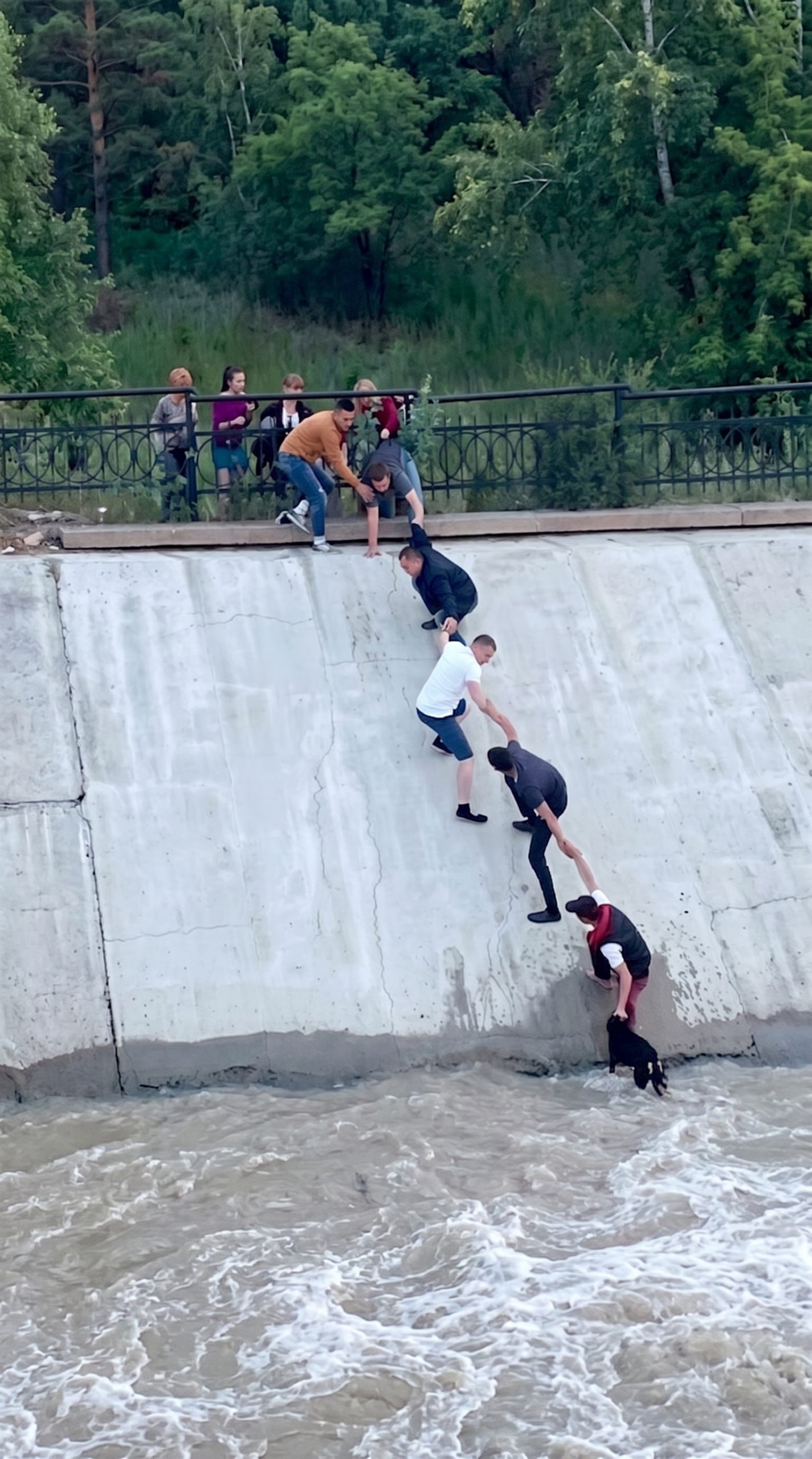
The frightened dog was fighting to keep his head above the water.
His paws pressed desperately against a towering concrete wall, searching for something to hold onto. But the surface offered no grip, and the restless current kept pulling him away.
Above him, people could see what was happening.
Below them, the dog was running out of strength.
At the Sayran reservoir in Almaty, Kazakhstan, an ordinary moment had become a dangerous struggle for survival.
One man decided he could not simply watch.
He climbed down toward the water, determined to reach the trapped animal. But what began as one person's act of compassion would soon become something far greater.
It would take a group of strangers, linked together by their hands and their willingness to help, to bring the dog back to safety.
Years later, their courage would be remembered in bronze.
A Frightened Dog With Nowhere to Escape
The Sayran reservoir is surrounded by steep concrete embankments that create a serious obstacle for anything trapped below.
The walls rise sharply above the water, leaving few places to stand and almost nothing to grasp.
For a dog struggling in the reservoir, escaping without assistance was extraordinarily difficult.
The animal had already become exhausted.
Each attempt to find a foothold against the smooth concrete ended without success. Its paws scraped against the surface while the moving water threatened to carry it farther from safety.
The dog could not simply climb out.
And the longer it remained in the water, the more desperate its situation became.
It was a distressing sight for anyone watching from above.
A vulnerable animal was struggling just beneath the edge of safety, close enough to be seen but separated from solid ground by a nearly vertical wall.
The difference between danger and rescue was only a short distance.
Yet that distance seemed almost impossible to cross.
Then a passerby made a decision.
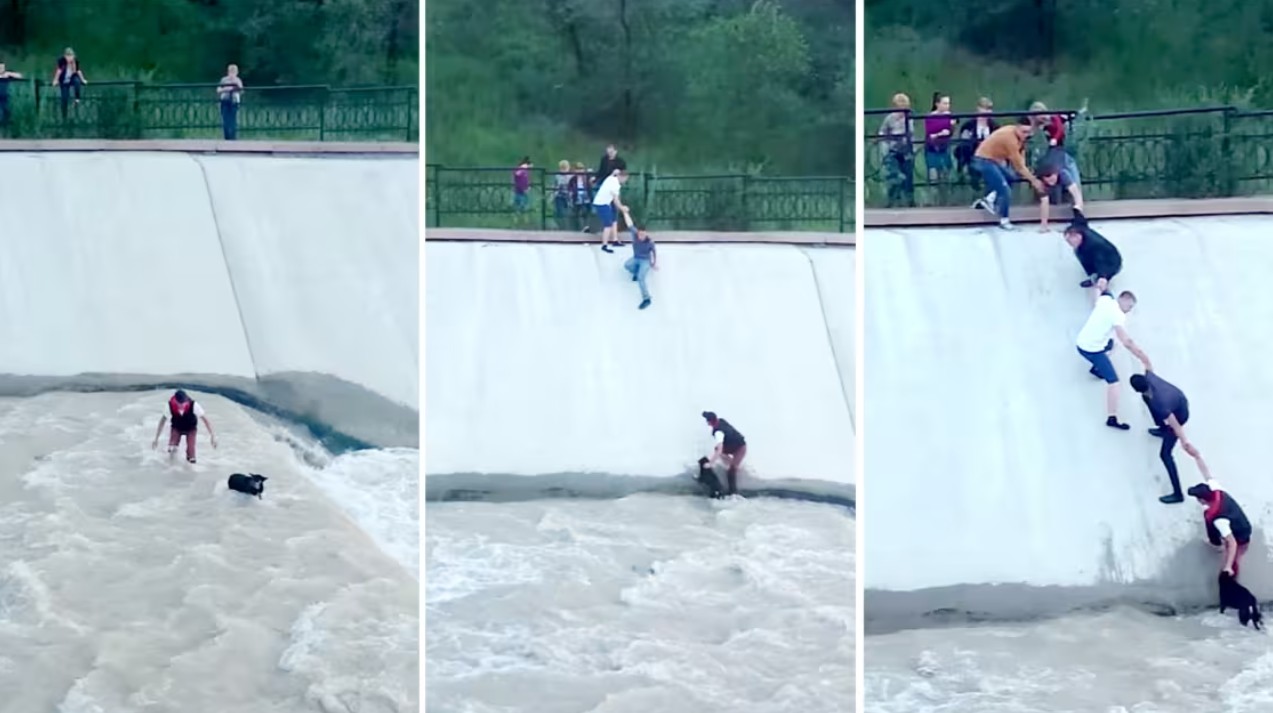
Instead of leaving the frightened dog to struggle alone, the man began descending the dangerous slope.
He had no easy path to follow.
The same steep concrete that trapped the animal also made reaching it hazardous.
But he continued.
One Man Reached the Dog, but Both Became Trapped
The passerby managed to reach the water and secure the struggling dog.
He held the frightened animal in his arms, protecting it from the powerful current.
For a moment, the most immediate danger appeared to be under control.
The dog was no longer facing the rushing water entirely alone.
Someone was holding on.
But the rescue was far from finished.
Getting down to the animal had been difficult. Climbing back up while carrying a soaked, exhausted dog was another challenge altogether.
The steep wall offered little assistance.
The man needed to keep the dog secure while somehow finding a way to return to the top of the embankment.
He could not manage both tasks on his own.
The rescuer had reached the animal, but now both were stranded below.
It was a moment that revealed how quickly a compassionate decision could become dangerous for the person trying to help.
There was no simple route back.
No easy foothold.
And no way for the man to release the dog without placing it at risk again.
What happened next changed the outcome.
When Strangers Became a Lifeline
The people watching from above recognized that the man and the dog needed help.
Several strangers moved toward the embankment.
Rather than attempting separate rescues, they began working together.
One person reached for another.
Hands gripped arms.
Bodies leaned carefully down the steep concrete slope.
Gradually, the strangers formed a human chain stretching from the safer ground above toward the rescuer waiting near the water.
Each person became a connection between those above and those below.
It was a simple idea.
But carrying it out required coordination, physical strength, and trust.
The wet surface made maintaining a secure position difficult. The rescuers had to support one another while dealing with the weight of the people below them and the exhausted dog.
A single lost grip could have placed the entire effort in danger.
Still, they held on.
The man at the bottom continued protecting the animal while those above worked to bring them closer to safety.
There was no elaborate equipment involved in the rescue described in the footage.
The most important resource was the willingness of ordinary people to help one another.
VIDEO: Strangers Form a Human Chain to Pull a Trapped Dog and His Rescuer From Dangerous Water
The rescue footage captures the extraordinary cooperation that made the effort possible.
No one person could solve the problem alone.
The man in the water needed the people above him. Those closest to the edge depended on the strength and stability of the others behind them.
Every connection mattered.
Together, they created the support that the concrete wall could not provide.
And finally, through a coordinated effort, the group managed to lift both the dog and the man back onto safe ground.
The frightened animal was out of the water.
Its rescuer was safe as well.
What had initially seemed impossible for one person had become achievable through the combined effort of several strangers.
The most dangerous part of the ordeal was over.
A Few Minutes of Courage That People Never Forgot
The entire rescue lasted only a matter of minutes.
But the meaning of those minutes extended far beyond the reservoir.
Someone who witnessed the incident recorded what happened, and the footage began spreading online.
People in different countries watched the same remarkable sequence.
A dog unable to escape.
A passerby willing to descend into danger.
And a group of strangers joining together when one person's strength was not enough.
The video did not need an elaborate explanation to communicate its message.
The actions spoke for themselves.
There was something especially moving about the way the strangers cooperated.
They had not gathered at the reservoir expecting to perform a rescue. Nothing in the account suggests that they arrived as an organized team.
They were simply people who found themselves near an animal in danger and a man who needed assistance.
Yet, when the situation demanded cooperation, they responded together.
The rescue offered a powerful reminder that compassion does not always take the form of a grand gesture.
Sometimes it begins with a single person noticing suffering.
Sometimes it grows when someone else decides to help.
And sometimes it becomes strong enough to accomplish what none of those involved could have managed alone.
The footage continued to inspire viewers long after the immediate danger had passed.
For those who witnessed the event, the rescue was a memorable example of practical kindness.
For people watching from elsewhere, it offered a different kind of encouragement.
In a world where troubling news often receives the greatest attention, here was a moment when strangers chose cooperation over indifference.
They saw a problem.
They recognized that someone needed help.
And they acted.
The dog survived the immediate emergency because people refused to leave it behind.
The original account does not describe the animal's later life, medical treatment, or adoption.
What it does confirm is the successful rescue of both the dog and the man who first reached it.
That outcome alone was significant.
But the story would eventually receive an unusual second chapter.
A Rescue Remembered Ten Years Later
About a decade after the incident, the human chain at Sayran reservoir remained part of the city's memory.
The remarkable event had left an impression strong enough to inspire a permanent public tribute.
ForteBank JSC partnered with the creative agency Progression on a project intended to celebrate the unity demonstrated during the rescue.
The idea was to preserve more than the memory of a dog being saved.
It was to recognize the extraordinary strength that can emerge when people support one another.
Contemporary artist Yerbosyn Meldibekov was selected to create the monument.
Known for work exhibited across Central Asia and internationally, Meldibekov was given the opportunity to transform a brief human encounter into something lasting.
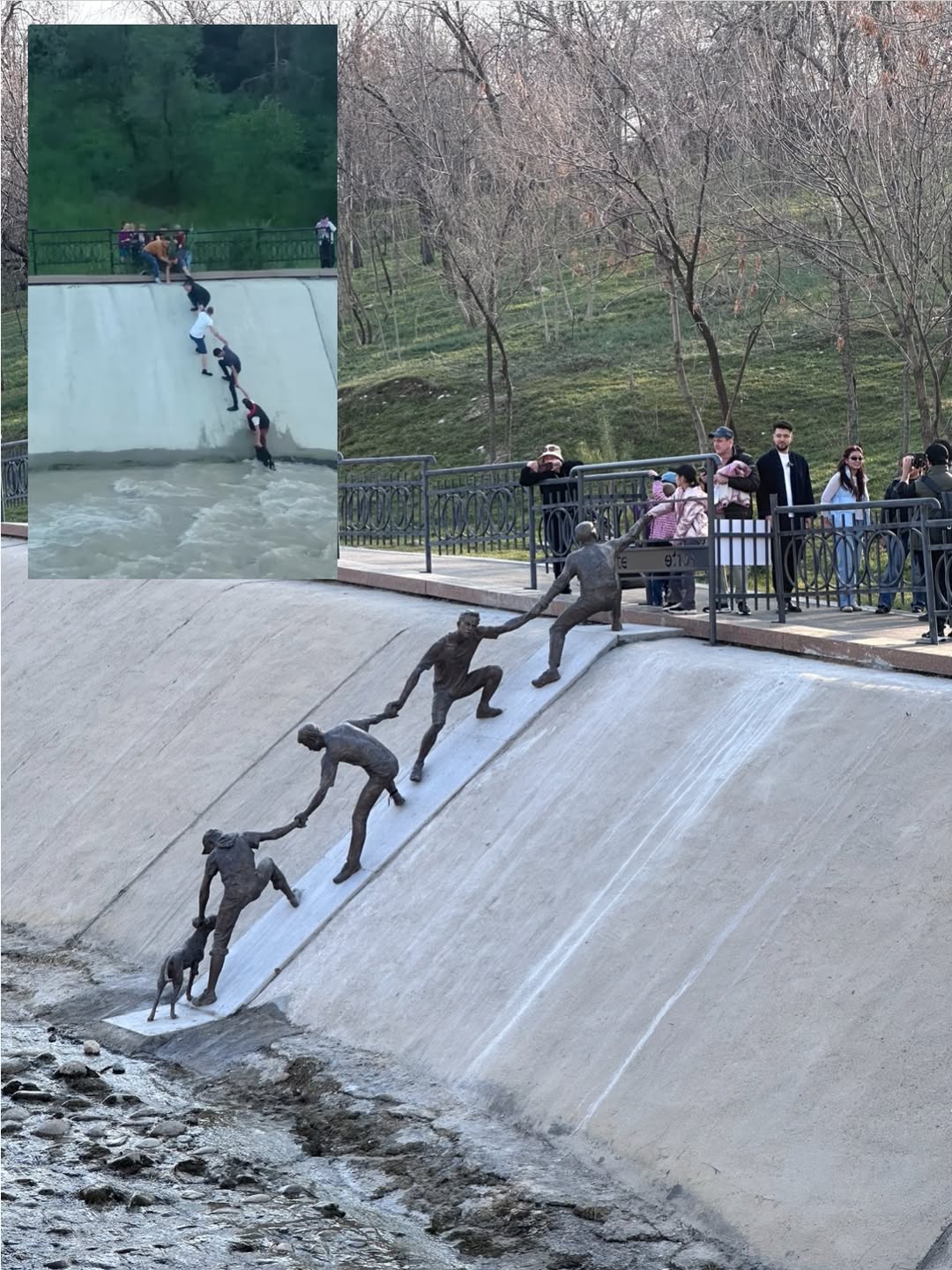
The result was a sculpture titled "Unity."
It was installed at the location where the original rescue had taken place.
That detail made the memorial especially meaningful.
Visitors were not simply looking at an artistic representation of an event that happened somewhere else.
They were standing beside the same reservoir where an exhausted animal had struggled in the water and strangers had formed a chain to help.
The concrete embankment was no longer just the setting of a dangerous incident.
It had become the setting of a public reminder about compassion.
A Monument That Allows Everyone to Join the Rescue
The sculpture recreates the formation of the rescuers.
Bronze human figures stretch across the embankment, connected to one another as if the rescue were still unfolding.
Each figure reaches toward the next.
The arrangement preserves the physical effort and cooperation that defined the original event.
But one feature makes the monument particularly memorable.
At the upper end of the sculpture, the final bronze figure extends a hand beyond the railing.
The hand reaches outward toward visitors.
It is an invitation.
Someone standing beside the monument can reach toward that extended hand and symbolically become another member of the human chain.
The design turns a historical rescue into an experience that includes the viewer.
Instead of simply observing what strangers once accomplished, visitors are invited to imagine themselves taking part.
It is a thoughtful artistic choice.
The original rescue succeeded because people added their strength to someone else's effort.
The monument carries that same idea forward.
One hand reaches out.
Another person has the opportunity to respond.
The story is no longer only about what happened at the reservoir. It is also about what each person might choose to do when someone needs help.
As footage and photographs of the monument circulated online, the story attracted renewed international attention.
The installation helped introduce the rescue to people who had never seen the original video.
It also gave those who remembered the incident a new reason to reflect on it.
The monument was not simply celebrating physical courage.
It was celebrating the decision to cooperate.
Without the first passerby, the dog might not have received the help it needed.
Without the strangers who formed the chain, the man might not have been able to bring the animal to safety.
Each person's contribution depended on the others.
That was the strength of the rescue.
And it became the central message of the sculpture.
The Hand That Still Reaches Out
There is a quiet beauty in the idea of preserving an act of kindness at the exact place where it happened.
The people involved in the rescue were not trying to create a famous moment.
They were responding to an immediate need.
A dog was struggling in dangerous water.
A man had climbed down to help.
Other people saw that he could not finish the rescue alone.
So they joined him.
The event could easily have remained a brief local memory.
Instead, someone recorded it, people around the world connected with it, and years later it inspired a monument that continues to communicate its meaning.
The story resonates because its lesson is understandable without regard to nationality, language, or background.
A life was in danger.
Someone cared enough to act.
Others cared enough to help.
And together, they changed the outcome.
Representatives of ForteBank described the project's meaning in terms of the strength people gain through unity.
Some challenges are simply too difficult for one person to overcome.
But a group working together can make a seemingly impossible task achievable.
The dog at Sayran reservoir became an unforgettable example of that principle.
Its rescue was not accomplished through extraordinary machinery or complicated planning.
It happened because people were willing to depend on one another.
One person reached the animal.
Others reached for him.
And the chain held.
Today, the sculpture known as "Unity" preserves that moment in bronze, with an outstretched hand reminding visitors that compassion is not limited to the people who participated in the original rescue.
Every person has the opportunity to offer support when it is needed.
Not every act of kindness will become a viral video.
Not every rescue will inspire a public monument.
Most will pass quietly, remembered only by those directly involved.
But their value is no less real.
The dog trapped below the reservoir wall did not need a monument.
It needed someone to notice.
Someone to reach down.
And others who would refuse to let go.
That is what makes this rescue worth remembering.
One person's compassion began the rescue. The strength of strangers working together brought it to a safe ending.


