
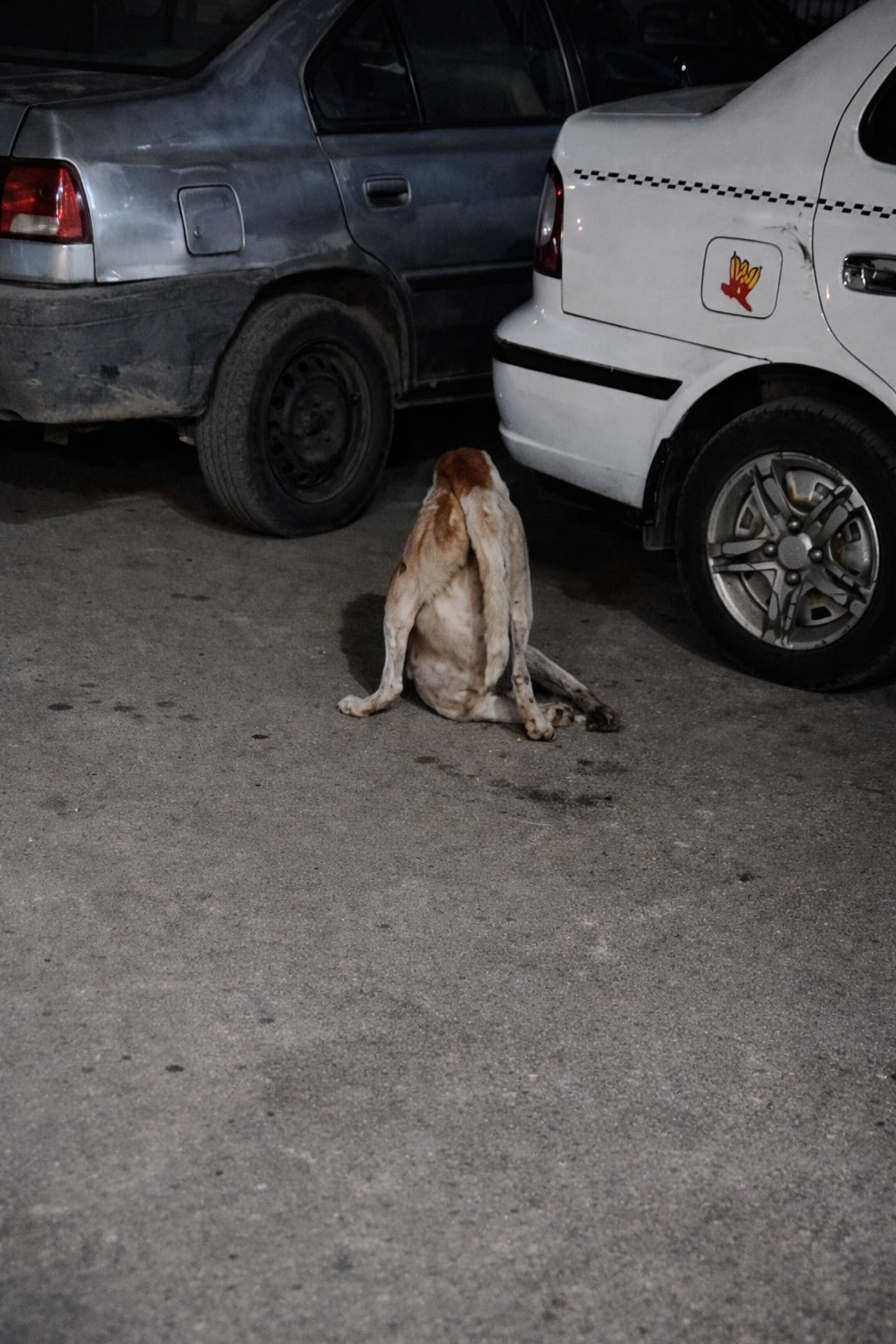
Cleopatra once had to pull herself across the street using little more than her chest and neck. Both of her front legs were so badly injured that ordinary movement had become almost impossible.
Yet the tiny dog continued trying.
People passed her. Vehicles moved along the road. Life continued around her while she struggled to make even the smallest progress.
There was no comfortable place to rest, no wheelchair to support her, and no family waiting to carry her somewhere safe.
At that point, Cleopatra did not even have the name that would later become part of her remarkable story.
She was simply a small stray dog in desperate need of help.
What followed would involve weeks of veterinary treatment, an extraordinarily difficult medical decision, and a second chance that eventually carried her all the way to Canada.
But before she could experience any of those changes, someone first had to notice that she was still fighting to survive.
The Little Dog Everyone Had Passed By
When rescuers learned about the injured stray, they understood that she needed urgent attention.
They were not prepared for the full extent of her condition.
Both front legs had sustained severe damage. Later veterinary assessments indicated that the injuries were consistent with repeated blunt-force trauma.
The complete circumstances of what had happened to Cleopatra were not established in the account. What was clear was that she had endured serious physical harm and had been left struggling on the streets.
Without the normal use of her front legs, even moving a short distance required enormous effort.
She relied on her chest and neck to push herself forward.
A few inches at a time.
Then a little farther.
It is difficult to imagine how exhausting such movement must have been for an animal so small.
For a healthy dog, walking is something natural. A few steps toward food, a familiar person, or a comfortable place require little thought.
For Cleopatra, those ordinary movements had become a struggle.
And the longer she remained outside without treatment, the more concerning her situation became.
Reports described people seeing her without stopping to help.
That detail makes this part of her story especially painful.
She was not hidden somewhere beyond human reach. She was out in the world, surrounded by movement and activity, yet still waiting for assistance.
Eventually, that changed.
A rescue team arrived and carefully lifted her from the street.
They wrapped her in blankets and took her somewhere she could receive proper care.
It was a simple act in comparison with everything that would come afterward.
But it was the beginning of her chance to live differently.
For the first time in this account, Cleopatra was no longer facing her condition without human help.
She had people willing to take responsibility for her care.
And she had a name.
Cleopatra.
A Rescue Was Only the Beginning
Being carried away from the street was an important turning point, but it did not mean Cleopatra's physical problems could be resolved quickly.
Her injuries were complex.
At the veterinary hospital, the medical team examined the damage to both front legs and considered what treatment might still be possible.
The goal was to preserve her limbs if they could.
That would require more than rest and routine care.
Cleopatra needed extensive medical intervention, and the road ahead was uncertain.
The veterinary team chose to try.
Over the following weeks, she underwent multiple surgical procedures. Metal plates and screws were used in attempts to stabilize the damaged bones.
These efforts were intended to give her legs an opportunity to heal.
Each procedure represented another attempt to protect her mobility and preserve as much function as possible.
But treatment could not erase the severity of the original injuries.
Even with continued medical attention, there were limits to what the veterinarians could accomplish.
For the people caring for Cleopatra, those limitations must have made the situation particularly difficult.
They were working to save her legs while also needing to consider her comfort and long-term well-being.
And throughout this period, Cleopatra displayed something that made her caregivers even more determined to help.
She remained affectionate.
Despite the difficult circumstances, she continued responding warmly to the people around her.
She welcomed attention rather than withdrawing completely from human contact.
Her behavior did not remove the seriousness of her medical condition.
But it offered a glimpse of the companion she could become if she were given the opportunity to live without constant discomfort.
There was still much to overcome.
And the most difficult decision had not yet arrived.
VIDEO: Cleopatra's Incredible Journey From Losing Both Front Legs to Learning to Run Again
The Decision That Changed Her Future
By approximately Day 70 of Cleopatra's journey, the veterinary team had reached a painful conclusion.
The repeated attempts to repair her front legs had not achieved the recovery they hoped for.
The damaged limbs were not healing adequately.
Continuing the same course of treatment would expose Cleopatra to further suffering without a reasonable prospect of restoring her legs.
The medical recommendation was therefore to amputate both front legs.
It was a difficult outcome after so much effort had already been invested in preserving them.
But the decision was made with her survival and quality of life in mind.
For a dog who had already struggled to move with damaged front limbs, losing them entirely represented another major adjustment.
Her body would need to function in a different way.
Her caregivers would need to think about mobility, support, daily comfort, and the practical challenges of helping her live as independently as possible.
There was also the emotional concern that often accompanies such a significant medical change.
Would Cleopatra continue to show interest in the world around her?
Would she still enjoy attention and companionship?
Would she be able to regain some freedom of movement?
No one could know exactly how she would adapt until she began recovering.
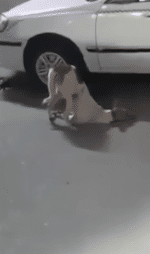
Yet Cleopatra's response offered encouragement.
She continued wagging her tail.
She still welcomed familiar caregivers.
The affection she had shown during treatment did not disappear after the amputations.
Her circumstances had changed dramatically, but her interest in the people around her remained.
It was an important reminder that a dog's quality of life cannot be measured only by the number of limbs it has.
Comfort matters.
Companionship matters.
The opportunity to move, play, and interact with the world matters.
For Cleopatra, those possibilities were not gone.
They simply required a different kind of support.
A Family Thousands of Miles Away Saw Her Worth
As Cleopatra adjusted to life without her front legs, another part of her story was beginning to unfold.
Around Day 90, a family in Canada learned about her situation.
They heard about the small dog who had survived serious injuries, endured weeks of treatment, and continued showing affection despite everything she had experienced.
Her story touched them.
But their response went beyond sympathy.
They offered Cleopatra a permanent home.
It was a remarkable development for a dog who had once been struggling alone on the streets.
A few weeks earlier, the main concern had been whether her damaged legs could be saved.
Now there was a family preparing to welcome her into a completely different life.
And they understood that love alone would not address every practical challenge Cleopatra faced.
She would also need equipment that suited her body and allowed her to move comfortably.
The family arranged for a wheelchair designed specifically for her needs.
This was more than a thoughtful gift.
It was a way of helping Cleopatra regain something she had been missing since her injuries: the ability to explore her surroundings without dragging her body along the ground.
A wheelchair could not replace her missing legs.
But it could provide support where her body needed it most.
It could make movement easier.
And it could open the door to activities that had once seemed out of reach.
For Cleopatra, the next stage would reveal just how much that freedom meant.
The Day Cleopatra Started Moving Freely Again
Around Day 100, Cleopatra was introduced to her specially designed wheelchair.
It was a major moment in her recovery.
After so much time spent struggling with severe injuries and adjusting to the loss of her front legs, she now had a mobility aid created around her physical needs.
At first, she moved cautiously.
That was understandable.
The wheelchair was unfamiliar, and she needed to adjust to the support it provided.
Her movements were careful as she began discovering how to use it.
Then her confidence grew.
Soon, Cleopatra was no longer simply attempting to move.
She was running.
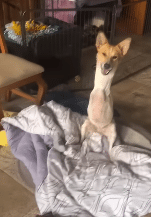
The contrast with her earlier condition was extraordinary.
This was the same little dog who had once been forced to pull herself across the street with her chest and neck.
Now she could move forward with support.
She could explore.
She could play.
She could experience a degree of independence that had seemed impossible during the worst period of her injuries.
For the people who had followed her treatment, watching that change must have been especially meaningful.
The wheelchair did not make Cleopatra's past disappear.
It did not undo the pain she had experienced or the surgeries she had endured.
But it changed what was possible in her everyday life.
Instead of focusing only on what she had lost, her caregivers could now see the activities she was able to enjoy.
Her enthusiasm was visible in the way she moved.
Her desire for companionship remained strong.
And her willingness to explore showed that disability had not taken away her interest in living.
The little dog who once struggled for every inch of progress had gained a new way to move through the world.
There was still another important journey ahead.
Cleopatra would soon leave for Canada, where the family who had offered her a home was waiting.
From a Lonely Street to a Loving Home
Cleopatra's journey eventually took her aboard a flight to Canada.
For a dog whose story had begun with serious injuries and an uncertain future, the destination represented an extraordinary change.
She was not traveling toward another round of unsuccessful treatment.
She was going to a permanent home.
By approximately Day 105, Cleopatra was adjusting well to life with her adoptive family.
The account describes a dog who quickly formed strong connections with the people caring for her.
She also developed friendships with other dogs.
Her wheelchair became an important part of how she explored her surroundings and participated in daily activities.
She played with toys.
She moved around her new home.
She enjoyed time with her family and the companionship of other animals.
Even stairs presented a challenge she showed determination to overcome.
These were ordinary aspects of life for many household dogs.
But for Cleopatra, each one represented something significant.
She was no longer limited to the small movements she could manage while injured on the street.
She had the support of people who understood her needs.
She had a mobility aid that made it easier to participate in everyday life.
And she had a home where her physical differences did not prevent her from being loved.
The change was not simply about having better surroundings.
It was about belonging.
Her adoptive family had welcomed Cleopatra with the understanding that she would require special care.
They had not waited for her to become a physically typical dog.
They had chosen her as she was.
That acceptance gave Cleopatra the opportunity to enjoy a life defined by much more than her medical history.
The Small Moments That Made Her Recovery Meaningful
Stories about rescued animals often focus on the most dramatic moments.
The discovery.
The emergency treatment.
The difficult operation.
The first time an injured dog manages to move again.
Those moments certainly matter in Cleopatra's journey.
But the quieter details of her new life are just as important.
A warm place to sleep.
Familiar people who welcome her presence.
Toys to play with.
Other dogs to spend time around.
A wheelchair that helps her participate in everyday activities.
None of these things changes the fact that Cleopatra has only two back legs.
Her physical condition remains part of who she is.
But it no longer tells the entire story of her life.
She has been given the chance to experience the security and affection that every companion animal deserves.
And the account of her adjustment in Canada suggests that she has embraced that opportunity with enthusiasm.
The same dog who continued wagging her tail during difficult medical treatment now has people who can respond to that affection every day.
The trust she showed her caregivers has become part of a lasting relationship with her family.
Her new life is not built around what she cannot do.
It is built around making the most of what she can.
For animals living with permanent disabilities, appropriate mobility support and a caring environment can make an enormous difference.
Cleopatra's experience offers a moving example of that possibility.
Her wheelchair gives her practical assistance.
Her family gives her companionship and security.
Together, those forms of support help her enjoy the kind of daily life that once seemed far beyond reach.
Cleopatra Was Never Defined by What She Lost
There is something especially memorable about Cleopatra's journey.
She survived a period of suffering that left her with permanent physical changes.
Veterinarians worked for weeks to preserve her front legs before determining that amputation was necessary.
She then faced the challenge of adapting to a different body.
At several points, the future remained uncertain.
Yet the story did not end at the veterinary hospital.
It continued through her recovery, the arrival of a specially designed wheelchair, and the compassion of a family willing to bring her across international borders into their home.
Those decisions were made by people.
People who chose to rescue her.
People who worked to provide medical care.
People who recognized that her life still held possibilities after amputation.
And people who were willing to offer a permanent home to a dog with special needs.
Cleopatra's determination mattered, but so did the care that made her progress possible.
Her story is not proof that every injured animal will experience the same outcome.
Recovery is different for every dog, and severe injuries can leave lasting challenges.
What Cleopatra's experience does show is that a permanent disability does not automatically prevent an animal from living a meaningful, affectionate, and active life.
With suitable care, mobility support, and a committed family, she was able to discover new possibilities.
Today, according to the account of her journey, Cleopatra enjoys the comfort of a loving home in Canada.
She has a warm bed.
She has people who cherish her.
She has canine companions and opportunities to play.
And she can move forward with the help of a wheelchair made for her needs.
It is a very different picture from the little dog who once struggled across the street while the world passed by.
Cleopatra lost both of her front legs.
But she did not lose her ability to love, to enjoy companionship, or to find happiness in a new home.
Perhaps the most important part of her story is not how much she endured.
It is what became possible when people finally gave her the care, patience, and opportunity she deserved.
Because Cleopatra was never simply a dog with missing legs.
She was always a life worth saving.


