
For eleven years, the ground beneath Lily's paws had been made of wire.
Not grass. Not a warm blanket. Not the soft cushion of a bed where a tired dog could stretch out and sleep without discomfort.
Just metal flooring.
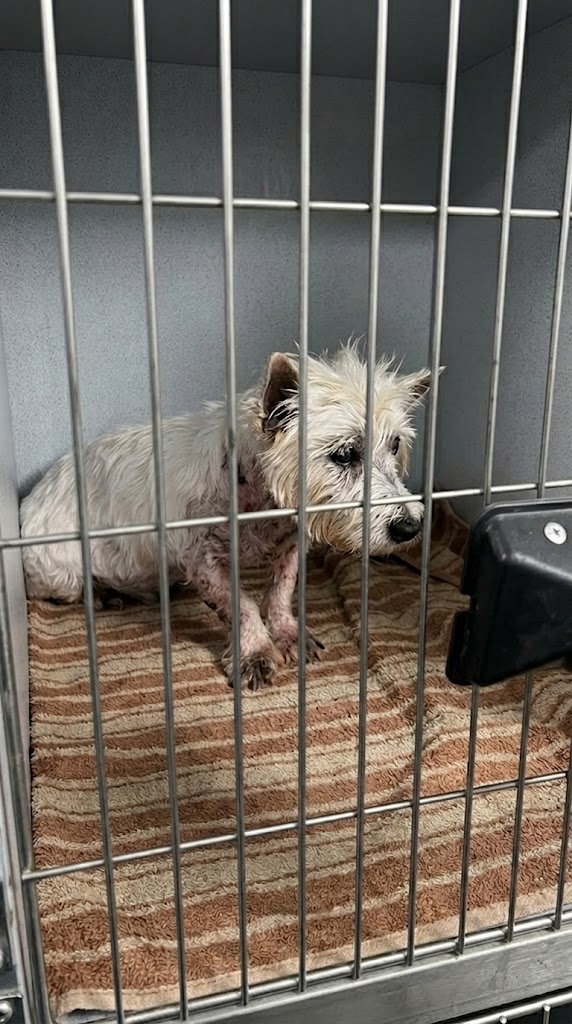
By the time rescuers met the elderly West Highland Terrier, her small body had already endured a lifetime of hardship. Her coat was tangled, her skin was irritated, and even standing appeared to bring discomfort.
At eleven years old, Lily had spent nearly her entire life being used for breeding.
She had produced puppies, but she had never experienced the simple security that most family dogs take for granted.
And when she was finally given a chance to rest somewhere soft, her reaction revealed just how unfamiliar kindness had been.
Eleven Years Without the Comfort of a Home
Lily's past was shaped by the conditions of a puppy mill, where her purpose had been measured by her ability to produce puppies.
For years, her physical needs and emotional well-being had received far too little attention.
There was no comfortable place to lie down.
No family waiting to welcome her into a warm room.
No familiar routine of gentle affection.
Instead, the small terrier spent year after year living on wire flooring that offered little relief to her aging body.
The effects were visible when rescuers from National Mill Dog Rescue finally encountered her.
Lily trembled frequently. Her fur had become heavily matted, concealing areas of irritated and damaged skin. Her paws showed signs of prolonged discomfort, and her overall condition suggested that her body had been struggling for a considerable time.
Her heart was weakened as well, adding another concern for those responsible for her recovery.
At an age when many dogs are enjoying peaceful retirement with their families, Lily was only beginning to discover what ordinary comfort could feel like.
That contrast made her situation especially moving.
Eleven years is a long time in the life of a dog.
For Lily, those years had passed without many of the experiences that make life as a beloved companion so different from merely surviving.
Yet her story was not going to end in that cage.
Someone had finally recognized that she deserved more.
The Rescue That Opened a Door to a Different Life
The team at National Mill Dog Rescue understood that helping Lily would involve much more than removing her from her previous environment.
Her body needed medical attention.
Her skin needed time to recover.
And after years of living under stressful conditions, she would need patience to become comfortable with unfamiliar people and surroundings.
For a dog with Lily's history, even ordinary acts of care could be overwhelming.
Being examined by strangers, hearing unfamiliar sounds, and experiencing different surfaces beneath her feet were all changes from the life she had known.
Her rescuers could not erase those eleven years.
But they could begin offering her something she had been missing throughout them: care centered on her own well-being.
Lily was no longer being valued for the puppies she might produce.
She was being treated as an individual whose comfort mattered.
The rescue brought her into the care of veterinary professionals who could begin addressing the physical consequences of her past.
At Rocky Mountain Vet, Dr. Jeff Young and his team examined the elderly terrier and worked to understand the extent of her medical needs.
What they discovered helped explain why even gentle handling required special consideration.
Her skin was extremely sensitive.
Areas of her belly, neck, and paws had been affected by prolonged contact with the wire flooring.
The veterinary staff needed to approach each step carefully.
Even a routine bath would require extra attention.
For Lily, the path toward a better life would begin with small, thoughtful decisions.
The kind of decisions that communicated, through actions rather than words, that her comfort finally mattered.
VIDEO: After 11 Years of Standing on Wire Floors, Lily Discovers What a Soft Bed Feels Like
A Gentle Bath Revealed the Cost of Years of Neglect
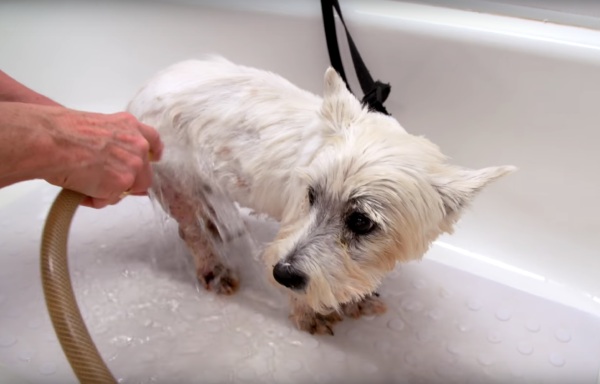
One of the first important steps in Lily's care was a proper bath.
For most household dogs, bathing is a familiar part of ordinary grooming.
For Lily, it revealed just how much attention her body needed.
As the veterinary team carefully cleaned her tangled coat, the condition of her skin became easier to assess.
Beneath the matted fur were extensive areas of inflammation and irritation.
Her belly, neck, and paws had been particularly affected.
The veterinary team associated much of this damage with the many years Lily had spent standing and resting on wire flooring.
It was a painful reminder that the environment surrounding an animal can affect its health long after the animal leaves it.
A surface that provides no proper cushioning can become especially difficult for a small, aging dog when exposure continues for years.
Lily's weakened condition made gentle handling essential.
After her bath, the staff faced a problem that would rarely arise with a healthy dog.
Drying her with a towel could irritate her already sensitive skin.
Rather than risk causing additional discomfort through rubbing, the technicians used a blow dryer with gentle warmth.
It was a simple adjustment.
But it reflected an important change in Lily's life.
Her care was now being adapted to what she needed.
Her comfort was no longer an afterthought.
The people around her were taking the time to notice where she hurt and to choose methods that would help protect her.
The medical staff also recognized that the visible condition of Lily's body was only one part of her story.
Years of neglect had left her physically vulnerable, but recovery would require more than treating irritated skin.
She had spent much of her life without the reassuring routines of a normal home.
She was unfamiliar with the kind of attention that family pets commonly receive.
And she could not be expected to become confident simply because her surroundings had changed.
Healing would have to happen gradually.
For Lily, that meant receiving steady care without being rushed.
Small Steps Toward Feeling Better
During her first week of treatment, Lily's caregivers focused on relieving some of the discomfort that had accumulated over the years.
Her paws required particular attention.
After so much time on wire flooring, the skin of her feet had become cracked and painful.
The veterinary team used medicated paw soaks to support healing and help improve their condition.
It was not an instant solution.
Skin affected by prolonged irritation needs careful attention, and Lily's age made it especially important to respect her physical limits.
Her eyes needed treatment as well.
Chronic dryness had caused discomfort, so the team provided specialized eye care to help ease the problem.
These treatments may sound ordinary when described individually.
A paw soak.
Eye care.
A careful bath.
A quieter environment.
But together, they represented something Lily had rarely experienced.
People were responding to her needs without expecting anything from her in return.
As her physical discomfort gradually eased, her behavior began to change.
The frightened dog who had arrived trembling started showing small signs of curiosity.
She became more willing to engage with her surroundings.
There were glimpses of a personality that had been difficult to see beneath her fear and discomfort.
It would be misleading to suggest that eleven years of hardship disappeared in a matter of days.
They did not.
Lily still needed time.
But improvement did not have to be dramatic to be meaningful.
For an elderly dog who had lived under such restrictive conditions, becoming a little more relaxed was already progress.
And the next part of her recovery would bring one of the most memorable moments of her rescue story.
The First Time Lily Stepped Onto a Soft Bed
Eventually, the veterinary team felt Lily was ready to leave the busier medical area and move into a quieter space where she could rest.
There, something ordinary was waiting for her.
A plush dog bed.
To a dog raised in a loving home, a soft bed may be little more than a familiar piece of furniture.
It becomes the place where afternoon naps happen, where tired paws can rest, and where sleep comes without the discomfort of a hard surface.
But Lily had no reason to recognize it.
For eleven years, wire flooring had been the surface beneath her body.
A soft bed was an entirely new experience.
When she approached it, she did not immediately climb in and relax.
She hesitated.
She looked at the unfamiliar object.
Then she began investigating it, sniffing and moving around it as though trying to understand what it was.
There was no need for anyone to hurry her.
No expectation that she should instantly know how to enjoy something she had never experienced.
She was allowed to discover it at her own pace.
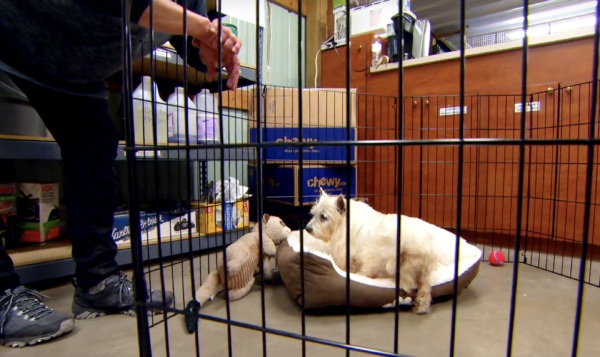
After several cautious moments, Lily finally stepped onto the bed.
The surface beneath her paws was different from the flooring she had known.
It was soft.
It offered cushioning.
And when she settled down, there were no rigid metal wires pressing against her tired body.
Lily curled herself into a small ball.
Then she closed her eyes.
That was all.
There was no dramatic celebration and no extraordinary trick.
Just an elderly dog resting on a comfortable bed.
Yet the simplicity of the moment made it especially powerful.
For most dogs, lying down somewhere soft is a routine part of life.
For Lily, it marked a change that had taken eleven years to arrive.
The moment also illustrated something important about animal rescue.
Not every meaningful milestone involves a major medical procedure or an obvious physical transformation.
Sometimes, progress is quiet.
It is a frightened animal becoming curious enough to explore.
It is a sensitive body finally finding a position that feels comfortable.
It is an elderly dog discovering that rest does not have to mean discomfort.
Lily's first experience with a soft bed could not undo her past.
But it offered a glimpse of the life she might still enjoy.
And that possibility was growing stronger.
From Lily to Maddie: A Family Finally Welcomes Her Home
As Lily gained strength, her rescuers began considering the next important step.
She needed a permanent home.
Medical treatment had helped address her immediate needs, but the long-term goal was to give her a safe and loving environment where she could continue adjusting.
At eleven years old, Lily was a senior dog with a complicated history.
She needed people who could understand that trust might take time and that unfamiliar situations could still make her nervous.
Fortunately, a family encountered her story and felt drawn to her.
They wanted to give the elderly terrier the home she had been missing.
Lily was adopted.
And with that adoption came another change.
Her new family gave her the name Maddie.
The name marked the beginning of a different chapter, one in which she would no longer be defined primarily by her years in a breeding facility.
Instead, she would be known as a treasured companion.
Maddie's new surroundings offered comforts that had once been completely unfamiliar to her.
Soft blankets.
Patient caregivers.
A home where affection was part of everyday life.
Her family understood that the adjustment would not happen all at once.
A dog who has spent many years in stressful conditions may continue reacting nervously even after reaching safety.
Maddie was no exception.
Sudden movements could still startle her.
Unexpected noises sometimes made her uneasy.
Those reactions were reminders that a new home, however loving, could not immediately erase everything she had experienced.
But this time, she had people around her who could offer reassurance.
When something frightened her, she was no longer facing that uncertainty without a supportive family.
When she needed space, patience was available.
And as she continued settling into her new life, she had opportunities to become more comfortable with gentle human interaction.
The transformation was not about turning her into a different dog.
It was about allowing the dog she had always been to experience a life built around care rather than confinement.
Learning That Gentle Hands Can Mean Safety
For Maddie, everyday life with her adoptive family became part of the continuing healing process.
The smallest interactions could carry meaning.
A gentle touch was no longer something she had to associate with uncertainty.
A calm voice could become familiar and reassuring.
A soft place to rest was no longer a rare discovery.
These changes were important because her physical recovery and emotional adjustment were closely connected.
Receiving medical care could help relieve her discomfort.
But building confidence required repeated experiences of being treated with patience.
That kind of trust cannot simply be demanded.
It develops through consistency.
Maddie still had moments when unfamiliar sounds or movements frightened her. Her family continued providing reassurance as she learned to navigate the home and the attention that came with being a cherished pet.
There was no need to measure her progress against the behavior of a dog who had always known family life.
Her starting point had been very different.
Before her rescue, human involvement in her life had largely revolved around breeding.
Now, human companionship offered affection and support.
Before her rescue, her sleeping surface had contributed to years of physical discomfort.
Now, comfortable bedding was part of her everyday surroundings.
Before her rescue, she had never known the security of belonging to a loving family.
Now, she had a home.
These were not small differences.
They changed the conditions of her daily life.
And for an elderly dog, whose remaining years deserve as much dignity and kindness as possible, that change mattered enormously.
Eleven Years Cannot Be Returned, But Her Future Has Changed
Maddie's journey is a reminder that rescue does not always mean restoring everything an animal has lost.
No one could give her back the years she spent in a cage.
No treatment could rewrite her earliest experiences.
And even in her new home, some reminders of her past continued to influence her reactions.
But the rescue team had been able to change what happened next.
National Mill Dog Rescue helped bring Lily out of an environment that had caused years of discomfort.
Dr. Jeff Young and the team at Rocky Mountain Vet provided medical attention suited to her fragile condition.
And a compassionate family gave her a permanent home where she could continue learning what safety and affection feel like.
Each part of that journey mattered.
The rescue made veterinary care possible.
The medical attention helped her begin recovering physically.
The patient environment allowed her curiosity and trust to emerge.
And adoption gave her the opportunity to enjoy those improvements within a family.
For the people who cared for her, seeing Maddie settle into her new life demonstrated why even the most challenging rescue cases deserve attention.
An elderly dog does not become less deserving of kindness because many years have already passed.
A difficult history does not make an animal unworthy of a home.
And recovery does not have to be perfect for a better life to be meaningful.
Perhaps the most memorable image from Maddie's journey will always be that first encounter with the soft bed.
A small white terrier cautiously approaching something unfamiliar.
Pausing.
Sniffing.
Finally stepping forward.
Then curling up and resting on a surface that did not hurt her.
After eleven years, she had discovered one of the simplest comforts a dog can experience.
Today, Maddie is part of a family that values her not for what she can produce, but simply for who she is.
Her story began with years of confinement and neglect.
But it continues with something entirely different.
A safe home.
A comfortable place to sleep.
And people who are happy to love her for the rest of her life.
For Maddie, those ordinary gifts have made all the difference.


