
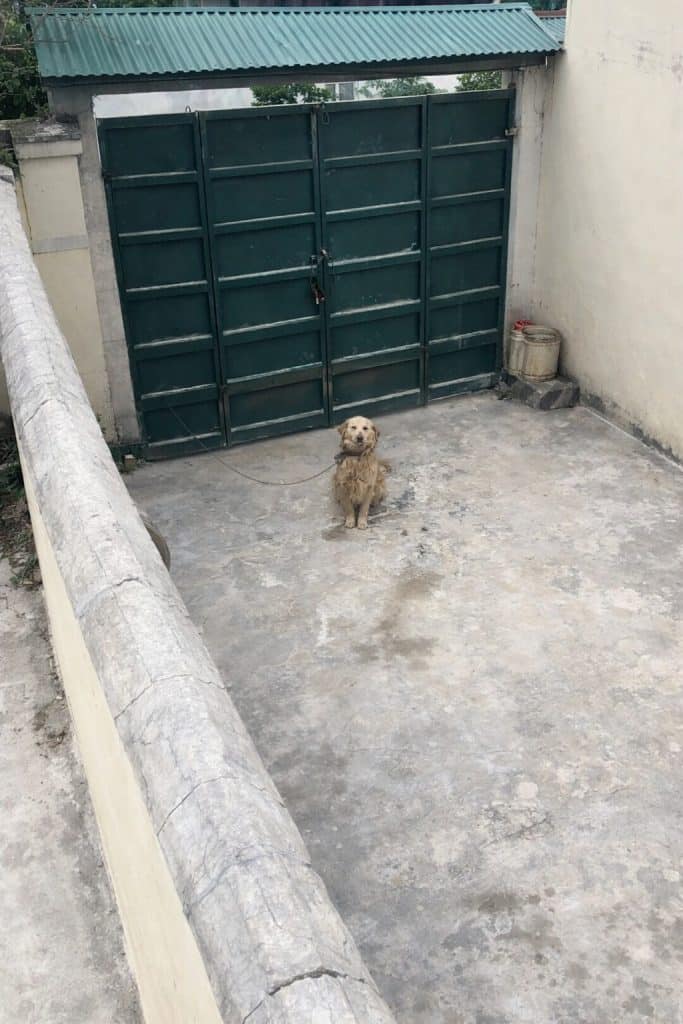
The Golden Retriever rarely barked when the woman looked through her window.
He simply watched her.
Beyond the neighboring fence, he sat in a neglected yard, held in place by a chain that allowed him to move only a short distance. The house behind him appeared empty, and the space around him offered little comfort.
Yet whenever their eyes met, he remained remarkably gentle.
For a woman who had only recently moved into the neighborhood, that quiet expression became impossible to forget.
She did not know his name. She did not know how long he had been living this way.
But she could see that something was missing from his life.
Someone to sit beside him.
Someone to care whether he was comfortable.
Someone who would look at him and see a companion rather than a guard dog.
What began as a concerned glance through a window would eventually change everything for the lonely Retriever.
The Gentle Dog Behind the Fence
At first, the woman could only observe the dog from next door.
The yard was poorly maintained. There were no toys scattered across the ground, no inviting place for him to play, and little indication that anyone regularly spent time with him.
His chain kept him confined to the same small area.
Day after day, she saw him waiting there.
What made the situation especially difficult to understand was his temperament. Despite his isolation, he showed none of the hostility she might have expected from an animal living without consistent attention.
He remained calm.
He watched people quietly.
And when the woman began offering him small pieces of meat over the fence, he accepted them without aggression.
Those first encounters created a connection.
For the dog, the food offered something welcome in an otherwise lonely routine. For the woman, each interaction made it harder to overlook the circumstances in which he was living.
She began paying closer attention to the property.
She noticed how little activity surrounded the house. She did not see anyone spending meaningful time with the Retriever.
Eventually, she learned why.
The people who owned the property had moved away.
But they had not taken their dog with them.
Instead, the Golden Retriever had been left chained outside to watch over the empty house.
The discovery changed the way she understood everything she had been seeing.
This was not simply a dog who preferred spending time outdoors.
He was an animal expected to remain at an abandoned property, serving a purpose for people who no longer lived there.
And however patiently he waited, the life he needed was not arriving.
Small Acts of Kindness Across a Fence
Knowing the truth did not mean the woman could immediately bring the Retriever home.
He still belonged to someone else, and she understood that she could not simply remove him from the property without permission.
But doing nothing was no longer an option she could accept.
She began finding practical ways to help.
A friend joined her efforts, and together they worked out an unusual method of getting supplies into the yard.
Using a ladder positioned near the fence, they lowered containers of food and water with a rope.
It required patience and careful handling.
Every visit meant arranging the supplies, reaching over the barrier, and making sure the dog received what he needed.
The process was far from convenient.
But the woman kept returning.
The Retriever began expecting those visits. Each evening, he waited for the familiar people who had started bringing him food, fresh water, and a little attention.
The routine was simple.
A container lowered over the fence.
A meal placed within reach.
A few moments when someone was there specifically for him.
These gestures could not remove the chain or change where he slept. Yet they gave the dog something his daily life had been missing: dependable human kindness.
The woman could see how gently he responded.
Instead of making her feel that she had done enough, his trusting behavior increased her concern.
Food could fill his stomach.
Water could ease his thirst.
But neither could replace companionship or freedom of movement.
He was still alone when the visits ended.
He was still confined to the same neglected yard.
And the empty house was still the center of his world.
The woman began to understand that helping him survive was only the beginning.
He needed more than occasional care from the other side of a fence.
He needed a different life.
One Carefully Prepared Meal Changed Her Decision
One day, the woman decided to prepare something special for the Retriever.
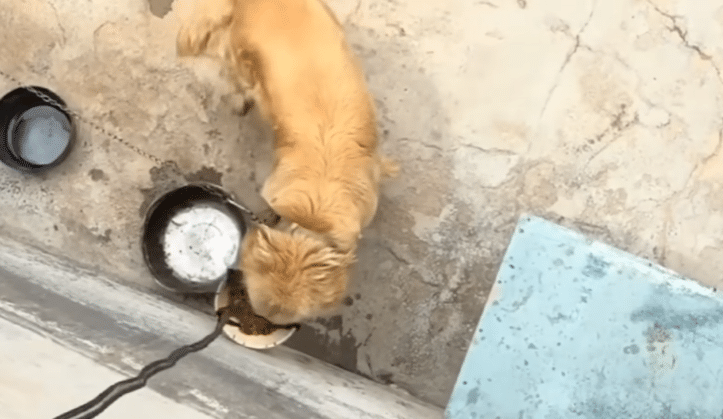
Rather than offering the usual food, she cooked a meal containing meat, eggs, and vegetables.
She brought it to the property and lowered it into the yard.
The dog began eating immediately.
There was nothing complicated about the moment. A hungry, gentle animal had been given a carefully prepared meal by someone who wanted him to feel cared for.
But watching him eat deeply affected the woman.
She was moved to tears.
Perhaps it was the contrast between the effort she had put into preparing his food and the bare surroundings in which he received it.
Perhaps it was the knowledge that, once the meal ended, he would still be attached to the same chain.
Whatever the reason, she could no longer accept this arrangement as his future.
Her next step would be more difficult than lowering food over a fence.
She needed to speak to the people who owned him.
And she needed to persuade them to let him go.
At first, they refused.
They explained that the Golden Retriever was needed to guard their property.
To them, his presence still served a purpose, even though they no longer lived in the house.
The woman continued the conversation.
She explained why the dog needed a proper home, regular companionship, and a life beyond the neglected yard.
The discussion lasted nearly an hour.
Then something changed.
The owners finally agreed that she could adopt him.
They had one condition: she would bring the dog back for occasional visits.
It was not the arrangement she might have wished for, but it gave the Retriever an opportunity he had not had before.
He could leave.
The chain and the lonely yard no longer had to define his entire life.
VIDEO: Chained Outside an Empty House, This Gentle Golden Retriever Finally Gets His Chance at Freedom
The First Steps Toward a Real Home
The day after the agreement, the woman's efforts entered an entirely new stage.
She could finally care for the Retriever without a fence between them.
Her first priority was his health.
After his long period of outdoor neglect, she took him to a veterinarian for a complete examination.
It was an important step. Although the dog had been gentle and willing to eat, those observations alone could not establish his overall condition.
A professional examination would help assess his needs as he began living in a different environment.
After the veterinary visit, she cleaned him up and brought him home.
The change was enormous.
For so long, his surroundings had been limited to a yard, a chain, and a house where no one lived.
Now he was entering a place where someone had chosen to welcome him.
There would be regular meals.
Comfortable places to rest.
And a person who wanted him nearby, not outside guarding an empty building.
His rescuer also gave him a name.
Kele.
The name means happiness.
For a Golden Retriever who had spent so much time without the ordinary comforts of companionship, it carried a particularly meaningful hope.
But moving into a loving home did not instantly make everything familiar.
At first, Kele seemed uncertain.
He had experienced a major change in his surroundings and routine. After spending so much time confined outdoors, even the simplest parts of indoor life were new.
There was no reason to hurry him.
He needed time to become comfortable.
His rescuer provided the steady attention that had been missing from his previous life, allowing him to adjust gradually.
Instead of being left in the yard, he could remain close to her.
Instead of waiting for someone to lower food from above a fence, he could begin learning that meals would arrive regularly.
Instead of being expected to guard a property, he could experience what it meant to be a cherished companion.
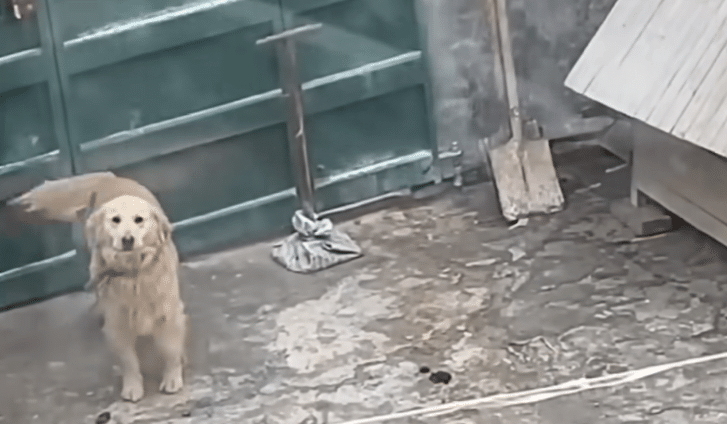
The Quiet Moment That Showed He Was Beginning to Trust
Kele's adjustment did not depend on one dramatic transformation.
It appeared in small, ordinary moments.
He started remaining near his rescuer.
He accepted affection.
The uncertainty that accompanied his first days gradually gave way to a more relaxed manner.
These were quiet changes, but they mattered.
For a dog accustomed to isolation, closeness to another living being was no longer something available only during brief visits.
Someone was there when he needed company.
Someone noticed him without requiring him to watch silently through a fence.
And when he wanted to rest, he had a comfortable place to do it.
Then came a moment that stayed with his rescuer.
Kele curled up beside her and fell into a deep sleep.
It was an ordinary scene in many households.
A dog resting peacefully next to someone he trusts.
But for Kele, it represented a striking contrast with his earlier circumstances.
He was no longer lying outside beside an empty building.
There was no need for him to remain in a yard alone.
He could settle down near the person who had worked so hard to give him this opportunity.
The woman had first known him as a quiet figure behind a fence, always watching.
Now he was close enough to curl up beside her.
His world had become smaller in one sense—he no longer had to watch the neighboring house from a distance—but richer in every way that mattered.
He had companionship.
He had care.
He had a place where he could rest.
And gradually, he was beginning to behave like a dog who felt at home.
Yet one part of his past remained unresolved.
His former owners had requested visits.
Three weeks after bringing Kele home, the woman prepared to honor that agreement.
She could not have known how emotionally difficult the reunion would become.
Three Weeks Later, an Unexpected Heartbreak
When Kele returned to the property where he had once lived, his reaction was immediate.
He recognized the people who had previously owned him.
His tail began wagging excitedly.
He jumped with enthusiasm, appearing genuinely delighted to see familiar faces.
The response revealed something deeply touching about his nature.
Although he had spent so much time alone in their yard, Kele still greeted them with affection.
Whatever those months or years had meant to the humans involved, the dog had not forgotten the people associated with his former life.
His excitement was unmistakable.
He seemed eager for attention.
But the reunion did not unfold as warmly as his greeting suggested he expected.
After briefly acknowledging him, the former owners pushed him away.
Then they went back inside and closed the door.
Kele remained outside.
The sudden contrast was painful to witness.
Moments earlier, he had been jumping with excitement.
Now he stood still, staring toward the closed door.
A soft whimper escaped him.
His rescuer could only watch the change in his behavior.
It was impossible to know precisely what Kele understood about the encounter. Dogs cannot explain their memories or expectations in words.
But his actions were clear enough.
He had approached the familiar people enthusiastically.
When they withdrew, his excitement disappeared.
The moment showed how strongly he still responded to a relationship that had once shaped his life.
Being adopted into a new home had not erased that familiarity.
Nor had the years of separation and neglect prevented him from offering affection.
The visit was a reminder that rescue is not always a simple transition from sadness to happiness.
An animal's past does not disappear merely because its circumstances improve.
Familiar people and places may continue to carry meaning.
And sometimes, a new beginning makes the contrast with the past even more visible.
When Kele returned to his rescuer's home later that day, he was unusually quiet.
She had seen him greet his former owners with enthusiasm.
She had also seen him standing before their closed door.
Now, back in the place where he was genuinely wanted, he seemed subdued.
What he made of the experience could not be known for certain.
But the woman understood something important.
She could not change how he had been treated before.
She could make sure his life was different from now on.
The Place Where Kele Finally Belonged
Back at home, Kele approached his rescuer and gently rested his head in her lap.
It was a small gesture.
No dramatic celebration.
No extraordinary event.
Just a Golden Retriever seeking closeness with the person who had become part of his daily life.
For the woman, the moment carried particular meaning after their difficult visit.
She remembered the dog she had once watched from her window.
The chain.
The empty house.
The neglected yard.
The quiet eyes that followed her whenever she looked outside.
She remembered the food she had tossed over the fence and the evenings when she and her friend had carefully lowered containers with a rope.
She remembered preparing a special meal and realizing that occasional kindness was not enough.
And she remembered the conversation that had finally persuaded his former owners to give him up.
Each of those moments had brought Kele closer to this one.
A place where he could rest his head against someone without a barrier between them.
The transition had taken determination, but it had also required patience afterward.
Kele had needed time to adjust to his new surroundings.
He had needed to become familiar with dependable care and daily affection.
And now, in the quiet comfort of his home, he was showing how much that consistency mattered.
His rescuer had given him more than a place indoors.
She had made room for him in her life.
That difference was visible in the way he stayed near her and gradually became more relaxed.
The dog who once waited outside an empty property no longer had to depend on brief moments of attention from a neighboring window.
He was part of a household.
He belonged to someone who wanted his company.
And his presence was no longer measured by the property he could protect.
It was valued simply because he was Kele.
From a Lonely Watchdog to a Cherished Companion
As Kele settled into his new home, more of his personality began to emerge.
The quiet, isolated Golden Retriever became increasingly playful and affectionate.
He discovered the pleasure of ordinary routines.
Comfortable naps.
Daily companionship.
Regular attention from someone who cared about him.
These are simple experiences, easy to overlook when they have always been part of a dog's life.
For Kele, they represented the very things his former situation had denied him.
He no longer spent his days confined to a small patch of ground.
He no longer watched the world from a neglected yard, waiting for occasional food or brief human contact.
And he no longer had to serve as the silent guardian of a house whose owners had moved away.
His new role was much simpler.
He was a beloved family companion.
The change did not mean that everything from his past had vanished. His response during the visit to his former owners demonstrated that familiar relationships could still affect him.
But those memories no longer determined the conditions of his everyday life.
He had a safe place to rest.
He had consistent care.
And he had someone who had chosen him, even when helping him had required far more than a few easy gestures.
Kele's rescue began with a woman noticing a dog next door.
She might have assumed his owners would eventually return or that his situation was not hers to question.
Instead, she paid attention.
When she realized he lacked regular companionship, she offered what she could.
When she learned he had been left behind to guard an empty property, she found ways to bring him food and water.
And when she understood that those efforts could not give him the life he deserved, she sought permission to bring him home.
There was no single extraordinary act that accomplished everything.
His future changed through a series of deliberate, compassionate choices.
One meal.
One visit.
One difficult conversation.
Then a new home and the patient work of building trust.
Today, Kele's story is no longer defined by the chain that once kept him outside.
It is defined by the affection he receives and the gentle, playful companion he has become.
His name was chosen to mean happiness.
And in the life he now shares with his rescuer, that name has finally found its place.
A dog once left to watch over an empty house is now surrounded by something far more valuable.
A home where someone is always glad he is there.


